Three types of information systems: Information-Retrieval Systems - - PDF document

three types of information systems
SMART_READER_LITE
LIVE PREVIEW

Three types of information systems: Information-Retrieval Systems - - PDF document

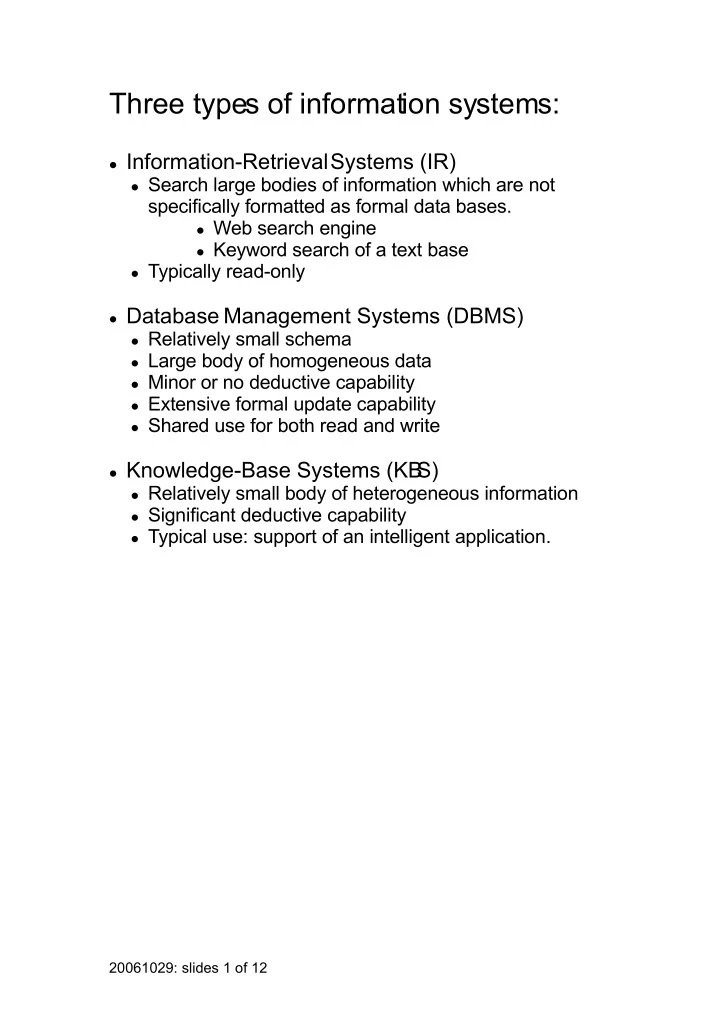
Three types of information systems: Information-Retrieval Systems (IR) Search large bodies of information which are not specifically formatted as formal data bases. Web search engine Keyword search of a text base Typically


slide-1
SLIDE 1

Three types of information systems:

 Information-Retrieval

Systems (IR)

 Search large bodies of information which are not

specifically formatted as formal data bases.

 Web search engine  Keyword search of a text base  Typically read-only  Database Management Systems (DBMS)  Relatively small schema  Large body of homogeneous data  Minor or no deductive capability  Extensive formal update capability  Shared use for both read and write  Knowledge-Base Systems (KB

S)

 Relatively small body of heterogeneous information  Significant deductive capability  Typical use: support of an intelligent application.

20061029: slides 1 of 12

slide-2
SLIDE 2

Key DBMS issues:

 Efficiency issues:  Databases can be very large. Efficient access must

be provided despite the size.

 Simplicity issues:  Many potential users are not sophisticated

programmers, and so simple means of access must be available.

 Means of more sophisticated access must also be

available.

 Multi-user issues:  Concurrency  Several users may have simultaneous access to

the database.

 Access via views  Each user has a limited “window” through which

the appropriate part of the database is viewed.

 Authorization  The access privileges of each user will be limited

in a specific way.

 Robustness issues:  Deadlock must be avoided.  A means of recovery from crashes, with minimal loss

  • f data, must be available.

20061029: slides 2 of 12

slide-3
SLIDE 3

Data Model Evolution:

Model Devel. Use Properties Analogy

File management 1950’s – 1970’s 1950’s- Low-level interaction. No data independence. Assembly language Navigational models 1950’s – 1960’s1960’s - Some data independence, but the model invites

  • dependence. Requires procedural queries.

Procedural languages Relational model 1970’s - Late 1980’s - Simple, easy to use for non-experts. Strong data

  • independence. Standard nonprocedural query

language (SQL). Excellent implementations exist. Limited expressive capability. Declarative languages Object-oriented models 1980’s - 1990’s - Powerful expressive capability, but require substantial expertise for use. Popular in niche applications. Standardization not imminent. Object-oriented languages Object-relational models 1990’s 1990’s - Attempt to integrate the simplicity of the relational model with the advanced features of the object-

  • riented approach. A new standardized query

language (SQL:1999) is available, with SQL:20xx on the way. Many “high-end” commercial relational systems embody object-relational features. ? Semi-structured models 1990's 2000's - Attempt to integrate data management with markup languages, principally via XML. ?

20061029: slides 3 of 12

slide-4
SLIDE 4

The course focuses on the relational

  • model. Why?

 The relational model

is very widely used.

 The relational model

provides a flexible interface which has components appropriate for users at all levels.

 A standard query language,

SQL, is used with virtually all commercial products. Thus, applications have a high degree of portability .

 The relational model

provides strong data independence: the external product is relatively independent of the internal implementat ion.

 The relational model

is dominant on microcomputers running Windows operating systems:

 Office suites:  Microsoft Office: Access  Lotus SmartSuite: Approach  Corel Suite: Paradox  Other microcomputer products:  dBase  All have proprietary graphical

interfaces, and provide programming-style queries as well.

20061029: slides 4 of 12

slide-5
SLIDE 5

 The relational model

has also been dominant on mainframe database servers, including but not limited to UNIX systems.

 Recently

, many of these system s have become available for the PC UNIX syst em Linux. (Some are free!)

 Oracle  Interbase 7 (Inprise, formerly Borland)  Sybase Adaptive Server Enterp

rise

 Informix (now owne

d by IBM)

 IBM DB2  PostgreSQL 7.4, 8.1 (public domain, very good)  There are even some products from Sweden:  MySQL (GPL)  Mimer SQL (Upright Database Technology)

20061029: slides 5 of 12

slide-6
SLIDE 6

In the past, this course had used Microsoft Access. Since 2002, PostgreSQL has been be used. Why?

 The dialect of SQL which is supported under

Access is much more limited than the dialects

  • f comprehensive

systems.

 PostgreSQL has matured greatly

in the past few years.

 The Department of Comput

ing Science has an SQL server, which is administered by the support staff. The following system will also be used:

 Leap  A simple relational database system which uses

the relational algebra as a query languag e.

 Although not of commercial

importance, use of this alternate query language is very beneficial pedagogically.

 Students are still free to use Microsoft

Access, although it will not be discussed in class.

 All final versions of SQL assignments must run

under PostgreSQL.

20061029: slides 6 of 12

slide-7
SLIDE 7

Database access models:

 SQL is the standard query language

for the relational model.

 There are many access models which are built

around SQL.

 Direct SQL: Write and send SQL

queries directly to the database system.

 Hosting SQL within a programming language:  Embedded SQL: SQL statements are

embedded in a host programming language, such as C. Generally requires preprocessing.

 Proprietary hosting languages: (e.g., Oracle

PL/SQL).

 Proprietary hosting systems: (e.g., within

Microsoft VBA).

 SQL / CLI ODBC: A vendor- and OS-

independent call-interface syst em (in principle) for SQL. Embedding may be in any of a variety of languag es (C, C++ are the most common.)

 In this course, we will use both direct SQL and

ODBC.

20061029: slides 7 of 12

slide-8
SLIDE 8

A Rough Course Outline:

 Introduction to DBMS’

s

 Knowledge Representation for DBMS's (10%)  Entity-Relationship Modelling  The Relational Model  Query Processing

and Constraints (40%)

 Query Languages  Relational Algebra  Relational Calculus  SQL  Views  Database Programming and the CLI/ODBC

Interface

 Dependencies and Normalization  Implementation Issues (40%)  Physical Database Design  Database System Architecture  Query Optimization  Transaction Processing and Concurrency Control  Recovery  Security and

Authorization

 Special Topics (10%)  Object-Oriented and Object-Relational

Approaches

20061029: slides 8 of 12

slide-9
SLIDE 9

Database System Architecture:

 Early approach: one-level  The user interacted directly

with the storage model.

 Analogy: assembly-

language programming

 Disadvantages:  Impossible to use for non-experts.  Difficult to use and error-p

rone even for experts.

 Evolution of storage

model, or migration to a new architecture, requires a total rebuild of all application programs.

20061029: slides 9 of 12

slide-10
SLIDE 10

A more modern approach: two-level

 Advantages:  Internal model and/or target architect

ure may be changed without requiring a rebuild of applications.

 Analogy: A high-level programming language.  Disadvantages:  There is a single external model for all.

20061029: slides 10 of 12

External Data Model Internal Storage Model External/ Internal mapping

slide-11
SLIDE 11

The ANSI/SPARC three-level architecture:

 Advantages:  Provides two levels of independence:  The internal storage model is isolated

from the conceptual component, as in the two-level architecture.

 Many external views are possible.  The conceptual model may be re-

designed without requiring rebuilds of application programs.

20061029: slides 11 of 12

Conceptual Data Model Internal Storage Model Conceptual/ Internal mapping External Data Model 1 External Data Model n

. . .

External/ Conceptual mapping

slide-12
SLIDE 12

Data independence:

 Data independence

refers to the idea that a more internal level of a database system may be re- engineered, or moved to a different architecture, without requiring a total rebuild of the more external layers.

 The ANSI/SPARC architecture provide

s two levels

  • f data independe

nce.

 It is often, however, something of an ideal, even

with the systems of today .

 Usually, in a relational system, both the conceptual

schema and the external schemata are relational.

 Still, the conceptual schema is often designed

using a more general tool than the relationa l model.

20061029: slides 12 of 12