
SLIDE 1
Information Exposure From Consumer IoT Devices: A Multidimensional Network-Informed Approach
Jingjing Ren, Daniel J. Dubois, David Choffnes Anna Maria Mandalari, Roman Kolcun, Hamed Haddadi
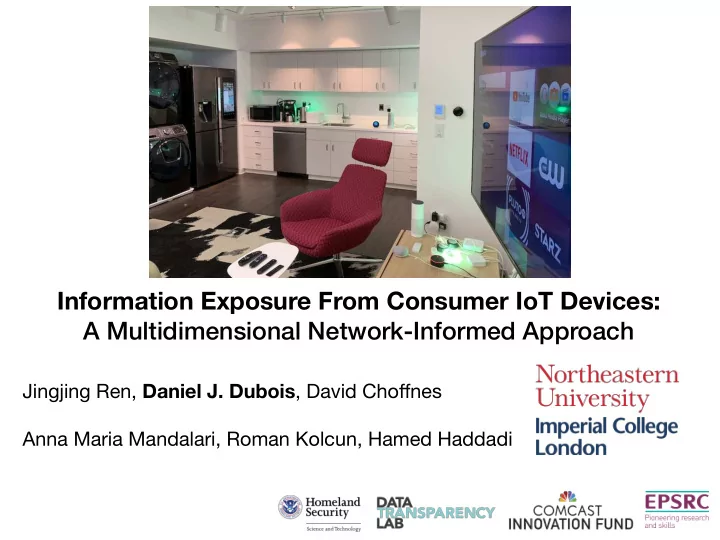
Information Exposure From Consumer IoT Devices: A Multidimensional - - PowerPoint PPT Presentation
Information Exposure From Consumer IoT Devices: A Multidimensional Network-Informed Approach Jingjing Ren, Daniel J. Dubois , David Cho ff nes Anna Maria Mandalari, Roman Kolcun, Hamed Haddadi Motivation 7+ billion IoT devices deployed worldwide
Information Exposure From Consumer IoT Devices: A Multidimensional Network-Informed Approach
Jingjing Ren, Daniel J. Dubois, David Choffnes Anna Maria Mandalari, Roman Kolcun, Hamed Haddadi
2
7+ billion IoT devices deployed worldwide
They may listen to you (e.g., smart speakers)
2
7+ billion IoT devices deployed worldwide
They may listen to you (e.g., smart speakers) They may watch you (e.g., smart doorbells)
2
7+ billion IoT devices deployed worldwide
They may listen to you (e.g., smart speakers) They may watch you (e.g., smart doorbells) They may know what you watch (e.g., smart TVs)
private information
expose it, and to whom
2
7+ billion IoT devices deployed worldwide
They may listen to you (e.g., smart speakers) They may watch you (e.g., smart doorbells) They may know what you watch (e.g., smart TVs)
3
Goal 1: What is the destination of IoT network traffic? Goal 2: What information is sent? Goal 3: Does a device expose information unexpectedly?
Identify destinations: First-party, Non first-party, Eavesdroppers Geolocate destinations: same vs. different privacy jurisdiction Search IoT traffic for private information exposure Information exposure we expect vs. information exposure we observe
E.g., video from cameras, audio from smart speakers, user activities, ...
4
Difficult to perform IoT experiments and generalize Difficult to measure exposed information for IoT
Our contribution: a testbed for running repeatable semi-automated IoT experiments at a scale (software and data available online) Our contribution: information inference from traffic patterns
US: Northeastern University
UK: Imperial College London
5
Amazon Cam Amcrest Cam Lefun Cam Luohe Cam Micro7 Cam ZModo Bell Bosiwo Cam D-Link Cam WiMaker Cam Xiaomi Cam Blink Cam Blink Hub Ring Doorbell Wanswiew Cam Yi Cam Wink2 Hub Insteon Hub Lightify Hub Philips Hue Hub Sengled Hub Smartthings Hub Xiaomi Hub D-Link Sensor Flux Bulb Philips Bulb Xiaomi Strip Honeywell T-stat Magichome Strip Nest T-stat TP-Link Bulb TP-Link Plug WeMo Plug LG TV Apple TV Fire TV Roku TV Samsung TV Invoke Speaker Allure Speaker Google Home Echo Dot Echo Spot Echo Plus Google Home Mini Behmor Brewer GE Microwave Samsung Dryer Samsung Fridge Samsung Washer Smarter iKettle Xiaomi Rice Cooker Netatmo Weather Smarter Brewer Anova Sousvide Xiaomi Cleaner
N=46 N=35 N=26
20 Cameras 15 Home Automation 13 Smart Hubs 9 TVs 11 Speakers 13 Appliances 81 Total
6
Sep/2018 to Feb/2019
Activity Description Power
power on/off the device
Voice
voice commands for speakers
Video
record/watch video
On/Off
turn on/off bulbs/plugs
Motion
move in front of device
Others
change volume, browse menu 34,586 experiments (92.6% automated)
7
Home IoT Internet Unencrypted traffic Encrypted traffic Eavesdroppers First-party destinations (e.g., IoT Manufacturers) Non first-party destinations (e.g., cloud providers, advertisers, etc.)
8
PCAP
Router
Internet traffic is the only signal that (by definition) all IoT devices produce
9
First party Non-first party
10
Network Traffic
Second-Level Domain (SLD)
Whois database (or common sense)
Organization IP Address
Destination IP
Same jurisdiction Different jurisdiction Geolocation
Passport
https://passport.ccs.neu.edu
Organization US 46 UK 35 US Common 24 UK Common 24 Amazon 31 24 16 17 Google 14 9 10 8 Akamai 10 6 6 5 Microsoft 6 4 1 1 Netflix 4 2 3 2 Kingsoft 3 3 1 1 21Vianet 3 3 1 1 Alibaba 3 4 2 2 Beijing Huaxiay 3 3 1 1 AT&T 2 1 1
Nearly all TVs contact Netflix w/o it being logged in or used Chinese cloud providers High reliance on cloud and CDN providers
11
Regional differences
12
Alibaba Cloud
Categories US Testbed UK Testbed Categories
Most devices contact outside testbeds’ privacy jurisdictions*
12
Alibaba Cloud
Categories US Testbed UK Testbed Categories
13
14
PII: MAC Address unencrypted! PII: MAC Address and Timestamps unencrypted (plus evidence of a video stream) each time motion is detected!
Other unencrypted content
Xiaomi Camera Samsung Fridge Insteon Hub MagicHome LED
15
Percentage of traffic by device category (US) Unencrypted Unknown Encrypted
Speakers Smart Hubs Appliances Home Automation TVs Cameras 0% 25% 50% 75% 100%
16
Functionality (e.g., toggling a light) Interaction method (local, app, or voice?)
Hypothesis:
Given the traffic patterns of an activity, look for similar patterns
Idea: Feasibility of a solution: use supervised machine learning
ML APPROACH
ML EVALUATION
Eavesdroppers may infer activity information even from encrypted traffic
We consider an activity inferable when F1-score is >0.75
17
Percentage of inferable devices by activity (US+UK)
Video (N=19) Voice (N=17) Power (N=81) Movement (N=19) Other Activities (N=52) On/Off (N=45) % of N devices where activity is inferable 0% 25% 50% 75% 100%
Activity
18
19
Popular doorbells
Video recording on detected motion (cannot be disabled)
19
Popular smart TVs
Contact Netflix, Google, and Facebook unexpectedly
Popular doorbells
Video recording on detected motion (cannot be disabled)
19
Popular smart TVs
Contact Netflix, Google, and Facebook unexpectedly
Popular doorbells
Video recording on detected motion (cannot be disabled) Frequently falsely triggered (e.g. "I like Star Trek")
Alexa-enabled devices
19
Popular smart TVs
Contact Netflix, Google, and Facebook unexpectedly
Popular doorbells
Video recording on detected motion (cannot be disabled) Frequently falsely triggered (e.g. "I like Star Trek")
Alexa-enabled devices
20
https://moniotrlab.ccis.neu.edu/imc19/