Random Walk Stockholm 2010 Chernogolovka 1982-90 Moscow - - PowerPoint PPT Presentation

random walk
SMART_READER_LITE
LIVE PREVIEW

Random Walk Stockholm 2010 Chernogolovka 1982-90 Moscow - - PowerPoint PPT Presentation

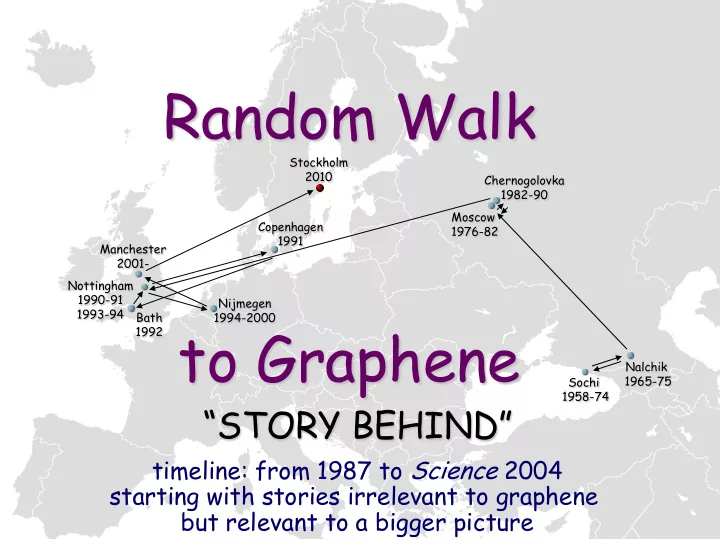
Random Walk Stockholm 2010 Chernogolovka 1982-90 Moscow Copenhagen 1976-82 1991 Manchester 2001- Nottingham 1990-91 Nijmegen 1993-94 Bath 1994-2000 to Graphene 1992 Nalchik 1965-75 Sochi 1958-74 STORY BEHIND timeline:


slide-1
SLIDE 1

Chernogolovka 1982-90 Sochi 1958-74 Nalchik 1965-75 Moscow 1976-82 Nottingham 1990-91 1993-94 Nijmegen 1994-2000 Bath 1992 Copenhagen 1991 Manchester 2001- Stockholm 2010

to Graphene Random Walk

timeline: from 1987 to Science 2004 starting with stories irrelevant to graphene but relevant to a bigger picture

“STORY BEHIND”

slide-2
SLIDE 2

as exciting as it sounds

“Investigation of mechanisms

  • f transport relaxation in metals

by a helicon resonance method”

PhD 1987 message I took away: NEVER TORTURE STUDENTS WITH BORING/DEAD PROJECTS !

slide-3
SLIDE 3

staff scientist in Chernogolovka: 1988-1990

magnetic field inhomogeneous

  • n a submicron scale

Geim, JETP Lett. 1989 Geim, Sergey Dubonos et al JETP Lett. 1990 later, two PRL 1991, 1994

SWEET TASTE OF FREEDOM

something new but still possible with available Soviet facilities diffusive ballistic

experience I took away: NEW EXPERIMENTAL SYSTEM IS BETTER THAN A NEW PHENOMENON !

slide-4
SLIDE 4

SEMICONDUCTOR PHYSICS

Geim, Laurence Eaves, Peter Main et al

  • Phys. Rev. Lett. 1991
  • Phys. Rev. Lett. 1992

GaAlAs heterostructures universal conductance fluctuations resonant tunnelling phenomena quantum point contacts quantum Hall effect 2DEG in periodic potentials

experience to tease colleagues: “NO SUCH THING AS BAD SAMPLES, ONLY BAD POSTDOCS ”

MOVING YEARS

postdocs in Nottingham x2, Bath & Copenhagen: 1990-1994 submicron GaAs wires from a drawer

my first 6-month visit age =32 h-index ~1

slide-5
SLIDE 5

fractional flux vortices & vortex shells micron-sized Hall probes to investigate superconductors, ferromagnetics, etc paramagnetic Meissner effect

GOING DUTCH

Nature 390, 259 (1997); Nature 396, 144 (1998); Nature 407, 55 (2000); PRL 79, 4653 (1997); PRL 85, 1528 (2000)

structures from Nottingham lithography in Russia: Sergey Dubonos measurements in Nijmegen

MESOSCOPIC SUPERCONDUCTIVITY FINDING RESEARCH NICHE: possible but somewhat different

associate professor in Nijmegen: 1994-2000

T > TC T < TC

writing up with Irina Grigorieva:

slide-6
SLIDE 6

“FRIDAY NIGHT EXPERIMENTS”

magnetic water descaler

starting 1997 water in high magnetic fields? ancient magnets: consume a lot of energy require extra cryostats

slide-7
SLIDE 7

A BIT OF LEVITY

water in high magnetic fields

slide-8
SLIDE 8

NEEDS EMPHASIS

Nature 1991

slide-9
SLIDE 9

KNOWLEDGE IS FUN

slide-10
SLIDE 10

WOW! FACTOR

slide-11
SLIDE 11
slide-12
SLIDE 12

PERCEPTION CHANGE

everything (and everybody) is magnetic; ever present diamagnetism is NOT negligible

messages to take away: LOOK FOR COMPETITIVE EDGE even obsolete facilities may offer some

in many textbooks

sideline experience

  • f the IgNobel Prize:

DON’T TAKE YOURSELF TOO SERIOUSLY

slide-13
SLIDE 13

MANCUNIAN WAY

Kostya Novoselov et al, Nature 426, 812 (2003) Irina Grigorieva et al, PRL 92, 237001 (2004)

microfabrication still in Russia (Dubonos)

2DEG-ferromagnetic-

  • superconducting hybrid

2 µm

Au probes on top of 2DEG rings

1 µm

V I

H

subatomic movements of domain walls

chair in Manchester: 2001 – present

FIRST ESTABLISH YOURSELF & SET UP NEW FACILITIES

empty lab; little start-up; no central microfabrication

by 2003: well-equipped lab and state-of-the-art microfabrication thanks to EPSRC & University

slide-14
SLIDE 14

HOW COMES THAT GECKO CAN CLIMB WALLS?

“FRIDAY NIGHTS” in MANCHESTER

slide-15
SLIDE 15

sticky feet: geckos climb due to their hairy toes

courtesy

  • f K Autumn

submicron size (!) - standard spatial scale in our work

“FRIDAY NIGHTS” in MANCHESTER

PNAS 2002

slide-16
SLIDE 16

GECKO TAPE

proof of concept: biomimetic dry adhesive based on “gecko principle”

Geim, Sergey Dubonos, Irina Grigorieva, Kostya Novoselov et al Nature Materials 2003

PLACING EMPHASIS

slide-17
SLIDE 17

magnetic water

3 different attempts – Sergey Morozov

permeability of high-Tc superconductor to oxygen

Jeroen Meessen in Nijmegen … … …

high-Tc superconductivity in NiAs+FeSe alloys

Lamarches’ samples (EPL 2000) well before the discovery of pnictide superconductivity

detection of “heart beats” of individual yeast cells

(Irina Barbolina, Kostya Novoselov et al APL 2006) … … …

“FRIDAY NIGHT” FAILURES

experience I am still mulling over: FAILURES ARE NOT AS OFTEN AS ONE CAN EXPECT

slide-18
SLIDE 18

BRIEF HISTORY OF GRAPHENE

slide-19
SLIDE 19

One Little Thought Cloud

metallic electronics

Schlesinger 2000 Lemanov & Kholkin 1994 Petrashov 1991 … E electric breakdown ~1V/nm max induced concentration ≈1014 cm-2 single atomic layer of a metal ≈1015 cm-2 rarely stable for thickness below 100 Å Bose (1906) Mott (1902)

mostly, Bi changes ~1%

change the number of electrons

  • > change conductivity
slide-20
SLIDE 20

tinkering for >10 years with the following idea MANY MANY DIFFERENT EPITAXIAL SYSTEMS ~few nm thick Al grown by MBE

  • n top of GaAlAs

from Nottingham

metallic electronics

Schlesinger 2000 Lemanov & Kholkin 1994 Petrashov 1991 … Bose (1906) Mott (1902)

chemically remove the substrate ↓ ultra-thin monocrystal WOULD IT BE STABLE, OR MELT AND OXIDIZE?

One Little Thought Cloud

slide-21
SLIDE 21

metallic electronics

Schlesinger 2000 Lemanov & Kholkin 1994 Petrashov 1991 … Bose (1906) Mott (1902)

carbon nanotube transistors

Ijima, Ebbesen, McEuen Dekker, Avouris

Two More Little Clouds

little known about thin films

  • f graphite

Dresselhauses’ review 1981 Esquinazi & Kopelevich 2000-2002

slide-22
SLIDE 22

polishing is dead, long live Scotch tape!

~2.5 cm

2002 PhD project of Da Jiang: make graphite films as thin as possible and study their “mesoscopic” properties including electric field effect & metallic transistor Oleg Shklyarevskii’s idea

graphite flakes

  • n cellotape
  • ptical

image

THE LEGEND OF SCOTCH TAPE

HOPG vs HDPG

slide-23
SLIDE 23

AFM 5x5 µm2

1 mm seen by a naked eye

UNTIL A SINGLE LAYER FOUND

Komnik Physics of Metal Films 1979 Venables, Spiller, Hanbucken Rep Prog Phys 1984

next to impossible to grow monolayers

a few months later a few years later

background as of 2004: thin film deposition & semiconductor physics incl MBE

SHOCK for INTUITION

slide-24
SLIDE 24

400 carbon atoms at 2000 K

Fasolino (Nijmegen)

Peierls; Landau; Mermin-Wagner; …

(only nm-scale flat crystals are possible to grow in isolation)

growth means temperature close to melting causes violent vibrations destroys

  • rder in 2D

2D GROWTH IS FORBIDDEN

slide-25
SLIDE 25

graphene: thermodynamically unstable

for <24,000 atoms or size < 20 nm

graphene sheets should scroll

Kaner Science 2003 Braga et al Nanolett 2004

THERMODYNAMIC STABILITY

Shenderova, Zhirnov, Brenner Crit Rev Mat Sci 2002

THERMODYNAMICALLY UNSTABLE does not mean IMPOSSIBLE

  • JUST METASTABLE-
slide-26
SLIDE 26

GRAPHENE VIA 3D GROWTH

slide-27
SLIDE 27

nanosrolls

Shioyama JMSL 2001 Kaner Science 2003

free growth

HISTORY OF GRAPHENE

Ebbessen (~60 layers) Nature 1997, APL 2001

TEM

as cited in our first paper in 2004 substrate growth

graphene on metal: Land et al Surf Sci 1992 graphene on graphite: Enoki Chem. Phys. Lett. 2001 J Phys 2002

STM

slide-28
SLIDE 28

cleavage substrate growth intercalation

McConville PRB 1986 Nagashima Surf Sci 1993 Forbeaux PRB 1998 Frindt Science 1989 Horiuchi et al APL 2004 Ohashi Tanso 1997 Ruoff APL 1999 Gan Surf Sci 2003 Kurtz PRB 1990 Ebbesen Adv Mat 1995 Grant Surf Sci 1970 (on Ru/Rh) Bommel Surf Sci 1975 (SiC) LEED STM SEM AFM

HISTORY OF GRAPHENE

TEM

proof of isolated graphene

added along the same lines in

  • ur 2007 review
slide-29
SLIDE 29

AFM

suspension of graphene oxide crystallites

2004: simple method of isolation of large crystals unambiguous observations of monolayers

Benjamin Brodie Phil Trans. 1859

  • ptics

just

  • bservations:

not enough to inspire further work

  • OBLIVION-

digging through old literature

“carbonic acid”

Ruess & Vogt 1948; Boehm & Hofmann 1962

TEM studies of the dry residue

DISCOVERY OF GRAPHENE

remained the best observation for over 40 years!

“Graphon 33”

slide-30
SLIDE 30

EUREKA MOMENT

hand-made devices (Novoselov) first on glass slides, then on oxidized Si wafer

resistance changed by as much as ~3%:

Kostya’s lab book

BEYOND OBSERVATION

50 µm

  • ptical image

width

  • f a hair

bad “metallic transistor”

slide-31
SLIDE 31

N.B. twice rejected by Nature

And after a lot of hard work …

down to a single layer; devices down to ~3 layers

  • n-off ratios ~30 at room T and >100 at low T
slide-32
SLIDE 32

WHY THIS PAPER IMPORTANT

  • observation of large isolated graphene crystals
  • simple and accessible method for their isolation
  • 100
  • 50

100 50

gate voltage (V) resistivity (kΩ)

2 4 6

SiO2 Si graphene

  • ASTONISHING ELECTRONIC QUALITY

ballistic transport on submicron scale under ambient conditions

electrons ~1013 cm-2 holes ~1013 cm-2

  • CONTROL ELECTRONIC PROPERTIES

NOT JUST AN OBSERVATION OF GRAPHENE: GRAPHENE REDISCOVERED IN ITS NEW INCARNATION

ambipolar electric field effect

changes by 100 times, not ~1%

slide-33
SLIDE 33

many more beautiful observations by other groups

NEW HIGH QUALITY 2D ELECTRON SYSTEM & BEYOND

massless and massive Dirac fermions two new types of the quantum Hall effect metallic in the limit of no charge carriers universal optical conductivity defined by the fine structure constant Klein tunnelling tuneable-gap semiconductor giant pseudo-magnetic fields by elastic strain new type of chemistry: graphane & fluorographene possibility of carving devices on a true nm scale sensors capable of detecting individual gas molecules … … … … …

slide-34
SLIDE 34

Sergey Morozov measurements Irina Grigorieva SEM, writing up Sergey Dubonos microfabrication Yuan Zhang microfabrication Anatoly Firsov microfabrication Da Jiang graphene crystallites

timeline finishes in mid 2004