Information Cascades in Human Networks Milo Trujillo Professor Gao - - PowerPoint PPT Presentation

information cascades in human networks
SMART_READER_LITE
LIVE PREVIEW

Information Cascades in Human Networks Milo Trujillo Professor Gao - - PowerPoint PPT Presentation

Information Cascades in Human Networks Milo Trujillo Professor Gao Information Cascades Generalization of Infection Modeling Infection based on % threshold of neighbors Agent-Based model to examine heterogeneous networks Discrete


slide-1
SLIDE 1

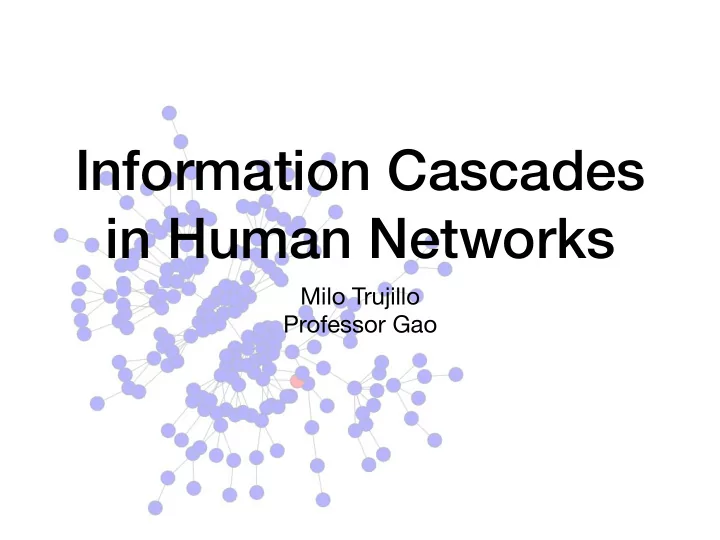
Information Cascades in Human Networks

Milo Trujillo Professor Gao
slide-2
SLIDE 2

Information Cascades

  • Generalization of Infection Modeling
  • Infection based on % threshold of neighbors
  • Agent-Based model to examine heterogeneous networks
  • Discrete timesteps
slide-3
SLIDE 3

Variable Activation Thresholds

  • “A Simple Model of Global Cascades on Random

Networks” ~ Duncan J. Watts, PNAS 2002

slide-4
SLIDE 4

Variable Activity Times

  • “Diffusion in Networks and the Virtue of Burstiness”, M.

Akbarpour, M. O. Jackson, PNAS 2018

  • Poisson, Reversing, and Sticky Agents
slide-5
SLIDE 5

Starting Goal

  • Combine heterogeneous activation thresholds and activity times
  • Apply to scale-free networks
  • Examine resilience to targeted vs random attacks
  • How do you best spread or halt a cascade in human

communities?

slide-6
SLIDE 6

Model

  • Random or Scale-Free

networks

  • One initial agent infected
  • Contagious for 10 turns
  • Spreads to all possible

neighbors each turn

  • No “recovery”
  • Simulation ends when no

agents contagious

slide-7
SLIDE 7

First Study

slide-8
SLIDE 8
slide-9
SLIDE 9
slide-10
SLIDE 10
slide-11
SLIDE 11

Activity Comparison

slide-12
SLIDE 12

Activity Comparison

slide-13
SLIDE 13

Activity Comparison

slide-14
SLIDE 14

Larger Scale Study

slide-15
SLIDE 15

First Study Conclusions

  • Scale Free Networks generally safer
  • Hubs act as gatekeepers, quarantine cascades
  • If a hub is susceptible, can easily spread cascade
  • Activity synchronization threatens communities
slide-16
SLIDE 16

Second Study

slide-17
SLIDE 17

Second Study

slide-18
SLIDE 18

Second Study

slide-19
SLIDE 19

Second Study Conclusions

  • Targeted attacks most effective in scale-free networks

with mid-level susceptibility to cascades

  • At high and low susceptibility, minimal difference from

random attack unless very centralized

slide-20
SLIDE 20

Future Work

  • Change Fixed Topology
  • Mix Types of Activity Patterns
  • Assortative versus Disassortative Communities