Information and crisis Megan Finn Prepared for History of - - PowerPoint PPT Presentation

information and crisis
SMART_READER_LITE
LIVE PREVIEW

Information and crisis Megan Finn Prepared for History of - - PowerPoint PPT Presentation

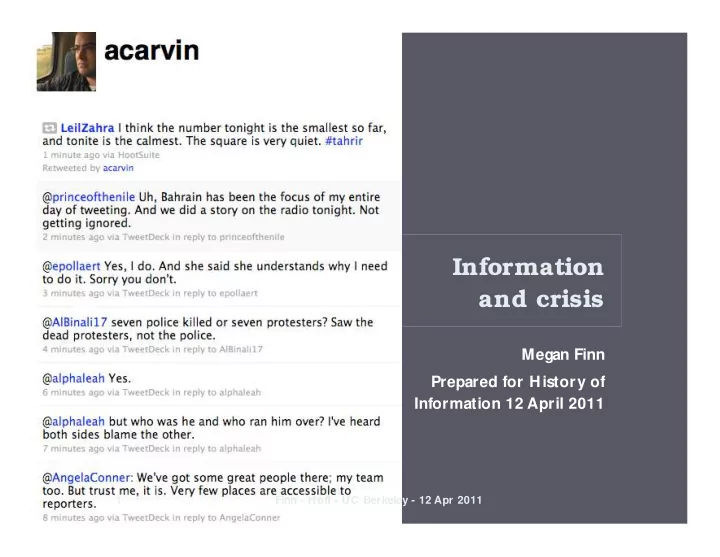
Information and crisis Megan Finn Prepared for History of Information 12 April 2011 1 Finn - HofI - UC Berkeley - 12 Apr 2011 Today Understanding Infrastructure and the post office You: on Twitter in Egypt

slide-1
SLIDE 1

Information and crisis

Megan Finn Prepared for History of Information 12 April 2011

1 Finn - HofI - UC Berkeley - 12 Apr 2011

slide-2
SLIDE 2

Today

Understanding Infrastructure and the post office You:

  • n Twitter in Egypt

Infrastructure, California and earthquakes

2 Finn - HofI - UC Berkeley - 12 Apr 2011

slide-3
SLIDE 3

Infrastructure Themes!

Monopolistic Private or government Profitability Surveillance

3 Finn - HofI - UC Berkeley - 12 Apr 2011

slide-4
SLIDE 4

The War Machine and the Love Machine

"Electric circuitry has

  • verthrown the regime of

'time' and 'space' and pours upon us instantly and continuously concerns of all

  • ther men… 'Time' has

ceased, 'space' has vanished.

We now live in a global

village . . . a simultaneous happening."

M arshall M cluhan et al.,

M edium is the M assege, 1967

"Everything in this new

warfare becomes a question

  • f time won by man over

the fatal projectiles toward which his path throws him… W e have to face the facts:

speed is war, the last war”

Paul Virilio, Speed and Politics.

1977

4 Finn - HofI - UC Berkeley - 12 Apr 2011

slide-5
SLIDE 5

Paradigms?

Technological determinism

5 Finn - HofI - UC Berkeley - 12 Apr 2011

slide-6
SLIDE 6

Information infrastructure

The postal system: information infrastructure without “technology”?

6 Finn - HofI - UC Berkeley - 12 Apr 2011

slide-7
SLIDE 7

Some bold statements

“O ne of the most effective elements of civilization”?

Francis Lieber, Encyclopedia Americana, 1932

“mighty arm of civil government”

N ew York Times, 1852

“How society in the nineteenth century could exist

without mail routes and the regular delivery of letters, it is impossible to conceive.”

J

ames Holbrock, M y Years Amongst the M ailbags.

1955

Q uoted from:

J

  • hn, Spreading the N ews,

1995

7 Finn - HofI - UC Berkeley - 12 Apr 2011

slide-8
SLIDE 8

Infrastructure: “Pervasive enabling resources”

So what constitutes infrastructure?

Infrastructure has the following qualities:

modular increments Embedded Transparent Reach Learned Practice installed base from J

ackson et al quoting Star and Ruhleder–

8 Finn - H ofI - UC Berkeley - 12 Apr 2011

slide-9
SLIDE 9

Circulation of mails

9 Finn - HofI - UC Berkeley - 12 Apr 2011

slide-10
SLIDE 10

Information infrastructure: Postal system

“To establish Post O ffices and Post Roads;”

U.S. Constitution - Article 1 Section 8

“The United States in Congress assembled shall also have

the sole and exclusive right and power of … establishing

  • r regulating post offices from one State to another,

throughout all the United States, and exacting such postage on the papers passing through the same as may be requisite to defray the expenses of the said office ...”

Article 9, “The Articles of Confederation” (Agreed to by

Congress N ovember 15, 1777; ratified and in force, March 1, 1781.)

10 Finn - HofI - UC Berkeley - 12 Apr 2011

slide-11
SLIDE 11

Modular increments

Fixed and changed in modular increments , through complex processes of negotiation and mutual adjustment with adjacent systems, structures, and practices Post O ffice Act, 1792:

  • 1. newspapers were subsidized
  • 2. public officials are not supposed to spy on the mail
  • 3. facilitated the expansion of the postal network

11 Finn - HofI - UC Berkeley - 12 Apr 2011

slide-12
SLIDE 12

Reach of the post office

Defined by its reach beyond particular spatial or temporal

locations;

By 1840:

~4 of every 5 Federal employees worked for the post office 13,486 post offices (75 in 1790)

1,087 people served by each office (43,084 per office in 1790) 1 office every 61.4 square miles (1 per 3492.7 square miles in 1790)

500,000 newspapers sent through the mail in 1790 39,000,000 newspapers sent through the mail in 1840

2.7 newspapers per capita from:

Headrick, W hen Information Came of Age,

2000.

12 Finn - HofI - UC Berkeley - 12 Apr 2011

slide-13
SLIDE 13

Embedded

Embedded in other structures, social arrangements, and technologies “… in the very process of incorporating the the citizenry

into American public life, postal policy marginalized a number of groups – in particular, women and blacks – and in this way identified the public sphere with free white men… ”

J

  • hn, Spreading the N ews, 1995.

13 Finn - HofI - UC Berkeley - 12 Apr 2011

slide-14
SLIDE 14

Transparent

Trans

parent (and largely invisible) once established,

“reappearing” only at moments of upheaval or breakdown; “… while his fear of the use of new communication

technologies may seem irrational, it may also be viewed as a legitimate response to fears of modernity and the attendant further ebbing of the slaveholders’ ability to control everything and everyone around them.”

J

ennifer R. Mercieca, “The Culture of Honor: How Slaveholders Responded to the Abolitionist Mail Crisis of 1835,”

14 Finn - HofI - UC Berkeley - 12 Apr 2011

slide-15
SLIDE 15

Another modular increment.

1845 and 1851:

Lower the rates for letters Pay by weight instead of by the sheet

1854:

prepayment only

15 Finn - HofI - UC Berkeley - 12 Apr 2011

slide-16
SLIDE 16

Practice

Deeply linked with conventions of practice and other forms

  • f routinized social action;

“our pervasive expectations of complete contact, of

boundless accessibility, actually link us back to the cultural moment when ordinary Americans first experience the mail in similar terms.”

Addressibility D ead Letter O ffice J

unk mail

Anonymity Henkin, The Postal Age. 2006

[Black Valentines (London, c.1850)] Source: Monash University Library http://www.lib.monash.edu.au/ exhibitions/recent-acquisitions4/ virtual/photos/photo6.html

16 Finn - HofI - UC Berkeley - 12 Apr 2011

slide-17
SLIDE 17

Scene at the San Francisco Post O ffice BAN C PIC 1963.002:0137--A

Learned

Learned as a part of membership within particular professional, social, or cultural communities;

“An interval of two weeks elapsing for the arrival of

  • ne mail to another, creates an anxiety to hear form

home that can scarcely be comprehended by other than residents of California”

17 Finn - HofI - UC Berkeley - 12 Apr 2011

slide-18
SLIDE 18

Installed base

Built on, shaped and constrained by its relationship to an already installed base;

http://www.postalmuseum.si.edu/ duty/dangersofthetrail.html

18 Finn - HofI - UC Berkeley - 12 Apr 2011

slide-19
SLIDE 19

Ongoing questions

W ho is controlling the infrastructure?

Government or private corporations? “natural” monopoly of infrastructure?

W hat are the practices that are part of the infrastructure?

Change in practice without technical change?

Point to point or broadcast?

19 Finn - HofI - UC Berkeley - 12 Apr 2011

slide-20
SLIDE 20

20 Finn - HofI - UC Berkeley - 12 Apr 2011

slide-21
SLIDE 21

Motion: Twitter was necessary for

the ousting of Mubarak

21 Finn - HofI - UC Berkeley - 12 Apr 2011

slide-22
SLIDE 22

Twitter, Egypt and the role of infrastructure in social movements

Debate! The rules:

2 Teams – one team arguing for the motion, one arguing against. Audience votes (for, against, undecided). Three introductions for each team. We will alternate between the teams. Introductions should be about two minutes each. There will be fifteen minutes for moderated questions. Three closing statements for each team. . We will alternate between teams. Concluding remarks should be about two minutes each. Audience votes (for, against, undecided). The team with the greatest GAIN in number of supporters will be declared victor and the first ever champions of the History

  • f Information current events debate.

22 Finn - HofI - UC Berkeley - 12 Apr 2011

slide-23
SLIDE 23

23 Finn - HofI - UC Berkeley - 12 Apr 2011

slide-24
SLIDE 24

Conclusion: 1868 Hayward Fault Earthquake

O verview of Information infrastructure O verview of Hayward Fault Earthquake How was the telegraph used?

Rumors Business Looking for loved ones

24 Finn - HofI - UC Berkeley - 12 Apr 2011