Political Participation and Awareness in America 1 1 2 3 3 4 - - PowerPoint PPT Presentation

political participation and awareness in america
SMART_READER_LITE
LIVE PREVIEW

Political Participation and Awareness in America 1 1 2 3 3 4 - - PowerPoint PPT Presentation

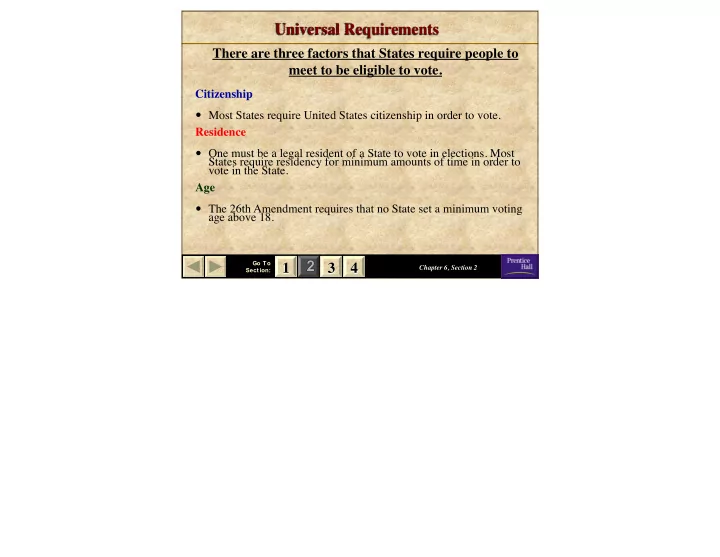
Universal Requirements There are three factors that States require people to meet to be eligible to vote. Citizenship Most States require United States citizenship in order to vote. Residence One must be a legal resident of a State to


slide-1
SLIDE 1

1 2 3

Go To Section:

4

Chapter 6, Section 2

3 4 1

Universal Requirements

There are three factors that States require people to

meet to be eligible to vote.

Citizenship

  • Most States require United States citizenship in order to vote.

Residence

  • One must be a legal resident of a State to vote in elections. Most

States require residency for minimum amounts of time in order to vote in the State. Age

  • The 26th Amendment requires that no State set a minimum voting

age above 18.

slide-2
SLIDE 2

1 2 3

Go To Section:

4

Other Qualifications

Chapter 6, Section 2

3 4 1

  • All states except North Dakota require citizens to register to vote.

Registration is a procedure of voter identification intended to prevent fraudulent voting.

  • At one time, poll taxes, or a special tax payment required to vote,

were prevalent in the South. Poll taxes are now forbidden by the 24th Amendment.

  • Literacy—a person’s ability to read or write—is no longer

required in any State to vote, but had been by several States at times in our nation’s history.

  • States also have restrictions on the right to vote on certain

members of the population, such as those found to be mentally incompetent or people convicted of serious crimes.

slide-3
SLIDE 3

1 2 3

Go To Section:

4

Political Participation and Awareness in America

Chapter 6, Section 2

3 4 1

slide-4
SLIDE 4

1 2 3

Go To Section:

4

Section 2 Review

  • 1. The three universal requirements States use for a person to be eligible to

vote are

(a) residence, gender, and income. (b) citizenship, property ownership, and gender. (c) citizenship, residence, and age. (d) income, employment, and age.

  • 2. The 24th Amendment forbids the use of

(a) poll taxes. (b) alcohol. (c) literacy tests as a means of voter qualification. (d) the death penalty.

Chapter 6, Section 2

Want to connect to the Magruder’s link for this section? Click Here!

3 4 1

slide-5
SLIDE 5

1 2 3

Go To Section:

4

Chapter 6, Section 3

S E C T I O N 3

Suffrage and Civil Rights

  • What rights are guaranteed by the 15th

Amendment, and what tactics were used in the past to circumvent those rights?

  • How significant was early civil rights legislation

passed in 1957, 1960, and 1964?

  • What are the provisions and effects of the Voting

Rights Act of 1965?

2 4 1

slide-6
SLIDE 6

1 2 3

Go To Section:

4

The Fifteenth Amendment

The Fifteenth Amendment (1870) declares that the right to vote cannot be denied to any citizen of

Chapter 6, Section 3

2 4 1

slide-7
SLIDE 7

1 2 3

Go To Section:

4

Early Civil Rights Legislation

Chapter 6, Section 3

2 4 1

Civil Rights Act of 1957 Civil Rights Act

  • f 1960
  • Created the United States Civil Rights Commission
  • Investigated and reported voter discrimination
  • Gave the Attorney General the power to require

federal courts to issue orders to prevent any interference with a person’s right to vote

  • Created federal voting referees who helped correct

conditions to prevent voter discrimination

slide-8
SLIDE 8

1 2 3

Go To Section:

4

The Civil Rights Act of 1964

Chapter 6, Section 3

2 4 1

The Law

  • More far-reaching than the Civil

Rights Acts of 1957 and 1960, the Civil Rights Act of 1964 abolished the use of voter registration or a literacy requirement to discriminate against any voter.

  • Its enforcement relied on

judicial action and the use of

The Aftermath

  • The violent response of civilians

and police and state troopers to a voter registration drive mounted by Dr. Martin Luther King, Jr. in Selma, Alabama showed that the Civil Rights Acts of 1957, 1960 and 1964 were still not enough to ensure voter equality.

slide-9
SLIDE 9

1 2 3

Go To Section:

4

The Voting Rights Act of 1965

Chapter 6, Section 3

2 4 1

slide-10
SLIDE 10

1 2 3

Go To Section:

4

African Americans at the Polls

Chapter 6, Section 3

2 4 1