Infectious Consequences of Immunodeficiency Antibody deficiency, - - PowerPoint PPT Presentation

infectious consequences of immunodeficiency
SMART_READER_LITE
LIVE PREVIEW

Infectious Consequences of Immunodeficiency Antibody deficiency, - - PowerPoint PPT Presentation

Infectious Consequences of Immunodeficiency Antibody deficiency, Phagocyte deficiencies, or Complement protein deficiencies are associated with recurrent Immunodeficiency infections with extracellular pyogenic bacteria (pneumonia, otitis


slide-1
SLIDE 1

1

Immunodeficiency

K.J. Goodrum 2005

Origins of Immunodeficiency

  • Primary or Congenital

– Inherited genetic defects in immune cell development or function, or inherited deficiency in a particular immune molecule

  • Secondary or acquired

– A loss of previously functional immunity due to infection, toxicity, radiation, splenectomy, aging, malnutrition, etc.

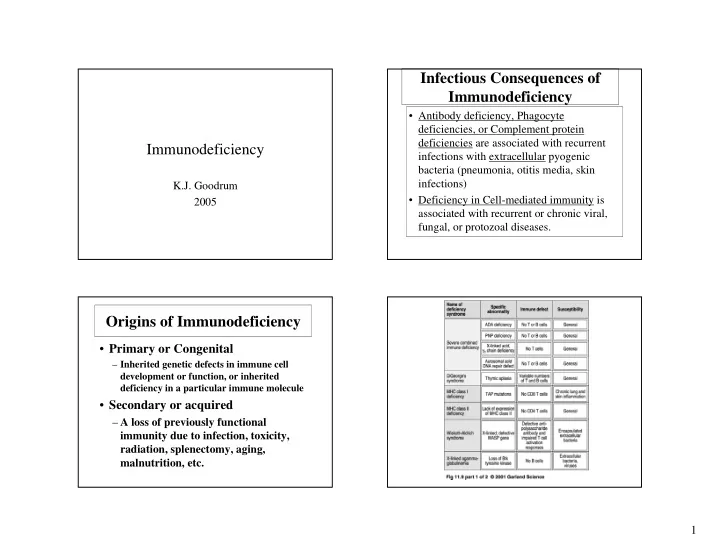
Infectious Consequences of Immunodeficiency

  • Antibody deficiency, Phagocyte

deficiencies, or Complement protein deficiencies are associated with recurrent infections with extracellular pyogenic bacteria (pneumonia, otitis media, skin infections)

  • Deficiency in Cell-mediated immunity is

associated with recurrent or chronic viral, fungal, or protozoal diseases.

slide-2
SLIDE 2

2

B cell Deficiencies

  • Congenital hypogammaglobulinemia

– Symptoms at 9 mo. to 2 yr of age – Treat with intravenous immunoglobulin (IVIG)

  • Hyper IgM: defective CD-40L expression
  • Selective IgA deficiency

– Occurs in 1:600-1:800 people – Possible connection with increased sinopulmonary infections and allergies

T Cell Deficiencies

  • Congenital Thymic aplasia
  • Chronic Mucocutaneous Candidiasis
slide-3
SLIDE 3

3

Severe Combined Immunodeficiency

  • X-linked SCID:

– Defect in IL-2 receptor

  • Swiss-Type SCID

– Adenosine deaminase deficiency

  • Bare Lymphocyte syndrome

– Absence of MHC Class II gene products

Phagocyte Deficiencies

  • Chronic Granulomatous Disease

– NADPH oxidase defect

  • Chediak -Higashi Syndrome

– Abnormal lysosome formation

  • Leukocyte Adhesion Deficiency

– Absence of leukocyte adhesion molecules

Complement Deficiencies

  • Single component deficiencies

– Example: C3 deficiency

  • Hereditary Angioedema

– C1 Inhibitor deficiency

  • C5,C6,C7,C8, or C9 deficiency

– Recurrent bacterial meningitis due defective membrane attack complex

Causes of Acquired Immunodeficiency

  • Cancer (immunoproliferative diseases)
  • Cytotoxic drugs or radiation
  • Malnutrition
  • Splenectomy
  • Immunosuppressive therapies
  • Stress/emotions
  • Aging (thymic atrophy)
  • Infection
slide-4
SLIDE 4

4

Immunopathogenesis of HIV- Infection

  • HIV infects and ultimately destroys CD4+ ,

CCR5+ or CXCR4+ T cells, monocytes, & dendritic cells.

  • Primary HIV Infection: A vigorous

immune response to HIV controls the primary infection. ( clonal Cytotoxic T cells, suppressive chemokines, poorly neutralizing antibody)

Immunopathogenesis of HIV-

  • Infection. (continued)
  • Chronic Asymptomatic Phase: Viral

trapping & replication in lymphoid tissues, high rate turnover of virus and CD4 T cells, loss of CD4 functional help to CTL and antibody responses, destruction of lymph tissue,, viral mutation and escape from recognition, exhaustion or viral inhibition of CD4 T cell renewal.

Immunopathogenesis of HIV-

  • Infection. (continued)
  • Overt AIDS: CD4 count declines, viral

load increases, opportunistic infections.

slide-5
SLIDE 5

5

Menu F B

Mechanisms of CD4+ T cell depletion- Dysfunction

  • Accumulation of unintegrated viral DNA
  • Loss of plasma membrane integrity due to

viral budding

  • Elimination of infected cells by HIV-

specific immune effectors

  • Syncytium formation
  • Autoimmunity

Mechanisms of CD4+ T cell depletion- Dysfunction(continued)

  • Superantigenic stimulation
  • Apoptosis
  • Infection of stem cells and interference with

lymphopoiesis