Ethical Theory The only thing that determines the Consequences - - PDF document

ethical theory
SMART_READER_LITE
LIVE PREVIEW

Ethical Theory The only thing that determines the Consequences - - PDF document

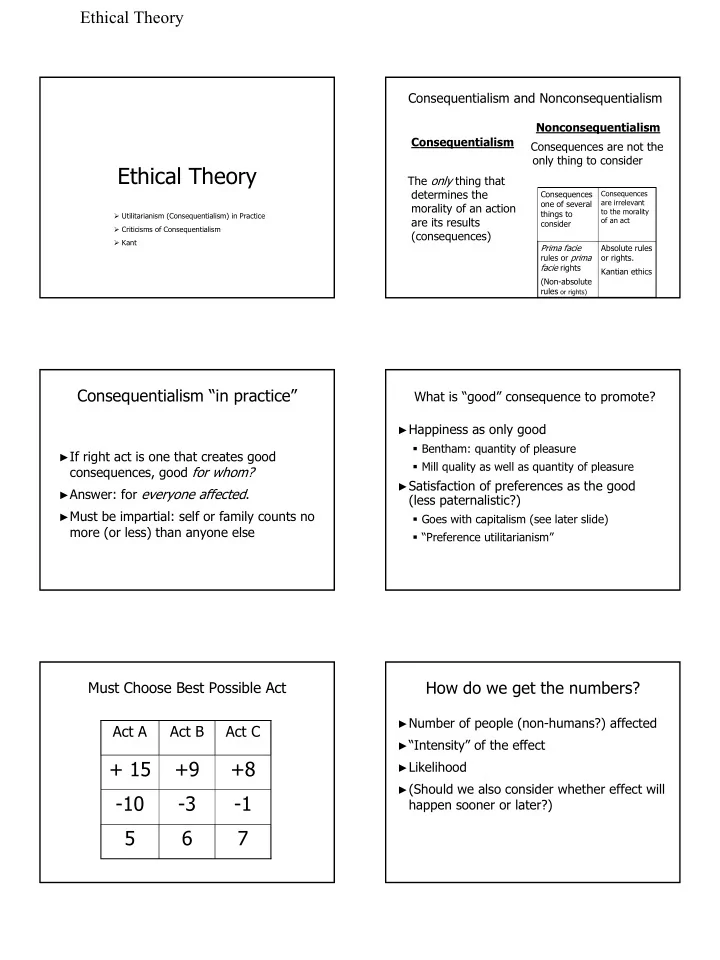
Ethical Theory Consequentialism and Nonconsequentialism Nonconsequentialism Consequentialism Consequences are not the only thing to consider Ethical Theory The only thing that determines the Consequences Consequences are irrelevant one of


slide-1
SLIDE 1

Ethical Theory Ethics 1

Ethical Theory

Utilitarianism (Consequentialism) in Practice Criticisms of Consequentialism Kant

Consequentialism and Nonconsequentialism

Consequentialism The only thing that determines the morality of an action are its results (consequences) Nonconsequentialism Consequences are not the

  • nly thing to consider

Absolute rules

  • r rights.

Kantian ethics Prima facie rules or prima facie rights (Non-absolute rules or rights)

Consequences are irrelevant to the morality

  • f an act

Consequences

  • ne of several

things to consider

Consequentialism “in practice”

►If right act is one that creates good

consequences, good for whom?

►Answer: for everyone affected. ►Must be impartial: self or family counts no

more (or less) than anyone else What is “good” consequence to promote?

►Happiness as only good

Bentham: quantity of pleasure Mill quality as well as quantity of pleasure

►Satisfaction of preferences as the good

(less paternalistic?)

Goes with capitalism (see later slide) “Preference utilitarianism”

Must Choose Best Possible Act Act C Act B Act A

7 6 5

  • 1
  • 3
  • 10

+8 +9 + 15

How do we get the numbers?

►Number of people (non-humans?) affected ►“Intensity” of the effect ►Likelihood ►(Should we also consider whether effect will

happen sooner or later?)

slide-2
SLIDE 2

Ethical Theory Ethics 2

A weak criticism of consequentialism: “we can’t predict the future”

►Consequentialism takes that into account

(likelihood)

►Reasonable to “play the odds,” just as we

do in everyday life

►Falsely assumes that a good ethical theory

must be simple and easy to apply.

How does utilitarian theory get applied as cost-benefit analysis?

► The “minus points” are costs (e.g., $$$) ► The “plus points” are benefits such as

Lives saved Reduction in risk of dying Suffering avoided (e.g., days in hospital) Pleasure gained Likelihood (% chance) must be considered: a 50% chance of 100 plus points of benefit = +50.

► Typical: is it worth spending a million dollars to . .

.?

►The “dwarfing of soft variables”—stuff

that can’t easily be quantified as dollars like enjoyment of a sunny day.

►Defining the value of a human life in

dollar terms.

Expected future earnings? Willingness to pay for reduction in risks Wording of surveys Problems of accepting human preferences.

What are the problems of CBA?

Problem of Preferences

►People often want things based on

manipulation or advertising.

►People are irrational at estimating risks. ►People often desire things for short-term

gain that conflict with genuine happiness (smoking, spending spree, long-term environmental damage for quick profits).

Criticisms of Consequentialism

Key Concepts

►Moral rules and moral rights ►Justice (as one part of morality) ►Morally relevant difference between acts

and omissions

►Intuition and “reflective equilibrium” ►Testing whether an argument withstands

criticism

slide-3
SLIDE 3

Ethical Theory Ethics 3

Problems Applying vs. Criticisms

► “Problems applying” utilitarianism do not

challenge the whole approach of the theory. (Criticisms do.)

► They are things utilitarians disagree about. ► If we decide consequentialism (utilitarianism)

is the right theory, then we may still debate

What things are good (happiness, etc.)? How to figure out the numbers (e.g., $ for life)

Criticisms of Consequentialism

(overview)

1.

Utilitarianism does not take into account rights and rules.

2.

Utilitarianism does not take into account justice.

3.

Consequentialism does not take into account special obligations to special people

4.

Consequentialism does not take into account the morally relevant difference between acts and omissions

5.

Consequentialism requires too much of us (relate this to #3)

Consequentialism ignores moral rules and moral rights

►A fundamental question of all ethics:

Do we need the notion of rights?

►Big problems: Where do rights come from?

What rights do we have?

►But can we have an acceptable ethical

theory without rights?

A Test Case for Consequentialism

A friendly country turns over to the United States someone with close ties to, and information about, terrorist activities planned against the United States. You think that gaining this information could prevent a terrorist attack and many deaths. The man is hostile and not ready to talk. What is it morally acceptable to do to extract information from this man? What are the limits?

slide-4
SLIDE 4

Ethical Theory Ethics 4

“We Broke Him”

►For three months of interrogation, Mr. Faruq

provided investigators with only scraps. "He was a hostile interrogation," said a Western intelligence specialist.

►Then, two weeks ago, the interrogators

"broke him," the specialist said.

►He declined to provide any details of

the techniques employed in the questioning.

Theory and Particular Cases

►Can’t decide on particular case first and

then pick the theory that matches. Why not?

►But we do test theory by application to

specific cases. (Analogy with science.)

►Debate on role of intuition. ►Reflective equilibrium.

Utilitarianism Ignores Justice

10% of population becomes slaves. 90% are extremely happy. Society has greatest balance of +/- points. Utilitarian chooses this. Everyone has freedom Total happiness not as great

Justice in 2 Areas

► Distributive justice: how should economic goods be distributed? Is it fair that some are rich and others poor ► Criminal justice: what is the justification for

punishment? Two main approaches:

Utilitarian

► Protection of society ► Rehabilitation, if possible ► Deterrence

Retributive

► People freely choosing evil deserve punishment ► The punishment should fit the crime ► Only the guilty should be punished

(We didn’t discuss criminal justice in class; see course pack)

Utilitarianism Ignores Special Obligations to Special People

But why should I save my daughter over 100 starving children?

►Cannot appeal to feelings ►Cannot appeal to what most people

would do.

►Need an ethical principle.

What principle might justify special

  • bligation of…

►Parents to their children? ►Children to their parents? ►Person to a 2-year-old brother? ►Person to a cousin? ►Person to a friend?

slide-5
SLIDE 5

Ethical Theory Ethics 5

Williams: kill one Indian to save 19

  • thers?

►Why does Williams think utilitarianism is

wrong?

►What does he mean by “integrity”? ►a special responsibility for what we do in

contrast to what others do or what we let happen.

Morally Relevant Difference Between Acts and Omissions

► What if killing can reduce the number who die, as

Williams’ Indian example?

► Is it morally worse to kill a patient who wants to

die than not to treat?

► Is it morally worse to bomb innocent civilians than

to allow them to die by not acting?

► Is it wrong to buy running shoes when the money

could save many people’s lives?

► Some criticize utilitarianism for requiring too much.

Think About

►What is the strongest criticism of

utilitarianism? Why?

►Can utilitarianism withstand criticism? ►Basic: A claim is well-grounded if the

arguments for it can withstand criticism.

►A “well-grounded claim” is one more worthy

  • f belief.

Possible Quiz 2

In one clear sentence, state one formulation

  • f Kant’s categorical imperative.

(The course pack discusses 2 of them.)

Kantian Ethics

► Difference between acts and omissions: action is

done with a particular intent

► When I buy running shoes, I don’t intend to kill

innocent people

► Kant: utilitarianism doesn’t understand the

meaning of a moral agent.

► Kant: consequences are irrelevant to morality ► Happiness and unhappiness can result from

earthquakes, sunsets, puppy dogs.

Consequentialism and Nonconsequentialism

Consequentialism The only thing that determines the morality of an action are its results (consequences) Nonconsequentialism Consequences are not the only thing to consider

Absolute rules

  • r rights.

Kantian ethics

Prima facie rules or prima facie rights (Non-absolute rules or rights)

Consequences are irrelevant to the morality

  • f an act

Consequences

  • ne of several

things to consider

slide-6
SLIDE 6

Ethical Theory Ethics 6

Kant’s 2 main concepts (review)

►The good will ►The categorical imperative

Kant’s view of human action

Events in the world

► Causeevent ► No freedom ► No moral praise or blame

Actions of moral agent

► Actionpurposes, reasons,

values

► Free will ► Can formulate idea of a

moral rule

► Can choose whether or not

to act

► Can be morally

praiseworthy or blameworthy

The “Good Will” and Kant’s Concept of a Person as Moral Agent

ACTION Intentions, purposes Cause EVENT Actions

  • f persons as

moral agents Events in the world

Kant: desires and inclinations are irrelevant

►Two neighbors: one desires to kill you and

doesn’t; one has only loving desires

►Kant: one is not praiseworthy or

blameworthy for feelings, desires. These are result of heredity and environment.

►One can choose whether to follow desires or

moral rule when they conflict.

►One is responsible for this choice

Categorical Imperative: 2 Formulations

For a rule to be a moral rule, it must be one that

►you could will to universalize. ►treats persons as ends in themselves and

not mere means.

“Could will to universalize”

►Not that you would want everyone to follow

  • it. (Then it would change with each person’s wants.)

►Ideally: impossible to will everyone to

follow; e.g., “never help others but always be helped by other people.”

►Also rules possible for everyone to follow

but you couldn’t will it.

slide-7
SLIDE 7

Ethical Theory Ethics 7

“Treat persons as ends, not mere means”

►Don’t use people ►Every person has intrinsic worth that cannot

be traded off.

►Ideal society: a “kingdom of ends”

Goes beyond utilitarianism

► Utilitarianism is impartial: everyone counts equally. ► If possible to kill one to save 9 others, all ten

count equally.

► It would be wrong to kill the one if not necessary

to save the 10.

► Kant: not enough. The one person has an inherent

value that cannot be traded off.

► In spirit, Kantianism consistent with human rights.

Criticisms of Kant’s Ethics

►It is too abstract to generate rules that can

guide concrete action.

►Kant’s ethics has no way to resolve conflicts

  • f rules (or rights)

►Kantian rules are too rigid. (They fail to

consider consequences!)