SLIDE 1
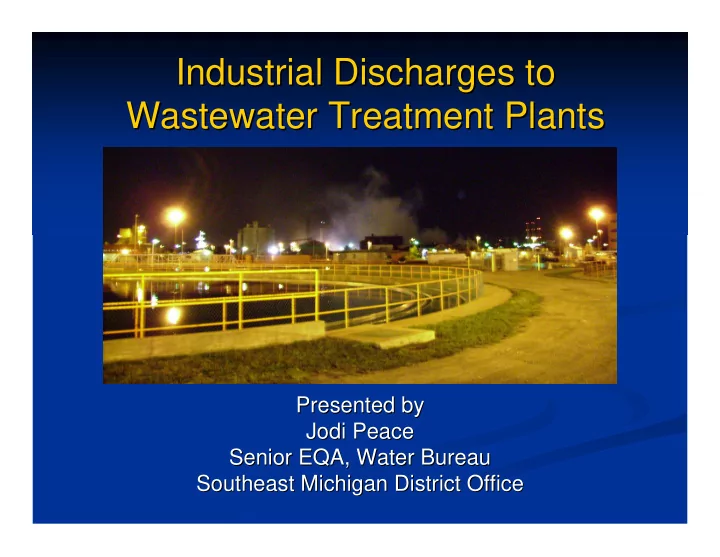
Industrial Discharges to Industrial Discharges to Wastewater Treatment Plants Wastewater Treatment Plants
Presented by Presented by Jodi Peace Jodi Peace Senior EQA, Water Bureau Senior EQA, Water Bureau Southeast Michigan District Office Southeast Michigan District Office
SLIDE 2 Regulatory Programs Regulatory Programs Wastewater Destinations (3.1) Wastewater Destinations (3.1)
DIRECT DISCHARGE 3.4 and 3.5 INDIRECT DISCHARGE 3.4 NPDES PERMIT (Surface Water Discharge) 3.2.3 POTW 3.2.1 PUMP and HAUL 3.2.2 INDIVIDUAL 3.2.3.a GENERAL 3.2.3.c PERMIT-BY-RULE 3.2.3.b STORM WATER 3.2.3.d NON-STORM WATER 3.2.3.c LIQUID / WASTEWATER (INCLUDING STORMWATER) DISCHARCHES STATE PERMIT (Ground Water Discharge) 3.2.4
SLIDE 3
Wastewater Disposal Options Wastewater Disposal Options
DIRECT DIRECT DISCHARGE DISCHARGE to Waters of the State to Waters of the State
SLIDE 4
Wastewater Disposal Options Wastewater Disposal Options
Public sewer Public sewer POTW
Waters of the State Waters of the State INDIRECT DISCHARGE INDIRECT DISCHARGE
SLIDE 5
What do I need to know about What do I need to know about discharging to a WWTP? discharging to a WWTP?
SLIDE 6 A water pollution control program A water pollution control program to prevent: to prevent:
Interference
Pass through
- Contamination of biosolids
Contamination of biosolids
- Damage to WWTP and collection
Damage to WWTP and collection system system
- Protect worker health and safety
Protect worker health and safety
Industrial Pretreatment Program Industrial Pretreatment Program
SLIDE 7 Industrial Pretreatment Program Industrial Pretreatment Program Regulations Regulations
- Part 403 of Title 40 of the Code of
Part 403 of Title 40 of the Code of Federal Regulations (40 CFR Part Federal Regulations (40 CFR Part 403) 403)
- Categorical Pretreatment Standards
Categorical Pretreatment Standards
- Rule 323.23 of the Michigan
Rule 323.23 of the Michigan Administrative Code (Part 23 Rules) Administrative Code (Part 23 Rules)
- Local Sewer Use Ordinance (SUO)
Local Sewer Use Ordinance (SUO)
SLIDE 8 Categorical Pretreatment Categorical Pretreatment Standards Standards
Title 40 of the Code of Federal Regulations, Federal Regulations, Parts 405 Parts 405 – – 471 471
EPA Guidance Materials
- n Categories, etc.,
- n Categories, etc.,
available from EPA available from EPA
http:// http://www.epa.gov/waterscience/guide/industry.html www.epa.gov/waterscience/guide/industry.html
SLIDE 9 Categorical Standards Categorical Standards 40 CFR Parts 404 40 CFR Parts 404 -
471
Metal Finishing
Electroplating
- Organic Chemical Formulation
Organic Chemical Formulation
Pharmaceuticals
- Metal Molding and Casting
Metal Molding and Casting
Iron & Steel
Leather Tanning
http:// http://www.epa.gov/waterscience/guide/industry.html www.epa.gov/waterscience/guide/industry.html
SLIDE 10 What to expect from an IPP What to expect from an IPP municipality municipality
Sewer Use Ordinance
- Wastewater discharge permit
Wastewater discharge permit
- Monitoring and inspections
Monitoring and inspections
Compliance assistance
Enforcement
- Protection of the local environment
Protection of the local environment
Fair treatment
SLIDE 11 IPP Sewer Use Ordinance IPP Sewer Use Ordinance
- Establishes legal authority for the
Establishes legal authority for the municipality to: municipality to:
issue permits
setting discharge limits
- conducting inspections and monitoring
conducting inspections and monitoring
Enforce the IPP… …
Local Limits
Approved by the DNRE
SLIDE 12 What to expect from an IPP What to expect from an IPP municipality municipality
Sewer Use Ordinance
- Wastewater discharge permit
Wastewater discharge permit
- Monitoring and inspections
Monitoring and inspections
Compliance assistance
Enforcement
- Protection of the local environment
Protection of the local environment
Fair treatment
SLIDE 13 Industrial User Permits Industrial User Permits
Discharge Authorization
Effluent limits
- Monitoring and Reporting requirements
Monitoring and Reporting requirements
Test methods -
40 CFR 136
Sample type and location
- Best Management Practices (
Best Management Practices (BMP BMP’ ’s s) )
- Notification requirements
Notification requirements
- Records retention requirements
Records retention requirements
SLIDE 14 What to expect from an IPP What to expect from an IPP municipality municipality
Sewer Use Ordinance
- Wastewater discharge permit
Wastewater discharge permit
- Monitoring and inspections
Monitoring and inspections
Compliance assistance
Enforcement
- Protection of the local environment
Protection of the local environment
Fair treatment
SLIDE 15 Monitoring Monitoring
At least once per year
All regulated pollutants
SLIDE 16 IPP Inspection IPP Inspection
Process areas where wastewater is generated wastewater is generated
Chemical storage areas
Pretreatment system
Monitoring location
Records review
SLIDE 17 What to expect from an IPP What to expect from an IPP municipality municipality
Sewer Use Ordinance
- Wastewater discharge permit
Wastewater discharge permit
- Monitoring and inspections
Monitoring and inspections
Compliance assistance
Enforcement
- Protection of the local environment
Protection of the local environment
Fair treatment
SLIDE 18 Compliance Assistance Compliance Assistance
POTW IPP staff
Local requirements
EPA and DNRE requirements requirements
Treatment systems
Pollution prevention
DNRE and EPA staff
State and federal regulations regulations
Categorical standards
SLIDE 19 What to expect from an IPP What to expect from an IPP municipality municipality
Sewer Use Ordinance
- Wastewater discharge permit
Wastewater discharge permit
- Monitoring and inspections
Monitoring and inspections
Compliance assistance
Enforcement
- Protection of the local environment
Protection of the local environment
Fair treatment
SLIDE 20 ENFORCEMENT ENFORCEMENT
Violations
discharge limits
late reports
Compliance schedules
Other IPP requirements
Enforcement tools:
Phone call/e-
mail
Notice of Violation
- Administrative Consent Order/Agreement
Administrative Consent Order/Agreement
Fines
Termination of service
SLIDE 21 What to expect from an IPP What to expect from an IPP municipality municipality
Sewer Use Ordinance
- Wastewater discharge permit
Wastewater discharge permit
- Monitoring and inspections
Monitoring and inspections
Enforcement
Compliance assistance
- Protection of the local environment
Protection of the local environment
Fair treatment
SLIDE 22 Environmental Protection Environmental Protection
Water quality
- Beneficial reuse of biosolids
Beneficial reuse of biosolids
Pollution emergencies
SLIDE 23 What to expect from an IPP What to expect from an IPP municipality municipality
Sewer Use Ordinance
- Wastewater discharge permit
Wastewater discharge permit
- Monitoring and inspections
Monitoring and inspections
Enforcement
Compliance assistance
- Protection of the local environment
Protection of the local environment
Fair treatment
SLIDE 24 Fair Treatment Fair Treatment
Categorical standards
Local Limits
Procedures
Enforcement Response Plan Plan
SLIDE 25
What can be discharged to a What can be discharged to a WWTP? WWTP?
SLIDE 26
Prohibited Discharges Prohibited Discharges
SLIDE 27 Prohibited Discharges Prohibited Discharges
Interfere or Pass-
through
- Fire or Explosion (Flashpoint
Fire or Explosion (Flashpoint <140 <140º ºF) F)
Corrosive (pH<5)
Block Flow
Heat (<140º ºF) F)
Oil
Toxic Gases
- Trucked Wastewater (unless
Trucked Wastewater (unless at designated points) at designated points)
SLIDE 28 Local Limits Local Limits
Developed by each POTW
POTW specific
Published in SUO
SLIDE 29 Why are local requirements Why are local requirements different ? different ?
Size of the WWTP
Treatment technology
Receiving stream
- Number and types of industries
Number and types of industries
- Ratio of domestic to nondomestic
Ratio of domestic to nondomestic users users
SLIDE 30 Wastewater Stabilization Lagoon Wastewater Stabilization Lagoon
- One of the least complex treatment systems.
One of the least complex treatment systems.
- Hold wastewater for long periods of time, until biological
Hold wastewater for long periods of time, until biological treatment is complete. treatment is complete.
- May have mechanical aeration, chemical feed.
May have mechanical aeration, chemical feed.
SLIDE 31 Mechanical Treatment Plants Mechanical Treatment Plants
Mechanically “ “accelerate accelerate” ” biological processes. biological processes.
- Settling, advanced chemical feed, solids handling.
Settling, advanced chemical feed, solids handling.
- Some have tertiary treatment such as sand filtration.
Some have tertiary treatment such as sand filtration.
SLIDE 32
“ “Massive Massive” ” Treatment Plants Treatment Plants
SLIDE 33 Why are local requirements Why are local requirements different ? different ?
Size of the WWTP
Treatment technology
Receiving stream
- Number and types of industries
Number and types of industries
- Ratio of domestic to nondomestic
Ratio of domestic to nondomestic users users
SLIDE 34 Surface Water Discharging Surface Water Discharging WWTPs WWTPs
- Receiving stream size and quality can affect
Receiving stream size and quality can affect WWTP WWTP’ ’s own discharge limits. s own discharge limits.
SLIDE 35 Receiving streams may require Receiving streams may require additional protections additional protections
State Rules
Coldwater Streams
Designated trout streams
- Historic or ongoing pollutant discharges
Historic or ongoing pollutant discharges
- Shared use with other WWTPs
Shared use with other WWTPs
- Surface water impoundments
Surface water impoundments
Drinking water intakes
SLIDE 36
SLIDE 37
Groundwater Discharging Facilities Groundwater Discharging Facilities
SLIDE 38 Why are local requirements Why are local requirements different ? different ?
Size of the WWTP
Treatment technology
Receiving stream
- Number and types of industries
Number and types of industries
- Ratio of domestic to nondomestic
Ratio of domestic to nondomestic users users
SLIDE 39
Every Community is Unique Every Community is Unique
SLIDE 40 Limited WWTP Capacities Limited WWTP Capacities
- WWTPs have limited capacities for treating
WWTPs have limited capacities for treating pollutants pollutants
- WWTPs treat incoming wastewater from all
WWTPs treat incoming wastewater from all sources sources -
domestic, commercial and industrial industrial
- The pollutants contributed by these sources
The pollutants contributed by these sources will vary because no two municipalities are will vary because no two municipalities are exactly alike exactly alike
SLIDE 41
Local policy decision
- Allocations can be uniform
Allocations can be uniform
Or non-
uniform
Allocations (“ “local limits local limits” ”) will be found in ) will be found in the local sewer use ordinance the local sewer use ordinance
Capacity Allocations Capacity Allocations
SLIDE 42 A SIMPLE EXAMPLE A SIMPLE EXAMPLE
- WWTP can treat 100 pounds per day of
WWTP can treat 100 pounds per day of phosphorus. phosphorus.
- Domestic loading = 40 pounds per day
Domestic loading = 40 pounds per day
- Available Industrial loading = 60 pounds
Available Industrial loading = 60 pounds per day per day
- 1 industry can discharge up to 60 Lbs/day
1 industry can discharge up to 60 Lbs/day
SLIDE 43 A SIMPLE EXAMPLE Part 2 A SIMPLE EXAMPLE Part 2
- WWTP can treat 100 pounds per day of
WWTP can treat 100 pounds per day of phosphorus. phosphorus.
- Domestic loading = 40 pounds per day
Domestic loading = 40 pounds per day
- Available Industrial loading = 60 pounds
Available Industrial loading = 60 pounds per day per day
- 3 industries have to share 60 Lbs/day
3 industries have to share 60 Lbs/day
SLIDE 44 Summary Summary
- Municipalities may be required to
Municipalities may be required to implement an IPP implement an IPP
- The IPP protects the environment, POTW
The IPP protects the environment, POTW workers and infrastructure workers and infrastructure
- Local IPP staff are knowledgeable and can
Local IPP staff are knowledgeable and can provide valuable assistance provide valuable assistance
- All municipal WWTPs are different
All municipal WWTPs are different
- All WWTPs have a limited capacity
All WWTPs have a limited capacity
SLIDE 45 Regulatory Update Regulatory Update
“Pretreatment Streamlining Rules Pretreatment Streamlining Rules” ”
- Published October 14, 2005
Published October 14, 2005
- Effective November 14, 2005
Effective November 14, 2005
- Reduce the burden on municipalities and industries
Reduce the burden on municipalities and industries
- More restrictive changes must be implemented
More restrictive changes must be implemented
- Less restrictive changes cannot be implemented in
Less restrictive changes cannot be implemented in Michigan until State rules are changed Michigan until State rules are changed
SLIDE 46 Regulatory Update Regulatory Update
“ “Clarification Clarification” ” of 403.12(g)(3) composite
sampling requirements. sampling requirements.
Old language:
The Control Authority may waive flow The Control Authority may waive flow-
proportional composite sampling for any Industrial User that composite sampling for any Industrial User that demonstrates that flow demonstrates that flow-
proportional sampling is infeasible. infeasible.
SLIDE 47
New Language:
- For all other pollutants, 24
For all other pollutants, 24-
hour composite samples must be obtained through flow samples must be obtained through flow-
- proportional composite sampling techniques,
proportional composite sampling techniques, unless time unless time-
- proportional composite sampling or
proportional composite sampling or grab sampling is authorized by the Control grab sampling is authorized by the Control
- Authority. Where time
- Authority. Where time-
- proportional composite
proportional composite sampling or grab sampling is authorized by the sampling or grab sampling is authorized by the Control Authority, the samples must be Control Authority, the samples must be representative of the Discharge and the decision representative of the Discharge and the decision to allow the alternative sampling must be to allow the alternative sampling must be documented in the Industrial User file for that documented in the Industrial User file for that facility or facilities. facility or facilities.
Regulatory Update Regulatory Update
SLIDE 48 What does this mean? What does this mean?
- If you discharge to a POTW with design flow
If you discharge to a POTW with design flow <5MGD (MIPP) <5MGD (MIPP) – – You may still have time You may still have time
- If you discharge to a POTW with design flow >5
If you discharge to a POTW with design flow >5 MGD (FIPP) MGD (FIPP)
you must collect flow-
- proportional composite samples
proportional composite samples
Or demonstrate that time demonstrate that time-
proportional composite sampling or grab samples are representative sampling or grab samples are representative
And have authorization from the IPP Control Authority have authorization from the IPP Control Authority to conduct time proportional 24 hour composite to conduct time proportional 24 hour composite samples samples
SLIDE 49
Questions? Questions?