DISCHARGES Presented By: Kerry Dunning, MHA, MSH, CPAR, RAC-CT A - - PDF document

discharges
SMART_READER_LITE
LIVE PREVIEW

DISCHARGES Presented By: Kerry Dunning, MHA, MSH, CPAR, RAC-CT A - - PDF document

POPULATION HEALTH & DISCHARGES Presented By: Kerry Dunning, MHA, MSH, CPAR, RAC-CT A portion of these materials were produced in partnership with the Iowa Department of Public Health for the Iowa Small Hospital Improvement Program (SHIP)


slide-1
SLIDE 1

1

DISCHARGES

POPULATION HEALTH & Presented By: Kerry Dunning, MHA, MSH, CPAR, RAC-CT

A portion of these materials were produced in partnership with the Iowa Department of Public Health for the Iowa Small Hospital Improvement Program (SHIP) Grant FY 18 Contract #5888SH01 and the Georgia State Office of Rural Health for the Georgia Small Hospital Improvement Grant FY 18.

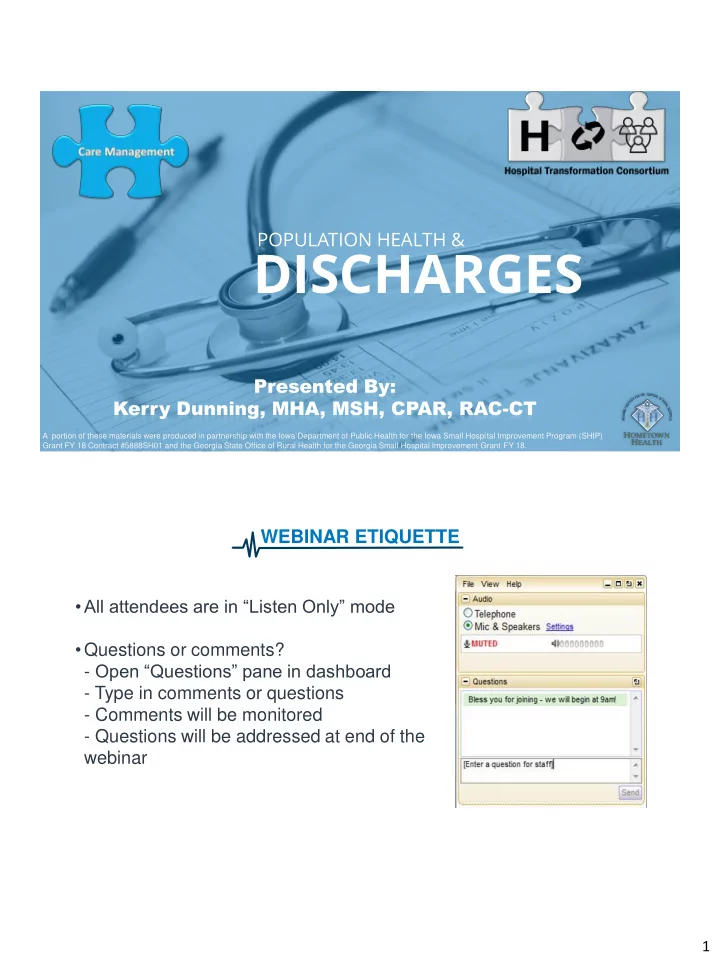
WEBINAR ETIQUETTE

  • All attendees are in “Listen Only” mode
  • Questions or comments?
  • Open “Questions” pane in dashboard
  • Type in comments or questions
  • Comments will be monitored
  • Questions will be addressed at end of the

webinar

slide-2
SLIDE 2

2

WEBINAR RESOURCES

  • This webinar will be recorded and

emailed to you to share with others

  • n your team, as well as posted on your

program dashboard.

  • Handouts are available for download in

the handouts pane and will also be posted to your program dashboard after the webinar.

CONTINUING EDUCATION

As an IACET Authorized Provider, HomeTown Health, LLC offers CEUs for its programs that qualify under the ANSI/IACET Standard. HomeTown Health, LLC is authorized by IACET to offer 0.1 CEUs for this program. In order to obtain these units, you must:

  • Attend webinar/view recording in its entirety within 30 days
  • Pass online quiz with 80% or better.
  • Complete webinar evaluation.

Following this webinar, all attendees who have viewed the recording in its entirety will receive an email with a link to the quiz and evaluation. Anyone that misses the webinar can view the recording online, posted on the program Dashboard, for CEUs.

slide-3
SLIDE 3

3 CONTINUING EDUCATION

HTHU provides over 300 courses online, over 100 Webinars a year, and various live training conference and workshops. Accredited Education from the International Association for Continuing Education & Training (IACET). (Who accepts the IACET CEU? Full list at www.iacet.org)

  • American Association of Respiratory Therapy
  • American Board of Medical Microbiology
  • American Society for Clinical Laboratory Science
  • American Society for Quality
  • American Speech-Language-Hearing Association
  • Board of Certified Safety Professionals
  • The Child Care Development Associate National

Credentialing Program

  • Clinician’s View (Occupational, Speech, and Physical

Therapy)

  • Federal Emergency Management Agency
  • Georgia, Massachusetts and Ohio Board of Nursing
  • Georgia Professional Standards Commission
  • Human Resources Certification Institute (for their

Professional in Human Resource Designation)

  • National Association of Rehabilitation Professionals in

the Private Sector

  • National Association of Social Workers
  • National Board for Certification in Occupational Therapy,
  • Inc. (NBCOT)
  • National Council for Therapeutic Recreation Certification
  • National Registry of Emergency Medical Technology

(EMT)

  • National Registry of Microbiologists
  • National Society of Professional Engineers
  • Society for Human Resources Management
  • State of Georgia, FL and Iowa Board of Professional

Engineers

  • The American Association of Integrative Medicine
  • The American College of Forensic Examiners Institute
  • The American Council on Pharmaceutical Education
  • The American Psychotherapy Association
  • The International College of The Behavioral Sciences
  • The National Board for the Accreditation of Occupational

Therapy (NBCOT)

ACTION ITEM: GROUP PARTICIPATION

Are you on this webinar with a group? If so, please enter: first/last names & email addresses in the question pane.

slide-4
SLIDE 4

4

AGENDA

Welc lcome, me, Introduc

  • ductio

tions s & Program

  • gram

Goals als Stephan hanie ie Love – HomeT meTown wn Health lth Educatio ation/T /Traini aining: Populati lation

  • n

Health lth & Dischar scharges es Kerry Dunnin ing – Kerry Dunning, ing, LLC Up Upcomin

  • ming Events

ts & Resou sources es Stephan hanie ie Love – HomeT meTown wn Health lth

Kerry Dunning, MHA, MSH,CPAR, RAC-CT and Series Trainer Kerry Dunning has 25 years experience in health care consulting and over 30 years in the industry. She specializes in the post-acute market working with hospital based skilled nursing and swing bed programs, critical access hospitals, freestanding skilled facilities, inpatient/outpatient rehab programs, inner city teaching hospitals and rural health care systems. From the beginning of her career, Kerry has been involved in cutting edge projects – working with Yale-New Haven/Bridgeport Hospital and CMS on ED direct admits to skilled nursing (1989-91); on a team with Tulane and the World Health Organization to open the first nursing home in Russia (1997-99); as part of a start-up therapy company (1989-1993) providing services in skilled nursing with a goal of returning residents to home; providing guidance to a team from Shandong University (China) on inpatient rehabilitation services (2006-2009); and for many years providing bed need analysis, market analysis and copacetic service line development for rural healthcare and multi-faceted urban systems. Her most recent planning project analyzes the need for long term care, skilled nursing, assisted living, memory care and swing beds in 2025 and 2035 for a hospital systems. She is currently working with the Illinois Critical Access Hospital Network (ICAHN) and

  • thers to develop quality measures for CAH swing beds. Kerry has provided webinars

and workshops for HomeTown Health and ICAHN for over 15 years, worked with

  • ther state associations, as an instructor at the University of North Florida, and

currently is the swing bed trainer for rural health care systems and state agencies.

Trainer Biography

slide-5
SLIDE 5

5

Kerry Dunning, LLC does not have any proprietary interest in any product, instrument, device, service, or material discussed during this learning event. The education offered by Kerry Dunning in this program is compensated by the HRSA Small Hospital Improvement Program (SHIP) grant in Iowa, Georgia and Florida.

Disclosure of Proprietary Interest Program Goals

Care Management Series

The goal of the Population Health Program is to provide training, resources and support on rural population health across the hospital team, and to promote collaboration through the gathering and sharing of best practices and case studies of successful population health initiatives and innovations in rural hospitals across six primary population health focus areas.

The purpose of the Quarterly Care Management Webinars to provide training, education, and resources to promote care integration and coordination (specifically during discharges, medical care transitions, and medication reconciliation) that facilitate patient- centered care, improved patient experience, improved clinical

  • utcomes, compliance, and efficient resource use.
slide-6
SLIDE 6

6

DISCHARGES

POPULATION HEALTH & Presented By: Kerry Dunning, MHA, MSH, CPAR, RAC-CT LEARNING OUTCOMES

DEFINE

discharge related guideline terminology such as transition planning and community care transitions.

RECALL

the importance of discharges to the patient experience.

COMPARE

the focus of discharges from a traditional discharge to multiple types of patient care settings that may be involved at various points in the treatment of a given patient.

DESCRIBE

  • discharge planning as a

continuous process rather than an event.

  • the integration of caregivers,

patients and patient. representatives

slide-7
SLIDE 7

7

What t you

  • u to

told us: us: Dis Discharge Pla Plannin ing

Hospital case manager is ‘on call’ for after- hours discharges and difficult patient care situations. Hospital has a discharge call-back program and includes the following, but not limited to: Emergency room visits, D/C from nursing floors, and Outpatient visits. Nursing staff utilizes a discharge assessment tool to determine patient readiness for discharge. Discharge program includes making appointments for follow-up visit with medical providers and/or therapy services as needed.

Population Health Challenges

  • Workforce in silos – clinical

and financial

  • Lack of patient data trends

provided to Case Managers

  • Traditional physician training
  • Industry in transition from

fee-for-service to quality and performance reimbursement

  • Regulations stifling innovation
  • Federal, state, reimbursement

changes, etc.

Options

  • Networks & Alliances
  • Data: patient by diagnosis;

return to hospital patients; cost per stay/ episode

  • Amass clinical talent
  • Focus on quality with shared

savings

  • Defining population health

across the system(s)

  • Changing regulations with
  • utcomes
slide-8
SLIDE 8

8

Move from payor-led Care Management to Population Health Management

Resources to help patients stay “healthy” and/or Give patients the resources they need

  • Must have data specific to:
  • Current Patient Status
  • Patient chronic and newly diagnoses diagnoses
  • Patient outcomes
  • Network of community resources
  • Value-based care
  • Hospital readmissions

Tri riple le Aim

The role between population health and discharge planning/

  • utcomes/care transitions:
  • Three components to the Triple Aim:
  • Improve the experience of care
  • Improve the health of populations
  • Reduce the per capita costs of healthcare

Performance Improvement

  • Improving measurement and analytics
  • Identifying, deploying and monitoring the effectiveness of quality

improvements

  • Using a data-driven approach to implementing evidence-based best

practices

slide-9
SLIDE 9

9

Health Example: Obesity Trends

No Data < 10% 10 to 14% 15 to 19% 20 to 24% 25 to 29% > 30% 1990 2000 2010 Sleep apnea and breathing problems Liver and Gallbladder disease Cancer (endometrial, breast, and colon) Stroke

  • Coronary heart disease
  • Hypertension

(high blood pressure)

  • Type 2 diabete0
  • Dyslipidemia (high cholesterol or

high levels of blood triglycerides)

Obesity Consequences

Osteoarthritis (a degeneration

  • f cartilage and

bone breaking down within a joint) Ob-Gyn problems (abnormal periods, infertility)

Your Community?

slide-10
SLIDE 10

10

First Steps:

X%

Diabetes

X%

Cancer

X%

Cardiovascular disease

1 2 3 4 5 6

Community Statistics:

Top Chronic Disease killers (average over the last 5 years) Other . . . . Source: (List source of your information and date it models and date it is gathered)

POLL

IN ONE WORD, WHAT IS YOUR BIGGEST BARRIER TO INTEGRATING POPULATION HEALTH CONCEPTS INTO YOUR DISCHARGE PLANNING PROCESS?

slide-11
SLIDE 11

11

TRANSITIONS OF CARE

  • Poorly executed care transitions from the hospital to the

community associated with higher costs, increased avoidable hospitalization, re-hospitalization, and poorer health outcomes

  • Deficient transitions result in the loss of critical clinical

patient information increase the risk of medical errors, posing a threat to patient safety

  • Inefficient transitions spur patient difficulties in

taking care of themselves and cause poor post- hospital

  • Taking action to reduce avoidable hospitalizations and ED visits among this

at-risk population, health systems = opportunity to improve quality and control

  • Transitions from one entity in a care system to another have significant

potential to fulfill this need and may improve health care quality, reduce costs, and promote more equitable care for vulnerable populations

  • Multi-professional care coordination teams and health information

technologies supporting transitions of care have been shown to reduce avoidable hospital admissions and readmissions, improve quality and health

  • utcomes, reduce lengths of stay, improve the continuity of care, and

reduce geographic barriers in order to ensure equitable delivery

Transit itions of

  • f Ca

Care: Tak aking Ch Charge

slide-12
SLIDE 12

12

Tec echnology an and Transiti tions of

  • f Car

Care

  • Development of a scalable health information technology with data

exchange capabilities across clinical and public health entities helps patient and provider

  • Enables:
  • Management of client consent to share data across entities in real time

for public health and inpatient care locations

  • Timely communications among case managers, inpatient clinicians, and

clients to determine care plans, support clinical decisions, utilize community resources, inform follow-up

  • Reduce the number of readmissions in order to better meet the

patient’s health care needs

  • Technology is used to cross barriers:
  • Multiple vendors
  • HIPAA and other privacy concerns

Ca Care Transiti tions Mod

  • dels

CMS Community Based Care Transitions Program (CCTP)

  • Encouraging communities to collaborate on improving are transitions

and reducing Medicare readmissions

  • Using Community Based Organizations (CBOs)
  • Managing Medicare transitions and improving care quality

Project BOOST (Better Outcomes by Optimizing Safe Transitions)

  • Improve hospital discharges and create safer transitions through

multidisciplinary teams

  • Training, mentoring, coaching
  • Collaboration between sites

Care Transitions Interventions (CTI)

  • Teaching patient self-management skills for hospital to home transition
  • 4 pillars: (1) medication self-management; (2) Patient-centered health

record; (3) Primary care/specialists follow-up; (4) “red flag” recognition Guided Care Comprehensive Primary Care for Complex Patients

  • Collaborate with PCPs and provide guided nurse care
  • 40-hour training (online)
slide-13
SLIDE 13

13

Ca Care Transiti tion Mod

  • dels

Project RED (Re-Engineered Discharge)

  • 12 steps including language assistance; follow-up appointments;

reconciling discharge plan with national guidelines, etc. STAAR (State Action on Avoidable Rehospitalizations

  • Outcome measures on 30-day all-cause readmissions
  • Patient experience measures
  • Process measures for education, handoffs, etc.

Transitional Care Model (TCM)

  • Prepares high risk older adults and caregivers to more effective

management of health conditions

  • Coordinated care by one Case Manager across all settings
  • Home visits and telemedicine
  • Patient understanding of symptoms

POLL

WHAT IS YOUR PRIMARY JOB DUTY?

slide-14
SLIDE 14

14

DISCHARGE PLANNING TO PATIENT-CENTERED

Hospital discharge planning is a process that determines the patient care needed after a hospital stay. Discharge Planner is responsible for making sure patients are released from the hospital to the proper environment that can best care for the patient as they recuperate. Person-Centered is a way of thinking and doing things that sees the people using health and social services as equal partners in planning, developing and monitoring care to make sure it meets their needs.

PLANNING PLANNER PATIENT-CENTERED

LEADERSHIP & CARE TRANSITIONS

IMPLEMENTATION

Implementing change requires a team effort headed by your organization's leadership team

RESPONSIBILITIES

Each person involved in change management has their responsibilities

LEADERSHIP

The entire organization must understand the role of leadership in strategic implementation and delegating responsibility

slide-15
SLIDE 15

15

Cas Case Management t is s Cha Changin ing

The old model of combined discharge planning and utilization management (UM) is not sustainable

  • Complexity, detail and intensity of utilization management changing
  • Criteria and levels of review and appeals have made UM a specialty in its
  • wn right
  • Tied to financial outcomes and does not require any patient contact

Discharge planning is not relevant in value-based care and population health Case managers are caught in arranging a post-acute service that may not be feasible or effective BUT they must discharge timely 29 percent of individuals with a medical condition have mental health comorbidities The 5 percent are patients presenting with comorbid medical and behavioral conditions An estimated 5 percent of the population use 50 percent of healthcare resources

THINK ABOUT THIS

slide-16
SLIDE 16

16

“Professional” Transitions

Leadership teams recognize the value of professional case managers

  • Linking patients from acute care to ambulatory care
  • Need for a thorough assessment and planning with the interdisciplinary team
  • Transitions can be to home, home are, SNF, other post-acute
  • There is no single discharge plan by diagnoses, or age, or co-morbidity

Hospital case managers must be able to articulate the purpose of care coordination to the patient AND to the hospital executives Having care transitions – following a patient through the entire Medicare stay is a path to better outcome

Ga Gaps be betw tween Providers and and Pub ublic Hea Health

They share a similar goal of health improvement and can build on this shared partnerships designed to bring about sustained improvements in population health The current health system devotes most of its resources to treating disease and not determining underlying causes of illness

  • Providers test and Public Health follows up – what does the “middle” look

like? This will be a data drive process:

  • More data sets are becoming available for widespread use
  • HHS has made a wide array of health-related data available to the public

(HHS, 2011b)

  • Data helps drive integration for treatment and care
slide-17
SLIDE 17

17

POLL

PLEASE SCORE YOURSELF BASED ON THE FOLLOWING OPTIONS: 0 = Driven by C-Suite Decisions 1 = Driven by Payor Choices 2 = Trading Data with Other Providers 3 = Involving and Following-Up with Patients 4 = Patient-Centered, Data-Driven Discharges

Ca Care Management to to Rela elational Con Connector

Examples of Relationship Connector or Coordination or Caregiving

  • Shared Goals – can include quality, patient

satisfaction, efficiency, clinical outcomes, financial outcomes,

  • Frequency of Communication – with

patients and with payors

  • Timeliness of Communication – before

discharge, after discharge and ongoing for 30 days

  • Problem Solving Communication –

Physicians, Care Managers, Patients, Patient support

slide-18
SLIDE 18

18

Ex Exam amples: Ca Care Man anagement to

  • Rela

elational Coor Coordination

Frontline Clinical Leadership

Shared goals No or infrequent mention

  • Care process redesign activities undergone with hospital

partners to jointly improve care processes and control costs

  • New collaborations with payor partners in case management

in order to improve care

  • Development of collaborative relationships with sub-

specialist physician groups in the community

  • Medical groups acting as a single system of care, including

shared standards Frequency of Communication

  • Increased communication with patients to improve post-

discharge processes and outcomes

  • In-person nurse visits to patient homes to review

medications and discharge plans

  • Use of electronic patient portals to educate and alert

patients to overdue health services

  • Regular meetings with payor partners to share progress and

identify issues with data sharing or develop clinical benchmarks

  • Meetings including workgroups, committees, disease

collaboratives

  • Interaction between discharge planning team and physician
  • ffices in order to collaborate on quality improvement

Timeliness of Communication No or infrequent mention Information from payors and hospitals, critical to form a comprehensive picture of patient care and improve care coordination Problem Solving Communication

  • Routine meetings within cross-functional care team to

discuss individual care plans for high-risk patients

  • Increased interactions between physicians and case

managers to help high-risk patients manage their care

  • Direct patient outreach to identify barriers to a healthier

lifestyle Identification of high-utilizing patients and coordination of intervention activities with payor partner

Care Management

Structure, incentives, and culture of the system in which they work can be poorly aligned. Recognizing the imperative to center on the patient is now:

  • Clinicians supply information and advice based on their expertise in

treatment and intervention options, along with potential outcomes

  • Patients, their families, and other caregivers bring personal

knowledge on the of different treatments for the patient's circumstances and preferences.

  • Patient-centered care does not mean agreeing to every the care

manager says Patients and their families are key drivers of the design and successful

  • utcomes.

Only when patients are fully engaged can they take control and the health system can see financial improvement.
slide-19
SLIDE 19

19

BEST PRACTICES

  • Clearwater Valley Hospital

& Clinics (Idaho)

  • Patient-Centered Medical

Home (PCMH)

Clearwater’s Redesign of Hospital Discharge

System has a CAH (23 beds) with 3 rural health clinics. They have 8 Family Medicine Physicians, 3 Physician Assistants, 1 General Surgeon, and 4 ED Physicians. CVHC serves 15,000 patients (with a population density of 4 people per square mile). The have the only Emergency Department along 240 miles of Highway 12. The also have a Patient- Centered Medical Home. They elected to focus on hospital discharges because: (1) care transition for high risk patients; (2) AHRQ “top 10” safety steps; (3) Highest risk/cost population; (4) Opportunity to leverage PCMH advantages to improve high risk population health Strategy: (1) Reduce errors in discharge process; (2) Educate patient to recognize problems/ understand plan of care; (3) Frequent contact with patient post discharge to correct errors and alter treatment plan as needed.

slide-20
SLIDE 20

20

Clearwater Readmission Rates Ris isk of

  • f ED

D Vis isit Aft fter Dis Discharge

slide-21
SLIDE 21

21

Status Quo at Project Start Som

  • me of
  • f th

the Ch Changes . . . . .

slide-22
SLIDE 22

22

Som

  • me of
  • f th

the Res esults

Pati tient-Centered Med edical l Ho Home

  • 1. Comprehensive Care: Accountable for meeting the majority of the

patient’s physical and mental health car needs, including prevention, wellness, acute care, and chronic care

  • 2. Patient-Centered: Partnering with patients and their families requires

understanding patient needs, culture, values, and preferences

  • 3. Coordinated Care: rosses all elements of the health care system,

including specialty care, hospitals, home health, and community services

  • 4. Accessible Services: Better services with shorter wait times for urgent

needs, around the clock telephone/electronic access to a member of the care team

  • 5. Quality and Safety: Ongoing engagement using evidence-based

medicine and clinical support tools to guide a SHARED decision

slide-23
SLIDE 23

23

What t is s a a Pati tient-Centered Med edical Ho Home?

  • The objective is to have a centralized setting that facilitates

partnerships between individual patients, and their personal physicians, and when appropriate, the patient’s family.

  • Care is facilitated by registries, information technology, health

information exchange and other means to assure that patients get the indicated care when and where they need and want it in a culturally and linguistically appropriate manner.

  • Guidelines approved by multiple physician groups in February 2011

available in the resources section

Home = a model or philosophy of primary care that is team-based, accessible and focused on what the patient wants and what the patient needs to know and what the patient needs in the way of support

Too

  • olk

lkit: Ac Action Plan lan Too

  • ols

ls

Population Health Care Management

Review of f Ac Actio ion Pla lan Tool

First Quarter Toolkit Resource Looking at:

  • Identifying Gaps
  • First Steps
  • Person-centered
  • Training
slide-24
SLIDE 24

24 Second Quarter Toolkit Resources

So Sour urces:

AHRQ PCMH Resource Center. https://pcmh.ahrq.gov/ American Academy of Family Physicians; American Academy of Pediatrics; American College of Physicians; American Osteopathic Association. Guidelines for Patient-Centered Medical Home Recognition and Accreditation Programs. February 2011. https://www.acponline.org/system/files/documents/running_practice/delivery_and_payment_models/pcmh/ understanding/guidelines_pcmh.pdf Bodenheimer T, Berry-Millet R. Care Management of Patients with Complex Health Care Needs. 2009 Retrieved from http://www.rwjf.org/en/research- publications/find-rwjf-research/2009/12/care-management-of- patients-with-complex-health-care-needs.html. [PubMed] Caron, R. Population Health: Principles and Applications for Management. Gateway; AUPHA.2017 Cramm JM, Nieboer AP. Rich interaction among professionals conducting disease management led to better chronic care. Health Affairs. 2012;31(11):2493–2500. [PubMed] Fleming, N. Pathways to Population Health. 2017. Advantage. Hodach, R; Grundy, P; Jain, Anil; Weiner, M. Provider-Led Population Health Management. 2016. Wiley Mayzell, G. Population Health: An Implementation Guide to Improve Outcomes and Lower Costs. 2016. CRC Press. McGrath, K. Redesign of the Hospital Discharge: Patient-Centered Care to Improve Safety, Cost, and Outcomes. http://www.safetynetmedicalhome.org/sites/default/files/Webinar-Redesign-of-the-Hospital-Discharge.pdf Noel P, Lanham H, Palmer R, Leykhum L, Parchman M. The importance of relational coordination and reciprocal learning for chronic illness care in primary care teams. Health Care Management Review. 2013;38(1):20–28. [PubMed]

slide-25
SLIDE 25

25

LEARNING OUTCOMES

DEFINE

discharge related guideline terminology such as transition planning and community care transitions.

RECALL

the importance of discharges to the patient experience.

COMPARE

the focus of discharges from a traditional discharge to multiple types of patient care settings that may be involved at various points in the treatment of a given patient.

DESCRIBE

  • discharge planning as a

continuous process rather than an event.

  • the integration of caregivers,

patients and patient. representatives

Questions?

If you have questions about this education, please contact: Kerry Dunning, MHA, MSH, CPAR, RAC-CT

Email: Kerry.dunning@kerrydunningllc.com Phone: 904-923-7229

Or you can contact hthtech@hometownhealthonline.com

slide-26
SLIDE 26

26

Upcoming Events and Resources

“Prepare to Share”

Your hospital team should have a Quarterly Meeting time scheduled to “put the pieces together.” Prepare your notes from today as well as your Toolkit to share with others on your Population Health team.

Re Recomm

  • mmen

ended ed Dates es for Intern ernal Meeti tings gs: *Quarter 1: Recommended between Aug 22-31 – Did you meet as a team to discuss your Q1 Recommended Meeting Agenda and resources? Quarter 2: Recommended between Nov 17- Dec 4 Quarter 3: Recommended between Feb 25- Mar 5 Quarter 4: Recommended between May 22-24 A sample Meeting Agenda and discussion topics will be provided and posted on your Program Dashboards in advance of the recommended dates each quarter.

slide-27
SLIDE 27

27

Care Management Series Training

Quarterly ly Care Managemen ement t & T The Pa Patien ent Exper erie ience e Webinar ar Series es

Held at 2 pm EST / 1 pm CST on the dates below. Register for the Webinar Series Here. Download or print a Program Overview: Overview Care Management Provide training and resources to promote care integration and coordination (specifically during discharges, medical care transitions, and medication reconciliation) that facilitate patient-centered care, improved patient experience, improved clinical outcomes, compliance, and efficient resource use. Intended Audience: Case Managers, Care Coordinators, Nurse Leaders, Discharge Planners Speaker: Kerry Dunning, Dunning Consulting LLC Questions? Contact Evelyn Leadbetter at evelyn.leadbetter@hometownhealthonline.com. June 28, 2018: Introduction to Care Management and Population Health Webinar 0.1 CEU September 20, 2018: Population Health and Discharges Webinar 0.1 CEU December 20, 2018: Population Health and Medicare Care Transitions Webinar 0.1 CEU March 14, 2019: Population Health and Medication Reconciliation Webinar 0.1 CEU

Other Population Health Events & Resources in Q2:

Webinar Date Training Title​ Intended Audience​

9/20/2018​ Care Management Series: Population Health and Discharges​ Case Managers, Care Coordinators, Nurse Leaders, Discharge Planners​ 10/9/2018​ Finance & Operations Series: Program Design for Cost Savings​ Financial Executives, COOs, and

  • ther Financial Leaders​

10/11/2018​ Physician Quality Series: Coordination of Quality Efforts – Physicians & Hospitals​ Physicians, Practice Administrators, and RHC/Clinic staff​ 10/16/2018​ Quarterly Compliance Officer Update - October​ Rural Hospital Compliance Officers, C-Suite, Board Members​ 11/13/2018​ Wellness and Disease Management Series: Chronic Disease Management Program for Staff​ Wellness committee members, nurse leaders, care coordinators, nurse educators, discharge planners, RHC staff, HR, Marketing, and leadership​

slide-28
SLIDE 28

28

Financial Stability Program Events & Resources in Q2:

Webinar Date Training Title Intended Audience

9/25/2018 Quarterly Coding Webinar: ICD-10-CM Annual Updates HIM, Coding, and other Hospital Financial Leaders (CFOs, Revenue Cycle Directors, Business Office leaders) 10/10/2018 Monthly Medicare Reimbursement Update Webinar Medicare Billers, Business Office Managers and CFO's 10/23/2018 Iowa Medicaid Update + Anatomy of an Appeal Medicaid Billers, Business Office Managers and CFO’s 11/14/2018 Monthly Medicare Reimbursement Update Webinar Medicare Billers, Business Office Managers and CFO's 11/27/2018 Physician CDI Training: The Rules of Medical Necessity Physicians, Hospital and Physician Office Coders, CDI Specialists, and Revenue Cycle Directors

Other Upcoming Events

Fo For: Date: e: Event:

Iowa CAHs Only (FLEX) September 21, 2018 Rural Hospital Learning Opportunity Program: “Hospital Quality and Finance Alignment: Working Together for Improvement” – REGISTER FOR KICKOFF https://register.gotowebinar.com/register/86 44066141560063491 All Georgia/Florida HTC SHIP Grant October 17, 2018 Georgia/Florida Financial and Care Management Workshops – REGISTER HERE http://www.hometownhealthonline.com/even t/19th-annual-fall-conference/ All Iowa CAHs (FLEX), All HTHU Subscribing Hospitals, any others who would like to join October 1 (Registration Deadline) Program Launching: RevUp2 Listen to Kickoff recording and view Program Overview http://www.hthu.net/revup2info/

slide-29
SLIDE 29

29

CONSORTIUM RESOURCES

There are on-demand training and certification programs available in HTHU’s:

  • School of Revenue Cycle Management
  • PFS/BO Certifications
  • School of Coding & Documentation
  • School of Clinical & Staff Compliance
  • School of Physician Office Education
  • School of HIT & Transformation
  • Board & Governance Training
  • School of Behavioral Health

Questions? Contact Meghan Williams at meghan.williams@ hometownhealthonline.com

TELL US HOW WE DID!

A survey will launch after this webinar closes: please take a moment to give us your feedback on the training, speaker, content, webinar format, and anything else. If there’s something we can help your hospital with, please let us know!

slide-30
SLIDE 30

30

CONSORTIUM DASHBOARD

Georgia/ Florida Hospitals: www.hthu.net/htc18 Password Protected Iowa Hospitals: www.hthu.net/iahtc18 Password Protected

Email hthtech@hometownhealthonline.com or Evelyn Leadbetter at evelyn.leadbetter@hometownhelathonline.com for your password.