Freshwater Discharges to Lake Worth Lagoon Julie O. Bishop - - PowerPoint PPT Presentation

freshwater discharges to lake worth lagoon
SMART_READER_LITE
LIVE PREVIEW

Freshwater Discharges to Lake Worth Lagoon Julie O. Bishop - - PowerPoint PPT Presentation

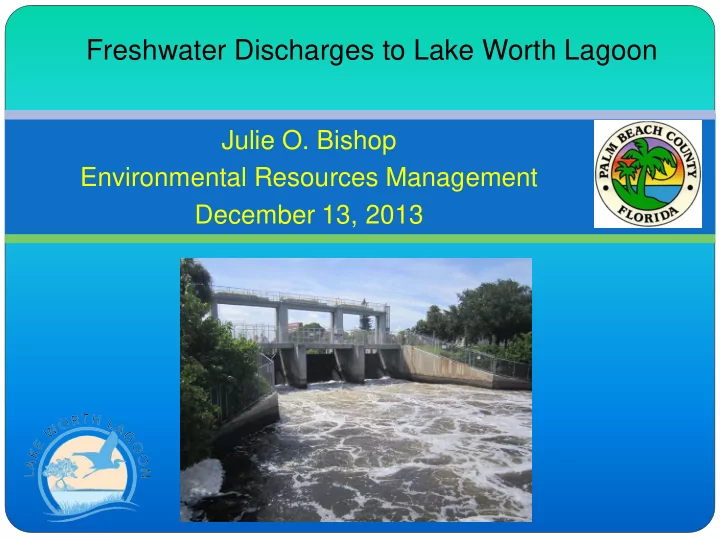
Freshwater Discharges to Lake Worth Lagoon Julie O. Bishop Environmental Resources Management December 13, 2013 LAKE WORTH LAGOON Orig. FW 20 mi long mi wide North Palm Beach to Ocean Ridge 13 Municipalities 480 sq.


slide-1
SLIDE 1

Julie O. Bishop Environmental Resources Management December 13, 2013

Freshwater Discharges to Lake Worth Lagoon

slide-2
SLIDE 2
slide-3
SLIDE 3
  • Orig. FW
  • 20 mi long
  • ½ mi wide
  • North Palm Beach

to Ocean Ridge

  • 13 Municipalities
  • 480 sq. mile

watershed

  • Urbanized

LAKE WORTH LAGOON

slide-4
SLIDE 4
slide-5
SLIDE 5
slide-6
SLIDE 6
slide-7
SLIDE 7
slide-8
SLIDE 8
slide-9
SLIDE 9

Seagrass Mapping

 Aerial Mapping ~5 yrs  2001 & 2007 seagrass

coverage 22% or >1600 acres

 2012 & 2013 unable to

capture aerial photo due to discharges and reduced water clarity

 Grant funded by State

Legislative Appropriation

C-17 C-51 C-16

slide-10
SLIDE 10

Seagrass Mapping

 2012 aerial failed

due to poor water clarity

 2013 methodology

sampling 1,000 points

2013 Adjacent to Rybovich Marina

slide-11
SLIDE 11

 70% with seagrass

North Lagoon

 7% with seagrass

Central Lagoon

SEAGRASS MAPPING 2013

 50% with seagrass

South Lagoon

C-17 C-51 C-16

slide-12
SLIDE 12

200 400 600 800 1000 1200 Total # of Cells with Seagrass

Overall frequency of seagrass occurrence in the Lake Worth Lagoon, 2000-2013

slide-13
SLIDE 13
slide-14
SLIDE 14

Oyster Station

March 2012 August 2013

slide-15
SLIDE 15
slide-16
SLIDE 16

S-155 Control Structure

C-51 Sediment Management Project Area

  • WPB Golf

Course

slide-17
SLIDE 17
slide-18
SLIDE 18
slide-19
SLIDE 19

Take Away Points:

 SFWMD is doing what it can to reduce discharges.  ‘System’ lacks water storage.  CERP, CEPP, A-1, Rock Pits, Mecca, C-51 Reservoir.  Too much freshwater kills seagrasses and oysters.  Seagrasses and oysters can recover.  Muck sediments are left behind.  Muck smothers most living organisms.  C-51 Sediment Trap helps.  Reducing discharges will also reduce sediments.

slide-20
SLIDE 20

C-51 Canal

 Freshwater Discharges contain

suspended sediments & high nutrients

 Results

 Muck Deposits  Increased Turbidity  Blankets Sand Substrate  Reduces Biodiversity

C-51

Ibis Isle Restoration John’s Island Oysters Snook Island Natural Area

Grassy Flats (Proposed)

slide-21
SLIDE 21

Capping w ith Sand Shooter

slide-22
SLIDE 22
slide-23
SLIDE 23

Grassy Flats Restoration Project

  • Caps 12 acres of muck

Proposed seagrass (10.52 ac) Enhanced seagrass (9.31 acres) Proposed cordgrass (1.14 ac) Proposed mangrove (0.33 ac) Proposed open area (0.27 ac) Proposed oyster/artificial reef (0.57 ac) Existing boat access to remain (30' wide) Existing mangrove planter (0 8 ac)

  • Partners sharing cost of $2.7M:
  • USFWS ($777,000)

( )

Existing mangrove planter (0.8 ac)

#

"Danger: Submerged Rock" sign

  • FDEP/NOAA ($110,000)
  • USACE ($842,000?)
  • Legislative appropriation ($110,000?)
  • PBC ($920,000, including in-kind)

PBC ($920,000, including in kind)

  • FWC (in-kind)
  • WPBFC (in-kind)
  • MIA (in-kind)

C t ti t b i S i

  • Construction to begin Spring 2013
slide-24
SLIDE 24
slide-25
SLIDE 25

w w w.LWLI.org

Julie O. Bishop Environmental Resources Management