(Indicative) outline Introduction Multimedia Indexing and - - PowerPoint PPT Presentation

indicative outline
SMART_READER_LITE
LIVE PREVIEW

(Indicative) outline Introduction Multimedia Indexing and - - PowerPoint PPT Presentation

(Indicative) outline Introduction Multimedia Indexing and Retrieval Descriptors Georges Qunot QBE, search, classification, fusion, post- Multimedia Information Modeling and Retrieval Group processing ... Deep learning


slide-1
SLIDE 1

Georges Quénot EARIA 17 October 2014 1

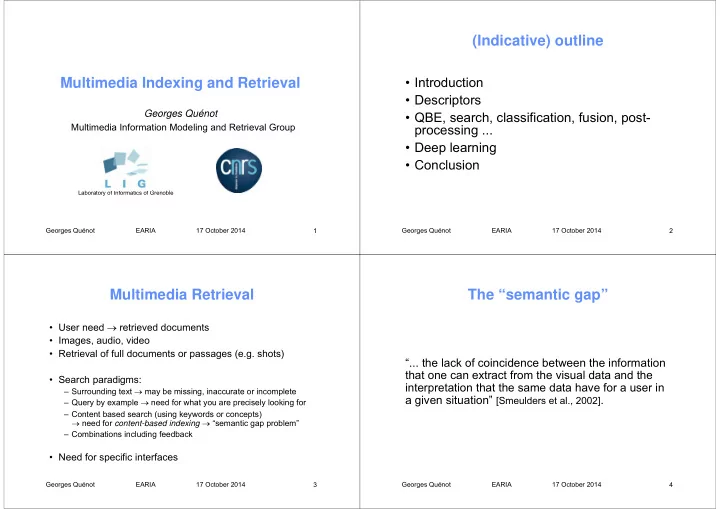
Multimedia Indexing and Retrieval

Georges Quénot Multimedia Information Modeling and Retrieval Group

Laboratory of Informatics of Grenoble

Georges Quénot EARIA 17 October 2014 2

(Indicative) outline

  • Introduction
  • Descriptors
  • QBE, search, classification, fusion, post-

processing ...

  • Deep learning
  • Conclusion

Georges Quénot EARIA 17 October 2014 3

Multimedia Retrieval

  • User need  retrieved documents
  • Images, audio, video
  • Retrieval of full documents or passages (e.g. shots)
  • Search paradigms:

– Surrounding text  may be missing, inaccurate or incomplete – Query by example  need for what you are precisely looking for – Content based search (using keywords or concepts)  need for content-based indexing  “semantic gap problem” – Combinations including feedback

  • Need for specific interfaces

Georges Quénot EARIA 17 October 2014 4

The “semantic gap”

“... the lack of coincidence between the information that one can extract from the visual data and the interpretation that the same data have for a user in a given situation” [Smeulders et al., 2002].

slide-2
SLIDE 2

Georges Quénot EARIA 17 October 2014 5

The “semantic gap” problem

Face Woman Hat Lena …

122 112 98 85 … 126 116 102 89 … 131 121 106 95 … 134 125 110 99 … … … … … …

?

Georges Quénot EARIA 17 October 2014 6

Query BY Example (QBE)

Descriptor Descriptors Query Documents Matching function Scores (e.g. distance or relevance) Extraction Extraction Ranking Sorted list

Georges Quénot EARIA 17 October 2014 7

Content based indexing by supervised learning

Descriptors Descriptors Training documents Test documents Train Model Extraction Extraction Predict Scores (e.g. probability of concept presence) Concept annotations

Georges Quénot EARIA 17 October 2014 8

Example : the QBIC system

  • Query By Image Content, IBM (stopped demo)

http://wwwqbic.almaden.ibm.com/cgi-bin/photo-demo

slide-3
SLIDE 3

Georges Quénot EARIA 17 October 2014 9

Descriptors

  • Engineered descriptors

– Color – Texture – Shape – Points of interest – Motion – Semantic – Local versus global – …

  • Learned descriptors

– Deep learning – Auto encoders – …

Georges Quénot EARIA 17 October 2014 10

Histograms - general form

  • A fixed set of disjoint categories (or bins), numbered from

1 to K.

  • A set of observations that fall into these categories
  • The histogram is the vector of K values h[k] with h[k]

corresponding to the number of observations that fell into the category k.

  • By default, the h[k] are integer values but they can also

be turned into real numbers and normalized so that the h vector length is equal to 1 considering either the L1 or L2 norm

  • Histograms can be computed for several sets of
  • bservations using the same set of categories producing
  • ne vector of values for each input set

Georges Quénot EARIA 17 October 2014 11

Histograms – text example

  • A vector of term frequencies (tf) is an histogram
  • The categories are the index terms
  • The observations are the terms in the documents

that are also in the index

  • A tf.idf representation corresponds to a weighting
  • f the bins, less relevant in multimedia since

histograms bins are more symmetrical by construction (e.g. built by K-means partitioning)

Georges Quénot EARIA 17 October 2014 12

Image intensity histogram

  • The set of categories are the possible intensity values

with 8-bit coding, ranging from 0 (black) to 255 (white) or ranges of these intensity values

256-bin 16-bin 64-bin

slide-4
SLIDE 4

Georges Quénot EARIA 17 October 2014 13

Image color histogram

  • The set of categories are ranges of possible color values
  • A common choice is a per component decomposition

resulting in a set of parallelepipeds

  • Any color space can be chosen (YUV, HSV, LAB …)
  • Any number of bins can be chosen for each dimension
  • The partition does not need to be in parallelepipeds

5×5×5-bin 125-bin 3×3×3-bin 27-bin 4×4×4-bin 64-bin R G B Representations with the parallelepipeds’ center colors:

Georges Quénot EARIA 17 October 2014 14

Image color histogram

  • The set of categories are ranges of possible color values

5×5×5-bin 125-bin 3×3×3-bin 27-bin 4×4×4-bin 64-bin

Georges Quénot EARIA 17 October 2014 15

Image histograms

Georges Quénot EARIA 17 October 2014 16

Image histograms

  • Can be computed on the whole image,
  • Can be computed by blocks:

– One (mono or multidimensional) histogram per image block, – The descriptor is the concatenation of the histograms of the different blocks. – Typically : 4 x 4 complementary blocks but non symmetrical and/or non complementary choices are also possible. For instance: 2 x 2 + full image center

  • Size problem  only a few bins per dimension
  • r a lot of bins in total
slide-5
SLIDE 5

Georges Quénot EARIA 17 October 2014 17

Fuzzy histograms

  • Objective: smooth the quantization effect

associated to the large size of bins (typically 4×4×4 for RGB).

  • Principle: split the accumulated value into two

adjacent bins according to the distance to the bin centers.

Georges Quénot EARIA 17 October 2014 18

Correlograms

  • Parallelepipeds/bins are taken in the Cartesian product
  • f the color space by itself : six components

H(r1,g1,b1,r2,g2,b2) (or only four components if the color space is projected on only two dimensions: H(u1,v1,u2,v2)).

  • Bi-color values are taken according to a distribution of

the image point couples:

– At a given distance one from the other, – And/or in one or more given direction.

  • Allows for representing relative spatial relationships

between colors,

  • Large data volumes and computations

Georges Quénot EARIA 17 October 2014 19

Color moments

  • Moments (color distribution global statistics)

– Means – Covariances – Third order moments – Can be combined with image coordinates – Fast and easy to compute and compact representation but not very accurate

Georges Quénot EARIA 17 October 2014 20

Image normalization

  • Objective : to become more robust again illumination

changes before extracting the descriptors.

  • Gain and offset normalization: enforce a mean and a

variance value by applying the same affine transform to all the color components, non-linear variants.

  • Histogram equalization: enforce an as flat as possible

histogram for the luminance component by applying the same increasing and continuous function to all the color components.

  • Color normalization: enforce a normalization which is

similar to the one performed by the human visual: “global” and highly non linear.

slide-6
SLIDE 6

Georges Quénot EARIA 17 October 2014 21

Texture descriptors

  • Computed on the luminance component only
  • Frequential composition or local variability
  • Fourier transforms
  • Gabor filters
  • Neuronal filters
  • Cooccurrence matrices
  • Normalization possible.

Georges Quénot EARIA 17 October 2014 22

Gabor transforms

(Circular) Gabor filter of direction , of wavelength  and of extension  : Energy of the image through this filter:

Georges Quénot EARIA 17 October 2014 23

       

 

Elliptic: Circular:

Gabor transforms

Georges Quénot EARIA 17 October 2014 24

  • Circular:

– scale , angle , variance , –  multiple of , typically :  = 1.25 , (“same number” of wavelength whatever the  value)

  • Elliptic:

– scale , angle , variances  and , –  and  multiples of , typically :  = 0.8  et  = 1.6 ,

  • 2 independent variables:

– scale  : N values (typically 4 to 8) on a logarithmic scale (typical ratio of 2 to 2) – angle  : P values (typically 8), – N.P elements in the descriptor,

Gabor transforms

slide-7
SLIDE 7

Georges Quénot EARIA 17 October 2014 25

Selection of points of interest

  • “High curvature” points or “corners”,
  • “Singular” points of the I[i][j] surface,
  • Extracted using various filters:

– Computation of the spatial derivatives at several scales, – Convolution with derivatives of Gaussians, – Harris-Laplace detector.

  • Interest points are selected, filtered and described
  • 2D (image): Scale Invariant Feature Transform (SIFT)

[Lowe, 2004]

  • 3D (video): Space-Time Interest Points (STIP) [Laptev,

2005]

  • Variable number of points per image or per video shot 

need for aggregation

Georges Quénot EARIA 17 October 2014 26

Descriptors of points of interest

  • SIFT descritptor: Histogram of gradient direction:

8 bins times 4 x 4 blocks in a neighborhood of the point.

Georges Quénot EARIA 17 October 2014 27

Local versus global descriptors

  • Global descriptors: single vector for a whole image
  • Local descriptors: one vector for each pixel, image patch,

image block shot 3D patch … e.g. SIFT or STIP

  • Need for a single vector of fixed length far any image and

with comparable components across images

  • Aggregation of local descriptors → global descriptor
  • Homogeneous with the local descriptor:

– max or average pooling

  • Heterogeneous with the local descriptor:

– Histogramming according to clusters in the local descriptor space [Sivic, 2003][Cusrka, 2004] – Gaussian Mixture Models (GMM) – Fisher Vectors (FV) [Perronnin, 2006], Vectors of Locally Aggregated Descriptors (VLAD) [Jégou, 2010] or Tensors (VLAT) [Gosselin, 2011], Supervectors

Georges Quénot EARIA 17 October 2014 28

Semantic or intermediate descriptors

  • Use of classifiers trained on other data and for other target

concepts [Ayache, 2007]

  • Vectors of scores of the other target concepts can be used

as intermediate or high level descriptors (opposed to low- level ones that are “close to the signal”)

  • Semantic descriptors can be either global or local (e.g. on

pixels or patches)

  • Semantic descriptors carry different information than low-

level one and of higher semantic value

  • The target concepts composing the semantic descriptors

does not need to be related to the final target ones

  • They do not need either to be recognized very accurately
  • Semantic descriptors are often as good as or better than

state of the art low-level ones and boost performance when combined with them

slide-8
SLIDE 8

Georges Quénot EARIA 17 October 2014 29

Query by example

  • Single query sample:

– 2, EMD or histogram intersection for histograms – Euclidian Distance : searching for identities – Angle between vectors : searching for similarities robust to illumination changes (for some other descriptors, e.g. Gabor transforms)

  • Multiple queries or relevance feedback:

– Linear combination of distances with different weights for positively and negatively marked samples [Rocchio, 1971] – Supervised learning from the marked samples (active learning) – Rely also on the choice of a distance between global descriptions

  • Direct matching and scoring between sets of local

descriptors:

– Costly but good for searching specific instances rather than general categories

Georges Quénot EARIA 17 October 2014 30

Content-based indexing

  • Training from annotated collections:

– LSCOM-TRECVid for videos – Pascal VOC or ImageNet for still images – Many others, e.g. Hollywood2 for actions in movies

  • Use of supervised learning methods:

– Support Vector Machines (SVM), linear or RBF – K nearest neighbors (KNN) – Neural Networks (NN), Multi-Layer Perceptrons (MLP) – Many others again – Adaptations for highly imbalanced data sets

  • Fusion if several descriptors and/or several

learning methods are simultaneously used.

Georges Quénot EARIA 17 October 2014 31

Fusion for concept classification

  • Several possible descriptors
  • Several possible classifiers
  • Early versus late fusion [Snoek, 2005]

– Early: concatenation of normalized descriptors – Late: combination of classification scores

  • Kernel fusion [Ayache, 2007]

– Fusion of kernels in RBF-based (e.g. SVM) learning methods

Georges Quénot EARIA 17 October 2014 32

Re-ranking for concept classification

  • Re-ranking (or re-scoring): use of detections

scores for other concepts of for other samples for improving the detection of a given concept for a given sample

  • Temporal re-scoring [Safadi, 2010]

– Re-score shots in a video with the hypothesis of a global or a local homogeneity of the contents

  • Conceptual re-scoring [Hamadi, 2013]

– Re-score an image or video sample for several concepts using implicit (co-occurrences) or explicit (ontologies) between them

  • Combination of both
slide-9
SLIDE 9

Georges Quénot EARIA 17 October 2014 33

Formal neural or unit

  • z

x1 x2 x3 x4 x5 1 1 linear combination sigmoid function w

Georges Quénot EARIA 17 October 2014 34

Neural layer (all to all)

  • z1

x1 x2 x3 x4 x5 1 1 matrix-vector multiplication per component operation z2 z3 w1 w2 w3

Georges Quénot EARIA 17 October 2014 35

Multilayer perceptron

  • 1

i1 i2 input layer

  • utput

layer i3 i4

  • 2
  • 3
  • 4

hidden layer

Georges Quénot EARIA 17 October 2014 36

Feed forward

  • Global network definition
  • Layer values:
  • with
  • and
  • Vector of all unit parameters:
  • (weights by layer concatenated)
  • Feed forward:
slide-10
SLIDE 10

Georges Quénot EARIA 17 October 2014 37

Error back-propagation

  • Training set: ,
  • input-output samples
  • , , and ,

, ,

  • Error on the training set:

∑ ,

,

  • Minimization of by gradient descent:

– Randomly initialize 0 – Iterate 1 

  • r 
  • – Back-propagation:
  • is computed by backward recurrence from
  • and
  • applying iteratively . ′

Georges Quénot EARIA 17 October 2014 38

ImageNet Challenge 2012

[Krizhevsky et al., 2012]

  • 7 hidden layers, 650K units, 60M parameterss (W )
  • GPU implementation (50× speed-up over CPU)
  • Trained on two GPUs for a week
  • A. Krizhevsky, I. Sutskever, and G. Hinton, ImageNet Classification with

Deep Convolutional Neural Networks, NIPS 2012

Georges Quénot EARIA 17 October 2014 39

ImageNet Classification 2012 Results

Krizhevsky et al. -- 16.4% error (top-5) Next best (non-convnet) – 26.2% error

Georges Quénot EARIA 17 October 2014 40

ImageNet Classification 2013 Results

http://www.image-net.org/challenges/LSVRC/2013/results.php Demo: http://www.clarifai.com/

slide-11
SLIDE 11

Georges Quénot EARIA 17 October 2014 41

Engineered versus learned descriptors

  • Classical “classification pipeline”

– Extraction(s) – [aggregation] – optimization(s) – classifier(s) – one or more levels of fusion – re-scoring (non exhaustive example) – Most of the stages are explicitly engineered: the form

  • f descriptors or processing steps has been thought

and designed by a skilled engineer or researcher – Lots of experience and acquired expertise by thousands of smart people over tens of years – Learning concerns only the classifier(s) stages and a few hyper-parameters controlling the other ones – Almost everything has been tried – The more you incorporate, the more you get (at a cost)

Georges Quénot EARIA 17 October 2014 42

Engineered versus learned descriptors

  • Deep learning pipeline: MLP with about 8 layers

– Advances in computing power (Tflops): large networks possible – Algorithmic advance: combination of convolutional layers for the lower stages with all-to-all layers; the topology of the image is preserved in the lower layers with weights shared between the units within a layer – Algorithmic advances: NN researchers finally find out how to have back-propagation working for MLP with more than three layers – Image pixels are entered directly into the first layer – The first (resp. intermediate, last) layers practically compute low- level (resp. intermediate level, semantic) descriptors – Everything is made using a unique and homogeneous architecture – A single network can be used for detecting many target concepts – All the level are jointly optimized at once – Requires huge amounts of training data

Georges Quénot EARIA 17 October 2014 43

Engineered versus learned descriptors

  • Deep learning (learned descriptors) outperform

almost everything else in more and more domains

  • The only observed weakness is that it does so
  • nly when a lot of training data is available
  • Some trials show that combining deep learning

and classical approaches outperforms both [Snoek 2013]

  • Many hybrid approaches are being studied and

appear promising