Outline Indicative Conditionals, Strictly 1 Monotonic Patterns - - PowerPoint PPT Presentation

outline indicative conditionals strictly
SMART_READER_LITE
LIVE PREVIEW

Outline Indicative Conditionals, Strictly 1 Monotonic Patterns - - PowerPoint PPT Presentation

Monotonic Patterns New Data A Strict Analysis Assorted Curiosities References Outline Indicative Conditionals, Strictly 1 Monotonic Patterns William Starr 2 New Data 3 A Strict Analysis Department of Philosophy will.starr@cornell.edu


slide-1
SLIDE 1

Indicative Conditionals, Strictly

William Starr

Department of Philosophy will.starr@cornell.edu http://williamstarr.net

April 6, 2019

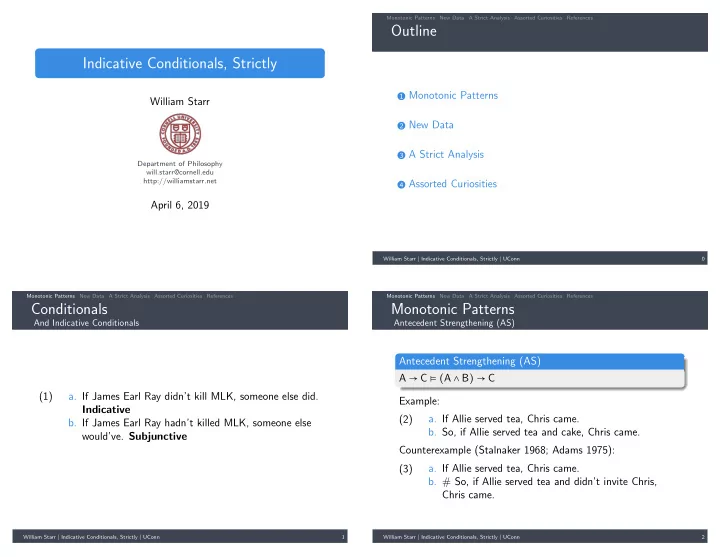
Monotonic Patterns New Data A Strict Analysis Assorted Curiosities References

Outline

1 Monotonic Patterns 2 New Data 3 A Strict Analysis 4 Assorted Curiosities

William Starr ∣ Indicative Conditionals, Strictly ∣ UConn Monotonic Patterns New Data A Strict Analysis Assorted Curiosities References

Conditionals

And Indicative Conditionals

(1)

  • a. If James Earl Ray didn’t kill MLK, someone else did.

Indicative

  • b. If James Earl Ray hadn’t killed MLK, someone else

would’ve. Subjunctive

William Starr ∣ Indicative Conditionals, Strictly ∣ UConn 1 Monotonic Patterns New Data A Strict Analysis Assorted Curiosities References

Monotonic Patterns

Antecedent Strengthening (AS)

Antecedent Strengthening (AS) A → C ⊧ (A ∧ B) → C Example: (2)

  • a. If Allie served tea, Chris came.
  • b. So, if Allie served tea and cake, Chris came.

Counterexample (Stalnaker 1968; Adams 1975): (3)

  • a. If Allie served tea, Chris came.
  • b. # So, if Allie served tea and didn’t invite Chris,

Chris came.

William Starr ∣ Indicative Conditionals, Strictly ∣ UConn 2

slide-2
SLIDE 2

Monotonic Patterns New Data A Strict Analysis Assorted Curiosities References

Monotonic Patterns

Simplification of Disjunctive Antecedents

Simplification of Disjunctive Antecedents (SDA) (A ∨ B) → C ⊧ (A → C) ∧ (B → C) Example: (4)

  • a. If Allie served tea or cake, Chris came.
  • b. So, if Allie served tea, Chris came; and, if Allie

served cake, Chris came. Counterexample (Adams 1975; McKay & van Inwagen 1977): (5)

  • a. If Allie served only tea or only cake, she served only

cake.

  • b. # So, if Allie served only tea, she served only cake.

William Starr ∣ Indicative Conditionals, Strictly ∣ UConn 3 Monotonic Patterns New Data A Strict Analysis Assorted Curiosities References

Monotonic Patterns

Meet the Family

Antecedent Monotonicity If A → C ⊧ D and B ⊧ A, then B → C ⊧ D

  • Conditional antecedents preserve consequence relations.
  • Antecedent Monotonicity follows from Transitivity and the

assumption that if A ⊧ B then ⊧ A → B (Starr 2019:n22) Transitivity A → B,B → C ⊧ A → C

  • Antecedent Monotonicity follows from Contraposition and

‘Consequent Monotonicity’ (Starr 2019:n23) Contraposition A → B ⊧ ¬B → ¬A

William Starr ∣ Indicative Conditionals, Strictly ∣ UConn 4 Monotonic Patterns New Data A Strict Analysis Assorted Curiosities References

What to Say...

About Monotonic Patterns?

  • Why are they sometimes good and sometimes bad?
  • Current accounts begin with an observation about the

felicity of indicative antecedents Indicative Felicity An indicative conditional is only felicitous in contexts where its antecedent is mutually supposed to be possible. (Stalnaker 1975; Adams 1975; Veltman 1986; Gillies 2010) (6)

  • a. Allie definitely did not serve tea.
  • b. # If Allie served tea, Chris came.

William Starr ∣ Indicative Conditionals, Strictly ∣ UConn 5 Monotonic Patterns New Data A Strict Analysis Assorted Curiosities References

Monotonic Patterns

Returning to the Counterexamples in Light of Indicative Felicity

Antecedent Strengthening (AS) A → C ⊧ (A ∧ B) → C Example revisited: (7)

  • a. Maybe Allie served tea and cake. If Allie served tea,

Chris came.

  • b. So, if Allie served tea and cake, Chris came.

Counterexample revisited: (8)

  • a. Maybe Allie served tea and didn’t invite Chris. # If

Allie served tea, Chris came.

  • b. # So, if Allie served tea and didn’t invite Chris,

Chris came.

William Starr ∣ Indicative Conditionals, Strictly ∣ UConn 6

slide-3
SLIDE 3

Monotonic Patterns New Data A Strict Analysis Assorted Curiosities References

Monotonic Patterns

Returning to the Counterexamples in Light of Indicative Felicity

Simplification of Disjunctive Antecedents (SDA) (A ∨ B) → C ⊧ (A → C) ∧ (B → C) Example revisited: (9)

  • a. Maybe Allie served tea, maybe she served cake. But,

if Allie served tea or cake, Chris came.

  • b. So, if Allie served tea, Chris came; and, if Allie

served cake, Chris came. Counterexample revisited: (10)

  • a. Maybe Allie served only tea. #But, if Allie served
  • nly tea or only cake, she served only cake.
  • b. # So, if Allie served only tea, she served only cake.

William Starr ∣ Indicative Conditionals, Strictly ∣ UConn 7 Monotonic Patterns New Data A Strict Analysis Assorted Curiosities References

The Generalization

About Monotonic Patterns

The Generalization Monotonic patterns sound compelling only when Indicative Felicity of conclusion is compatible with the truth (and Indicative Felicity) of the premises. Terminology An argument pattern is said to satisfy Indicative Felicity just in case the premises and conclusion satisfy Indicative Felicity.

William Starr ∣ Indicative Conditionals, Strictly ∣ UConn 8 Monotonic Patterns New Data A Strict Analysis Assorted Curiosities References

Monotonic Patterns

Two Explanations

Variably-Strict Explanation (Stalnaker 1975)

1 ‘Examples’ are semantically invalid but pragmatically

compelling (reasonable inference): any context which is updated with a felicitous and true assertion of the premise, is one where the conclusion is true if felicitous.

2 ‘Counterexamples’ exist because monotonic patterns are

semantically invalid, and do not sound pragmatically compelling because Indicative Felicity is not satisfied.

  • Key Prediction: any time Indicative Felicity is satisfied,

a monotonic pattern will sound compelling.

William Starr ∣ Indicative Conditionals, Strictly ∣ UConn 9 Monotonic Patterns New Data A Strict Analysis Assorted Curiosities References

Monotonic Patterns

Two Explanations

Strict Explanation

1 ‘Examples’ are compelling because monotonic patterns

are semantically valid.

2 ‘Counterexamples’ sound bad because violation of

Indicative Felicity for conclusion leads to:

  • Pragmatical infelicity (Veltman 1986, 1985)
  • Semantic presupposition failure (Gillies 2004, 2009)
  • Equivocation via accommodation (Warmbr¯
  • d 1981)
  • Key Prediction: any time Indicative Felicity is satisfied,

a monotonic pattern will sound compelling.

William Starr ∣ Indicative Conditionals, Strictly ∣ UConn 10

slide-4
SLIDE 4

Monotonic Patterns New Data A Strict Analysis Assorted Curiosities References

Variably-Strict Analyses

Of Conditionals

Basic Variably-Strict Analysis A → B is true in a world w, relative to f , just in case all f (A,w)-worlds are B-worlds.

  • f (A,w) are the A-worlds most similar to w.
  • Context Sensitivity: if w ′ is in context set c,

w ′ ∈ f (A,w). (Stalnaker 1975)

William Starr ∣ Indicative Conditionals, Strictly ∣ UConn 11 Monotonic Patterns New Data A Strict Analysis Assorted Curiosities References

Basic Variably-Strict Analysis

Of Conditionals

William Starr ∣ Indicative Conditionals, Strictly ∣ UConn 12 Monotonic Patterns New Data A Strict Analysis Assorted Curiosities References

Basic Strict Analysis

Of Conditionals

Basic Strict Analysis A → B is true in a world w, relative to a space of accessible worlds R(w), just in case all A-worlds in R(w) are B-worlds.

  • R(w) the information had by relevant agent’s in w.
  • Context Sensitivity: R(w) is the information ‘had’ by the

conversationalists in w.

William Starr ∣ Indicative Conditionals, Strictly ∣ UConn 13 Monotonic Patterns New Data A Strict Analysis Assorted Curiosities References

Basic Strict Analysis

Of Conditionals

William Starr ∣ Indicative Conditionals, Strictly ∣ UConn 14

slide-5
SLIDE 5

Monotonic Patterns New Data A Strict Analysis Assorted Curiosities References

A Consensus?

If There is One...

Variably-Strict vs. Strict Analyses Debate between variably-strict and strict analyses comes to:

1 Compelling monotonic patterns are better explained

  • pragmatically. (Variably-Strict)

2 Compelling monotonic patterns are better explained

  • semantically. (Strict)
  • (Shared) Key Prediction: any time Indicative Felicity is

satisfied, a monotonic pattern will sound compelling.

William Starr ∣ Indicative Conditionals, Strictly ∣ UConn 15 Monotonic Patterns New Data A Strict Analysis Assorted Curiosities References

New Counterexamples

SDA and Epistemic Possibility

(11)

  • a. If the coin came up heads or tails, maybe it came up

heads.

  • b. # If the coin came up tails, maybe it came up heads.

(12)

  • a. Maybe the coin came up tails. But, if the coin came

up heads or tails, maybe it came up heads.

  • b. # If the coin came up tails, maybe it came up heads.
  • Unlike (10), premise is not infelicitous when conjoined

w/conclusion’s presupposition.

  • So (11) is a counterexample to the ‘Key Prediction’ of

both strict and variably-strict analyses.

William Starr ∣ Indicative Conditionals, Strictly ∣ UConn 16 Monotonic Patterns New Data A Strict Analysis Assorted Curiosities References

New Counterexamples

AS and Epistemic Possibility

(13)

  • a. If Allie served tea, maybe Chris came.
  • b. # If Allie served tea and Chris didn’t come, maybe

Chris came. (14)

  • a. Maybe Allie served tea and Chris didn’t come. But,

if Allie served tea, maybe Chris came.

  • b. # If Allie served tea and Chris didn’t come, maybe

Chris came.

  • Unlike (8), premise is not infelicitous when conjoined

w/conclusion’s presupposition.

  • So (13) is a counterexample to the ‘Key Prediction’ of

both strict and variably-strict analyses.

William Starr ∣ Indicative Conditionals, Strictly ∣ UConn 17 Monotonic Patterns New Data A Strict Analysis Assorted Curiosities References

New Counterexamples

AS and Probably

(15)

  • a. If Allie served tea, Chris probably came.
  • b. # If Allie served tea and Chris didn’t come, Chris

probably came. (16)

  • a. Maybe Allie served tea and Chris didn’t come. But,

if Allie served tea, Chris probably came.

  • b. # If Allie served tea and Chris didn’t come, Chris

probably came.

  • Premise is not infelicitous when conjoined w/conclusion’s

presupposition.

  • So (15) is a counterexample to the ‘Key Prediction’ of

both strict and variably-strict analyses.

  • See Lassiter (2018) for related counterexamples to SDA.

William Starr ∣ Indicative Conditionals, Strictly ∣ UConn 18

slide-6
SLIDE 6

Monotonic Patterns New Data A Strict Analysis Assorted Curiosities References

New Counterexamples

Returning to Strict vs. Variably-Strict Debate

  • Parallel counterexamples exist for Trans, Contraposition
  • This style of counterexample exists for all monotonic

patterns

  • While not depending on a violation of Indicative Felicity
  • (Shared) Key Prediction: any time Indicative Felicity is

satisfied, a monotonic pattern will sound compelling.

  • This is false.
  • Where should we look for a better analysis?
  • Other patterns favor a strict analysis:

1 Embedded Monotonic Patterns 2 ‘Preserving Antecedents’ as in Import-Export

William Starr ∣ Indicative Conditionals, Strictly ∣ UConn 19 Monotonic Patterns New Data A Strict Analysis Assorted Curiosities References

Embedded Monotonic Patterns

Background

Limited Antecedent Weakening A → C,B → C ⊧ (A ∨ B) → C

  • Shared validity in strict/variably-strict analyses

Simplification of Disjunctive Antecedents (SDA) (A ∨ B) → C ⊧ (A → C) ∧ (B → C)

  • Only valid on strict analysis

The Disjunctive Equivalence (A ∨ B) → C ⊧ ⊧ (A → C) ∧ (B → C)

  • Only valid on strict analysis

William Starr ∣ Indicative Conditionals, Strictly ∣ UConn 20 Monotonic Patterns New Data A Strict Analysis Assorted Curiosities References

Embedded Monotonic Patterns

The Disjunctive Equivalence

(17)

  • a. If Allie served tea, then if Bill brought honey or Chris

brought sugar, everyone was happy. A → ((B ∨ C) → H)

  • b. If Allie served tea, then if Bill brought honey,

everyone was happy. A → (B → H)

  • Easily predicted by strict analysis via:

1 The Disjunctive Equivalence 2 Substitution of equivalent consequents 3 Consequent weakening

  • Not predicted by pragmatic variably-strict analysis:
  • Conditional in consequent of (17) not asserted

William Starr ∣ Indicative Conditionals, Strictly ∣ UConn 21 Monotonic Patterns New Data A Strict Analysis Assorted Curiosities References

Embedded Monotonic Patterns

More Generally

  • Embedded cases exist for other monotonic patterns
  • E.g. contraposition
  • Old-style counterexamples lurk here too

(18)

  • a. If Chris came then if Allie served only tea or only

cake, she served only cake.

  • b. # If Chris came then if Allie served only tea, she

served only cake.

  • These facts favor strict analyses where Indicative Felicity

is treated as a semantic presuppposition

  • cf. Veltman (1986); Gillies (2009); Stalnaker (1975)

William Starr ∣ Indicative Conditionals, Strictly ∣ UConn 22

slide-7
SLIDE 7

Monotonic Patterns New Data A Strict Analysis Assorted Curiosities References

Preserving Antecedents

Antecedent Preservation

Antecedent Preservation (AP) ⊧ A → (B → A)

  • Valid on strict analysis; not variably-strict analysis.

Example: (19) If Allie served tea, then if Chris came Allie served tea. Familiar counterexample: (20) # If the coin came up heads, then if the coin came up tails it came up heads.

  • Both explained on strict analysis w/semantic approach to

Indicative Felicity

  • No explanation of (19) on variably-strict analysis

William Starr ∣ Indicative Conditionals, Strictly ∣ UConn 23 Monotonic Patterns New Data A Strict Analysis Assorted Curiosities References

Preserving Antecedents

Antecedent Preservation

Antecedent Preservation (AP) ⊧ A → (B → A)

  • Valid on strict analysis; not variably-strict analysis.

New counterexample: (21) # If the coin maybe came up heads, then if the coin came up tails, the coin maybe came up heads. ◇H → (¬H → ◇H)

  • So there’s still work to be done for strict analysis

William Starr ∣ Indicative Conditionals, Strictly ∣ UConn 24 Monotonic Patterns New Data A Strict Analysis Assorted Curiosities References

Preserving Antecedents

Import-Export

Import-Export A → (B → C) ⊧ ⊧ (A ∧ B) → C)

  • Valid on strict analysis; not variably-strict analysis.

Example: (22)

  • a. If Allie bet, then if the coin came up heads, she won.
  • b. If Allie bet and the coin came up heads, she won.
  • No explanation of (22) on variably-strict analysis

William Starr ∣ Indicative Conditionals, Strictly ∣ UConn 25 Monotonic Patterns New Data A Strict Analysis Assorted Curiosities References

Basic Dynamic Semantics

Just Information

Classical Picture

  • Sentences (relative to contexts) refer to regions of logical

space W

  • Interpreters use utterances of them to shift to region of

logical space within region referred to Dynamic Picture (Veltman 1996; Heim 1982) Assign each φ a function [φ] encoding how it changes s ⊆ W : s[φ] = s′ (I.e.: [φ](s) = s′)

  • Meaning as information update potential.
  • s as mutual information.

William Starr ∣ Indicative Conditionals, Strictly ∣ UConn 26

slide-8
SLIDE 8

Monotonic Patterns New Data A Strict Analysis Assorted Curiosities References

The Dynamic Analysis

Basics

Dynamic Informational Semantics (Veltman 1996) Where s ⊆ W :

1 s[A] = {w ∈ s ∣ w(A) = 1} 2 s[¬φ] = s − s[φ] 3 s[φ ∧ ψ] = (s[φ])[ψ] 4 s[φ ∨ ψ] = s[φ] ∪ s[ψ]

Support (Basic Logical Concept) s ⊫ φ ⇐ ⇒ s[φ] = s

  • s supports φ just in case any information φ can provide is

already part of s.

William Starr ∣ Indicative Conditionals, Strictly ∣ UConn 27 Monotonic Patterns New Data A Strict Analysis Assorted Curiosities References

The Dynamic Analysis

Conditionals, Epistemic Modals

Dynamic Strict Conditional v1 (Gillies 2003, 2009) s[φ → ψ] = ⎧ ⎪ ⎪ ⎨ ⎪ ⎪ ⎩ s if s[φ] ⊧ ψ ∅

  • therwise
  • Tests that all φ-worlds in s are ψ-worlds.

Epistemic Modals (Veltman 1996)

1 s[◇φ] = {w ∈ s ∣ s[φ] ≠ ∅} 2 s[φ] = {w ∈ s ∣ s ⊧ φ}

William Starr ∣ Indicative Conditionals, Strictly ∣ UConn 28 Monotonic Patterns New Data A Strict Analysis Assorted Curiosities References

The Dynamic Analysis

Conditionals, Epistemic Modals

Dynamic Strict Conditional w/Presupposition s[φ → ψ] = ⎧ ⎪ ⎪ ⎪ ⎪ ⎪ ⎨ ⎪ ⎪ ⎪ ⎪ ⎪ ⎩ s if ∃w ∈ s∶w ⊧ φ & s[φ] ⊧ ψ ∅ if ∃w ∈ s∶w ⊧ φ & s[φ] ⊭ ψ Undefined if ∄w ∈ s∶w ⊧ φ

  • Presupposes that φ is true in some w ∈ s.
  • Tests that all φ-worlds in s are ψ-worlds.
  • Semantic presupposition for old-style counterexamples,

embedded variations

  • This presupposition: prevents (◇A ∧ ¬A) → (◇A ∧ ¬A)

from being a counterexample to numerous validities

William Starr ∣ Indicative Conditionals, Strictly ∣ UConn 29 Monotonic Patterns New Data A Strict Analysis Assorted Curiosities References

The Dynamic Analysis

Dynamic Strawsonian Consequence

Strawsonian Dynamic Consequence φ1,...,φn ⊧ ψ ⇔ ∀s∶if s[φ1]⋯[φn][ψ] is defined, then s[φ1]⋯[φn] ⊧ ψ

  • s’s w/failed presuppositions don’t count toward validity

(Strawson 1952:173-9, von Fintel 1999a, Beaver 2001)

  • Non-Strawsonian Definition: no conditional validities!

William Starr ∣ Indicative Conditionals, Strictly ∣ UConn 30

slide-9
SLIDE 9

Monotonic Patterns New Data A Strict Analysis Assorted Curiosities References

The Dynamic Analysis

And Old Counterexamples: AS

(3)

  • a. If Allie served tea, Chris came.
  • b. # So, if Allie served tea and didn’t invite Chris,

Chris came.

  • s0 = {wAIC,waIC,waic};
  • Contextually excluded: wAic,wAIc,wAiC,waiC
  • s0[A → C] = s0, since s0[A] ⊧ C.
  • But s0[A → C] is undefined.
  • So states like s0 don’t count for/against consequence.
  • Beauty of Strawsonian Dynamic Consequence at work!

William Starr ∣ Indicative Conditionals, Strictly ∣ UConn 31 Monotonic Patterns New Data A Strict Analysis Assorted Curiosities References

The Dynamic Analysis

And the New Counterexamples: AS

(13)

  • a. If Allie served tea, maybe Chris came.

A → ◇C

  • b. # If Allie served tea and Chris didn’t come, maybe

Chris came. (A ∧ ¬C) → ◇C

  • s0 = {wAC,wAc,waC,wac}
  • s0[A → ◇C] = s0, since s0[A] ⊧ ◇C
  • s0[(A ∧ ¬C) → ◇C] = ∅, since s0[A ∧ ¬C] ⊭ ◇C
  • So s0[A → ◇C] ⊭ (A ∧ ¬C) → ◇C
  • Hence: A → ◇C ⊭ (A ∧ ¬C) → ◇C
  • Why? Because of how ◇ works.

William Starr ∣ Indicative Conditionals, Strictly ∣ UConn 32 Monotonic Patterns New Data A Strict Analysis Assorted Curiosities References

The Dynamic Analysis

How Does ◇ Work?

Persistence (Veltman 1985; Groenendijk et al. 1996) φ is persistent just in case s′ ⊧ φ if s ⊧ φ and s′ ⊆ s.

  • Support for φ persists after more information comes in.
  • ◇A is not persistent.
  • Moving from s to s′ can eliminate A-worlds.

Fact (Starr) If the main consequents are persistent, then antecedent preservation and all monotonic patterns other than contraposition are valid. (Given semantics/logic above.)

William Starr ∣ Indicative Conditionals, Strictly ∣ UConn 33 Monotonic Patterns New Data A Strict Analysis Assorted Curiosities References

The Dynamic Analysis

How Do and → Work?

Miserly (Veltman 1985) φ is miserly just in case s′ ⊭ φ if s ⊭ φ and s′ ⊆ s.

  • s continues to withhold support of φ even after s is

enriched with more information.

  • B and A → B are not miserly.
  • Moving from s to s′ can eliminate ¬B-worlds.

Fact (Starr) If the main consequents are miserly, then contraposition and modus tollens are valid. (Given semantics/logic above.)

William Starr ∣ Indicative Conditionals, Strictly ∣ UConn 34

slide-10
SLIDE 10

Monotonic Patterns New Data A Strict Analysis Assorted Curiosities References

The Dynamic Analysis

Overall Logic

Unrestricted Validities

1 Identity: ⊧ φ → φ 2 Modus Ponens: φ → ψ,φ ⊧ ψ 3 Deduction Equivalence: φ ⊧ ψ ⇐

⇒ ⊧ φ → ψ

4 Import-Export: φ1 → (φ2 → ψ)

⊧ ⊧ (φ1 ∧ φ2) → ψ Persistent Validities For persistent ψ:

1 Antecedent Strengthening: φ1 → ψ ⊧ (φ1 ∧ φ2) → ψ 2 SDA: (φ1 ∨ φ2) → ψ ⊧ (φ1 → ψ) ∧ (φ2 → ψ) 3 Transitivity: φ1 → φ2,φ2 → ψ ⊧ φ1 → ψ 4 Antecedent Preservation: ⊧ ψ → (φ → ψ)

William Starr ∣ Indicative Conditionals, Strictly ∣ UConn 35 Monotonic Patterns New Data A Strict Analysis Assorted Curiosities References

The Dynamic Analysis

Overall Logic

Miserly Validities For miserly ψ:

1 Contraposition: φ → ψ ⊧ ¬ψ → ¬φ 2 Modus Tollens: φ → ψ,¬ψ ⊧ ¬φ

  • See Veltman (1986) and Yalcin (2012) for MT

counterexamples w/non-miserly ψ Conditional/Modal Interactions (Gillies 2010)

1 φ → ◇ψ

⊧ ⊧ ◇(φ ∧ ψ)

2 (φ → ψ)

⊧ ⊧ φ → ψ ⊧ ⊧ φ → ψ

William Starr ∣ Indicative Conditionals, Strictly ∣ UConn 36 Monotonic Patterns New Data A Strict Analysis Assorted Curiosities References

Dynamic Analysis

Review

1 Informational support as basic logical concept 2 Dynamic Strict Conditional, Epistemic Modals + Presupp. 3 Strawsonian Dynamic Logic

  • Modus Ponens, Identity, Import-Export, Deduction

Equivalence valid

4 Addresses old-style counterexamples to monotonic

patterns and AP

5 New counterexamples explained:

  • AS, SDA, Trans, AP only valid when main consequent is

persistent

  • CP, MT only valid when main consequent is miserly

6 Captures embedded monotonic patterns, AP

William Starr ∣ Indicative Conditionals, Strictly ∣ UConn 37 Monotonic Patterns New Data A Strict Analysis Assorted Curiosities References

Assorted Curiosities

Truth, ‘Probably’ and Subjunctives

{w},△,⊲

William Starr ∣ Indicative Conditionals, Strictly ∣ UConn 38

slide-11
SLIDE 11

Monotonic Patterns New Data A Strict Analysis Assorted Curiosities References

What Happened to Truth-Conditions?

Two Questions

Truth-Conditions Just as Good? (Gillies 2009) φ → ψC = {w ∣ C(w) ∩ φC ⊆ ψCφ}

  • All the contextually-live φ-worlds are ψ-worlds
  • C(w) is the set of live worlds with respect to w
  • Cφ(w) = C(w) ∩ φC, for all w
  • Modus ponens requires assuming that for all w,

w ∈ C(w).

  • This assumption is inconsistent with interpreting C(w) as

agents’ information.

  • That interpretation is essential for basic applications.

William Starr ∣ Indicative Conditionals, Strictly ∣ UConn 39 Monotonic Patterns New Data A Strict Analysis Assorted Curiosities References

What Happened to Truth-Conditions?

A Basic Application

  • Chris just had a brief glimpse at two shapes x and y.
  • She thinks there was both a triangle and a square.
  • Given Chris’ information, is it correct for her to

assert/believe: (23) If x is a triangle, y is a square.

  • My judgment: Correct.
  • As it turns out, x and y are both squares.
  • Given Chris’ information and the actual state of things, is

it correct for her to assert/believe (23)?

  • My judgment: Probably, but some ambivalence.

William Starr ∣ Indicative Conditionals, Strictly ∣ UConn 40 Monotonic Patterns New Data A Strict Analysis Assorted Curiosities References

What Happened to Truth-Conditions?

The Point

Key Points about (23)

1 We do have simple judgments about whether some

information supports a conditional belief/assertion.

2 Those judgments can occur even if that information is

false in world of evaluation.

3 When we learn what the world of evaluation is, our

judgments can change.

  • Point 1 suggests judgments reflect contextual information

alone — no ‘world of evaluation’.

  • Judgments are not a product of both w and C(w)
  • Point 2 incompatible w/requiring w ∈ C(w) for all w.
  • Can point 3 be explained on the dynamic approach?

William Starr ∣ Indicative Conditionals, Strictly ∣ UConn 41 Monotonic Patterns New Data A Strict Analysis Assorted Curiosities References

Truth from a Dynamic Perspective

Truth and Perfect Information

d’Alembert (1751) on Truth “The universe... would only be one fact and one great truth for whoever knew how to embrace it from a single point of view.” (d’Alembert 1995:29) Truth, Propositions (Starr 2010) w ⊧ φ ⇐ ⇒ {w}[φ] = {w} φ = {w ∣ w ⊧ φ} Classical Consequence (Starr 2010) φ1,...,φn ⊧Cl ψ ⇐ ⇒ ∀w ∶ {w}[φ1]⋯[φn] ⊧ ψ

  • Classical logic is the logic of perfect information

William Starr ∣ Indicative Conditionals, Strictly ∣ UConn 42

slide-12
SLIDE 12

Monotonic Patterns New Data A Strict Analysis Assorted Curiosities References

Truth from a Dynamic Perspective

Truth is Just One Perspective, Man

  • Sentences can be evaluated from a range of uncertain

(informational) perspectives.

  • That’s a matter of the information supporting the

sentence.

  • Can also be evaluated from a range of certain (worldly)

perspectives.

  • That’s a matter of a world making the sentence true.
  • As in (23) after evaluation world is revealed.
  • From semantics and truth definition it follows that:

Truth-Conditions for Indicative Conditionals

1 φ → ψ is true in w if φ ∧ ψ is true in w. 2 φ → ψ is false in w if φ ∧ ¬ψ is true in w. 3 Otherwise, φ → ψ’s truth-value is undefined.

William Starr ∣ Indicative Conditionals, Strictly ∣ UConn 43 Monotonic Patterns New Data A Strict Analysis Assorted Curiosities References

Trivalent Truth-Conditions

Why They Matter

  • Interaction of quantificational operators and conditionals

entails choice:

1 if-clauses are just restrictors (Lewis 1975; Kratzer 1986) 2 Conditionals have trivalent truth-conditions

(Jeffrey 1963; Belnap 1970; McDermott 1996; Huitink 2008)

  • Option 2 faces serious logical difficulties. Either:
  • ¬(φ → ψ) ⊧ φ is valid (Huitink 2008; Jeffrey 1963)
  • Modus ponens is invalid (McDermott 1996:31)
  • The account here has no such logical difficulties — logic

is not beholden to truth-conditions.

  • But it can appeal to those truth-conditions in defining

quantificational operators!

William Starr ∣ Indicative Conditionals, Strictly ∣ UConn 44 Monotonic Patterns New Data A Strict Analysis Assorted Curiosities References

Semantics for ‘Probably’

Adapting Yalcin (2012)

sPr[△φ] = ⎧ ⎪ ⎪ ⎨ ⎪ ⎪ ⎩ sPr if Pr({w ∈ s∶w ⊧ φ} ∣ {w ∈ s∶w ⊧ φ or w ⊭ φ}) > 0.5 ∅Pr

  • therwise
  • Update clause for atomics must also change to

conditionalize Pr ; disjunction tricky. Interesting Consequences

1 φ → △ψ

⊧ ⊧ △(φ → ψ)

2 sPr ⊧ △(A → B) ⇐

⇒ Pr(B ∣ A) > 0.5

3 △φ is neither persistent nor miserly.

See also de Finetti (1936), Milne (1997), Rothschild (2014).

William Starr ∣ Indicative Conditionals, Strictly ∣ UConn 45 Monotonic Patterns New Data A Strict Analysis Assorted Curiosities References

What about Subjunctives?

Antecedent Preservation Failure?

Antecedent Preservation (AP) ⊧ A → (B → A) New indicative counterexample: (21) # If the coin maybe came up heads, then (even) if the coin came up tails, the coin maybe (also) came up heads. ◇H → (¬H → ◇H)

  • Consider its subjunctive counterpart, in context where we

don’t know outcome of past coinflip. (24) If the coin could have come up heads, then (even) if the coin came up tails, the coin could (also) have come up

  • heads. ◇⊲ H → (⊲ ¬H → ◇⊲ H) (Starr 2014)

William Starr ∣ Indicative Conditionals, Strictly ∣ UConn 46

slide-13
SLIDE 13

Monotonic Patterns New Data A Strict Analysis Assorted Curiosities References

What about Subjunctives?

Counterfactual Expansion

Counterfactual Expansion ⊲ (Starr 2014) sf [⊲ A] = {w ′ ∣ ∃w ∈ s ∶ w ′ ∈ f (w,A)}f

  • w ′ is among the A-worlds closest to some w ∈ s
  • w ′ may be outside s (cf. Iatridou 2000; von Fintel 1999b)
  • sf [◇⊲ H → (⊲ ¬H → ◇⊲ H)] amounts to testing that:
  • sf [◇⊲ H][⊲ ¬H] ⊧ ◇⊲ H
  • sf [◇⊲ H] tests that sf [⊲ H] ≠ ∅.
  • If passed, next step is sf [¬ ⊲ H].
  • This expands to include most-similar ¬H-worlds.
  • ◇⊲ H can persist after updating with ¬H
  • So new counterexamples may not exist for subjunctives...

William Starr ∣ Indicative Conditionals, Strictly ∣ UConn 47 Monotonic Patterns New Data A Strict Analysis Assorted Curiosities References

What about Subjunctives?

And New Counterexamples?

Allie didn’t host, or serve anything. (25)

  • a. If Allie had served only tea or only cakes, she could

have served only tea.

  • b. So, if Allie had served only cakes, she could (also)

have served only tea.

  • At least much better than indicative counterparts!

William Starr ∣ Indicative Conditionals, Strictly ∣ UConn 48 Monotonic Patterns New Data A Strict Analysis Assorted Curiosities References

Conclusion

Indicative Conditionals, Strictly

Highlights

1 New counterexamples to monotonic patterns

  • That satisfy Indicative Felicity!

2 Problem for variably-strict and strict analyses alike. 3 Presuppositional dynamic strict analysis provides

compelling diagnosis

  • Differs from Gillies (2009) and Veltman (1986) in

semantic treatment of Indicative Felicity and/or use of Strawsonian dynamic consequence.

4 Also provides promising approach to:

  • Trivalent truth-conditions for indicatives
  • Modal/quantifier/conditional interaction
  • Unified analysis of indicatives and subjunctives

William Starr ∣ Indicative Conditionals, Strictly ∣ UConn 49 Monotonic Patterns New Data A Strict Analysis Assorted Curiosities References

Thank you!

(Slides available at http://williamstarr.net/research)

William Starr ∣ Indicative Conditionals, Strictly ∣ UConn 50

slide-14
SLIDE 14

Monotonic Patterns New Data A Strict Analysis Assorted Curiosities References

References I

  • E. W. Adams (1975). The Logic of Conditionals. D. Reidel, Dordrecht.
  • D. Beaver (2001). Presupposition and Assertion in Dynamic Semantics. CSLI

Publications, Stanford, California.

  • N. Belnap (1970). ‘Conditional Assertion and Restricted Quantification’. Nˆ
  • us

4(1):1–12.

  • J. L. R. d’Alembert (1995). Preliminary Discourse to the Encyclopedia of Diderot.

University of Chicago Press, Chicago. Originally published in 1751.

  • B. de Finetti (1936). ‘La Logique de la Probabilit´

e’. Actes du Congr´ es International de Philosophie Scientifique 4:31–9.

  • A. S. Gillies (2003). ‘Epistemic Conditionals and Conditional Epistemics’. Unpublished

manuscript, Harvard University.

  • A. S. Gillies (2004). ‘Epistemic Conditionals and Conditional Epistemics’. Noˆ

us 38(4):585–616.

  • A. S. Gillies (2009). ‘On Truth-Conditions for “If” (but Not Quite Only “If”)’.

Philosophical Review 118(3):325–349.

  • A. S. Gillies (2010). ‘Iffiness’. Semantics and Pragmatics 3(4):1–42.

William Starr ∣ Indicative Conditionals, Strictly ∣ UConn 51 Monotonic Patterns New Data A Strict Analysis Assorted Curiosities References

References II

  • J. Groenendijk, et al. (1996). ‘Coreference and Modality’. In S. Lappin (ed.), The

Handbook of Contemporary Semantic Theory, pp. 179–213. Blackwell Publishers, Oxford.

  • I. R. Heim (1982). The Semantics of Definite and Indefinite Noun Phrases. Ph.D.

thesis, Linguistics Department, University of Massachusetts, Amherst, Massachusetts.

  • J. Huitink (2008). Modals, Conditionals and Compositionality. Ph.D. thesis, Radboud

University Nijmegen, Nijmegen.

  • S. Iatridou (2000). ‘The Grammatical Ingredients of Counterfactuality’. Linguistic

Inquiry 31(2):231–270.

  • R. C. Jeffrey (1963). ‘On Indeterminate Conditionals’. Philosophical Studies

14(3):37–43.

  • S. Kaufmann (2005). ‘Conditional Predictions’. Linguistics and Philosophy

28(2):181–231.

  • A. Kratzer (1986). ‘Conditionals’. In Proceedings from the 22nd Regional Meeting of

the Chicago Linguistic Society, pp. 1–15, Chicago. University of Chicago.

  • D. Lassiter (2018). ‘Complex Sentential Operators Refute Unrestricted Simplification
  • f Disjunctive Antecedents’. Semantics & Pragmatics 11(9):Early Access.

William Starr ∣ Indicative Conditionals, Strictly ∣ UConn 52 Monotonic Patterns New Data A Strict Analysis Assorted Curiosities References

References III

  • D. K. Lewis (1975). ‘Adverbs of Quantification’. In E. L. Keenan (ed.), Formal

Semantics of Natural Language, pp. 3–15. Cambridge University Press, Cambridge, England.

  • M. McDermott (1996). ‘On the Truth Conditions of Certain “If”-Sentences’. The

Philosophical Review 105(1):1–37.

  • T. J. McKay & P. van Inwagen (1977). ‘Counterfactuals with Disjunctive

Antecedents’. Philosophical Studies 31:353–356.

  • P. Milne (1997). ‘Bruno de Finetti and the Logic of Conditional Events’. The British

Journal for the Philosophy of Science 48(2):195–232.

  • D. Rothschild (2014). ‘Capturing the relationship between conditionals and

conditional probability with a trivalent semantics’. Journal of Applied Non-Classical Logics 24(1-2):144–152.

  • R. Stalnaker (1968). ‘A Theory of Conditionals’. In N. Rescher (ed.), Studies in

Logical Theory, pp. 98–112. Basil Blackwell, Oxford.

  • R. Stalnaker (1975). ‘Indicative Conditionals’. Philosophia 5:269–286. Page references

to reprint in Stalnaker (1999).

  • R. C. Stalnaker (1999). Context and Content: Essays on Intentionality in Speech and
  • Thought. Oxford University Press, Oxford.

William Starr ∣ Indicative Conditionals, Strictly ∣ UConn 53 Monotonic Patterns New Data A Strict Analysis Assorted Curiosities References

References IV

  • W. B. Starr (2010). Conditionals, Meaning and Mood. Ph.D. thesis, Rutgers

University, New Brunswick, NJ.

  • W. B. Starr (2014). ‘A Uniform Theory of Conditionals’. Journal of Philosophical

Logic 43(6):1019–1064.

  • W. B. Starr (2019). ‘Counterfactuals’. In E. N. Zalta (ed.), Stanford Encylcopedia of
  • Philosophy. Metaphysics Research Lab, Stanford University, spring 2019 edn.
  • P. F. Strawson (1952). Introduction to Logical Theory. Methuen, London.
  • F. Veltman (1985). Logics for Conditionals. Ph.D. dissertation, University of

Amsterdam, Amsterdam.

  • F. Veltman (1986). ‘Data Semantics and the Pragmatics of Indicative Conditionals’.

In E. C. Traugott, A. ter Meulen, J. S. Reilly, & C. A. Ferguson (eds.), On

  • Conditionals. Cambridge University Press, Cambridge, England.
  • F. Veltman (1996). ‘Defaults in Update Semantics’. Journal of Philosophical Logic

25(3):221–261.

  • K. von Fintel (1999a). ‘NPI Licensing, Strawson Entailment Context Dependency’.

Journal of Semantics 16(2):97–148.

  • K. von Fintel (1999b). ‘The Presupposition of Subjunctive Conditionals’. In
  • U. Sauerland & O. Percus (eds.), The Interpretive Tract, vol. MIT Working

Papers in Linguistics 25, pp. 29–44. MITWPL, Cambridge, MA.

William Starr ∣ Indicative Conditionals, Strictly ∣ UConn 54
slide-15
SLIDE 15

Monotonic Patterns New Data A Strict Analysis Assorted Curiosities References

References V

  • K. Warmbr¯
  • d (1981). ‘An Indexical Theory of Conditionals’. Dialogue, Canadian

Philosophical Review 20(4):644–664.

  • S. Yalcin (2012). ‘A Counterexample to Modus Tollens’. Journal of Philosophical

Logic 41(6):1001–1024.

William Starr ∣ Indicative Conditionals, Strictly ∣ UConn 55 Monotonic Patterns New Data A Strict Analysis Assorted Curiosities References

Import-Export

Kaufmann (2005:213) Counterexample

Import-Export A → (B → C) ⊧ ⊧ (A ∧ B) → C) We have a very wet match that is unlikely to light if struck, but will definitely light if thrown in the campfire. (26)

  • a. If the match lights, it will light if you strike it.
  • b. If you strike the match and it lights, it will light.
  • (26a) seems false, while (26b) seems logically true.

William Starr ∣ Indicative Conditionals, Strictly ∣ UConn 56 Monotonic Patterns New Data A Strict Analysis Assorted Curiosities References

Import-Export

Kaufmann (2005:213) Counterexample

Import-Export A → (B → C) ⊧ ⊧ (A ∧ B) → C) We had a very wet match that was unlikely to light if struck, but would definitely have light if thrown in the campfire. We don’t remember what happened to it. (27)

  • a. If the match lit, then if it was struck, it lit.
  • b. If the match was struck and it lit, then it lit.
  • Much less clear that (27a) is false.
  • Tentative conclusion: original counterexample is due to

future tense/discourse relations/word-order.

William Starr ∣ Indicative Conditionals, Strictly ∣ UConn 57