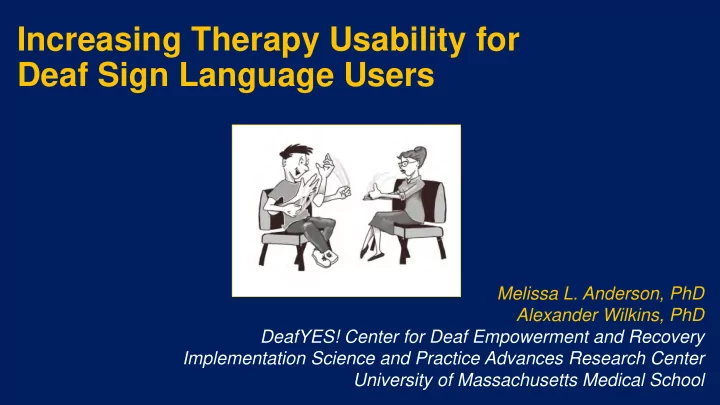
SLIDE 1 Increasing Therapy Usability for Deaf Sign Language Users
Melissa L. Anderson, PhD Alexander Wilkins, PhD DeafYES! Center for Deaf Empowerment and Recovery Implementation Science and Practice Advances Research Center University of Massachusetts Medical School
SLIDE 2 Webinar Housekeeping Items
- The webinar is being recorded and will be available soon for viewing on iSPARC’s website.
- If you’re calling in over the phone, remember to enter your unique audio pin.
- Captioning services are available. Please check the chat box for the link.
- If you’re experiencing audio problems, please check your settings in the GoToWebinar “Audio”
tab.
- If you are having any technical difficulties, please email the organizer at
deirdre.logan@umassmed.edu or use the “Questions” tab.
- We will have a Q&A session after the presentation. If you have questions for the Q&A session,
please type them into the “Questions” tab as you think of them.
SLIDE 3
Agenda
1. Who is the clinical population? 2. What are common barriers to treatment? 3. Where is the current state of the field? 4. How can we overcome these barriers?
SLIDE 4
Agenda
1. Who is the clinical population? 2. What are common barriers to treatment? 3. Where is the current state of the field? 4. How can we overcome these barriers?
SLIDE 5 U.S. Deaf Community
who communicate using American Sign Language (ASL)
embracing Deafhood versus medical view of curing/fixing deafness
SLIDE 6 U.S. Deaf Community
- History of oppression within majority hearing
world, especially around freedom to use ASL
SLIDE 7 Behavioral Health Disparities
- Increased rates of mental health conditions and
substance use disorder. Examples:
- Mood and anxiety disorders = 2 - 2.5x the
general population
- Trauma exposure = 2x the general population
- Problem drinking = 3x the general population
SLIDE 8
Agenda
1. Who is the clinical population? 2. What are common barriers to treatment? 3. Where is the current state of the field? 4. How can we overcome these barriers?
SLIDE 9 Language Barriers
- Deaf clients’ primary language = ASL
- Limited number of ASL-fluent providers
- Limited access to, willingness to provide, or funds
to support certified ASL interpreters
- English (written) is acquired as a 2nd language
SLIDE 10 Language Barriers
- Many Deaf individuals have also been impacted by
early language deprivation:
- 90 – 95% of Deaf children born into hearing families
- If family does not learn ASL, exposure to a fully
accessible language may not occur until school age
- r later (depending on type of school placement)
- Can result in an array of language, cognitive, and
socioemotional delays
SLIDE 11 Language Barriers
- What is Language Deprivation? video by The Nyle
DiMarco Foundation available here: https://youtu.be/cUTymzn5FEc
SLIDE 12 Health Literacy
- Many Deaf clients also present with fund of
information deficits and low health literacy:
- Health-related vocabulary among Deaf ASL users
parallels non-English-speaking U.S. immigrants
- “Many adults deaf since birth or early childhood do
not know their own family medical history, having never overheard their hearing parents discussing this with their doctor” (Barnett et al., 2011)
SLIDE 13 Cultural Considerations
- Most available therapists are hearing and,
therefore, represent the majority oppressor group
- If this history of oppression is not addressed in the
therapy process, can lead to:
- Increased mistrust and fear
- Reduced help-seeking behavior
- Reduced treatment retention
- Reduced treatment efficacy
SLIDE 14
Agenda
1. Who is the clinical population? 2. What are common barriers to treatment? 3. Where is the current state of the field? 4. How can we overcome these barriers?
SLIDE 15 Evidence-Based Therapies
- Approaches that have been formally
researched and found to lead to positive
- utcome in a particular population
- Current shift toward using EBTs across
the behavioral health system (e.g., increased insurance reimbursements, state contract mandates)
SLIDE 16 Evidence-Based Therapies
- ACT
- CBT
- DBT
- IMR
- MI/MET
- PE
- TF-CBT
- CPT
- EMDR
- More ABCs…
SLIDE 17
Evidence-Based Therapies
Most EBTs combine traditional talk therapy with client workbooks or handouts.
SLIDE 18 Evidence-Based Therapies
Client materials often include:
- Sophisticated strategies for tracking
mood, behavior, and thoughts
- Psychology jargon
- Assumptions based on hearing people’s
experience and social norms
SLIDE 19
Evidence-Based Therapies
Currently-available EBTs fail to meet Deaf clients’ unique linguistic and cultural needs.
SLIDE 20
Pop Quiz!
How many evidence-based therapies have been developed for and evaluated with Deaf individuals?
SLIDE 21
Agenda
1. Who is the clinical population? 2. What are common barriers to treatment? 3. Where is the current state of the field? 4. How can we overcome these barriers?
SLIDE 22 Adapting EBTs
So what can we do to improve EBTs?
- Plain text revisions
- Translations into ASL
- Include Deaf culture, values, and norms
- Acknowledge history of oppression
SLIDE 23 Deaf-Friendly Therapy
Principle #1: Adapt for Language
- Match communication abilities of
client
- Simplify or avoid English-based
materials
- Use visual, pictorial, and video aids
SLIDE 24
SLIDE 25 Deaf-Friendly Therapy
Principle #2: Address FOI Deficits
- Assess for knowledge gaps
- Provide psychoeducation
- Provide access to
additional resources
SLIDE 26
SLIDE 27 Deaf-Friendly Therapy
Principle #3: Leverage Storytelling
- Use stories and narratives
- Use visual metaphors
SLIDE 28
SLIDE 29 Deaf-Friendly Therapy
Principle #4: Use Examples
- Teach abstract concepts by providing
concrete examples (e.g., “abuse”)
- Pull specific examples from client’s life
(e.g., “coping skills”)
SLIDE 30
SLIDE 31 Deaf-Friendly Therapy
Principle #5: Use Active Strategies
- Practice skills together
- Play educational games
- Role-play social situations
SLIDE 32
Integrating the Split Self
Watch the Integrating the Split Self video from Signs of Safety available on iSPARC’s website.
SLIDE 33 Deaf-Friendly Therapy
Principle #6: Leverage Technology
- Apps:
- Mood trackers
- Art/expression
- ASL Videos
SLIDE 34 Deaf-Friendly Therapy
Principle #7: Use Peer-to-Peer Approaches
accountability
- Peer specialists/coaches
- Support groups
- Peer recovery stories
SLIDE 35
Signs of Safety
SLIDE 36 Review: 7 Principles
- 1. Adapt for Language
- 2. Address Fund of Information Deficits
- 3. Leverage Storytelling
- 4. Use Examples
- 5. Use Active Strategies
- 6. Leverage Technology
- 7. Use Peer-to-Peer Approaches
SLIDE 37 Acknowledgements
Research described in this presentation was supported by the National Institute On Alcohol Abuse and Alcoholism (NIAAA) of the National Institutes of Health (NIH) under Award Number
- R34AA026929. The content is solely the
responsibility of the authors and does not necessarily represent the official views of the National Institutes of Health (NIH).
SLIDE 38
THANK YOU!
SLIDE 39