SLIDE 1
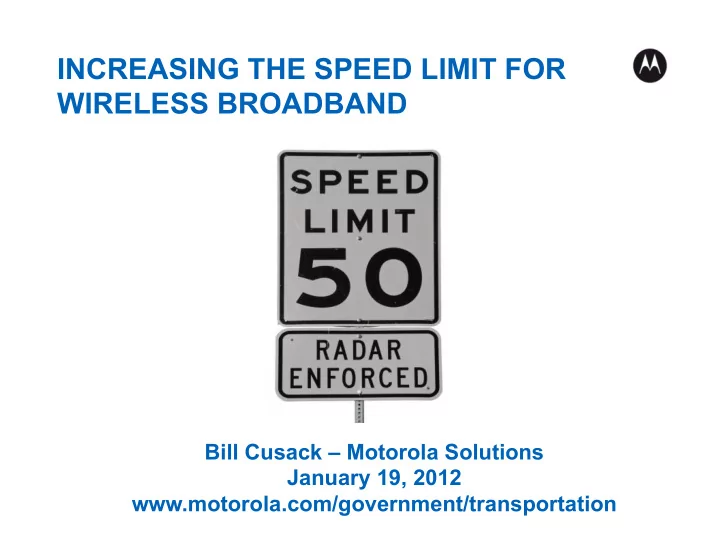
INCREASING THE SPEED LIMIT FOR WIRELESS BROADBAND
Bill Cusack – Motorola Solutions January 19, 2012 www.motorola.com/government/transportation
SLIDE 2 PAGE 2
LEADER IN ALL MARKETS WE SERVE
- PUBLIC SAFETY COMMUNICATIONS
- ENTERPRISE MOBILE COMPUTING
- COMMERCIAL TWO-WAY RADIOS
- ADVANCED DATA CAPTURE
- PUBLIC SAFETY LTE
MOTOROLA SOLUTIONS
BENEFITS
- CLARITY OF PURPOSE
- SOLUTIONS VS PRODUCTS
- FOCUS ON CUSTOMER NEEDS
- UNLOCK SHAREHOLDER VALUE
- INCREASED STRATEGIC FLEXIBILITY
- MANAGEMENT & OPERATIONAL FOCUS
SLIDE 3 3
6 ¡
BUILDING ON A RICH 80-YEAR HISTORY OF FIRSTS
First practical, affordable automobile radio by Galvin Mftg First police two-way radio First FM portable two-way radio First words from the moon replayed by Motorola Transponder First wireless data system First portable cellular phone – DynaTAC First 700MHz public safety wideband high speed data field trial First IP based two-way wide area system First ISSI multi- vendor demo (interoperability) First rugged Enterrprise Digital Assistant First handheld laser scanner First commercial spread spectrum WLAN First wireless switch First two- dimensional barcode scanner First trunked radio system Invented Six Sigma Quality process First VoIP WLAN phone Industry-leading subscriber designs: APX, TETRA ATEX, Covert First public safety private broadband LTE system
1930 1939 1943 1969 1970 1978 1983 1991 1998 2002 2007 2009 1980 1989 2001 1986 2000 2011
SLIDE 4 4
TO BE THE LEADING GLOBAL PROVIDER OF MISSION-CRITICAL COMMUNICATIONS FOR GOVERNMENT AND ENTERPRISE CUSTOMERS
GOVERNMENT ENTERPRISE
Replace with Asia retail
MOTOROLA SOLUTIONS' VISION
SLIDE 5 HEALTHCARE & EDUCATION ENERGY & UTILITIES RETAIL & HOSPITALITY TRANSPORTATION & LOGISTICS MANUFACTURING & FIELD MOBILITY GOVERNMENT
PAGE 5
DIVERSE CUSTOMER BASE
TRANSPORTATION & LOGISTICS MANUFACTURING & FIELD MOBILITY GOVERNMENT
SUPPORTED BY ~1,700 DIRECT SALES PEOPLE AND ~25,000 INDIRECT CHANNEL PARTNERS
SLIDE 6 PAGE 6
OVER $1B IN R&D ANNUALLY STRONG IP PORTFOLIO
- THOUSANDS OF PATENTS FOCUSED
ON MISSION-CRITICAL AND WIRELESS TECHNOLOGIES LEADER IN STANDARDS DEVELOPMENT DRIVING MISSION-CRITICAL TECHNOLOGY TARGETED INVESTMENT IN NEXT GENERATION INNOVATIONS AND ADVANCED SERVICES
TECHNOLOGY LEADERSHIP
SLIDE 7 PAGE 7
UNMATCHED SOLUTIONS PORTFOLIO
VERTICALS PRODUCT + APPS + SERVICES NEXT GENERATION
CUSTOMER FOCUSED SOLUTIONS DRIVEN TECHNOLOGY LEADERS
GOVERNMENT ENTERPRISE
PCR iC&C PRIVATE BB TETRA ASTRO iDEN ADC WLAN RFID MCD CEC
ENERGY & UTILITIES RETAIL & HOSPITALITY TRANSPORTATION & LOGISTICS MANUFACTURING & FIELD MOBILITY EDUCATION & HEALTHCARE GOVERNMENT
SLIDE 8 Motorola Wireless Network Solutions
Mobile Office RFID Tagging Wireless LAN Mobile Computing Data Capture Software Solutions Wireless Broadband Bridging & Backhaul
Motorola has become the leader in Enterprise Mobility.
Building on our heritage to become everything wireless
… the Motorola not everyone knows.
SLIDE 9
HOW FAST IS YOUR DATA?
It wasn’t that long ago when dial-up was considered fast
SLIDE 10
HOW FAST IS YOUR DATA?
Now we can stream video to our HDTVs over wireless networks
SLIDE 11
ARE YOU STUCK IN THE SLOW LANE?
Is your city or town using dial-up generation technology?
SLIDE 12
GET INTO THE FAST LANE! Wired Wireless
What’s the best technology to monitor and manage your roadways?
SLIDE 13
HOW ABOUT WIRELESS?
Isn’t wireless complicated and unreliable?
SLIDE 14
HOW ABOUT WIRELESS?
We’ve always used wires to control traffic signals!
SLIDE 15
HOW ABOUT WIRELESS?
What if you want to do more than control traffic signals?
SLIDE 16
HIGH-QUALITY VIDEO WITHOUT WIRES
Monitor and control intersections with data and live video
SLIDE 17
HIGH-QUALITY VIDEO WITHOUT WIRES
Reliably send video back to the TMC without digging up roads
SLIDE 18
HIGH-QUALITY VIDEO WITHOUT WIRES
Install wireless broadband networks that improve traffic safety
SLIDE 19 FASTER WIRELESS BROADBAND
- 1. High-speed technology
- 2. Broadband design choices
- 3. Optimizing your network
The road to reliable wireless data and high-quality video
SLIDE 20
HIGH-SPEED TECHNOLOGY
Increasing the speed limit for wireless broadband
3G 4G
SLIDE 21 ~~ Average data transfer rates ~~
WiMAX HSDPA EV-DO UMTS EDGE CDMA 1X 60 kbps 115 kbps 256 kbps 400 kbps 1.0 Mbps 4.0 Mbps LTE 802.11g 4.0 Mbps 14.4 Mbps MP3 song 11 mins 6 mins 3 mins 2 mins 38 secs 10 secs 10 secs 3 sec 0.0 0.5 1.0 1.5 2.0 2.5 3.0 3.5 4.0 4.5 5.0 (MB)
4G 3G 2G
Speeds comparable and faster than wired broadband networks
SO HOW FAST IS 4G?
SLIDE 22
WHAT MAKES THE DATA SO FAST?
Let’s review performance-enhancing technologies
SLIDE 23
OFDM
What is OFDM and what does the acronym stand for?
SLIDE 24
Broadband signal is split into multiple subcarriers
OFDM – ORTHOGONAL FREQUENCY DIVISION MULTIPLEXING
SLIDE 25
OFDM – HOW IT WORKS
Broadband signal is split into multiple subcarriers
SLIDE 26
OFDM – HOW IT WORKS
Broadband signal is split into multiple subcarriers
SLIDE 27
OFDM – HOW IT WORKS
OFDM receivers reconstruct subcarriers back to the original video
SLIDE 28
OFDM – HOW IT WORKS
Have you ever been stuck in bumper-to-bumper traffic
SLIDE 29
OFDM – HOW IT WORKS
And watch a motorcycle zip past you between the lanes?
SLIDE 30
OFDM – HOW IT WORKS
The OFDM-enhanced speed limit gives you clear video
SLIDE 31
MIMO
What’s MIMO and what does the acronym stand for?
SLIDE 32
MIMO – MULTIPLE INPUT, MULTIPLE OUTPUT
Transmit Receive Beamforming antenna technology that increases data speed
SLIDE 33
MIMO – HOW IT WORKS
Signal is simultaneously transmitted on multiple antennas
SLIDE 34
MIMO – HOW IT WORKS
The signals from the receive antennas add constructively
+ + +
Higher speed
SLIDE 35
Wired Wireless
Do two parallel roads to the same place get you there faster?
MIMO – HOW IT WORKS
SLIDE 36
Wired Wireless
One road could be gridlocked and the other road clear
MIMO – HOW IT WORKS
SLIDE 37
Wired Wireless
MIMO means multiple chances for a clear lane during rush hour
MIMO – HOW IT WORKS
SLIDE 38
Wired Wireless
The big difference between MIMO and OFDM is . . .
MIMO – HOW IT WORKS
SLIDE 39
Wired Wireless
MIMO signals add constructively so overall speed increases
MIMO – HOW IT WORKS
SLIDE 40
The MIMO-enhanced speed limit gives you faster data
56 Mbps
MIMO – HOW IT WORKS 802.11g
300 Mbps
802.11n
SLIDE 41
We’ve always needed line of sight for microwave paths
WERE THE LAWS OF PHYSICS REPEALED?
SLIDE 42 WERE THE LAWS OF PHYSICS REPEALED?
0.6 Fresnel zone clearance plus allowance for tree growth
Path Length (6.60 miles)
0.5 1.0 1.5 2.0 2.5 3.0 3.5 4.0 4.5 5.0 5.5 6.0 6.5
Elevation (feet)
1100 1200 1300 1400 1500 1600 1700 1800 1900
SLIDE 43
YOU DON’T NEED LINE OF SIGHT ANY MORE!
OFDM and MIMO increase speed even if there’s path gridlock
SLIDE 44 Around Buildings Over Desert or Water Through Trees Over Hills
OFDM and MIMO increase speed even if there’s path gridlock
YOU DON’T NEED LINE OF SIGHT ANY MORE!
SLIDE 45 OBSTUCTED PATH EXAMPLE
Reliable connection without the expense of running cable
Sears Tower
LOS Location Standard: 14Mbps Enhanced : 19Mbps NLOS Location Standard: No Connection Enhanced: 6.2Mbps NLOS Location Standard No Connection Enhanced: 6.1Mbps Access Point
SLIDE 46 Variable Message Signs
TMC / Control
AP
SLIDE 47 Bridge Monitoring System Overview
5.8GHz PTP600 (~25 miles) 5.8GHz PTP600 (2.6 miles)
SLIDE 48 ~25 miles ~2.6 miles ~1.8 miles
Bridge Monitoring System Overview
SLIDE 49
EXTENDING TRAFFIC SIGNAL CONTROL
More reliable than cellular or standard microwave designs
SLIDE 50
EXTENDING TRAFFIC SIGNAL CONTROL
Oakland County, Michigan wireless broadband network
SLIDE 51 OAKLAND COUNTY MICHIGAN Road Commission
Challenge
- Leased lines proving expensive and hard to
- btain in remote areas
Solution
- PTP, PMP replaced leased lines
- Bandwidth upgrade enabled video monitoring
- Ten signal controllers previously out of reach
- f phone lines added to system
Benefits
- Eliminated $650,000 in leased-line costs
- Extended traffic control to new locations
- Reduced traffic delays and lowered emissions
EXTENDING TRAFFIC SIGNAL CONTROL
“For years we have been seeking a solution to the challenges we have faced with traditional phone lines. Motorola has provided that solution through its wireless technology.”
Gary Plotrowicz Traffic-Safety Department Director
SLIDE 52 FASTER WIRELESS BROADBAND
- 1. High-speed technology
- 2. Broadband design choices
The road to reliable wireless data and high-quality video
SLIDE 53
FASTER WIRELESS BROADBAND
Two wireless broadband technologies – which is better for you?
802.11 MESH Networks 4G LTE Networks
SLIDE 54
FASTER WIRELESS BROADBAND
The road to reliable wireless data and high-quality video
Is 802.11 MESH the right road for me to take?
SLIDE 55
WIRELESS BROADBAND TECHNOLOGIES
A MESH design typically uses access points on street lights
802.11 MESH Networks
SLIDE 56
802.11 MESH NETWORKS
Video and sensor information connect to wireless access point
SLIDE 57
802.11 MUNICIPAL WI-FI
Municipal WiFi networks are designed for surfing the Internet
SLIDE 58 802.11 MUNICIPAL WI-FI
Municipal WiFi networks are designed for surfing the Internet
- Limited security
- No priority for government users
- One point of failure can disable network
SLIDE 59
802.11 MUNICIPAL WI-FI
Do you want to share your traffic management network with him?
SLIDE 60
BEYOND WI-FI – MESH NETWORKS
Wireless broadband optimized for government users
SLIDE 61 BEYOND WI-FI – MESH NETWORKS
Wireless broadband optimized for government users
- Secure, private network
- Licensed 4.9 GHz frequencies
- Network can survive multiple failures
SLIDE 62
Mobility and seamless connectivity
MESH-ENABLED ARCHITECTURE (MEA)
SLIDE 63
Ad hoc networking and range extension
MESH-ENABLED ARCHITECTURE (MEA)
SLIDE 64
Reliability – automatic signal rerouting
MESH-ENABLED ARCHITECTURE (MEA)
SLIDE 65
200 client devices, 469 wireless routers, 51 access points
CITY OF PROVIDENCE MESH NETWORK
SLIDE 66
PTP microwave or digital cable – 51 backhaul connections
CITY OF PROVIDENCE BACKHAUL
SLIDE 67
MESH NETWORKS
Designed for mobility and customized coverage
SLIDE 68 PORTABLE VIDEO POD #1
Portable Video POD #3 Portable Video POD #2
Customer’s Command Vehicle AP
Command Vehicle / Construction Trailer
Two (2) Fixed Mount Video POD’s (to be mounted to the Command Vehicle).
Wireless Manager
SLIDE 69
MESH FOR TRAFFIC MANAGEMENT
Wireless equipment integrated in traffic light controller cabinet
SLIDE 70
MESH FOR TRAFFIC MANAGEMENT
Chandler, Arizona – wireless intersection control
SLIDE 71
Why dig a trench to run cable under the road?
MESH FOR TRAFFIC MANAGEMENT
SLIDE 72 “All three intersections were wired and communicating in less than 8 hours total time.”
Matt Zinn Product Manager for Strategic Partnerships, Siemens Traffic Solutions
CHANDLER, ARIZONA
Challenge
- Construction project eliminated traffic
controller cables at 3 major intersections Solution
- MESH wireless network solution replaced
control cables Benefits
- Wireless traffic signal control without
backhoe fade
- Video from intersections sent to Traffic
Management Center
MESH FOR TRAFFIC MANAGEMENT
SLIDE 73
MESH FOR TRAFFIC MANAGEMENT
MESH, point-to-point and point-to-multipoint wireless broadband
SLIDE 74 MESH FOR TRAFFIC MANAGEMENT
- Addison
- Frisco
- Grapevine
- Bedford
- Grand Prairie
MESH, point-to-point and point-to-multipoint wireless broadband
SLIDE 75
MESH FOR PUBLIC SAFETY
LAPD Jordan Downs housing project
SLIDE 76
MESH FOR PUBLIC SAFETY
Surveillance video is monitored at the command center
SLIDE 77
MESH FOR PUBLIC SAFETY
And sent real-time to the responding officers
SLIDE 78
MESH FOR PUBLIC SAFETY
Crime was reduced 40% after system installation
SLIDE 79
NEXT GENERATION WIRELESS BROADBAND
Why would you choose LTE over MESH?
SLIDE 80 ~~ Average data transfer rates ~~
WiMAX HSDPA EV-DO UMTS EDGE CDMA 1X 60 kbps 115 kbps 256 kbps 400 kbps 1.0 Mbps 4.0 Mbps LTE 802.11g 4.0 Mbps 14.4 Mbps MP3 song 11 mins 6 mins 3 mins 2 mins 38 secs 10 secs 10 secs 3 sec 0.0 0.5 1.0 1.5 2.0 2.5 3.0 3.5 4.0 4.5 5.0 (MB)
4G 3G 2G
LTE is not as fast as 802.11g or 802.11n
SO HOW FAST IS 4G LTE?
SLIDE 81
802.11 MESH NETWORKS
MESH is cost-effective for smaller geographic areas
SLIDE 82
LTE (LONG TERM EVOLUTION) NETWORKS
LTE is better suited for larger geographic areas
SLIDE 83 COVERAGE COMPARISON
Antenna height and frequency band determine coverage
Very high bandwidth with focused coverage 700 MHz 700 MHz 2.4 or 4.9 GHz Lower bandwidth, broadest coverage area High bandwidth, moderate coverage zone 100 – 700 sq mi
6 – 15 mi radius
20 – 100 sq mi
3 – 6 mi radius Not recommended for rural
10 – 15 sq mi
1.7 – 2.2 mi radius
2 – 8 sq mi
.8 – 1.6 mi radius
Urban Coverage Rural Coverage
1 site 2x - 5x sites >100x sites .07 – .5 sq mi
.15 – .4 mi radius
Voice & Data Mesh/WiFi
# Sites Compared to 700 MHz
LTE
SLIDE 84
4G PUBLIC NETWORKS AT 700 MHz
Cellular networks designed for commercial use
SLIDE 85
4G PRIVATE NETWORKS AT 700 MHz
Private networks dedicated for state and local government use
SLIDE 86
PRIORITY ON A PUBLIC 4G NETWORK
Can you afford to share bandwidth with commercial users?
SLIDE 87
VIDEO ON AN AIRPORT BUS
How many people on the rental car bus are checking e-mail?
SLIDE 88
VIDEO ON AN AIRPORT BUS
Can surveillance video effectively share bandwidth with riders?
SLIDE 89
WHAT YOU’LL BE SEING SOON WITH LTE
Will government agencies choose public or private networks?
SLIDE 90
MIXED PRIVATE AND PUBLIC LTE NETWORKS
Private 4G network Public 4G network
Roaming between public and private broadband networks
SLIDE 91
MIXED PRIVATE AND PUBLIC LTE NETWORKS
Private 4G network Public 4G network
Roaming between public and private broadband networks
SLIDE 92
LTE MACHINE-TO-MACHINE
LTE wireless card can be installed in traffic controller cabinet
SLIDE 93
- 1. High-speed technology
- 2. Broadband design choices
- 3. Optimizing your network
The road to reliable wireless data and high-quality video
FASTER WIRELESS BROADBAND
SLIDE 94
OPTIMIZING YOUR NETWORK
How do you increase capacity with limited speed and bandwidth?
SLIDE 95
OPTIMIZING YOUR NETWORK
What happens when you watch video on a slow network?
SLIDE 96
OPTIMIZING YOUR NETWORK
What happens when you watch video on a slow network? Buffering video – please wait
SLIDE 97
OPTIMIZING YOUR NETWORK
How can you optimize video on a busy network?
SLIDE 98 OPTIMIZING YOUR NETWORK
How can you optimize video on a busy network?
- Quality of Service (QoS)
- Adaptive bit rate
- Frame rates that fit the application
SLIDE 99
QUALITY OF SERVICE (QoS)
Video quality is excellent when there’s no network traffic
SLIDE 100
QUALITY OF SERVICE (QoS)
But what happens when the network is congested?
SLIDE 101
QUALITY OF SERVICE (QoS)
Video degrades when you’re sharing bandwidth
SLIDE 102
QUALITY OF SERVICE (QoS)
QoS gives your signal a high priority ensuring clear video
SLIDE 103
Wired Wireless
QoS gives puts your video signal in the HOV lane
QUALITY OF SERVICE (QoS)
SLIDE 104
Wired Wireless
Can you send 1536 kbps of data through a 96 kbps pipe?
ADAPTIVE BIT RATE
SLIDE 105
ADAPTIVE BIT RATE
Strong signal – 1536 kbps throughput
SLIDE 106
ADAPTIVE BIT RATE
Good signal – 768 kbps throughput
SLIDE 107
ADAPTIVE BIT RATE
Fair signal – 384 kbps throughput
SLIDE 108
ADAPTIVE BIT RATE
Poor signal – 96 kbps throughput
SLIDE 109
WHICH FRAME RATE IS BEST FOR YOU?
Are you shooting video of a race or are you monitoring traffic?
SLIDE 110
WHICH FRAME RATE IS BEST FOR YOU?
15 frames per second is fine for most applications
SLIDE 111
WHICH FRAME RATE IS BEST FOR YOU?
5 frames per second gives you choppy video
SLIDE 112
WHICH FRAME RATE IS BEST FOR YOU?
1 frame per second will still show roadway congestion
SLIDE 113 FASTER WIRELESS BROADBAND
- 1. High-speed technology
- 2. Broadband design choices
- 3. Optimizing your network
The road to reliable wireless data and high-quality video
SLIDE 114
LET’S REVIEW THE TECHNOLOGIES
Which technology lets your data zip between the lanes of traffic?
SLIDE 115
LET’S REVIEW THE TECHNOLOGIES
Which technology adds signals constructively to increase speed?
SLIDE 116 LET’S REVIEW THE TECHNOLOGIES
Do the laws of physics still apply?
Sears Tower
LOS Location Standard: 14Mbps Enhanced : 19Mbps NLOS Location Standard: No Connection Enhanced: 6.2Mbps NLOS Location Standard No Connection Enhanced: 6.1Mbps Access Point
SLIDE 117
LET’S REVIEW THE NETWORKS
Which network is cost-effective for smaller geographic areas?
SLIDE 118
LET’S REVIEW THE NETWORKS
Which network is better suited for larger geographic areas?
SLIDE 119
LET’S REVIEW OPTIMIZATION
How can you put your video signal in the HOV lane?
SLIDE 120
LET’S REVIEW OPTIMIZATION
How can you send 1536 kbps of data through a 96 kbps pipe?
SLIDE 121
LET’S REVIEW OPTIMIZATION
Do you need to send 30 f/s video over a busy network?
SLIDE 122
ARE YOU STUCK IN THE SLOW LANE?
Is your city or town using dial-up generation technology?
SLIDE 123
GET INTO THE FAST LANE! Wired Wireless
Today’s wireless networks are designed for speed and reliability
SLIDE 124
GET INTO THE FAST LANE! Wireless Wireless
Today’s wireless networks are designed for speed and reliability
SLIDE 125
GET INTO THE FAST LANE
Take the road to reliable wireless data and high-quality video
SLIDE 126
INCREASING THE SPEED LIMIT FOR WIRELESS BROADBAND
Bill Cusack – Motorola Solutions January 19, 2012 www.motorola.com/government/transportation