
SLIDE 1
Rebuilding Stream Crossing In Infrastructure after Tropical Storm Ir Irene
Rob
- b Evans
Riv ivers Program Manager VT De Department of
- f Envi
vironmental Con Conservati tion
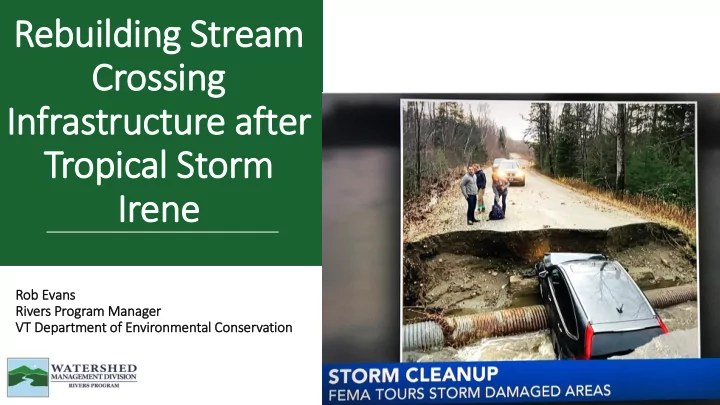
In Infrastructure after Tropical Storm Ir Irene Rob ob Evans - - PowerPoint PPT Presentation
Rebuilding Stream Crossing In Infrastructure after Tropical Storm Ir Irene Rob ob Evans Riv ivers Program Manager VT De Department of of Envi vironmental Con Conservati tion 1.VT Context/Background 2.FEMA Public Assistance grants
Rob
Riv ivers Program Manager VT De Department of
vironmental Con Conservati tion
4
5
Flood Recovery reimbursement program that covers permanent repair work to damaged or destroyed public infrastructure. “….not an infrastructure improvement program.”
Structure is eligible for replacement if Repair cost > 50% of Replacement cost Standard practice is in-kind repair/replacement Upsizing the structure eligible if it needs to meet codes and standards; OR FEMA uses its discretionary “mitigation” authority to allow upsizing of the structure (case by case)
Structure is eligible for replacement if Repair cost > 50% of Replacement cost Standard practice is in-kind repair/replacement, Unless:
Upsizing the structure eligible if it needs to meet codes and standards;
OR FEMA uses its discretionary “mitigation” authority to allow upsizing of the structure (case by case).
facility;
and implemented prior to the disaster declaration;
being repaired, i.e., they are Non- discretionary; and
facility;
and implemented prior to the disaster declaration;
being repaired, i.e., they are Non- discretionary; and
reasonable:
Rule contains hydro-geomorphic performance standards. Design requirements in consideration of sediment and debris transport, and fish passage: ▪ span length ▪ opening height ▪ depth of structure (embeddedness)
17
Traditional methods focus on hydraulic sizing based on design flows (e.g. 25 or 50 year flood).
18
Old – 7’ Pipe New – 16’ x 8’ Precast Arch
Interruption of stream sediment/debris transport aggradation above and degradation below
FEMA questioned whether VT’s performance-based standards allowed for too much discretion in their technical application. Vermont argued that bridges and culverts have been traditionally designed from codes using performance-based engineering standards;
The Stream Alteration Rule employs “equilibrium” and “connectivity” performance standards. 15 USC § 205c (2) [Title 15. Commerce and Trade; Chapter 6: “engineering standard” means “a standard which prescribes (A) a concise set of conditions and requirements that must be satisfied by a material, product, process, procedure, convention, or test method; and (B) the physical, functional, performance and/or conformance characteristics thereof.”
Stream Alteration performance standards are not discretionary, and the engineering design process is contained in 3 complimentary technical documents:
Key modifications: minimum span height, length, embeddedness standards; Needed explicit reference to the above for Individual Permit requirements; Needed to add specific reference to the VTrans Hydraulics Manual; Needed us to include specific language from Dept of Fish and Wildlife Guidelines;
The revised mandatory nature of design requirements for replacement culverts and bridges under the Rule and Permit appear to adequately address the previous concerns identified by FEMA that put in doubt the Rule and Permit would meet the requirements of 44 CFR…
Rob
Riv ivers Prog
Ver ermont t DE DEC rob.evans@vermont.gov 802.4 .490.6152