(In an Increasingly Dishonest World) Friday October 30, 2015 - - PowerPoint PPT Presentation

in an increasingly dishonest world friday october 30 2015
SMART_READER_LITE
LIVE PREVIEW

(In an Increasingly Dishonest World) Friday October 30, 2015 - - PowerPoint PPT Presentation

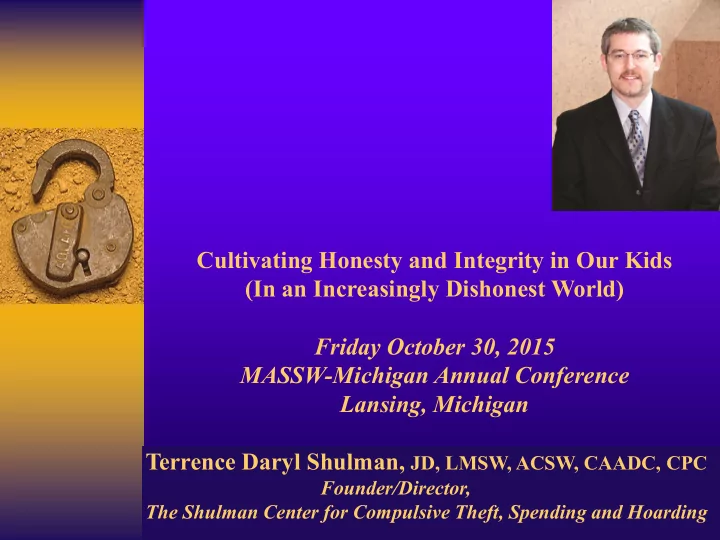
Cultivating Honesty and Integrity in Our Kids (In an Increasingly Dishonest World) Friday October 30, 2015 MASSW-Michigan Annual Conference Lansing, Michigan Terrence Daryl Shulman, JD, LMSW, ACSW, CAADC, CPC Founder/Director, The Shulman


slide-1
SLIDE 1

Cultivating Honesty and Integrity in Our Kids (In an Increasingly Dishonest World) Friday October 30, 2015 MASSW-Michigan Annual Conference Lansing, Michigan Terrence Daryl Shulman, JD, LMSW, ACSW, CAADC, CPC

Founder/Director, The Shulman Center for Compulsive Theft, Spending and Hoarding

slide-2
SLIDE 2

Quotes

Rules are made for breaking... or at least bending! ---Anonymous Laws are like cobwebs, which may catch small flies, but let wasps and

hornets break through.—Jonathan Swift

The healthy being craves an occasional wildness, a jolt from normality, a

sharpening of the edge of appetite… a brief excursion from his way of life.— Robert MacIver

It’s not the dumb kids who cheat, it’s the kids with a 4.6 GPA who are under

the pressure of keeping their grades up in order to get into the best colleges.-- South Bay, CA teacher/parent

The cover-up is worse than the crime.—Anonymous If there’s a wall, there’s a way around it.—Robert Shulman (my Dad) You’re only mistake was getting caught!—Anonymous Honesty is its own reward.--Anonymous

slide-3
SLIDE 3

Goals and Objectives

 1. To define honesty and integrity and what it means for kids  2. To learn the different kinds of dishonesties and their

prevalences.

 3. To learn different reasons why kids engage in dishonest

behavior and attitudes.

 4. To learn what we can do to cultivate greater honesty and

integrity in our kids.

slide-4
SLIDE 4

About Terrence Shulman

 I live in Southfield and have been married 13 years  I used to shoplift and steal from work between ages

15-25 (1980 – 1990)

 I was arrested 2x for shoplifting--1986/1990  I’ve been “in recovery” from compulsive stealing

since 1990

 I have been an attorney since 1992  I started C.A.S.A. (Cleptomaniacs And Shoplifters

Anonymous) in 1992 in metro-Detroit

 I obtained my MSW in 1997 and have been a full-

time addictions therapist ever since

 I founded The Shulman Center in 2004  I’ve authored 4 books on compulsive shoplifting,

employee theft, shopping/spending, and hoarding

slide-5
SLIDE 5

My story…

slide-6
SLIDE 6

Definitions

 Honesty: being honest, upright, fair, truthful, frank,

sincere; free from deceit or fraud

 Integrity: adherence to moral and ethical principles;

soundness of moral character; being whole; reliable

 Respect: being esteemed or honored, deference to, a

sense of worth or excellence

slide-7
SLIDE 7

Why are honesty and integrity important?

 Builds trust  Builds self-esteem  Leads to opportunities  Creates peace of mind  Lessens chance of negative situations/consequences  Improves relationships  What to do when things seem unfair in life?  What are the pros and cons of “taking shortcuts”?

slide-8
SLIDE 8

What’s in the News?

 Justin Bieber  Miley Cyrus  students and teachers cheating on exams  sexting  Lance Armstrong, Alex Rodriguez, PEDs  bullying  Wall Street shenanigans  political scandals  Mark Zuckerberg

slide-9
SLIDE 9

Forms of Dishonesty

 shoplifting  employee theft  theft from individuals (including parents!)  credit card fraud/misuse  identity theft  cheating on tests  plagiarism  false resume info / references  sex and sexting  drugs and alcohol  other addictions  lying

slide-10
SLIDE 10

Josephson Institute of Ethics Stats

 2009 survey: 51% of kids 17 and younger believed that

cheating was necessary for success

 2012 survey found, contrary to prior research, women are as

likely as men to lie for a financial reward 2009

 2013 study found that children of divorce are slightly more

likely to lie and cheat

 2013 study found that children from religious families do not

necessarily cheat less, though those who believed in a loving God were more likely to cheat than those who believed in an angry God

 2013 study suggests that students who are more fatigued tend

to cheat more

 2013 study found that many students who cheat initially

report a “cheater’s high” despite andy conflicts

slide-11
SLIDE 11

Some more statistics...

 Over 10% (30 million) Americans shoplift and about 1/4 are under age 18.—

2011, The Shulman Center estimate

 75% of employees steal from work and most do so repeatedly.—2010, U.S.

Chamber of Commerce

 Time theft (loafing) costs U.S. companies $500 Billion/year in lost

  • productivity. 2005, Denver Post

 The average credit card debt per adult American is about $10,000.—2010,

Time and Money magazines

 Nine out of ten middle schoolers admit to copying someone else's

homework; two-thirds say they have cheated on exams; 75%-98% percent

  • f college students surveyed each year admit to cheating at some time in

their academic careers. --2011, NoCheating.org

 15% of Americans said they would be likely to cheat on their taxes.—2010,

DBB Worldwide

 59% of American high school students say they cheated on a test in the past

year; 21% say they stole from a relative; 80% say they lied to a parent; 92% say they’re satisfied with their ethics and character.—2011, Josephson Institute of Ethics
slide-12
SLIDE 12

A QUIZ 1.You get a traffic ticket. You know you are responsible. Do you lie to the

  • fficer? Do you fight the ticket? Yes or No?

2.You receive too much change back from a transaction somewhere. Do you speak up and mention the error and return the money? Yes or No? 3.Have you lied about the age of a child--or about your own age or student status--to receive a discount at a movie theater? Yes or No? 4.Have you lied in front of your children, engaged in gossip or mean talk, or told your children to keep your secret(s) from someone? Yes or No?

  • 5. Have you eaten food or drunk a beverage in a supermarket before paying

for it? Yes or No?

  • 6. If your child brought home a report card with 5 A’s and a B, did you focus on

the B? Yes or No?

  • 7. If you’ve had an affair and you suspect or know that your child knows, did

you admit your behavior and discuss it? Yes or no?

  • 8. Have you brought home office supplies or other items from work without

permission and your child knows it? Yes or No?

  • 9. Is your child aware you overspend, don’t pay your bills on time or filed

bankruptcy? Yes or No? 10.Do you over-help your child with his/her homework or cover for him/her to the teachers? Yes or no? 11.Do you download music, movies, “illegally” or share them? Yes or no? 12.You dent a car with your car in a parking lot. Do you own up to it in some way? Yes or No?

slide-13
SLIDE 13
  • Questions to ask your kids
  • 1. What was your reasoning for doing what you did?
  • 2. Did you ever think to look at it from a different point of

view?

  • 3. Did you ever think to talk to me or someone about it?

Why or why not?

  • 4. What would the world look like if everyone did that?
  • 5. How would you feel if you were on the other side of

that?

  • 6. Who gets the advantage by that? Who gets the

disadvantage? Is that fair?

  • 7. What do you think your coach, teacher, minister, friend

would feel about that?

  • 8. What harm does this decision create? Is it worth it?
  • 9. Even if no harm has been done, could it still be wrong?
  • 10. Do you think honesty and integrity are important? Why
  • r why not?
slide-14
SLIDE 14

Things to consider when dishonesty is discovered

 Not everything is so black and white--there are, at times,

some gray area ethics

 Express a sincere interest in your child’s feelings & opinions  Don’t talk too much--listen, too!  Don’t disagree too early  Ask your child what he/she might tell his/her own children  Don’t set yourself up as the final answer--sometimes

encourage your child to seek other opinions

 Underkill vs. Overkill  Hypocrisy, favoritism, unfairness  Are you pressuring your child to be perfect?  Do we think about or share our own childhood dishonesties?  Is your child’s actions a cry for help? Is therapy an option?

slide-15
SLIDE 15

COMMON REASONS KIDS LIE, CHEAT & STEAL 1. Not taught value

  • f

following rules/being careful/being honest

  • 2. Had too many rules/too many cautions against

taking risks (rebelled)

  • 3. Witnessed rule breaking/risk taking by others
  • 4. Had own boundaries violated, abused or betrayed
  • 5. Was let down by authority/hypocrisy of authority
  • 6. Peer pressure--broke rules to fit in and/or taught

rules were made to be broken

  • 7. Attention deficit/hyperactivity—distracted/restless
  • 8. Narcissistic tendencies--rules don’t apply to me
  • 9. Had to raise self; thus, little respect for authority
  • 10. Experience excitement, power, satisfaction from

risks/rule-breaking

slide-16
SLIDE 16

Parents and teachers: pay attention! Your kids are watching you... and they’re learning about honesty and dishonesty from you (as well as

  • thers).

We need to ask

  • urselves

the following questions: How honest am I and how often do I follow or play by the rules? Has my child witnessed my dishonesty and, if so, what have I said/done about this? Do I hold double-standards for myself or other people or am I consistent? Am I physically/emotionally attuned/available to my children or do I need to improve this? Do I put too much pressure on my kid(s) to get good grades, achieve, never make mistakes? When my kid(s) get in trouble or make a mistake or get a bad grade, how do I react? Do I convey unconditional love for my child(ren) or do I convey love

  • nly

when they behave?

slide-17
SLIDE 17

The Five Love Languages

(Gary Chapman)

 Words of Affirmation  Quality Time  Receiving Gifts  Acts of Service  Physical Touch  Q: How do you and your kids tend to give and receive love?

slide-18
SLIDE 18

Successful Prevention/Treatment

 Public/childhood education  Support systems/community  Healthy physical outlets  Allowing boys/men to feel all emotions  Specialized therapy (men’s, group, marital, addiction)  Support groups (especially men’s groups)  Medications  Marital counseling  Work/play balance  Vocation/purpose and meaning  Nature  Poetry/Art

slide-19
SLIDE 19

19

Some books of interest...

Terrence Shulman, “Something for Nothing: Shoplifting Addiction

& Recovery,” “Biting The Hand That Feeds: The Employee Theft, Epidemic,” “Bought Out and $pent! Recovery from Compulsive $hopping and $pending,” and “Cluttered Lives, Empty Souls: Compulsive Stealing, Spending and Hoarding.”

Michael Parker, “Talk to Your Kids: Conversations About Ethics” Arthur Dobrin, Ethics for Everyone: How to Increase Your Moral

Intelligence

Harold Kushner, How Good Do We Have To Be Randy Cohen, Be Good: How to Navigate The Ethics of

Everything

Leland Benton, Why You Lie, Cheat & Deceive Dona

Matthews and Joaane Foster, Beyond Intelligence: Secrets of Raising Happily Productive Kids

19

slide-20
SLIDE 20
slide-21
SLIDE 21

Contact info for Terrence Daryl Shulman:

PO Box 250008

Franklin, Michigan 48025

248-358-8508

terrenceshulman@theshulmancenter.com

www.terrenceshulman.com

www.theshulmancenter.com

www.kleptomaniacsanonymous.org

www.employeetheftsolutions.com

www.shopaholicsanonymous.org

www.hoardersanonymous.org

Counseling/Consulting/Trainings/Presentations/Books/Referrals