
SLIDE 1
BRICS-EU: Divide ut
reges?
8 May 2012
Tanguy STRUYE DE SWIELANDE
- Prof. International Relations, Coordinator
Chair InBev Baillet-Latour – Relations European Union - China
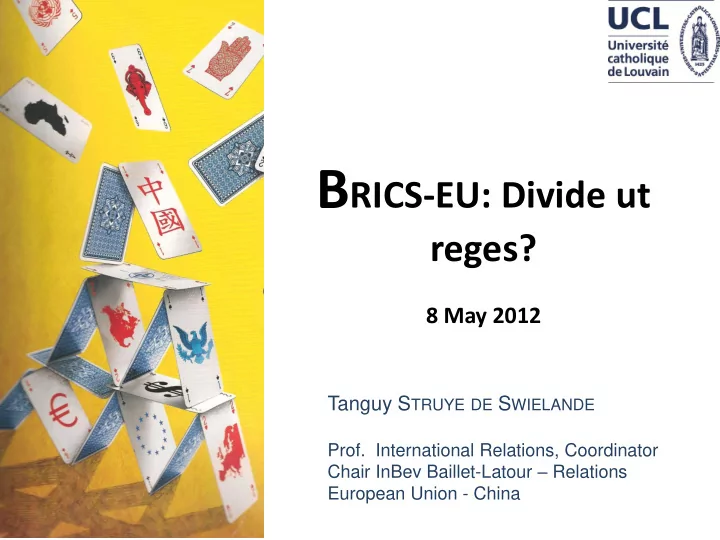
In a world in transition, emerging powers as Brazil, India and - - PowerPoint PPT Presentation
B RICS-EU: Divide ut reges? 8 May 2012 Tanguy S TRUYE DE S WIELANDE Prof. International Relations, Coordinator Chair InBev Baillet-Latour Relations European Union - China In a world in transition, emerging powers as Brazil, India and
8 May 2012
Tanguy STRUYE DE SWIELANDE
Chair InBev Baillet-Latour – Relations European Union - China
– document of the European Parliament entitled “On the EU foreign policy towards the BRICS and other emerging powers: objectives and strategies”?
– it is in the interest of the EU to fulfill a leading role by reinforcing its bilateral relations with emerging powers without recognizing formally forums as BRICS and IBSA which make the agenda setting of the Europeans on the world scene more complicated.
"What experience and history teach is this - that people and governments never have learned anything from history, or acted on principles deduced from it."
Today = Age of rising powers
Global order is being recast/ in transition
world
Shifting geopolitical landscape
– economically, politically, …culturally/ideologically
– Realpolitik
– 2001: Jim O’Neill, Goldman Sachs – 2003: Report « The Path to 2050 »
– Emerging markets/economies : Brasil, Russia, India and China
– 30% of world surface – 42% of world population – 20% of world economy
– 33 countries » 2004: 77% of world economy » 2015: 65,7% » 2030: 43%
–
– Decisions: majority of 85%
2,43%
– Emerging countries: 47,19%
– NOT GDP/Capita
– Rapid economic grow, but Gross Domestic Product (GDP) is still inferior to developed countries
– An “emerging economy” is not necessarily an “emerging power” – Indispensable precondition
culturally, politically,…)
– Ray Cline: Pp = (C + E + M)*(S + W)
Pp: Perceived power, C: Critical mass, E: Economic capability, M: Military capability, S: Strategic purpose, Will to pursue national strategy
– Scenario of the « potential power »
power
definition a power in becoming, caracterized by its instability and relativity.
lead to a global power.
collapse by reason of internal or external factors before reaching its objective.
– Strategy of Reform
– Strategy of Revolution
– Strategy of conquest (territorial/sphere of
influence)
– Strategy of Alliance
– June 2009: First Summit
– Influence on economic questions – Multilateralism/ multipolarity
– “entangling diplomacy” (Paul)/ strategic institutionnalism ( Ikenberry)
– What is behind this policy?
– Balancing the West (The Rest against the West)
– Traditional alliances? – Divisions, no homogeneous bloc
– Diplomatic coordinations (U.N.) – Binding (restrain dominant power through institutional agreements) – Buffering » Regional alternative orders » Ex. Shanghai Cooperation Organization/ Collective Security Treaty Organization/ BRICS/ IBSA – Baiting » To establish principles or institutions, becoming a referent
– Real objective: power
– Alliance of circumstances – Manoeuver of the challengers
world scene
– Driving force= China
– Heterogeneous (Aron) – …fundamental “political” differences and competition
– Political system
– Security/ defense
– Economies
trade
– 500 bill (2015)
– Corruption (I/R/C/SA), social instability, (C), communautarian instability(I/SA) – WTO negotiations » Divisions on agriculture ( Br-I) – Different energy demands » I/C/SA: importing countries » R/B: exporting countries
– India: services and technologies – Chine: heavy industry and finances
– Brasil 53th – Russia: 56th – China: 93th – India: 133th
– Geopolitics
– China/ Russia/ India – China India
– Paralysis of the EU project – Lack of strategy
– # document of the European Parliament entitled “On the EU foreign policy towards the BRICS and other emerging powers:
– 120
Document:
governance system based on close consultation and cooperation with the BRICS and other emerging economies, there will be little incentive for international cooperation and concerted action on major global issues with the potential risk of (i) political and economic fragmentation and the emergence of competing world agendas and separate regional areas, (ii) the disentanglement of global economic structures and investment flows and (iii) the creation of regional blocs of influence with very limited international coordination and no possibility of concerted solutions to transnational challenges
– No collaboration:
to the resolution of conflicts
– Concerted actions?
– Wishfull thinking
document
integration capacity and hence the capacity to engage in multipolar governance systems; believes that this demonstrates further the potential interest of the BRICS in contributing to global governance; takes the view, therefore, that the BRICS and other emerging countries are in the process
foreign policy terms and thus becoming partners of emerged powers and supporters of a global governance system based on universal values, partnership and inclusiveness;
– Different culture, history, values
– Different interpretation of multilateralism/ multipolarity (normative power) – Viable alternative to neoliberal model?
– Implies a strong, effective EU diplomacy (European External Action Service) – Limit the role of the member states – Implementation, no declarations
Document
the EU and individual BRICS countries would provide a valuable
trust, reconcile positions and encourage BRICS countries to assume greater responsibility in a new system of global governance, based on shared responsibility, common approaches and,more closely coordinated actions; expresses the view that the instrument of strategic, partnerships could provide valuable synergies in achieving such objectives
– Need for the EU to position itself in rising multipolar order – WORLD changes rapidly, THE EU NOT
…)
– Culture/History/ Ideology (geoculture) – Politics ( geopolitics) – Economics (geoeconomics) – Security and Defense (geostrategy)
cooperation, but in the name of national interest and not global governance
– The emerging powers will play following the rules of international institutions because “the liberal international order”? – Kant? (H. Bull)
– Hobbes-Grotius (H. Bull)
(soft)balancing Followship/bandwagoning Divide BRIDGE I/B