SLIDE 1
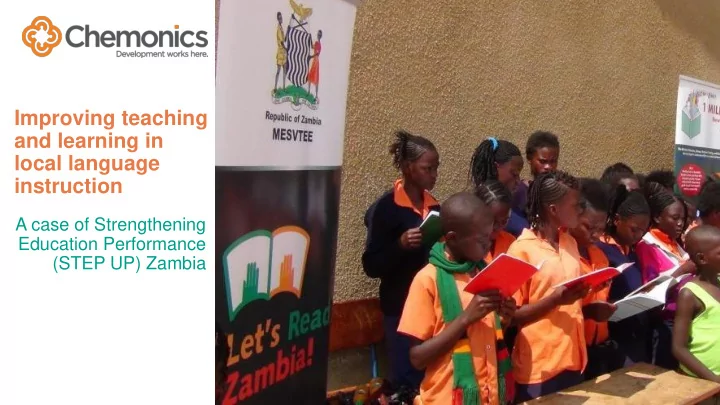
Improving teaching and learning in local language instruction
A case of Strengthening Education Performance (STEP UP) Zambia
SLIDE 2
Strengthening Education Performance (STEP-Up) Zambia
SLIDE 3
- STEP- Up Zambia, a 5 year USAID funded project and managed by
Chemonics International aimed to support education management reforms to improve learner performance
- Five Key Task Areas:
- Integrate and strengthen systems for improved decision making
- Promote equity as a central theme in policy development and education
management reform
- Institutionalize Ministry of General Education(MOGE)’s management of
HIV/AIDS workplace programs
- Strengthen decentralization for improved learner performance
- Engage Zambian institutions of higher education in educational research
related to school effectiveness and learning achievement
SLIDE 4
Background to the Study
SLIDE 5 Contextual Background
- In 2014 the Zambian Ministry of Education launched a new
curriculum which called for using local language instruction to improve teaching of reading in primary schools.
- In order to further the conversation and identify specific areas for
continued growth, STEP-Up Zambia in collaboration with three higher education institutions undertook an applied research to gain insights into issues associated with local language instruction teaching and learning in the early grades.
SLIDE 6
Importance of study
International research suggests that familiar local language instruction is a best practice for improved early grade reading outcomes. This study builds upon international findings and provides localized, Zambian specific data to strengthen the implementation of the national curriculum. As much as the implementing policies related to local language instruction are challenging, policy revisions and actions to support these findings help to ensure that all children have equitable access to quality learning.
SLIDE 7
Motivation for the Study
SLIDE 8 Motivation for the study
- Debates for and against the local language policy
- Zambia has 73 dialects
- 7 official language are used for instruction
- Local language or mother tongue?
- Persistent challenges related to improving early grade reading
- utcomes
- EGRA results show that much need to be done
- National assessment results of literacy in early grades show learners are not
reading as expected.
SLIDE 9
SLIDE 10
Research Process
SLIDE 11 Research process
- The sample included school administrators (37), teachers (134),
parents (137), and 157 students (grades 3 and 4).
- The investigation was done by means of interviews, questionnaires
and focus group discussions.
SLIDE 12
Results of the Study
Strategies for Improving teaching and learning in local language instructions
SLIDE 13 Availability of reading materials
Learner Access to school books
English Chinyanja Other
33% 64% 3%
read is compromised by lack of textbooks, teacher guides, story books, and other materials.
SLIDE 14 Talking walls improve learner understanding
- All teachers interviewed and 98% of administrators indicated that the
presence and use of talking walls during lessons enhanced learning in a classroom.
- They believed talking walls made pupils understand concepts learned.
- They, however, cautioned that talking walls should not substitute the
presence of a teacher.
Benefits of Talking Walls: » Self study after class » Lesson review » Revision » Help slower pupils catch up » Help administrators track school progress
SLIDE 15 Monitoring improves and sustains teachers’ performance
80%
Teachers believed that monitoring improved their performance.
70%
PTA members believed standard
monitor teaching regularly. Pupils felt their teachers taught better when á visitor’ was present and they were monitored.
65%
Good monitoring occurs when it is unexpected and focused on student learning. Some teachers feel expected monitoring has a limited impact as “the teacher will only prepare when he/she knows the monitors are coming.
SLIDE 16 Other Key Results
- Teacher preparedness
- Pre-service training
- Classroom teaching
- Regular assessment and feedback
- School/home environment
- Parent/community involvement
SLIDE 17
Recommendations from the Study
SLIDE 18 Recommendations
- Schools should provide extra reading for learners whose mother
tongue is not the language of instruction
- Schools provide sufficient teaching and reading materials
- Promote more School Based CPD to share teaching approaches and
experiences
- Pre-service teacher training need to support the teaching in the local
language policy
- Improve the monitoring of teaching on a regular basis
SLIDE 19
Thank you