Improving Seniors' Health Outcomes Reduce Nursing Home & - - PowerPoint PPT Presentation

improving seniors health outcomes
SMART_READER_LITE
LIVE PREVIEW

Improving Seniors' Health Outcomes Reduce Nursing Home & - - PowerPoint PPT Presentation

SNAP Access: Improving Seniors' Health Outcomes Reduce Nursing Home & Hospital Admissions by Meeting Basic Needs The 2017 Maryland Food Access and Nutrition Network (MFANN) Conference October 24, 2017 @BeneDataTrust #SDOH #SeniorsOnSNAP


slide-1
SLIDE 1

Reduce Nursing Home & Hospital Admissions by Meeting Basic Needs

The 2017 Maryland Food Access and Nutrition Network (MFANN) Conference

October 24, 2017

@BeneDataTrust #SDOH #SeniorsOnSNAP #SIE4Health
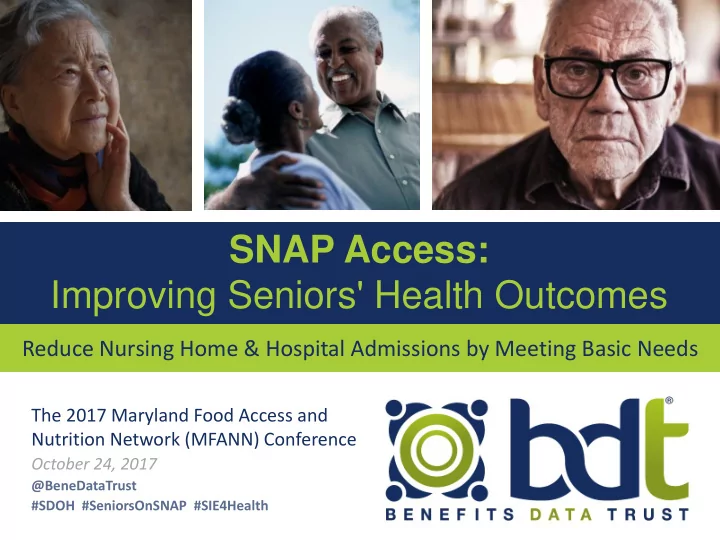
SNAP Access: Improving Seniors' Health Outcomes

slide-2
SLIDE 2

TITLE

  • Text
slide-3
SLIDE 3

SERVICE DELIVERY MODEL

slide-4
SLIDE 4

I’m looking forward

to help with the food and not having to worry about asking my children if they can help me… I really appreciate your help.

  • Ms. J, age 66

4

slide-5
SLIDE 5

The Problem: Seniors Basic Needs Aren’t Met

5

88% of US healthcare

expenditures are spent on medical care alone, but:

  • 10% is attributed to

medical care

  • 70% is attributed to

behavioral and socio-economic factors

slide-6
SLIDE 6

Benefits Data Trust The Johns Hopkins School of Nursing The Hilltop Institute at UMBC Maryland Department of Human Services Maryland Department of Health Robert Wood Johnson Foundation

The Research Collaboration

6

(Links to the original research: the first on hospitals and the second on nursing homes)

slide-7
SLIDE 7

Access to Supplemental Nutrition Assistance Program (SNAP) food assistance  Improved health outcomes and reduces healthcare costs

The Study Hypothesis

7

slide-8
SLIDE 8
  • 68,956 dual-eligible

adults 65+

  • Nearly 70% female
  • At least 2 chronic

conditions

The Study Population

8

African American 33% Caucasian 39% Hispanic 5% Other 13% Unknown 10%

slide-9
SLIDE 9

Deep Poverty

9

Average annual income approximately

$5,800

slide-10
SLIDE 10

10

slide-11
SLIDE 11

11

Odds of nursing home admission: -23% Odds of hospital admission: -14%

Shorter stays in both settings if admitted

The Findings: Seniors on SNAP

After just one year…

slide-12
SLIDE 12
  • 47% SNAP enrollment
  • Average monthly benefit of $117
  • 21% LIHEAP enrollment
  • Average annual benefit of $339

Benefits Utilization

12

slide-13
SLIDE 13

What We Can Save

13

If all non-SNAP participants from sample were enrolled:

  • $34 million savings from nursing homes
  • $19 million savings from hospitalizations
slide-14
SLIDE 14

He went above and beyond the call. I’m an old man, and I don’t understand half of these

  • things. Every question I

asked him, he gave me a good answer in a language I can

  • understand. He did a

wonderful, wonderful job.

  • Mr. M, age 71

Research Implications for Low-Income Seniors

  • Over 5.5 million eligible

low-income seniors not enrolled in SNAP

  • Seniors average SNAP

amount: $1,400/ year

14

slide-15
SLIDE 15

When you're 77, it's hard to understand some of these

  • things. You have been such a

help today! I didn't even know they had these [benefits!] You don't know how great that is when you're living on Social Security.”

  • Ms. R, age 77

15

slide-16
SLIDE 16

Comprehensive Solutions

16

slide-17
SLIDE 17

17

slide-18
SLIDE 18

Connect with Us!

18

Katherine Heflin, MS Program Manager

Maryland Benefits Center at Benefits Data Trust Email:

kheflin@bdtrust.org

Twitter:

@BeneDataTrust @KatherineHeflin

LinkedIn:

BDT: https://www.linkedin.com/co mpany/1855250/ Katherine: https://www.linkedin.com/in /katherine-heflin-15662731/

slide-19
SLIDE 19

Citations

19

Our New Studies Cited:

  • Samuels, L. et al. “Does the Supplemental Nutrition Assistance Program Affect Hospital Utilization Among Older Adults? The

Case of Maryland.” Population Health Management. http://online.liebertpub.com/doi/pdfplus/10.1089/pop.2017.0055

  • Szanton, et al. “Food assistance is associated with decreased nursing home admissions for Maryland’s dually eligible older

adults.” BMC Geriatrics. http://bmcgeriatr.biomedcentral.com/articles/10.1186/s12877-017-0553-x

Other Sources Cited:

  • Bengle, Rebecca, et al. “Food Insecurity is associated with Cost-Related Medication Non-Adherence in Community-Dwelling,

Low-Income Older Adults in Georgia,” Journal of Nutrition for the Elderly, 29.2 (2010): 170-191.

  • Berkowitz, Seth, et al. “Food Insecurity and Metabolic Control among U.S. Adults with Diabetes, “Diabetes Care, 36.10

(2013): 3093-3099.

  • Bradley, E., et al., (2011). Health and Social Services Expenditures: Associations with Health Outcomes, BMJ Quality &
  • Safety. 20(10), 826-831.
  • Bradley, E., et al (2016). Variation in Health Outcomes: The Role of Spending on Social Services, Public Health, and Health

Care, 2000-09, Health Affairs 35(5), 760-768.

  • Health Impact Project, “Case Study: Low Income Energy Assistance Program,” Accessed at

http://www.healthimpactproject.org/resources/case-study-low-income-energy-assistance-program

  • Robert Wood Johnson Foundation, “Health Care’s Blind Side: The Overlooked Connection between Social Needs and Good

Health,” December 2011. Accessed at http://www.rwjf.org/content/dam/farm/reports/surveys_and_polls/2011/rwjf71795

  • Sokol, Michael, et al. “Impact of Medication Adherence on Hospitalization Risk and Healthcare Cost,” Medical Care, 43.6

(2005): 521-530.

  • Seligman, Hilary K, et al. “Food Insecurity is associated with Chronic Disease among Low-Income NHANES Participants,”

Journal of Nutrition, 140.2 (2010): 304-310.