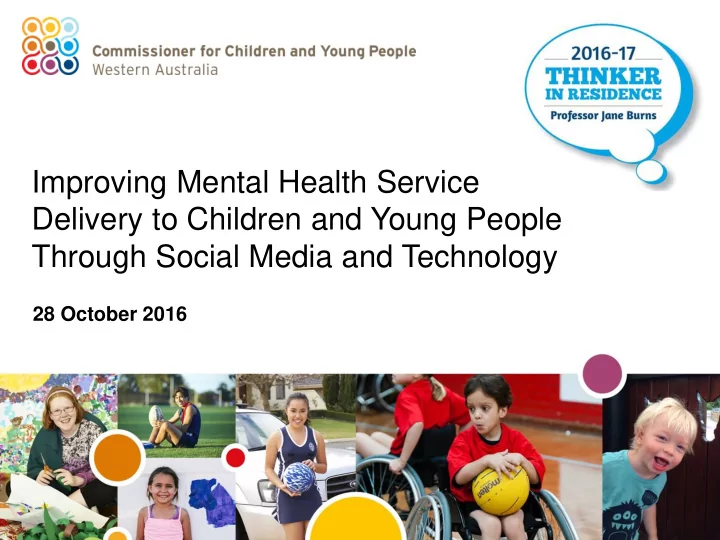
SLIDE 1 Improving Mental Health Service Delivery to Children and Young People Through Social Media and Technology
28 October 2016
SLIDE 2 Professor Jane Burns
2016-17 Thinker in Residence
SLIDE 3 Ming Luo
Secretarial Officer of YDAN Ex Vice Secretary of YAC Vision
SLIDE 4 Social Media Platforms
60%
45%
35%
30%
- 5. Twitter, Google Plus and Linkedin 25%
- 6. WhatsApp and other
10%
5%
SLIDE 5 Why?
- Sense of friendship and belonging
70%
30%
30%
- Desire to connect and reconnect
25%
- To promote causes and activities
25%
25%
10%
- Real world connections, level playing 15%
field and other
SLIDE 6 Social Media… Enhances face-to-face interactions?
- Communication with others
60%
55%
- To share details of daily life
35%
30%
30%
20%
20%
SLIDE 7 Are you treated differently online?
- “Online or not, there will always be differences
between us and someone else and it is usually
- noticed. Whether it is when I have failed to respond in
a conversation or struggle to read an online post.”
- “Because although there are people out there who
judge there are great people who understand my disability and accept me for who I am.”
SLIDE 8 Some wise words for dealing with cyber-bullying
- “Block them or tell admin about it.”
- “Just leave it a couple of days. Don’t fight them
because they know it’s getting to you if you do and if it gets worse tell someone don’t keep it to yourself.”
- “Stop talking to me please I don’t like that to be bully
and walk away from it when someone bullies you.”
- “I would suggest making it easier and less time
consuming to report cyber bullying occurrences and harsher penalties than there already are.”
SLIDE 9 Some tips that may/may not be helpful
- Increase online presence
- Increase opportunities for interactions
- On current trends
- Photos, videos, variety of mediums
- Accessibility
SLIDE 10 Dr Michelle Blanchard
Butterfly Foundation
SLIDE 11 USING TECHNOLOGIES TO RESPOND TO EATING DISORDERS
Professionals Seminar: Improving mental health service delivery to children and young people via social media and technology
Dr Michelle Blanchard National Manager, Programs and Practice The Butterfly Foundation @MischaBee @BFoundation
SLIDE 12 EATING DISORDERS IN AUSTRALIA
- Eating disorders are serious and complex mental illnesses.
- People with an eating disorder have disturbed eating behaviours and
distorted beliefs, with extreme concerns about weight, shape, eating and body image.
- Includes Anorexia Nervosa (3%), Bulimia Nervosa (12%), Binge Eating
Disorder (47%) and OSFED (38%).
- Genetic, psychological and environmental factors
- In 2012, 913, 986 people lived with an eating disorder.
- Socio-economic cost of $70B.
SLIDE 14 ABOUT BUTTERFLY
- Founded in May 2003 by Claire Middleton
- Peak body for consumers and carers
- Education Services – for Young People, Parents and Educators
- National Helpline (Telephone and Online Support)
- Recovery Support Services
- Financial Assistance for Recovery
- Intensive Outpatient Program
- Partnership with SCHN
- Manage National Eating Disorders Collaboration
SLIDE 15 BUTTERFLY ONLINE AND TELEPHONE SERVICE OFFERING
- National Helpline (1800 ED HOPE)
- Email, Web and Phone Support, 8am to 9pm, Monday to
Friday, except National Public Holidays
- Online Support Groups
- Monthly Online Counsellor facilitated Support Groups for
those in recovery, carers and siblings
- Understanding Eating Disorder Recovery Webinar for Carers
SLIDE 16
WEB CHAT INTERFACE
SLIDE 17
MULTIPLE ENTRY POINTS
SLIDE 18 SERVICE UTILISATION
CONTACT DETAILS TOTAL FY16 Total incoming contacts 7318 Number of incoming phone calls (including voicemails) 3774 Number of incoming emails 1351 Number of incoming Webchats 2191 Number of outgoing contacts (phone and email) 1642 Average Length of Incoming Phone Call (in minutes) 18 Average Length of Webchat (in minutes) 48
SLIDE 19 SNAPSHOT (SEPTEMBER 2016)
- 53% of contacts are from consumers
- 46% aged 25 and under
- 4% male
- 26% repeat callers
- 8% from Western Australia
- 68% engage in dieting and disordered eating, 41% restrict, 35% binge.
- 27% received a referral
SLIDE 20 NATURE OF CALLS
- People with lived experience needing information, support and
referrals
- Carers, family and friends looking for advice on how to support their
loved one
- Youth, health, education and community services professionals seeking
consultation on supporting people with eating disorders, including referrals.
SLIDE 21 PRACTITIONER REFERRAL DATABASE
- Extensive practitioner database for referral. Includes: Psychiatry,
psychology, counselling, social work, occupational therapy and
- dietetics. Includes both individual and group programs, public and
private.
- All practitioners screened to ensure suitability.
- To be considered for inclusion email:
practitionerdatabase@thebutterflyfoundation.org.au
SLIDE 22
OTHER TOOLS AND RESOURCES FOR YOUNG PEOPLE
SLIDE 23
EATINGDISORDERSINFO.ORG.AU
SLIDE 24
RECOVERY RECORD
SLIDE 25
RISE UP
SLIDE 26
ADDITIONAL RESOURCES FOR FAMILIES
SLIDE 27
FEED YOUR INSTINCT (BY CEED)
SLIDE 28
RESOURCES FOR PROFESSIONALS
SLIDE 29
NATIONAL EATING DISORDERS COLLABORATION (NEDC.COM.AU)
SLIDE 30 30
DOWNLOADABLE RESOURCES
SLIDE 31
JOURNAL OF EATING DISORDERS
SLIDE 32
HOW FAR IS TO FAR? (BY EDV)
SLIDE 33
THE MANNEQUIN PROJECT
SLIDE 34
WHERE TO FOR TECHNOLOGY USE IN EATING DISORDERS?
SLIDE 35 THE NEW FRONTIER
- New Social Media Reporting Tools
- Seamless integrated pathways to care in an ecosystem
delivered to scale
- How to manage risk and leverage opportunity associated
with biometrics
- Virtual Reality to simulate everyday situations eg restaurant
meals
SLIDE 36
SLIDE 37
Q&A
SLIDE 38
Thank you to our partners
SLIDE 39
Find out more
Website www.ccyp.wa.gov.au Twitter @CCYPWA #CCYPThinker
Let us know what you think
www.surveymonkey.com/r/thinker2016