Palpitations and Management of Arrhythmias y Fernando Vega, M.D. - - PDF document

palpitations and management of arrhythmias y
SMART_READER_LITE
LIVE PREVIEW

Palpitations and Management of Arrhythmias y Fernando Vega, M.D. - - PDF document

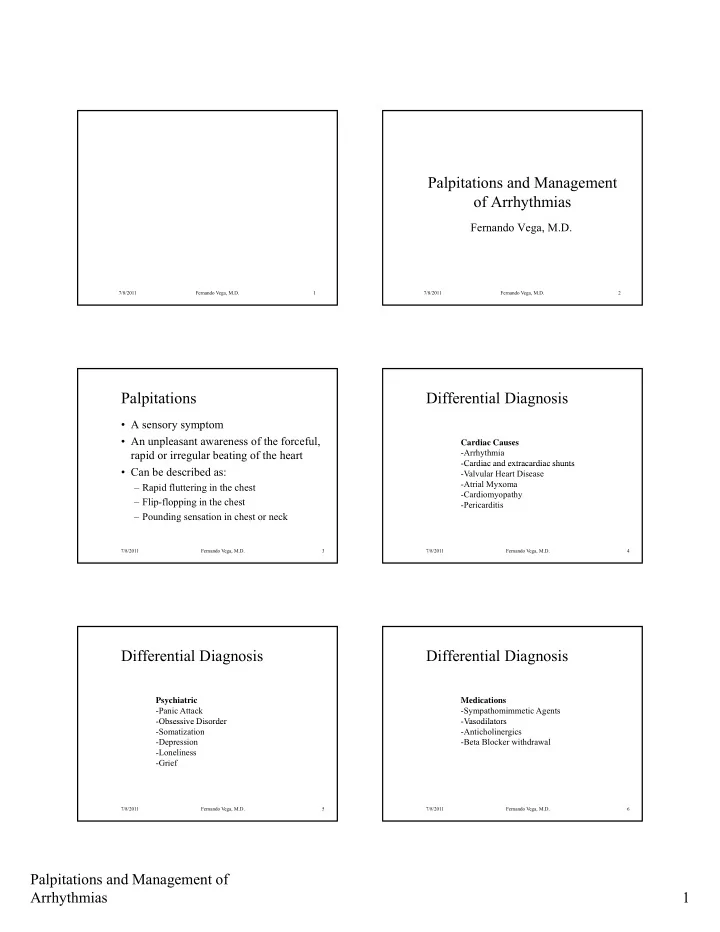
Palpitations and Management of Arrhythmias y Fernando Vega, M.D. 7/8/2011 Fernando Vega, M.D. 1 7/8/2011 Fernando Vega, M.D. 2 Palpitations Differential Diagnosis A sensory symptom An unpleasant awareness of the forceful,


slide-1
SLIDE 1

Palpitations and Management of Arrhythmias 1

7/8/2011 Fernando Vega, M.D. 1

Palpitations and Management

  • f Arrhythmias

7/8/2011 Fernando Vega, M.D. 2

y

Fernando Vega, M.D.

Palpitations

  • A sensory symptom
  • An unpleasant awareness of the forceful,

rapid or irregular beating of the heart

7/8/2011 Fernando Vega, M.D. 3

  • Can be described as:

– Rapid fluttering in the chest – Flip-flopping in the chest – Pounding sensation in chest or neck

Differential Diagnosis

Cardiac Causes

  • Arrhythmia
  • Cardiac and extracardiac shunts

7/8/2011 Fernando Vega, M.D. 4

Cardiac and extracardiac shunts

  • Valvular Heart Disease
  • Atrial Myxoma
  • Cardiomyopathy
  • Pericarditis

Differential Diagnosis

Psychiatric

  • Panic Attack
  • Obsessive Disorder

7/8/2011 Fernando Vega, M.D. 5

Obsessive Disorder

  • Somatization
  • Depression
  • Loneliness
  • Grief

Differential Diagnosis

Medications

  • Sympathomimmetic Agents
  • Vasodilators

7/8/2011 Fernando Vega, M.D. 6

Vasodilators

  • Anticholinergics
  • Beta Blocker withdrawal
slide-2
SLIDE 2

Palpitations and Management of Arrhythmias 2

Differential Diagnosis

Habbits

  • Caffeine
  • Nicotine

7/8/2011 Fernando Vega, M.D. 7

Nicotine

  • Cocaine
  • Amphetamines

Differential Diagnosis

Metabolic Disorders

  • Hypoglycemia
  • Thyrotoxicosis

7/8/2011 Fernando Vega, M.D. 8

Thyrotoxicosis

  • Pheochromocytoma
  • Argentaffionoma
  • Scromboid Food poisoning

Differential Diagnosis

High Output States

  • Anemia
  • Pregnancy

7/8/2011 Fernando Vega, M.D. 9

Pregnancy

  • Paget’s Disease
  • Fever

History

Symptoms:

  • “flip-flopping in chest” – isolated PACs or

PVCs

  • Often caused by supraventricular or

7/8/2011 Fernando Vega, M.D. 10

  • Often caused by supraventricular or

Ventricular premature contraction

ECG - PAC

7/8/2011 Fernando Vega, M.D. 11

History

Symptoms:

  • “rapid fluttering in chest”

7/8/2011 Fernando Vega, M.D. 12

  • Sustained surpraventricular or ventricular

arrhythmia including sinus tachycardia

  • May be regular or irregular
slide-3
SLIDE 3

Palpitations and Management of Arrhythmias 3

ECG _*

7/8/2011 Fernando Vega, M.D. 13

ECG - VT

7/8/2011 Fernando Vega, M.D. 14

History

Symptoms:

  • “pounding in the neck”
  • Irregular pounding of the neck is caused by

7/8/2011 Fernando Vega, M.D. 15

arioventricular dissociation where the atria contract against an occasionlly closed AV

  • valve. Cannon A waves are formed.
  • Examples include PVC’s, third degree

heart block or ventricular tachycardia

History

Mode of Onset:

  • Abrupt suggests paroxysmal abnormal tachycardia,

though sinus tach may start abruptly in anxiety.

7/8/2011 Fernando Vega, M.D. 16

Mode of Termination:

  • Abrupt suggests paroxysmal arrhythmia,

though high adrenergic tone caused by arrhythmia may result in consequent sinus tach.

History

Characteristics:

  • Rapid, irregular – AF, AFL, Atrial tachycardia,

multiple PACs or PVCs

  • Rapid, regular – SVT, VT

7/8/2011 Fernando Vega, M.D. 17

Circumstances:

  • Panic/anxiety – the chicken or the egg?
  • Catecholamine excess

–Exercise – idiopathic RVOT VT, AF –Emotional startle – Long QT syndrome

Palpitations

  • Most patients with Palpitations will have

benign supraventricular or ventricular ectopy PVC’ d t i d t i l

7/8/2011 Fernando Vega, M.D. 18

  • The above are not associated with

increased mortality in pts with structurally normal hearts

  • PVC’s and non sustained ventricular

tachycardia come in less often.

slide-4
SLIDE 4

Palpitations and Management of Arrhythmias 4

Palpitations – Structurally Normal

  • No history of cardiovascular disease,

congenital anomalies N l ECG

7/8/2011 Fernando Vega, M.D. 19

  • Normal ECG

Palpitations – Other rhythms

  • Atrial Fibrilation
  • Wolf Parkinson White

7/8/2011 Fernando Vega, M.D. 20

  • Prolonged Q-T Syndrome

Palpitations – Other rhythms

Atrial Fibrilation

7/8/2011 Fernando Vega, M.D. 21

Palpitations – Atrial Fibrilation

7/8/2011 Fernando Vega, M.D. 22

Palpitations – Atrial Fibrilation

  • Hemodynamicaly Stable?

Three Questions to ask:

7/8/2011 Fernando Vega, M.D. 23

  • Rate vs. Rhythm Control?
  • Anticoagulate?

Palpitations – Atrial Fibrilation

  • Chest Pain

Hemodynamic Stability

7/8/2011 Fernando Vega, M.D. 24

  • Other perfusion Abnormalities
  • Signs of heart failure
slide-5
SLIDE 5

Palpitations and Management of Arrhythmias 5

Palpitations – Atrial Fibrilation

  • Lone Atrial Fib

Anticoagulation

7/8/2011 Fernando Vega, M.D. 25

  • Persistent Atrial Fibrilation
  • Intermittent Atrial Fibrilation

Palpitations – Other rhythms

  • Atrial Fibrilation
  • Wolf Parkinson White

7/8/2011 Fernando Vega, M.D. 26

  • Prolonged Q-T Syndrome

Palpitations – Other rhythms

  • Characterized by delta wave

Wolf Parkinson-White Syndrome

7/8/2011 Fernando Vega, M.D. 27

ECG - WPW

Wolf Parkinson-White Syndrome

7/8/2011 Fernando Vega, M.D. 28

Palpitations – Other rhythms

  • Increased risk of torsade de pointes
  • Primary Sx: palpitations, syncope

Prolonged QT Interval

7/8/2011 Fernando Vega, M.D. 29

  • Can be congenital or acquired

y p p , y p seizures and cardiac arrest

Palpitations – Other rhythms

Prolonged QT Interval

7/8/2011 Fernando Vega, M.D. 30

slide-6
SLIDE 6

Palpitations and Management of Arrhythmias 6

Palpitations – Other rhythms

Prolonged QT Interval

7/8/2011 Fernando Vega, M.D. 31

Palpitations – Other rhythms

QTc = QT interval / square root of RR

7/8/2011 Fernando Vega, M.D. 32

QT is measured in lead II, maybe V2-3, V56 QT is not always prolonged and varies over time

Palpitations – Other rhythms

Prolonged QT Interval

7/8/2011 Fernando Vega, M.D. 33

Palpitations – Other rhythms

Prolonged QT Interval

7/8/2011 Fernando Vega, M.D. 34

Palpitations – Prolonged QT

Antiarrhythmics:

  • Amniodarone

Drugs that cause prolonged Q-T Intervals:

7/8/2011 Fernando Vega, M.D. 35

  • Disopyramide
  • Dofetilide, sematilide, ibutilide
  • Quinidine
  • Sotalol

Palpitations – Prolonged QT

ANTIHISTAMINES: Drugs that cause prolonged Q-T Intervals:

7/8/2011 Fernando Vega, M.D. 36

  • Astemizole
  • Terfenadine
slide-7
SLIDE 7

Palpitations and Management of Arrhythmias 7

Palpitations – Prolonged QT

ANTIMICROBIALS: E h i i h l i h Drugs that cause prolonged Q-T Intervals:

7/8/2011 Fernando Vega, M.D. 37

  • Erythromycin, azithro, clarithro
  • Some flouroquinones
  • TMP/SMZ
  • Other: Pentamidine, chloroquine

mefloquine

Palpitations – Prolonged QT

  • Anorexia nervosa
  • Hypocalcemia

Metabolic Disorders:

7/8/2011 Fernando Vega, M.D. 38

Hypocalcemia

  • Hypockalemia
  • Hypomagnesemia
  • Hypothyroidism (sporadic case reports)
  • Liquid protein diets
  • Starvation

Palpitations:oth Considerations

  • Mitral Valve Prolapse
  • Organic Heart Disease

7/8/2011 Fernando Vega, M.D. 39

  • Obsession

Palpitations:oth Considerations

  • Mitral Valve Prolapse
  • Organic Heart Disease

7/8/2011 Fernando Vega, M.D. 40

  • Obsession

Palpitations-other Considerations

Mitral Valve Prolapse

Framingham Heart Study compared 84 patients with MVP to 3403 control subjects;

7/8/2011 Fernando Vega, M.D. 41

with MVP to 3403 control subjects; Chest pain, dyspnea, syncope, CHF, AF and ECG abnormalities were equally prevalent in matched controls.

Palpitations-other Considerations

Mitral Valve Prolapse

  • Elevated urine and plasma catecholamine levels

7/8/2011 Fernando Vega, M.D. 42

  • Exaggerated heart rate response to phenylephrine
  • Decreased bradycardic response to dive reflex
  • Isoproterenol reproduces symptoms
slide-8
SLIDE 8

Palpitations and Management of Arrhythmias 8

Palpitations-Main Points

  • Symptoms sometimes characterizes the arrhythmia
  • Arrhythmia is almost always benign in healthy pts.
  • A normal ECG supports above

7/8/2011 Fernando Vega, M.D. 43

pp

  • Look out for atrial fib, prolonged QT intervals, WPW
  • Look out for other signs of organic disease: Q waves,

ST changes, hypertrophy

Palpitations-Further Workup

  • Holter Monitoring
  • Event Monitoring
  • Echocardiogram

7/8/2011 Fernando Vega, M.D. 44

g

  • CXR
  • EPS Mapping

Palpitations - Management

  • Caffeine, caffeine, caffeine
  • Nutritional support of the heart

7/8/2011 Fernando Vega, M.D. 45

  • Hepatodoron, donkey thistle, aurum stibium hyosciamus
  • Beta blockade may not supress arrhythmia but

associated symptoms

  • Other antiarrhythmics

Palpitations: Baseline ECG

7/8/2011 Fernando Vega, M.D. 46

Wolff-Parkinson-White

Palpitations: Baseline ECG

7/8/2011 Fernando Vega, M.D. 47

LVH with strain and LAE

Palpitations: Baseline ECG

7/8/2011 Fernando Vega, M.D. 48

Old ASMI

slide-9
SLIDE 9

Palpitations and Management of Arrhythmias 9

Palpitations: Baseline ECG

7/8/2011 Fernando Vega, M.D. 49

Long Q-T interval

Palpitations: Baseline ECG

7/8/2011 Fernando Vega, M.D. 50

Atrial Fibrilation

Palpitations: Brief Discussion on Atrial Fib

Common, especially in middle age Rule out Hyperthyroidism “Lone Atrial Fibrlation” – No pharmacological treatment necessary

7/8/2011 Fernando Vega, M.D. 51

“Intermittent Atrial Fibrilation”- Studies show high likelyhood Of mural thrombi and possible embolization “Persistent Atrial Fibrilation” – Requires anticoagulation

Palpitations: Brief Discussion on Atrial Fib

Rhyhm vs. Rate control Rule “Lone

7/8/2011 Fernando Vega, M.D. 52

“Intermitt “Persistent Atrial

Palpitations: Baseline ECG

7/8/2011 Fernando Vega, M.D. 53

Normal ECG

Palpitations: ECG with Symptoms

7/8/2011 Fernando Vega, M.D. 54

Narrow QRS Tachycardia

slide-10
SLIDE 10

Palpitations and Management of Arrhythmias 10

Palpitations: Narrow QRS Tachycardia

  • Regular? No → AF AT/AFL with variable block MAT

7/8/2011 Fernando Vega, M.D. 55

Regular? No → AF, AT/AFL with variable block, MAT

  • Visible P waves? No → AVNRT
  • Atrial rate greater than ventricular rate? Yes → AT/AFL
  • Short RP interval? AVNRT, AVRT, AT
  • Long RP interval? AT, PJRT, Atypical AVNRT

Palpitations: Narrow QRS Tachycardia

Take the “Adenosine Challenge” Take the “Adenosine Challenge”

7/8/2011 Fernando Vega, M.D. 56

g

  • Sudden termination → AVNRT, AVRT, SNRT
  • Persistent Atach, high-degree AV block → AFL, AT
  • Gradual slowing, then reacceleration → ST, JT
  • No change in rate → inadequate dose, VT

Palpitations: ECG with Symptoms

7/8/2011 Fernando Vega, M.D. 57

Wide QRS Tachycardia

Palpitations: Wide QRS Tachycardia

  • Regular? No → AF/AFL/AT with BBB or AP

7/8/2011 Fernando Vega, M.D. 58

  • Is QRS identical to that of SR?

Yes → SVT with BBB, antidromic AVRT

  • A-V dissociation or fusion beats? Yes → VT
  • QRS morphology? Bizarre → VT
  • Previous MI or structural heart disease? Yes → VT

Palpitations: Workup

  • 24 hour Holter monitor
  • Continuous loop event recorder

7/8/2011 Fernando Vega, M.D. 59

  • Echocardiogram
  • Treadmill test (for sxs with or after exercise)
  • E.P. testing

Palpitations: Management

  • Reassurance
  • AV node blocking meds
  • Antiarrhythmic therapy

7/8/2011 Fernando Vega, M.D. 60

  • Antiarrhythmic therapy
  • Catheter ablation
slide-11
SLIDE 11

Palpitations and Management of Arrhythmias 11

Palpitations: Management

  • Reassurance
  • AV node blocking meds
  • Antiarrhythmic therapy

7/8/2011 Fernando Vega, M.D. 61

  • Antiarrhythmic therapy
  • Catheter ablation

Palpitations: Management

  • Reassurance
  • AV node blocking meds
  • Antiarrhythmic therapy

7/8/2011 Fernando Vega, M.D. 62

  • Antiarrhythmic therapy
  • Catheter ablation

AF 1/3

7/8/2011 Fernando Vega, M.D. 63

AF 2/3

7/8/2011 Fernando Vega, M.D. 64

AF 3/3

7/8/2011 Fernando Vega, M.D. 65

Palpitations: Management

7/8/2011 Fernando Vega, M.D. 66