Implementing the New Revenue Recognition Standards Under ASC 606 - - PowerPoint PPT Presentation

implementing the new revenue
SMART_READER_LITE
LIVE PREVIEW

Implementing the New Revenue Recognition Standards Under ASC 606 - - PowerPoint PPT Presentation

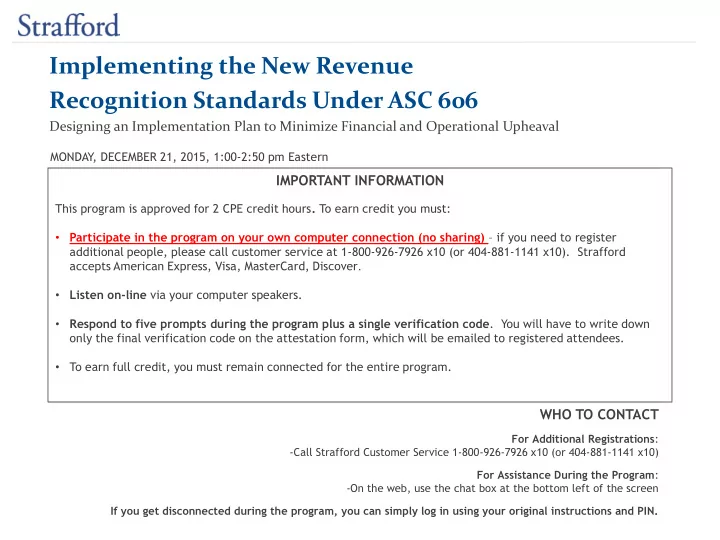
Implementing the New Revenue Recognition Standards Under ASC 606 Designing an Implementation Plan to Minimize Financial and Operational Upheaval MONDAY , DECEMBER 21, 2015, 1:00-2:50 pm Eastern IMPORTANT INFORMATION This program is approved for


slide-1
SLIDE 1

WHO TO CONTACT

For Additional Registrations:

  • Call Strafford Customer Service 1-800-926-7926 x10 (or 404-881-1141 x10)

For Assistance During the Program:

  • On the web, use the chat box at the bottom left of the screen

If you get disconnected during the program, you can simply log in using your original instructions and PIN.

IMPORTANT INFORMATION

This program is approved for 2 CPE credit hours. To earn credit you must:

  • Participate in the program on your own computer connection (no sharing) – if you need to register

additional people, please call customer service at 1-800-926-7926 x10 (or 404-881-1141 x10). Strafford accepts American Express, Visa, MasterCard, Discover.

  • Listen on-line via your computer speakers.
  • Respond to five prompts during the program plus a single verification code. You will have to write down
  • nly the final verification code on the attestation form, which will be emailed to registered attendees.
  • To earn full credit, you must remain connected for the entire program.

Implementing the New Revenue Recognition Standards Under ASC 606

Designing an Implementation Plan to Minimize Financial and Operational Upheaval

MONDAY , DECEMBER 21, 2015, 1:00-2:50 pm Eastern

slide-2
SLIDE 2

Tips for Optimal Quality

Sound Quality When listening via your computer speakers, please note that the quality

  • f your sound will vary depending on the speed and quality of your internet

connection. If the sound quality is not satisfactory, please e-mail sound@straffordpub.com immediately so we can address the problem. Viewing Quality To maximize your screen, press the F11 key on your keyboard. To exit full screen, press the F11 key again.

FOR LIVE EVENT ONLY

slide-3
SLIDE 3
  • Dec. 21, 2015

Implementing the New Revenue Recognition Standards Under ASC 606

George I. Victor Giambalvo Stalzer & Company gvictor@gsco-cpas.com Robert Dyson MBAF rdyson@mbafcpa.com Marta Alfonso MBAF malfonso@mbafcpa.com

slide-4
SLIDE 4

Notice

ANY TAX ADVICE IN THIS COMMUNICATION IS NOT INTENDED OR WRITTEN BY THE SPEAKERS’ FIRMS TO BE USED, AND CANNOT BE USED, BY A CLIENT OR ANY OTHER PERSON OR ENTITY FOR THE PURPOSE OF (i) AVOIDING PENALTIES THAT MAY BE IMPOSED ON ANY TAXPAYER OR (ii) PROMOTING, MARKETING OR RECOMMENDING TO ANOTHER PARTY ANY MATTERS ADDRESSED HEREIN.

You (and your employees, representatives, or agents) may disclose to any and all persons, without limitation, the tax treatment or tax structure, or both, of any transaction described in the associated materials we provide to you, including, but not limited to, any tax opinions, memoranda, or other tax analyses contained in those materials. The information contained herein is of a general nature and based on authorities that are subject to change. Applicability of the information to specific situations should be determined through consultation with your tax adviser.

slide-5
SLIDE 5

Implementing the New Revenue Recognition Standard Under ASC 606

George I. Victor, CPA Giambalvo, Stalzer & Company CPAs, P.C

slide-6
SLIDE 6

Background of Existing Revenue Recognition Requirements

6

slide-7
SLIDE 7

Background of Existing Revenue Recognition Requirements

  • Current revenue recognition guidance under

U.S. GAAP is generally more rules based vs. principle based (more bright lines, requiring less judgment)

  • Current revenue recognition guidance over a

long period of time has developed into a multitude of requirements for specific transactions and industries such as software, real estate, and construction, among others

7

slide-8
SLIDE 8

Background of Existing Revenue Recognition Requirements

  • Prior to issuance of ASC 606 there existed over

200 specialized transaction or industry specific literature under US GAAP.

  • Current revenue recognition guidance is

generally more conservative, often resulting in less revenue recognition.

8

slide-9
SLIDE 9

Background of Existing Revenue Recognition Requirements

  • Under current revenue recognition guidance,

many goods or services promised in a contract with a customer are not always identified as distinct revenue generating transactions

  • Those promises, however may represent separate
  • bligations of the selling entity to the customer.
  • The transaction price did not specifically identify

these obligations as individual components.

9

slide-10
SLIDE 10

Background of Existing Revenue Recognition Requirements

Current guidance - ASC 605 - Revenue Recognition

  • 605-10 Overall
  • 605-15 Products
  • 605-20 Services
  • 605-25 Multiple-Element Arrangements
  • 605-28 Milestone Method
  • 605-30 Rights to Use
  • 605-35 Construction-Type and Production-Type Contracts
  • 605-40 Gains and Losses
  • 605-45 Principal Agent Considerations
  • 605-50 Customer Payments and Incentives
  • 905 Agriculture
  • 908 Airlines
  • 910 Contractors—Construction
  • 912 Contractors—Federal Government
  • 915 Development Stage Entities
  • 920 Entertainment—Broadcasters
  • 922 Entertainment—Cable Television
  • 924 Entertainment—Casinos
  • 926 Entertainment—Films

10

slide-11
SLIDE 11

Background of Existing Revenue Recognition Requirements

Current guidance - ASC 605 - Revenue Recognition, continued

  • 928 Entertainment—Music
  • 932 Extractive Activities—Oil and Gas
  • 940 Financial Services—Brokers and Dealers
  • 942 Financial Services—Depository and Lending
  • 944 Financial Services—Insurance
  • 946 Financial Services—Investment Companies
  • 948 Financial Services—Mortgage Banking
  • 952 Franchisors
  • 954 Health Care Entities
  • 958 Not-For-Profit Entities
  • 970 Real Estate—General
  • 972 Real Estate—Common Interest Realty Associations
  • 974 Real Estate—Real Estate Investment Trusts
  • 976 Real Estate—Retail Land
  • 978 Real Estate—Time-Sharing Activities
  • 980 Regulated Operations
  • 985 Software

11

slide-12
SLIDE 12

Background of Existing Revenue Recognition Requirements

New guidance - ASC 606 - Revenue from Contracts with Customers

  • 606-10 Overall
  • 606-10-00 Status
  • 606-10-05 Overview and Background
  • 606-10-10 Objectives
  • 606-10-15 Scope and Scope Exceptions
  • 606-10-20 Glossary
  • 606-10-25 Recognition
  • 606-10-32 Measurement
  • 606-10-45 Other Presentation Matters
  • 606-10-50 Disclosure
  • 606-10-55 Implementation Guidance and Illustrations
  • 606-10-60 Relationships
  • 606-10-65 Transition and Open Effective Date Information
  • 606-10-75 XBRL Elements

12

slide-13
SLIDE 13
  • II. ASC 606 AND THE PRINCIPLES-BASED

APPROACH

ROBERT A. DYSON, CPA, MS

slide-14
SLIDE 14

14

  • In May 2014, the Financial Accounting Standards Board (“FASB”)

issued Accounting Standards Update (“ASU”) No. 2014-09, Revenue from Contracts with Customers.

  • ASU 2014-09 created the new Accounting Standards Codification

(“ASC”) Topic 606, “Revenue from Contracts with Customers,” and ASC Subtopic 340-40, “Other Assets and Deferred Costs – Contracts with Customers.”

  • Since issuing the original ASU, FASB has proposed three revisions

in addition to deferring the effective date.

slide-15
SLIDE 15

15

ASU 2014-09 supersedes:

  • The revenue recognition requirements in ASC 605, Revenue Recognition
  • Most industry specific guidance in the ASC’s Industry-Specific section.

ASU 2014-09 is:

  • 700 pages long;
  • Potentially far-reaching and can affect a large number of entities;
  • Users of the financial statements (owners, banks, regulatory agencies)

may see changes in operating results;

  • Not something to typically address right before issuance.
slide-16
SLIDE 16

16

  • The amount of recognized revenue is the consideration to which the

entity expects to be entitled as a result of the transfer of promised goods or services to customers pursuant to the provisions of the applicable contracts.

  • The timing of recognized revenue is based on the satisfaction of

contractual obligations, rather than the type of contract or payment terms. TOPIC 606: BASIC CONCEPTS

slide-17
SLIDE 17

17

  • Although ASU 2014-09 does not change the amount of revenue

earned from a contract, it may affect the timing of the recognition of that revenue.

  • Proper recognition of revenue in both amount and reporting period is

necessary to avoid any adverse implications arising from misstated financial statements.

  • Misstated revenue has been a longstanding major problem. A 2010

study published by the Committee of Sponsoring Organizations of the Treadway Commission reported that 61 percent of the 347 companies cited in Securities and Exchange Commission accounting and auditing releases between 1998 and 2007 recorded revenue inappropriately, primarily by creating fictitious revenue or recognizing revenue prematurely. TOPIC 606: IMPORTANCE OF PROPER APPLICATION

slide-18
SLIDE 18

18

Topic 606 applies to all contracts and other agreements with customers except for:

  • Lease contracts
  • Insurance contracts
  • Certain financial instruments
  • Guarantees, other than product or service warranties
  • Nonmonetary exchanges between entities in the same line of business to

facilitate sales to customers or potential customers

  • Non-exchange agreements, such as joint venture and collaboration

arrangements

  • Agreements providing each party the unilateral enforceable right to terminate

wholly unperformed contracts without compensating the other party

  • Agreements which the entity concludes it is not probable it will collect the

amounts due

TOPIC 606: SCOPE

slide-19
SLIDE 19

19

Revenue from contracts not meeting Topic 606’s criteria should be recognized using:

  • Existing generally accepted accounting principles (“GAAP”);

Or

  • When the entity has no remaining obligations and has

received all, or substantially all, of the nonrefundable consideration.

slide-20
SLIDE 20
  • III. FIVE STEP REVENUE RECOGNITION

MODEL

ROBERT A. DYSON, CPA, MS

slide-21
SLIDE 21

21

The New Revenue Recognition Process Step 1: Identify the contract with a customer. Step 2: Identify the separate performance obligations. Step 3: Determine the transaction price. Step 4: Allocate the transaction price to the performance obligations. Step 5: Recognize revenue when (or as) the entity satisfies a performance obligation.

slide-22
SLIDE 22

22

Step 1 - Identify Contract with Customer Topic 606 applies to contracts that create rights and obligations which are enforceable as a matter of law. Contracts must meet the following criteria:

  • Both parties have approved the contract, preferably in writing, and are

committed to perform their respective obligations

  • The entity can identify each party’s rights regarding the goods or services to

be transferred

  • The entity can identify the payment terms for the goods or services to be

transferred

  • The contract has commercial substance
  • It is probable that the entity will collect the consideration to which it will be

entitled

slide-23
SLIDE 23

23

  • Foxtrot Company (“Foxtrot”) is a retail company selling consumer

appliances and services to the general public. In July 2020, Foxtrot

  • ffered a promotion selling a laptop computer and a related three

year service contract for $1,000. The entire amount is due upon close of sale.

  • The service contract provides an extended product warranty, anti-

virus program, debugging and hardware maintenance. Foxtrot is not responsible for the manufacturer’s warranty. Because of its reputation for quality, Foxtrot sells service contracts to people who purchase their laptop from other sellers. EXAMPLE

slide-24
SLIDE 24

24

Identify the Contract with a Customer

In applying Topic 606, Foxtrot documents approval by all parties by immediately transferring the laptop, receiving consideration and signing a contract specifying the types of services to be provided. The contract has commercial substance because it transfers actual services and

  • property. The approval by all parties enhances the probability that the

contract will be legally enforceable.

slide-25
SLIDE 25

25

Step 2 - Identify Separate Performance Obligations

  • At contract inception, the entity identifies each performance obligation,

which is a promise to transfer either a distinct good or service or a series

  • f similar goods or services that have the same pattern of transfer.

A good or service is distinct if it meets both of the following criteria:

  • Capable of being distinct – The customer can benefit from the good or

service either on its own or together with other resources readily available to the customer.

  • Distinct within the context of the contract – The promise to transfer the

good or service is separately identifiable from other promises in the contract. A good or service that is not distinct should be combined with other promised goods and services which bundled together meet the above criteria.

slide-26
SLIDE 26

26

  • Performance obligations may be either explicitly stated in the

contract or implied based on the entity’s customary business practices or other expectations.

  • For example, explicit or implied rights of return and warranties

could be additional performance obligations.

  • A key issue is reconciling legal obligations with customer

expectations.

  • The Company may routinely promise goods and services in addition

to those specified in the contract.

  • The sales department may make similar promises.
  • The Company should consider the legal implications of fulfilling or

not fulfilling such additional promises. IDENTIFY SEPARATE PERFORMANCE OBLIGATIONS

slide-27
SLIDE 27

27

Contractual Provisions

At contract inception, Foxtrot identifies two performance obligations: delivery of the laptop and the promise to provide specified supporting services.

Consideration of Warranty

FASB identified two types of warranties:

  • Assurance warranties provides the customer assurance that the product

complies with its agreed upon specifications. These warranties are generally not a performance obligation.

  • Service warranties provide services in addition to assurance and are

generally considered performance obligations.

IDENTIFY SEPARATE PERFORMANCE OBLIGATIONS

slide-28
SLIDE 28

28

Consideration of Warranty

  • Warranties required by law, such as product liability laws, are not

performance obligations because such laws are deemed to protect customers from defective products.

  • The longer the coverage period, the more likely additional services are being

provided, which implies the warranty is a performance obligation.

  • The nature of the tasks promised by the entity affects the determination of

whether the warranty is a performance obligation. The requirement to accept the return of a defective product is not a performance obligation; the promise to upgrade a product to current technology (such as software enhancements) is a performance obligation.

Conclusion on Warranty

Foxtrot concluded that the warranty is not a performance obligation because the warranty is limited to defective goods, which makes it an assurance warranty.

IDENTIFY SEPARATE PERFORMANCE OBLIGATIONS

slide-29
SLIDE 29

29

Step 3 - Determine Transaction Price

  • The transaction price is the amount to which Foxtrot expects to be entitled in

exchange for transferring promised goods and services to its customer.

  • The transaction price assumes that the goods or services will be transferred

in accordance with the existing contract and, in the absence of contrary evidence, that the contract will not be cancelled, renewed, or modified. It excludes amounts expected to be refunded as a result of any contingency.

  • The transaction price may include fixed amounts, variable amounts, any

financing component reflecting the time value of money, noncash consideration and any payments to the customer (such as refunds).

slide-30
SLIDE 30

30

Variable Consideration

  • Consideration is variable if its realization is contingent on the occurrence or

nonoccurrence of a future event. This event could be explicitly stated in the contract or resulting from the customer’s valid expectation based on the seller’s customary business practices, published policies, or specific statements.

  • Variable consideration is included in the transaction price if it is not expected

to be reversed. Estimated variable consideration is based on the provisions

  • f each contract and information used in establishing prices during the bid-

and-proposal process. This estimate should apply either of the following methods consistently throughout the contract period:

  • The expected value is the sum of probability-weighted amounts in a

range of possible consideration amounts.

  • The most likely amount is the single most likely amount in a range of

possible consideration amounts.

DETERMINE TRANSACTION PRICE

slide-31
SLIDE 31

31

The transaction price is the amount to which Foxtrot expects to be entitled in exchange for transferring the laptop and services to

  • customers. It does not include amounts collected on behalf of third

parties, such as sales taxes. Foxtrot’s transaction price is fixed at $1,000. The customer pays the same amount for the delivery of the laptop and access to supporting services, whether it uses the services extensively, infrequently or never. All consideration is received upfront and is non-refundable and none of it is deemed variable or contingent. DETERMINE TRANSACTION PRICE

slide-32
SLIDE 32

32

Step 4 - Allocate Transaction Price to Performance Obligations

  • If the warranty required a service in addition to providing product assurance and its

price is included in the product price, Foxtrot would classify the warranty as a separate performance obligation and allocate part of the sales price to that warranty. The performance obligation could be access to that service, even if it is not used.

  • If the warranty is a separate contract, Foxtrot would “bundle” the warranty contract

with the product sales contract and apply the above guidance.

  • Foxtrot allocates the transaction price to each performance obligation reflecting the

amount of consideration to which it expects to be entitled for satisfying that obligation. Contracts with several performance obligations may require the allocation to be based

  • n a relative standalone selling price of each performance obligation.
  • The standalone selling price is the price at which an entity sells a promised good or

service separately to a customer. The best evidence of a standalone selling price is the observable price of a separately sold good or service in similar circumstances and to similar customers. A contractually stated price or a list price cannot be presumed to be the standalone selling price unless it is compared to an observable price.

slide-33
SLIDE 33

33

ALLOCATE TRANSACTION PRICE TO PERFORMANCE OBLIGATIONS

If not directly observable, the standalone selling price should be estimated by using such methods as, but are not limited to, the following:

  • Adjusted market assessment approach—the entity estimates the price that a customer

would be willing to pay for those goods or services under normal market conditions. This approach may consider prices charged by both the entity and its competitors.

  • Expected cost plus a margin approach—an entity forecasts its expected costs of

satisfying a performance obligation and an appropriate profit margin.

  • Residual approach—an entity estimates the standalone selling price of one

performance obligation by deducting the sum of the observable standalone selling prices of other goods or services from the total transaction price.

slide-34
SLIDE 34

34

The residual approach can only be used if one of the following criteria is met:

  • A representative standalone selling price is not discernible because the

entity sells the same good or service at significantly different prices to different customers at or near the same time.

  • The entity has not yet established a price and previously has not sold that

good or service on a standalone basis.

ALLOCATE TRANSACTION PRICE TO PERFORMANCE OBLIGATIONS

slide-35
SLIDE 35

35

  • The entity may apply different methods to estimate various standalone

selling prices included in one contract. Thus, an entity may apply the adjusted market assessment approach to certain standalone prices, the expected cost plus margin approach to others, and the residual approach to a final obligation.

  • A contract contains a discount if the sum of the standalone selling prices

exceeds the transaction price. Generally, the discount is proportionately allocated to each performance obligation based on the relative standalone selling prices of the underlying goods or services. However, the discount should be allocated to specific performance obligations if the entity has

  • bservable evidence that the entire discount relates to only one or more, but

not all, performance obligations.

ALLOCATE TRANSACTION PRICE TO PERFORMANCE OBLIGATIONS

slide-36
SLIDE 36

36

Ordinarily, variable consideration is allocated to each performance obligation on a relative standalone selling price basis. However, variable consideration may be attributable to a specific part of the contract, such as all or part of one or more performance obligations. An entity should allocate a variable amount (and subsequent changes to that amount) to a distinct good or service that forms part

  • f a single performance obligation if both of the following criteria are met:
  • The terms of a variable payment relate specifically to the satisfaction of the

performance obligation or transfer of a distinct good or service within that

  • bligation.
  • The allocated variable consideration represents the amount to which the

entity expects to be entitled in exchange for satisfying the performance

  • bligation or transferring the distinct good or service.

ALLOCATE TRANSACTION PRICE TO PERFORMANCE OBLIGATIONS

slide-37
SLIDE 37

37

  • Foxtrot determines the standalone selling price as that which it sells the

laptop and service separately. Customers may separately buy the laptop for $800 and the three year service contract for $300 for a total standalone price

  • f $1,100. At the date of sale, Foxtrot allocates $727 [(800/1,100) X 1,000] to

the laptop and $273 [(300/1,100) X 1,000] to the service contract.

  • The transaction price can change after contract inception. Such changes

specifically applicable to one or more performance obligations should be allocated based on the standalone selling prices in effect at contract

  • inception. In other words, the entity should not allocate a revised transaction

price based on standalone selling prices which changed after contract inception.

ALLOCATE TRANSACTION PRICE TO PERFORMANCE OBLIGATIONS

slide-38
SLIDE 38

38

Step 5 - Recognize Revenue When Entity Satisfies Performance Obligation

  • Foxtrot recognizes revenue when it has a legally enforceable right to receive payment

after satisfying its legal obligations specified in the contract. Revenue related to the laptop is recognized at a point of time because the performance obligation is satisfied

  • n the date of transfer. Foxtrot recognizes revenue from the service contract over time

(the three year service contract period) as the customer simultaneous receives and consumes the benefits (access to computer support) and Foxtrot’s right of payment for performance completed to date is enforceable.

  • Foxtrot records a contract liability to reflect its obligation to provide its service contract

after receiving the upfront consideration. At date of sale, Foxtrot would debit the $1,000 received in cash and recognize $727 in revenue and a contract liability of $273. This is somewhat different from current practice, which would record the $273 prepayment of the service contract as deferred revenue.

slide-39
SLIDE 39

39

  • Any agreement to repurchase the asset affects the evaluation of whether control has

been transferred. Control is not transferred if Foxtrot has the obligation or right to repurchase the laptop at the customer’s request when the customer has an economic incentive to require the repurchase of the laptop or refund unrealized amounts of the service contract. Foxtrot is not responsible for the manufacturers’ warranty, but follows a policy of exchanging defective or unwanted equipment for like or comparable

  • equipment. It then seeks a credit from the manufacturer. This policy provides the

customer with no economic incentive to return the laptop or cancel the service

  • contract. Accordingly, the sales contract is accounted for sales with a right of return.

RECOGNIZE REVENUE WHEN ENTITY SATISFIES PERFORMANCE OBLIGATION

slide-40
SLIDE 40
  • IV. CRITICAL STEPS IN DEVELOPING AN

IMPLEMENTATION PLAN TO PREPARE FOR THE NEW STANDARD

MARTA ALFONSO, CPA/CFF, CIRA, JD

slide-41
SLIDE 41

41

Entities can elect for early implementation in an annual reporting period beginning after December 15, 2016.

TOPIC 606: EFFECTIVE DATES

Entity Type Effective for annual periods beginning after

  • Public business entity
  • Non-profit entity that is a conduit bond obligor for

publicly traded securities

  • Employee benefit plan that files financial statements

with the Securities and Exchange Commission December 15, 2017

  • All other entities

December 15, 2018

slide-42
SLIDE 42

42

An entity should implement this guidance using one of the following methods:

  • Retrospectively to each prior reporting period - This method applies the

existing guidance on changes in accounting principle. All comparative years and retained earnings, equity or net assets as of the beginning of the earliest period presented are retroactively adjusted to reflect the application of the new revenue guidance.

  • Retrospectively with the cumulative effect of initially applying recognized at

the date of initial application - This method recognizes the cumulative effect

  • f initially applying this guidance as an adjustment to the opening balance of

retained earnings as of the date of initial application. The cumulative effect reflects the retrospective application of this guidance to contracts that are not completed at the date of initial application.

TOPIC 606

slide-43
SLIDE 43

43

Entities may use the following practical expedients when applying the above transition methods to each prior reporting period.

  • Completed contracts that begin and end within the same annual

reporting period need not be restated.

  • Completed contracts that have variable consideration may be

measured using the transaction price at the date the contract was completed rather than in accordance with Topic 606.

  • For all reporting periods presented before the date of initial

application, the amount of the transaction price allocated to the remaining performance obligations and an explanation of when revenue is expected to be recognized need not be disclosed. TOPIC 606

slide-44
SLIDE 44

44

Legal expertise may be necessary to interpret the provisions of existing contracts when the entity applies one of the following methods of implementation:

  • Adjust all comparative years and retained earnings, equity or net

assets as of the beginning of the earliest period presented to reflect the application of the new revenue guidance.

  • Recognize the cumulative effect of initially applying this guidance as

an adjustment to the opening balance of retained earnings as of the date of initial application. The cumulative effect reflects the retrospective application of this guidance to contracts that are not completed at the date of initial application. TOPIC 606: TRANSITION

slide-45
SLIDE 45

45

Attorneys may be called upon to:

  • Participate in collaborative efforts to consider the implications of the new

revenue recognition rules on existing contracts

  • Assist clients in identifying the performance obligations of existing contracts

(Step 2)

  • Identify the criteria in determining when the client satisfies a performance
  • bligation (Step 5)

TOPIC 606: ROLE OF ATTORNEYS

slide-46
SLIDE 46

46

On June 3, 2014, FASB and IASB established the Joint Transition Resource Group for Revenue Recognition (“TRG”) to inform the Boards about issues arising during the implementation of the new revenue recognition standards. The TRG is advisory only and is not authorized to issue guidance. TRG has held two meetings to discuss such issues as principal versus agency, sales based and usage based royalties and contract enforceability and termination clauses.

slide-47
SLIDE 47
  • V. COMMERCIAL CONSIDERATIONS AND

IMPACT ON OPERATIONS

MARTA ALFONSO, CPA/CFF, CIRA, JD

slide-48
SLIDE 48

48

  • May be a noticeable change for entities that have multiple deliverables. For

example, retailer of equipment who

  • Sells equipment;
  • Delivers the equipment;
  • Is liable for a warranty obligation.
  • May not be as much a change for cash basis businesses (restaurants, bars,

etc.)

  • It may require additional analysis by sellers of products or service providers

to identify goods and services not specifically specified in the contract but

  • ne routinely provided to customers and/or were promised by the sales

department.

slide-49
SLIDE 49

49

Implications of the New Revenue Recognition Rules

  • The amount of revenue recognized from contracts for sales of

products that contain the right of return or warranties may change as a result of adopting the new revenue recognition guidance.

  • The current accounting rule of simply estimating a warranty liability

has been replaced with an evaluation of the legal implications of granting a warranty on products or services sold.

slide-50
SLIDE 50

50

Implications of the New Revenue Recognition Rules

  • Warranties reflect the combination of regulatory requirements, marketing

activities, and general industry practice.

  • Reporting entities need to determine whether the warranty provides an extra

service or is it simply providing assurance that the product or service transferred meets the specifications agreed upon at contract inception.

  • Such a determination may be based on product protection laws (which would

not make the warranty a separate performance obligation) or industry practice (which potentially could cause the warranty to be deemed a separate performance obligation).

  • In the latter case, the reporting entity would have to allocate the purchase

price to both the shipment and warranty.

slide-51
SLIDE 51

51

Implications of the New Revenue Recognition Rules

  • The delay in recognizing revenue could materially affect a reporting entity.
  • Currently, Foxtrot would recognize the full $1,000 per unit as revenue and a

liability reflecting the estimated cost of the warranty if the sale and warranty were included in the same contract.

  • The new accounting rules require the allocation of the revenue to the

different performance obligations. Foxtrot would have to defer recognizing $273 of revenue when the warranty expired or until the additional services had been fulfilled.

  • If the warranty is included in a separate contract, Foxtrot would have to

account the sale and warranty contracts as one contract.

slide-52
SLIDE 52

52

Financial statement preparers should assess the pronouncement’s effects on those standard contracts and long-term contracts expected to be open as of the date of initial application. Many contractual provisions reflect marketing, industry practice and other considerations not related to legal or accounting matters. Accountants need to assess the revenue recognition implications of existing or proposed contractual provisions. Changes in revenue recognition could have a greater effect than just bookkeeping. For example, changes in revenue recognition could affect covenants based on revenues or public companies who issue press releases on revenue growth. Attorneys may be engaged to revise contractual provisions that may adversely affect the amount of revenue recognized in a given period.

LOOKING AHEAD

slide-53
SLIDE 53

53

All parties need to monitor changes in the revenue recognition rules. In 2015, FASB proposed changes to licensing transactions and identifying performance

  • bligations, principal versus agent considerations and certain other areas.

Changes in rules are potentially significant to individual entities.

LOOKING AHEAD

slide-54
SLIDE 54

Financial Reporting Impact

54

George I. Victor, CPA Giambalvo, Stalzer & Company CPAs, P.C

slide-55
SLIDE 55

Financial Reporting Impact

  • Disclosure requirements under ASC 606 are more

comprehensive than under current revenue recognition guidance.

  • Management should evaluate its current

reporting system to determine if it has the capabilities to provide the required information in a manner that is:

– Complete – Accurate – Timely

55

slide-56
SLIDE 56

Financial Reporting Impact

General – required disclosures: The objective of the disclosure requirements is for an entity to disclose sufficient information to enable users of financial statements to understand the nature, amount, timing, and uncertainty of revenue and cash flows arising from contracts with customers. An entity shall disclose qualitative and quantitative information about all of the following: a. Its contracts with customers. b. The significant judgments, and changes in the judgments, made in applying the guidance in this Topic to those contracts c. Any assets recognized from the costs to obtain or fulfill a contract with a customer

56

slide-57
SLIDE 57

Financial Reporting Impact

Contracts with Customers – required disclosures:

  • a. Revenue recognized from contracts with

customers , which the entity shall disclose separately from its other sources of revenue

  • b. Any impairment losses recognized (in accordance

with Topic 310 on receivables) on any receivables

  • r contract assets arising from an entity’s

contracts with customers, which the entity shall disclose separately from impairment losses from

  • ther contracts.

57

slide-58
SLIDE 58

Financial Reporting Impact

Disaggregation of Revenue – required disclosures: An entity shall disaggregate revenue recognized from contracts with customers into categories that depict how the nature, amount, timing, and uncertainty of revenue and cash flows are affected by economic factors. In addition, an entity shall disclose sufficient information to enable users of financial statements to understand the relationship between the disclosure of disaggregated revenue

58

slide-59
SLIDE 59

Financial Reporting Impact

Contract Balances – required disclosures:

  • a. The opening and closing balances of receivables,

contract assets, and contract liabilities from contracts with customers, if not otherwise separately presented

  • r disclosed
  • b. Revenue recognized in the reporting period that was

included in the contract liability balance at the beginning of the period

  • c. Revenue recognized in the reporting period from

performance obligations satisfied (or partially satisfied) in previous periods (for example, changes in transaction price).

59

slide-60
SLIDE 60

Financial Reporting Impact

Performance Obligations – required disclosures:

  • a. When the entity typically satisfies its performance obligations (for

example, upon shipment, upon delivery, as services are rendered, or upon completion of service) including when performance obligations are satisfied in a bill-and-hold arrangement

  • b. The significant payment terms (for example, when payment typically is

due, whether the contract has a significant financing component, whether the consideration amount is variable, and whether the estimate

  • f variable consideration is typically constrained
  • c. The nature of the goods or services that the entity has promised to

transfer, highlighting any performance obligations to arrange for another party to transfer goods or

  • d. Obligations for returns, refunds, and other similar obligations
  • e. Types of warranties and related obligations.

60

slide-61
SLIDE 61

Financial Reporting Impact

Transaction Price Allocated to the Remaining Performance Obligations – required disclosures:

  • a. The aggregate amount of the transaction price allocated to

the performance obligations that are unsatisfied (or partially unsatisfied) as of the end of the reporting period

  • b. An explanation of when the entity expects to recognize as

revenue the amount disclosed, which the entity shall disclose in either of the following ways:

– 1. On a quantitative basis using the time bands that would be most appropriate for the duration of the remaining performance

  • bligations

– 2. By using qualitative information.

61

slide-62
SLIDE 62

Financial Reporting Impact

Significant Judgments – required disclosures: Judgments, and changes in the judgments that significantly affect the determination of the amount and timing of revenue from contracts. In particular, an entity shall explain the judgments, and changes in the judgments, used in determining both of the following:

  • a. The timing of satisfaction of performance
  • bligations
  • b. The transaction price and the amounts allocated

to performance obligations

62

slide-63
SLIDE 63

Financial Reporting Impact

Determining the Timing of Satisfaction of Performance Obligations – required disclosures: For performance obligations that an entity satisfies over time, an entity shall disclose both of the following:

  • a. The methods used to recognize revenue (for example, a

description of the output methods or input methods used and how those methods are applied)

  • b. An explanation of why the methods used provide a

faithful depiction of the transfer of goods or services.

63

slide-64
SLIDE 64

Financial Reporting Impact

Determining the Transaction Price and the Amounts Allocated to Performance Obligations – required disclosures: An entity shall disclose information about the methods, inputs, and assumptions used for all of the following:

  • a. Determining the transaction price, which includes, but is not

limited to, estimating variable consideration, adjusting the consideration for the effects of the time value of money, and measuring noncash

  • b. Assessing whether an estimate of variable consideration is

constrained

  • c. Allocating the transaction price, including estimating standalone

selling prices of promised goods or services and allocating discounts and variable consideration to a specific part of the contract (if applicable)

  • d. Measuring obligations for returns, refunds, and other similar
  • bligations.

64

slide-65
SLIDE 65

Financial Reporting Impact

Practical Expedients – required disclosures: If an entity elects to use the practical expedient, the entity shall disclose either:

  • The practical expedient regarding the existence of a

significant financing component or;

  • The practical expedient for expensing certain costs
  • f obtaining a contract

65

slide-66
SLIDE 66

Financial Reporting Impact

Non public companies – may elect not to provide specific disclosures related to the following:

  • Quantitative disaggregation disclosures
  • Contract balances
  • Transaction price allocated to remaining

performance obligations

  • Use of practical expedients
  • Certain information related to cost incurred to
  • btain or fulfill a contract with at customer

66

slide-67
SLIDE 67

Treatment of Deferred Tax Assets/Liabilities

67

slide-68
SLIDE 68

Treatment of Deferred Assets/Liabilities

Temporary Differences

  • When adopting ASC 606, accounting policies

related to revenue may not be consistent with US federal income tax rules

  • Timing of revenue recognized for financial

statement purposes may not align with revenue recognized for US federal tax purposes.

  • New temporary differences may arise, or may

need to be computed in a different manner.

68

slide-69
SLIDE 69

Treatment of Deferred Assets/Liabilities

  • Management will need to evaluate the ability
  • f the current accounting process and data

collection methods to capture timing differences that may result from adoption of the new standard.

69

slide-70
SLIDE 70

Treatment of Deferred Assets/Liabilities

Some examples of temporary differences that may result from adoption of the new standard are as follows:

  • Performance obligations

– Different identified performance obligations for financial reporting vs. tax may result in different patterns of revenue recognition, and revenue recognized from each performance obligation

  • Examples: Sales incentives in the form of free goods or services,

customer awards credits or loyalty programs, or

  • ptions/renewals for additional goods or services in the future

70

slide-71
SLIDE 71

Treatment of Deferred Assets/Liabilities

  • Transaction price

– May differ due to

  • Variable consideration, such as rebates, price

concessions, performance bonuses, and rights of return

  • Noncash consideration
  • Consideration payable to a customer, and
  • Significant finance components

– Different transaction price may result in temporary difference

because of different pattern of revenue for financial reporting

  • vs. tax

71

slide-72
SLIDE 72

Treatment of Deferred Assets/Liabilities

  • Customer credit risk vs. price concessions

– Significant judgment is required in distinguishing between customer credit risk (bad debt) and implied price concession. Financial reporting of both, compared to tax treatment can result in temporary differences .

  • Capitalization of contract costs

– Differences in cost capitalization policies between financial reporting and tax will result in different expense recognition, which can result in temporary differences

  • Cumulative effect adjustment in the period of adoption

– Current and deferred tax consequences resulting from a cumulative effect adjustment should be reported in the period

  • f adoption

72

slide-73
SLIDE 73

Treatment of Deferred Assets/Liabilities

  • Effect of changes in revenue recognition for foreign subsidiaries

– Should perform an analysis by tax jurisdiction to determine if the change in revenue recognized results in temporary differences.

  • Reversal of existing timing difference - deferred tax

assets/liabilities

– Temporary differences arising from change in revenue recognition as a result of adoption of the new standard may different deferred tax assets and liabilities from what was reported under the current standard. – Consider if deferred tax assets are realizable – An evaluation should be made to determine if a valuation allowance is required.

73