Implementing Implementation Manual Implementation Manual - - PDF document

implementing
SMART_READER_LITE
LIVE PREVIEW

Implementing Implementation Manual Implementation Manual - - PDF document

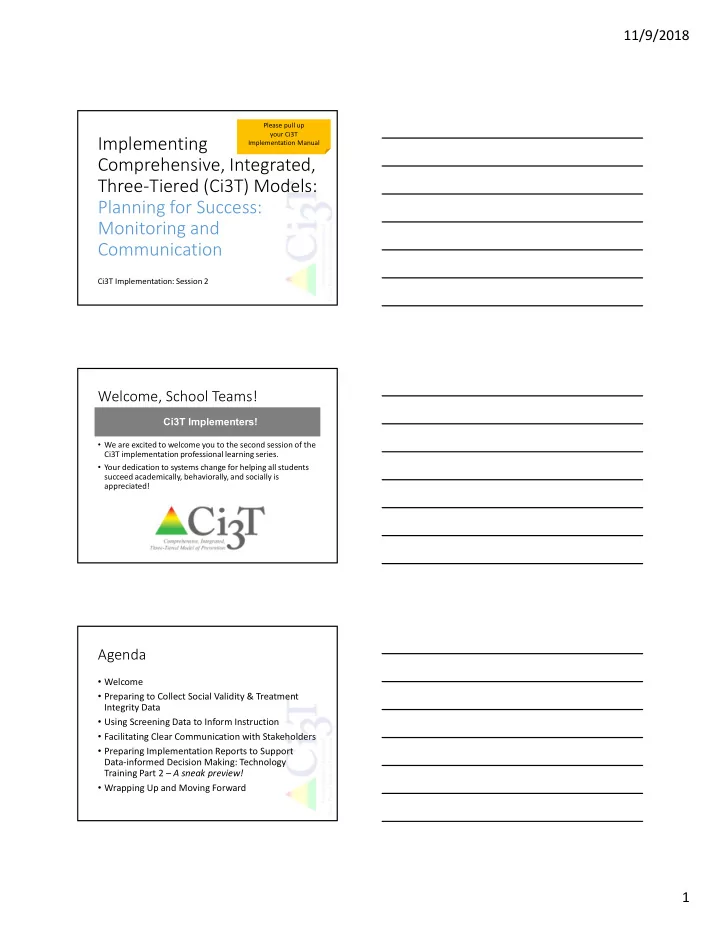
11/9/2018 Please pull up Please pull up your Ci3T your Ci3T Implementing Implementation Manual Implementation Manual Comprehensive, Integrated, Three-Tiered (Ci3T) Models: Planning for Success: Monitoring and Communication Ci3T


slide-1
SLIDE 1

11/9/2018 1

Implementing Comprehensive, Integrated, Three-Tiered (Ci3T) Models: Planning for Success: Monitoring and Communication

Ci3T Implementation: Session 2

Please pull up your Ci3T Implementation Manual Please pull up your Ci3T Implementation Manual

Welcome, School Teams!

  • We are excited to welcome you to the second session of the

Ci3T implementation professional learning series.

  • Your dedication to systems change for helping all students

succeed academically, behaviorally, and socially is appreciated!

Ci3T Implementers!

Agenda

  • Welcome
  • Preparing to Collect Social Validity & Treatment

Integrity Data

  • Using Screening Data to Inform Instruction
  • Facilitating Clear Communication with Stakeholders
  • Preparing Implementation Reports to Support

Data-informed Decision Making: Technology Training Part 2 – A sneak preview!

  • Wrapping Up and Moving Forward
slide-2
SLIDE 2

11/9/2018 2

Sep Oct Nov Dec Jan Feb Mar Apr May

KU Ci3T Day 1 11/13/18 5:00- 7:00PM KU Ci3T Day 2 12/05/18 8:00AM- 4:00PM KU Ci3T Day 3 01/15/19 5:00- 7:00PM KU Ci3T Day 4 02/12/19 8:00AM- 4:00PM KU Ci3T Day 5 04/03/19 5:00- 7:00PM KU Ci3T Day 6 05/09/19 8:00AM- 4:00PM KU Ci3T IMP Day 1 09/19/18 KU Ci3T IMP Day 2 11/14/18 KU Ci3T IMP Day 3 01/16/19 KU Ci3T IMP Day 4 03/19/19 KU Ci3T IMP Day 5 04/02/19 Technology Training Day 1 09/20/18 9:00AM- 12:00PM Technology Training Day 2 11/28/18 5:00- 7:00PM TOT Coaching Call Session 1 09/20/18 TOT Coaching Call Session 2 11/16/18 TOT Coaching Call Session 3 12/07/18 TOT Coaching Call Session 4 01/17/19 TOT Coaching Call Session 5 02/13/19 TOT Coaching Call Session 6 03/21/19 TOT Coaching Call Session 7 04/04/19 TOT Coaching Call Session 8 05/03/19 KU Ci3T EMPOWER Session 1 10/03/18 KU Ci3T EMPOWER Session 2 11/15/18 KU Ci3T EMPOWER Session 3 01/24/19 KU Ci3T EMPOWER Session 4 03/20/19 KU Ci3T EMPOWER Session 5 04/17/19 KU Ci3T TRAINING KU Ci3T TRAINING KU Ci3T IMPLEMENTATION 5:00-7:00 PM KU Ci3T IMPLEMENTATION 5:00-7:00 PM Trainer of Trainers Coaching Calls 4:00-5:30 PM Trainer of Trainers Coaching Calls 4:00-5:30 PM KU Project EMPOWER 5:00-7:00 PM KU Project EMPOWER 5:00-7:00 PM

Upcoming Professional Development

Wrap Up and Preview

Last Session Review

  • Gained an understanding
  • f
  • long-range planning
  • conducting effective

meetings

  • communicating with

stakeholders

  • Reviewed rollout of and

implementation procedures for

  • teaching, reinforcing, and

monitoring the academic, behavior, and social skills components of your Ci3T model of prevention

Today’s Preview

  • Prepare to collect social

validity and treatment integrity data

  • Use screening data to

inform instruction at Tier 1, Tier 2, and Tier 3

  • Communication with all

stakeholders:

  • District
  • Ci3T Leadership Team
  • Faculty and staff
  • Students, parents,

community

Log on to dropbox.com

OPEN:

  • IM18 Ci3T Leadership Team Meeting Agenda TEMPLATE
  • 1. Click the file to start a preview
  • 2. Click “Open” in the top right corner, which allows

multiple people to edit together online

slide-3
SLIDE 3

11/9/2018 3

Using Dropbox

As you work on documents from Dropbox today:

  • Edit files in Word Online for simultaneous collaboration with your

team

  • Copy and rename files so your school initials are at the beginning

and today’s date is at the end of the file name.

  • XXES IM18 Ci3T Leadership Team Meeting Agenda YYYY MM DD.docx

Welcome

Please pull up your Ci3T Implementation Manual 2018-2019

IM18 Ci3T Leadership Team Meeting Agenda TEMPLATE

Predictability

slide-4
SLIDE 4

11/9/2018 4

Academic

Behavioral

Social

Validated Curricula PBIS Framework Validated Curricula Goal: Reduce Harm Specialized individual systems for students with high risk Goal: Reverse Harm Specialized group systems for students at risk Goal: Prevent Harm School/classroom-wide systems for all students, staff, & settings

(Lane, Kalberg, & Menzies, 2009)

Comprehensive, Integrated, Three-Tiered Model of Prevention

Preparing to Collect Social Validity & Treatment Integrity Data

slide-5
SLIDE 5

11/9/2018 5

Systematic Screening

Academic Behavior

Treatment Integrity Social Validity

Essential Components of Primary Prevention Efforts

Ci3T Primary Plan Procedures for Monitoring: Elementary

Social Validity

slide-6
SLIDE 6

11/9/2018 6

Social Validity: Primary Intervention Rating Scale

Ensure all faculty and staff receive an emailed link to Qualtrics for the PIRS and TSR surveys

Year of Implementation Fall Spring n % (SD) n % (SD) 2017-2018 39 92.41 (8.46) 37 92.92 (7.53)

Social Validity: PIRS Results

Social validity refers to the level of:

  • Social significance of intervention goals
  • Social acceptability of intervention procedures
  • Social importance of intervention outcomes

(Wolf, 1978)

Treatment Integrity

slide-7
SLIDE 7

11/9/2018 7

Is Ci3T Being Implemented as Planned?

Three measures of treatment integrity:

  • 1. Ci3T Treatment Integrity: Teacher Self-Report

(Ci3T TI: TSR)

  • 2. Ci3T Treatment Integrity: Direct Observation

(Ci3T TI: DO)

  • 3. School-wide Evaluation Tool (SET)

CC0 No rights reserved

Teacher Self-Report (Ci3T TI: TSR)

Faculty and staff receive an emailed link to a Qualtrics survey

Ci3T Treatment Integrity: Teacher Self-Report (Ci3T TI: TSR)

  • 38-item checklist with procedures for
  • Teaching
  • Reinforcing
  • Monitoring
  • Timepoint: beginning of the year until current date
  • Likert-type scale ranging from
  • 0 = no, not at all

○ 1 = yes, some of the time

  • 2 = yes, most of the time
  • 3 = yes, all of the time
  • Comments
slide-8
SLIDE 8

11/9/2018 8

Ci3T Treatment Integrity Direct Observation (Ci3T TI: DO)

  • Subset of Ci3T TI: TSR
  • 13 procedures for teaching
  • 8 procedures for reinforcing
  • Stratified, random selection of educators
  • Personnel who directly instruct students
  • Observers trained to criterion
  • 30-min observations
  • Teacher perspective
  • Observer perspective

CC0 No rights reserved

Treatment Integrity: Teacher Self-Report and Direct Observation Results

Treatment Integrity Procedures Teacher Self-Report Mean (SD) Direct Observation Fall 2018 Mean (SD) Direct Observation Spring 2019 Mean (SD) Fall 2018 n = 39 Spring 2019 n = 38 Educator n = 13 Observer n = 13 Educator n = 10 Observer n = 13 Teaching 85.08% (11.21) 90.21% (8.54) 91.07% (7.81) 89.41% (7.48) 90.03% (6.13) 87.30% (8.84) Reinforcing 84.70% (12.65) 86.58% (10.89) 87.86% (10.55) 64.87% (18.19) 82.97% (16.81) 61.37% (18.38) Monitoring 79.01% (21.35) 87.84% (13.20)

  • Total

83.09% (12.68) 88.47% (8.80) 90.16% (7.73) 81.62% (8.28) 87.86% (8.13) 79.42% (9.13)

2018-2019

  • Note. Monitoring procedures are not observed. A subset of observable teaching and reinforcement

procedures are identified for observation. (-) = not applicable.

Treatment Integrity: School-wide Evaluation Tool (SET; Version 2.0)

(Todd, Lewis-Palmer, Horner, Sugai, Sampson, & Phillips, 2012)

  • Measures 7 subscales representing core

components of school-wide positive behavioral interventions and supports (PBIS)

  • Scores reported in each subscale and an overall

total score.

  • Includes the collection of products as well as brief

interviews with administrator, faculty & staff, and students.

slide-9
SLIDE 9

11/9/2018 9

  • Interviews
  • Administrator
  • 10-15 randomly selected staff
  • A minimum of 3 Ci3T Leadership Team members
  • 15 Randomly selected students
  • Observations/Walk-through
  • School rules posted in 10 locations
  • Crisis procedure posted in 7 locations
  • Permanent products

Administering the SET

Download SET Manual and SET training at pbis.org (http://www.pbis.org/evaluation/evaluation-tools)

Treatment Integrity: SET Results – Lincoln Elementary School

Category Total Points Earned Total Points Possible % Earned Fall 2017 Spring 2018 Fall 2017 Spring 2018

Expectations Defined

3 4 4 75 100

Behavioral Expectations Taught

8 10 10 80 100

On-going System for Rewarding Behavioral Expectations

5 6 6 83.33 100

System for Responding to Behavioral Violations

5 6 8 62.50 75

Monitoring & Decision- Making

8 8 8 100 100

Management

15 14 16 93.75 87.50

District-Level Support

4 4 4 100 100

TOTAL SCORE

Goal: 80% on Behavioral Expectations Taught and Overall Scores 84.94 94.64

slide-10
SLIDE 10

11/9/2018 10

Treatment Integrity: SET Results

20 40 60 80 100 Expectations Defined Behavioral Expectations Taught On-going System for Rewarding Behavioral Expectations System for Responding to Behavioral Violations Monitoring & Decision-Making Management District-Level Support Total Score Fall 2017 Spring 2018

Percentage of Points Earned

  • 50 item self-report
  • Ci3T Leadership Team members

complete the measure 2x per year (during treatment integrity window)

  • Scores predict fidelity and

sustainability of implementation

  • f tiered models
  • Available from pbis.org

Schoolwide Universal Behavior Sustainability Index: School Teams (SUBSIST)

Data to support sustainability of system change

Sharing Data with Faculty and Staff

slide-11
SLIDE 11

11/9/2018 11

Sharing Data with Faculty and Staff

Templates available at ci3t.org/imp

Reflect & Plan!

Let’s talk… And make plans!

  • How you will use these data?
  • How and when you will share these data with

your full faculty and staff?

Let’s talk… And make plans!

  • How you will use these data?
  • How and when you will share these data with

your full faculty and staff?

Time point Open Date Close Date Fall 10/15/18 11/20/18 Spring 2/11/19 3/22/19

Using Screening Data to Inform Instruction

Considerations for

  • Primary (Tier 1) Prevention Efforts
  • Teacher-Delivered, Low-Intensity Supports
  • Secondary (Tier 2) and Tertiary (Tier 3) Supports
slide-12
SLIDE 12

11/9/2018 12

Starting the year with Ci3T… Screening Practices

  • District system …
  • Preparing…
  • Previewing …
  • Dedicating time …
  • Reminding …
  • Supporting …
  • Following through …
  • Summarizing …
  • Using data to inform

instruction...

Academic Screening: Reading and Math Benchmarks

READING

Grade: % (n) of Students Teacher: Benchmark Strategic Intensive Fall x% (n = x) x% (n = x) x% (n = x) Winter x% (n = x) x% (n = x) x% (n = x) Spring x% (n = x) x% (n = x) x% (n = x)

Set Goal By spring, % will be at benchmark on reading screening measures.

MATH

Set Goal By spring, % will be at benchmark on math screening measures.

Grade: % (n) of Students Teacher: Benchmark Strategic Intensive Fall x% (n = x) x% (n = x) x% (n = x) Winter x% (n = x) x% (n = x) x% (n = x) Spring x% (n = x) x% (n = x) x% (n = x)

slide-13
SLIDE 13

11/9/2018 13

Academic Screening Data

20 40 60 80 100 Fall Winter Spring

58.78 63.21 64.22 26.28 18.53 21.22 14.94 18.26 14.56

Screening Time Point

2015-2016 District-wide Fifth Grade – Oral Reading Fluency (AIMSweb)

Intensive Strategic Benchmark 20 40 60 80 100 Fall Winter Spring

59.86 61.01 64.19 26.86 23.14 22.66 13.29 15.85 13.15

Percentage of Students Screening Time Point

2014-2015 District-wide Fifth Grade – Oral Reading Fluency (AIMSweb) n = 723, 723, 721 n = 700, 713, 768

SRSS-IE: Cut Scores

  • Enter ‘practice’ data into that one sheet so that the total scores and conditional

formatting are tested.

  • Confirm the “Count” column is completed (students’ numbered sequentially).

Formulas are anchored by the “Count” column; it must contain a number for each student listed for accurate total formulas.

Elementary School Middle and High School SRSS-E7 SRSS-I5 SRSS-E7 SRSS-I6 Items 1-7 Items 8-12 Items 1-7 Items 4, 8-12 0-3 = low risk 4-8 = moderate risk 9-21 = high risk 0-1 = low risk 2-3 = moderate risk 4-15 = high risk 0-3 = low risk 4-8 = moderate risk 9-21 = high risk 0-3 = low risk 4-5 = moderate risk 6-18 = high risk

Elementary School Level: Lane, K. L., Oakes, W. P., Swogger, E. D., Schatschneider, C., Menzies, H., M., & Sanchez, J. (2015). Student risk screening scale for internalizing and externalizing behaviors: Preliminary cut scores to support data-informed decision making. Behavioral Disorders, 40, 159-170. Middle and High School Levels: Lane, K. L., Oakes, W. P., Cantwell, E. D., Schatschneider, C., Menzies, H., Crittenden, M., & Messenger, M. (in press). Student Risk Screening Scale for Internalizing and Externalizing Behaviors: Preliminary cut scores to support data-informed decision making in middle and high schools. Behavioral Disorders.

SRSS-E7 Results – All Students

Elementary School - Fall

0% 20% 40% 60% 80% 100% F14 F15 F16 F17 69.25% 85.47% 77.16% 84.16% 23.82% 9.97% 17.59% 11.88% 6.93% 4.56% 5.25% 3.96% % of Students Screened Screening Time Point Low Risk (0-3) Moderate (4-8) High (9-21) N = 25 N = 86 N = 250 N = 16 N = 35 N = 300 N = 17 N = 57 N = 250 N = 12 N = 36 N = 255

slide-14
SLIDE 14

11/9/2018 14

SRSS-I5 Results – All Students

Elementary School - Fall

0% 20% 40% 60% 80% 100% F14 F15 F16 F17 56.51% 82.34% 80.56% 76.24% 23.55% 12.25% 13.89% 13.20% 19.94% 5.41% 5.56% 10.56% % of Students Screened Screening Time Point Low Risk (0-1) Moderate (2-3) High (4-15) N = 19 N = 72 N = 85 N = 204 N = 43 N = 289

N = 45 N = 261 N = 18 N = 40 N = 231 N = 32

Screening …

Considering the Logistics & Ci3T in Action

ci3t.org/screening

slide-15
SLIDE 15

11/9/2018 15

Protocols

Screening Protocol Example Site-level Coaching Protocol Example

Screening Results

Elementary Screening Middle and High School

Sharing Screening Results with your Staff!

Using Screening Data to Inform Instruction

Considerations for

  • Primary (Tier 1) Prevention Efforts
  • Teacher-Delivered, Low-Intensity Supports
  • Secondary (Tier 2) and Tertiary (Tier 3) Supports

see Lane, Menzies, Bruhn, and Crnobori (2011)

slide-16
SLIDE 16

11/9/2018 16

Academic Screening Measures

Use the selected tool’s technical manual(s) or

  • nline systems to apply cut scores for decision

making

20 40 60 80 100 Fall Winter Spring 52 31 17 Percentage of Students Screening Time Point

2015-2016 Elementary School Fourth Grade – Oral Reading Fluency

Intensive Strategic Benchmark

Social Skills Improvement System – Performance Screening Guide Spring 2012 – Total School

0% 10% 20% 30% 40% 50% 60% 70% 80% 90% 100%

Reading Skills Math Skills Prosocial Behavior Motivation to Learn

43.35 47.96 56.12 55.42 45.60 47.55 36.73 38.24 11.04 4.49 7.14 6.34 Percent of Students Subscales Adequate progress Moderate Difficulties Significant Difficulties

N = 54 N = 223 N = 212

n = 489 n = 490 n = 490 n = 489

N = 22 N = 233 N = 235 N = 35 N = 180 N = 275 N = 31 N = 187 N = 271

Student Risk Screening Scale Middle School Fall 2004 - Fall 2011

77.00% 86.00% 86.00% 89.79% 93.08% 90.55% 92.56% 94.06% 17.00% 11.00% 11.00% 7.87% 6.29% 7.77% 6.11% 3.71% 6.00% 3.00% 3.00% 2.34% 0.63% 1.68% 1.34% 2.23%

0% 20% 40% 60% 80% 100% Fall 2004 Fall 2005 Fall 2006 Fall 2007 Fall 2008 Fall 2009 Fall 2010 Fall 2011 High Moderate Low

Fall Screeners n = 12 n = 20 n = 507 Percentage of Students

N=534 N=502 N=454 N=476 N=477 N=470 N=524 N= 539

Lane & Oakes

slide-17
SLIDE 17

11/9/2018 17

SRSS Results – All Students

Example Middle School: Spring

0% 20% 40% 60% 80% 100% S15 S16 S17 S18 71.36% 81.47% 18.87% 13.63% 9.77% 4.90% % of Students Screened Screening Time Point Low Risk (0-3) Moderate (4-8) High (9-21)

N = 604

N = 59 N = 114 N = 431 *102 students not screened N = 32 N = 89 N = 532

SRSS Comparison by Grade Level Example Middle School: Spring 2015

Grade Level N = 604 Screened Low (0-3) Moderate (4-8) High (9-21)

6th 214 156 (72.90%) 39 (18.22%) 19 (8.88%) 7th 195 146 (74.87%) 34 (17.44%) 15 (7.69%) 8th 195 129 (66.15%) 41 (21.03%) 25 (12.82%)

*102 students not screened

First Grade Illustration: Academic (Curriculum-Based Measurement) and Behavior (Student Risk Screening Scale) Screeners

Kalberg, J. R., Lane, K. L., & Menzies, H. M. (2010). Using systematic screening procedures to identify students who are nonresponsive to primary prevention efforts: Integrating academic and behavioral measures. Education and Treatment of Children, 33(4), 561-584.

slide-18
SLIDE 18

11/9/2018 18

Second Grade Illustration: Academic (Curriculum-Based Measurement) and Behavior (Student Risk Screening Scale & Systematic Screening for Behavior Disorder) Screeners

Kalberg, J. R., Lane, K. L., & Menzies, H. M. (2010). Using systematic screening procedures to identify students who are nonresponsive to primary prevention efforts: Integrating academic and behavioral measures. Education and Treatment of Children, 33(4), 561-584.

Let’s talk… And make plans!

  • Discuss and list questions on

screening procedures.

Using Screening Data to Inform Instruction

Considerations for

  • Primary (Tier 1) Prevention Efforts
  • Teacher-Delivered, Low-Intensity Supports
  • Secondary (Tier 2) and Tertiary (Tier 3) Supports

see Lane, Menzies, Bruhn, and Crnobori (2011)

slide-19
SLIDE 19

11/9/2018 19

Consider this class….

Classroom Management Practices

  • Classroom

Climate

  • Physical Room

Arrangement

  • Routines and

Procedures

  • Managing

Paper Work

Low-Intensity Strategies

Opportunities to Respond Behavior- Specific Praise Active Supervision Instructional Feedback High p Requests Precorrection Incorporating Choice

Comprehensive, Integrative, Three-Tiered (Ci3T) Models of Support Assess, Design, Implement, and Evaluate Basic Classroom Management Effective Instruction Low-Intensity Strategies Behavior Contracts Self-Monitoring

  • -

Functional Assessment-Based Interventions

Schoolwide Positive Behavior Support Low-Intensity Strategies Higher-Intensity Strategies Assessment
Opportunities to Respond Behavior Specific Praise Active Supervision Instructional Feedback High p Requests Precorrection Incorporating Choice

Low-Intensity Strategies: Building capacity through professional learning

Self-Monitoring Behavior Contracts

slide-20
SLIDE 20

11/9/2018 20

Professional Learning! www.ci3t.org/pl

Low-Intensity Strategy Lincoln Elementary On-Site Expert Behavior-Specific Praise: Identifying the specific expectation the student met.

  • “Niama, great job using your graphic
  • rganizer to draft your essay.”
  • “Justice, thank you for pushing in your

chair to keep the walkway safe.”

  • Eric Common, Behavior Specialist
  • Mark Buckman, Special Education
  • Grant Allen, Parent Volunteer

Opportunities to Respond: Providing 4-6

  • pportunities per minute for students to

respond individually, choral, verbal, written, gesture, or symbol.

  • “Show me thumbs or thumbs down if...”
  • “Show me on your white board what…”
  • “Turn to your elbow partner and say…”
  • “All together now, what is…”
  • David Royer, Administration
  • Emily Cantwell, 5th Grade
  • Scarlett Lane, 3rd Grade
  • Mallory Messenger, Counselor

Instructional Choice: Providing within-task

  • r between task choices to increase

academic engaged time and motivation.

  • “Ronaldo, of these 3 tasks today, which

would you like to work on first?”

  • “Suzy, do you want to work with

colored pencils, crayons, or sparkly markers?”

  • Abbie Jenkins, 2nd Grade
  • Scarlett Lane, 3rd Grade
  • Bryan Simmons, PE
  • Liane Johl, Kindergarten

Using Screening Data to Inform Instruction

Considerations for

  • Primary (Tier 1) Prevention Efforts
  • Teacher-Delivered, Low-Intensity Supports
  • Secondary (Tier 2) and Tertiary (Tier 3) Supports

see Lane, Menzies, Bruhn, and Crnobori (2011)

slide-21
SLIDE 21

11/9/2018 21

Academic

Behavioral

Social

Validated Curricula PBIS Framework Validated Curricula

(Lane, Kalberg, & Menzies, 2009)

Comprehensive, Integrated, Three-Tiered Model of Prevention

Secondary (Tier 2) Intervention Grids

Comprehensive, Integrative, Three-Tiered (Ci3T) Models of Support Assess, Design, Implement, and Evaluate Basic Classroom Management Effective Instruction Low-Intensity Strategies Behavior Contracts Self-Monitoring

  • -

Functional Assessment-Based Interventions

Schoolwide Positive Behavior Support Low-Intensity Strategies Higher-Intensity Strategies Assessment

Building a Ci3T Tier Library

Teacher-Delivered Strategies (T1 T2) Tier 1 Tier 3 Tier 2

slide-22
SLIDE 22

11/9/2018 22

An illustration

Support Description Schoolwide Data: Entry Criteria Data to Monitor Progress: Exit Criteria Small group reading instruction with self- monitoring Small group reading instruction (30 min, 3 days per week). Students monitored their participation in the reading instructional

  • tasks. Students

used checklists

  • f reading lesson

components each day to complete and compare to teachers’ rating. K – 1. Students who: Behavior: Fall SRSS at moderate (4-8) or high (9-21) risk Academic: Fall AIMSweb LNF at the strategic or intensive level AIMSweb reading PSF and NWF progress monitoring probes (weekly). Daily self- monitoring checklists Treatment Integrity Social Validity Meet AIMSweb reading benchmark at next screening time point. Low Risk on SRSS at next screening time point.

slide-23
SLIDE 23

11/9/2018 23

Small group Reading Instruction with Self- Monitoring

Lane, K.L., & Oakes, W. P. (2012). Identifying Students for Secondary and Tertiary Prevention Efforts: How do we determine which students have Tier 2 and Tier 3 needs? In preparation.

First Grade Students’ Self Monitoring Form

Altmann, S. A. (2010). Project support and include: the additive benefits of self-monitoring on students’ reading acquisition. Unpublished master’s thesis, Vanderbilt University.

Treatment Integrity Social Validity Monitor student progress

Altmann, S. A. (2010). Project support and include: the additive benefits of self-monitoring on students’ reading acquisition. Unpublished master’s thesis, Vanderbilt University.

slide-24
SLIDE 24

11/9/2018 24

Instructional Choice

ci3t.org/pl

Support Description School-wide Data: Entry Criteria Data to Monitor Progress Exit Criteria Daily Behavior Report (DBR) Card DBR will be completed by the classroom teacher during daily observation periods (e.g., core instruction during English Language Arts) and parents will sign the form each day. DBR will be used to rate academic engagement, respect, and disruption. At the conclusion of each

  • bservation period, the

teacher will indicate the degree to which the student displayed each behavior. The teacher will meet briefly with the student to share the teacher’s DBR rating and home-school communication procedures will be established for student to bring a paper copy or email to parent or caregiver each day DBR was implemented for a parent/caregiver to sign. Behavior  SRSS-E7 score: Moderate (4-8) and/or  SRSS-I5 score: Moderate (2-3) AND  Evidence of teacher implementation of Ci3T primary (Tier 1) plan [treatment integrity: direct

  • bservation]

AND  Parent permission AND Academic  Student is in grade 2

  • r 3

Student measures  Daily behavior report (DBR; daily)  Attendance and tardies Social validity  Teacher: IRP-15  Student: CIRP Treatment integrity  Tier 2 treatment integrity measures  Ci3T TI: Direct

  • bservation (30

min if needed)  Review student progress at end of 24 sessions  Team agrees goals have been met or no further Positive Action small group sessions are warranted  SRSS-E7 and I5 scores are in the low risk category

Daily Behavior Report Cards

http://dbr.education.uconn.edu/

Support Description School-wide Data: Entry Criteria Data to Monitor Progress Exit Criteria Positive Action (PA) – counselor-led small group Counselors and/or social workers will lead small group Positive Action sessions for approximately 30-40 min 2-3 days per week. Students will acquire new skills, learn how to engage more fully in instructional experiences, and learn how to meet more school- wide expectations. Small groups will run for up to 24 sessions (8 to 12 weeks depending on the number of sessions conducted per week) using a subset of Positive Action lessons appropriate for student skillsets as identified using Skills For Greatness (teacher, counselor, parent versions) and SSiS-Rating Scale (teacher and parent version). Behavior  SRSS-E7 score: Moderate (4-8) and/or  SRSS-I5 score: Moderate (2-3) AND  2 or fewer absences in first 3 months of school AND  Evidence of teacher implementation of Ci3T primary (Tier 1) plan [treatment integrity: direct observation] AND  Parent permission AND Academic  Student is in grade 2 or 3 Student measures  SSiS-Rating Scale (Pre/Post)  Skills for Greatness (Pre/Post)  Daily behavior report (DBR; daily)  Attendance and tardies Social validity  Teacher: IRP-15  Student: CIRP Treatment integrity  Tier 2 treatment integrity measures  Ci3T TI: Direct

  • bservation (30 min

if needed)  Review student progress at end

  • f 24 sessions

 Team agrees goals have been met or no further Positive Action small group sessions are warranted  SRSS-E7 and I5 scores are in the low risk category

Positive Action: Tier 2 Groups

slide-25
SLIDE 25

11/9/2018 25

Support Description Schoolwide Data: Entry Criteria Data to Monitor Progress: Exit Criteria READ 180 (Stage C) Reading Intervention Students participate in a 50 min reading instructional block during their study hall period. Students meet in the computer lab for participation in the online portion 20 min daily. Instruction is relevant to high school students. Students use a progress management system to monitor and track their own progress. Instruction is taught by special education teachers and general education teachers with training in the READ 180 Curriculum. (1) Students in grades 9 – 12. (2) Reading performance basic

  • r below basic on

state assessment (but above 4th grade reading level). (3) SRSS risk scores in the moderate range (4 – 8).

Student Measures: Meeting individual READ 180 reading goals: (1) Progress Monitoring with Scholastic Reading Inventory (2) Writing Assessments (3) formative assessments (vocabulary, comprehension and spelling) (4) Curriculum-based Assessments (5) Attendance in class Treatment Integrity: Teachers monitor performance and attendance in class. Completion of weekly checklists for activities completed. Social Validity: Students and teachers complete surveys

Students meet instructional reading goals. SRSS score in the low risk category (0 – 3) on the next screening time point.

Lane, K. L., Oakes, W. P., Menzies, H. M., Oyer, J., & Jenkins, A. (2013). Working within the context of three-tiered models of prevention: Using school wide data to identify high school students for targeted

  • supports. Journal of Applied School Psychology, 29, 203-229.

Support Description Schoolwide Data: Entry Criteria Data to Monitor Progress: Exit Criteria Mentoring Program (Sophomores/ Juniors/ Seniors) Focus is on academic achievement, character development, problem- solving skills, improving self-esteem, relationships with adults and peers, and school attendance. Volunteer teachers serve as mentors; meeting weekly (30 – 60 min) with students during the school day. (1) 10th/11th/ 12th graders (2) Behavior: SRSS: High (9-21)

  • r Moderate (4-8)

by either 2nd or 7th period teacher ODR ≥ 2 Absences ≥ 5 days in one grading period (3) Academic: GPA ≤ 2.75 Student Measures: (1) Increase of GPA at mid-term and semester report cards. (2) Decrease of ODR monitored weekly. (3) Reduced absences (fewer than one per quarter) Treatment Integrity: Mentors complete weekly mentoring checklists to report meeting time and activities. Social Validity: Pre and post surveys for students and mentors. Yearlong support Students who no longer meet criteria next fall Seniors: graduation

Lane, K. L., Oakes, W. P., Menzies, H. M., Oyer, J., & Jenkins, A. (2013). Working within the context of three-tiered models of prevention: Using school wide data to identify high school students for targeted

  • supports. Journal of Applied School Psychology, 29, 203-229.

Comprehensive, Integrative, Three-Tiered (Ci3T) Models of Support Assess, Design, Implement, and Evaluate Basic Classroom Management Effective Instruction Low-Intensity Strategies Behavior Contracts Self-Monitoring

  • -

Functional Assessment-Based Interventions

Schoolwide Positive Behavior Support Low-Intensity Strategies Higher-Intensity Strategies Assessment

slide-26
SLIDE 26

11/9/2018 26

Academic

Behavioral

Social

Validated Curricula PBIS Framework Validated Curricula

(Lane, Kalberg, & Menzies, 2009)

Comprehensive, Integrated, Three-Tiered Model of Prevention

Tertiary (Tier 3) Intervention Grids

Comprehensive, Integrative, Three-Tiered (Ci3T) Models of Support Assess, Design, Implement, and Evaluate Basic Classroom Management Effective Instruction Low-Intensity Strategies Behavior Contracts Self-Monitoring

  • -

Functional Assessment-Based Interventions

Schoolwide Positive Behavior Support Low-Intensity Strategies Higher-Intensity Strategies Assessment

slide-27
SLIDE 27

11/9/2018 27

Changes in Harry’s Behavior

10 20 30 40 50 60 70 80 90 100 4/27 4/28 4/29 4/30 5/5 5/10 5/13 5/14 5/17 5/18 5/19 5/20 5/21 5/24 5/25 5/26 5/27 5/28 Percentage of AET Date of Session Baseline 1 Baseline 2 Intervention 2 Intervention 1 Cox, M., Griffin, M. M., Hall, R., Oakes, W. P., & Lane, K. L. (2012). Using a functional assessment-based intervention to increase academic engaged time in an inclusive middle school setting. Beyond Behavior, 2, 44 – 54.

Let’s talk… And make plans!

  • Discuss and list questions on

using screening data to inform instruction.

Facilitating Clear Communication with Stakeholders

Communicating and Collaborating with your

  • District
  • Ci3T Leadership Team
  • Faculty and Staff
  • Students, Parents, and Community
  • Policy Makers
slide-28
SLIDE 28

11/9/2018 28

Monitoring Implementation: Develop Action Items for Communication with Stakeholders

District Ci3T Leadership Team Faculty and Staff Students, Parents, & Community

Procedures for Teaching, Reinforcing, and Monitoring

Communicating and Collaborating with your:

  • District
  • Ci3T Leadership Team
  • Faculty and Staff
  • Students, Parents, and

Community

  • Policy Makers

Communicating and Collaborating with your:

  • District
  • Ci3T Leadership Team
  • Faculty and Staff
  • Students, Parents, and

Community

  • Policy Makers

SYSTEMS PRACTICES DATA

pbis.org

Building Capacity and Sustainability

  • f Tiered Prevention Models

OUTCOMES

For Academic Achievement, Behavior, and Social Competencies Communication Structures Communication Content Communication Content

slide-29
SLIDE 29

11/9/2018 29

District Communication with Stakeholders

Let’s talk… Communication with

Stakeholders

  • How will you use these multiple sources of data

to inform professional learning for developing school capacity for low intensity strategies and tiered supports?

  • How will you use your Ci3T Team meeting time

effectively and plan to communicate with all stakeholders?

  • How will share program level data (TI and SV)

as well as student progress?

Using Treatment Integrity and Social Validity Data to Support Implementation:

Part 2 - A sneak preview!

slide-30
SLIDE 30

11/9/2018 30

Primary Intervention Rating Scale (PIRS)

Item Mean Standard Deviation The primary plan is acceptable for this school 5.42 0.49

Ci3T Treatment Integrity: Direct Observation (Ci3T TI: DO)

Wrapping Up and Moving Forward

slide-31
SLIDE 31

11/9/2018 31

Ci3T: Tertiary Prevention Ci3T: Secondary Prevention Ci3T: Primary Prevention Session 1: Overview of Ci3T Prevention Models Setting a Purpose Establish team meetings and roles Session 2: Mission and Purpose Establish Roles and Responsibilities Procedures for Teaching Procedures for Reinforcing Reactive Plan Session 3: Procedures for Monitoring Session 4: Revise Primary Plan using Stakeholder feedback Prepare presentation Session 5: Overview of Teacher focused Strategies Overview of Student Focused Strategies Using data to determine Draft the Secondary Intervention Grid based

  • n existing supports

Session 6: Final revisions of Ci3T Plan based on stakeholder feedback Draft Tertiary Prevention Intervention Grids Design Implementation Manual and Plan for roll out to faculty, students, and parents

Ci3T Training Series

Additional Professional Development on Specific Topics

Core Content Curriculum Teacher Driven Supports: Instructional Techniques to Improve Students’ Motivation; General Classroom Management Practices; Low-Intensity Behavior Supports Functional Assessment- based Interventions Reading, Math, Writing Benchmarking and Progress Monitoring Tools Student Driven Interventions, Strategies, & Practices Check In - Check Out Additional Tier 3 Supports

Ci3T Team Training Sequence

Sep Oct Nov Dec Jan Feb Mar Apr May

KU Ci3T Day 1 11/13/18 5:00- 7:00PM KU Ci3T Day 2 12/05/18 8:00AM- 4:00PM KU Ci3T Day 3 01/15/19 5:00- 7:00PM KU Ci3T Day 4 02/12/19 8:00AM- 4:00PM KU Ci3T Day 5 04/03/19 5:00- 7:00PM KU Ci3T Day 6 05/09/19 8:00AM- 4:00PM KU Ci3T IMP Day 1 09/19/18 KU Ci3T IMP Day 2 11/14/18 KU Ci3T IMP Day 3 01/16/19 KU Ci3T IMP Day 4 03/19/19 KU Ci3T IMP Day 5 04/02/19 Technology Training Day 1 09/20/18 9:00AM- 12:00PM Technology Training Day 2 11/28/18 5:00- 7:00PM TOT Coaching Call Session 1 09/20/18 TOT Coaching Call Session 2 11/16/18 TOT Coaching Call Session 3 12/07/18 TOT Coaching Call Session 4 01/17/19 TOT Coaching Call Session 5 02/13/19 TOT Coaching Call Session 6 03/21/19 TOT Coaching Call Session 7 04/04/19 TOT Coaching Call Session 8 05/03/19 KU Ci3T EMPOWER Session 1 10/03/18 KU Ci3T EMPOWER Session 2 11/15/18 KU Ci3T EMPOWER Session 3 01/24/19 KU Ci3T EMPOWER Session 4 03/20/19 KU Ci3T EMPOWER Session 5 04/17/19 KU Ci3T TRAINING KU Ci3T TRAINING KU Ci3T IMPLEMENTATION 5:00-7:00 PM KU Ci3T IMPLEMENTATION 5:00-7:00 PM Trainer of Trainers Coaching Calls 4:00-5:30 PM Trainer of Trainers Coaching Calls 4:00-5:30 PM KU Project EMPOWER 5:00-7:00 PM KU Project EMPOWER 5:00-7:00 PM

Upcoming Professional Development

Ci3T Team Implementation Support

Supporting Success: A Look at Tier 1 9/19/18 5:00-7:00 PM Planning for Success: Monitoring and Communication 11/14/18 5:00-7:00 PM Using Your Data to Inform Instruction 1/16/19 5:00-7:00 PM Supporting Students Across the Tiers 3/20/19 5:00-7:00 PM Planning for the Year Ahead 4/2/19 5:00-7:00 PM

slide-32
SLIDE 32

11/9/2018 32

SESSION 1: Setting up for Success TECHNOLOGY TRAINING PART 1: Preparing Your Data Structures SESSION 2: Monitoring and Communi- cating for Success TECHNOLOGY TRAINING PART 2: Preparing Implementa- tion Reports SESSION 3: Using Your Data to Inform Instruction SESSION 4: True Integration SESSION 5: Planning for the Year Ahead SUMMER SUPPORT

JULY JULY AUGUST AUGUST SEPTEMBER SEPTEMBER OCTOBER OCTOBER NOVEMBER NOVEMBER DECEMBER DECEMBER JANUARY JANUARY FEBRUARY FEBRUARY MARCH MARCH APRIL APRIL MAY MAY JUNE JUNE

Fall T.I. Window (4 wks) October November 4th Monday – 3rd Friday

Ci3T Professional Learning Series

Spring T.I. Window (4 wks) February March 2nd Monday – 2nd Friday

Academic

Behavioral

Social

Validated Curricula PBIS Framework Validated Curricula Goal: Reduce Harm Specialized individual systems for students with high risk Goal: Reverse Harm Specialized group systems for students at risk Goal: Prevent Harm School/classroom-wide systems for all students, staff, & settings

(Lane, Kalberg, & Menzies, 2009)

Comprehensive, Integrated, Three-Tiered Model of Prevention

Let’s talk… And make plans!

  • 1. What did I learn?
  • 2. How will I take this information back

to my faculty, staff, and parents?

slide-33
SLIDE 33

11/9/2018 33

Please Take a Minute to Get Organized

Please stay until all materials are organized.

  • Team Materials:
  • Save all documents with your school initials at the

beginning and the date at the end of the file name.

  • XXS IM18 Ci3T Leadership Team Meeting Agenda YYYY MM DD.docx
  • Save to your school’s Dropbox folder
  • Clearly identify the person(s) on your team

in charge of each action item listed on the agenda.

Wrap Up and Preview

Today’s Review

  • Prepare to collect social

validity and treatment integrity data

  • Use screening data to

inform instruction at Tier 1, Tier 2, and Tier 3

  • Communicate with all

stakeholders:

  • District
  • Ci3T Leadership Team
  • Faculty and staff
  • Students, parents,

community

Next Session Preview

  • Reviewing your

implementation data

  • Using your data to

support your faculty and staff

  • Using your data to

support students

Sep Oct Nov Dec Jan Feb Mar Apr May

KU Ci3T Day 1 11/13/18 5:00- 7:00PM KU Ci3T Day 2 12/05/18 8:00AM- 4:00PM KU Ci3T Day 3 01/15/19 5:00- 7:00PM KU Ci3T Day 4 02/12/19 8:00AM- 4:00PM KU Ci3T Day 5 04/03/19 5:00- 7:00PM KU Ci3T Day 6 05/09/19 8:00AM- 4:00PM KU Ci3T IMP Day 1 09/19/18 KU Ci3T IMP Day 2 11/14/18 KU Ci3T IMP Day 3 01/16/19 KU Ci3T IMP Day 4 03/19/19 KU Ci3T IMP Day 5 04/02/19 Technology Training Day 1 09/20/18 9:00AM- 12:00PM Technology Training Day 2 11/28/18 5:00- 7:00PM TOT Coaching Call Session 1 09/20/18 TOT Coaching Call Session 2 11/16/18 TOT Coaching Call Session 3 12/07/18 TOT Coaching Call Session 4 01/17/19 TOT Coaching Call Session 5 02/13/19 TOT Coaching Call Session 6 03/21/19 TOT Coaching Call Session 7 04/04/19 TOT Coaching Call Session 8 05/03/19 KU Ci3T EMPOWER Session 1 10/03/18 KU Ci3T EMPOWER Session 2 11/15/18 KU Ci3T EMPOWER Session 3 01/24/19 KU Ci3T EMPOWER Session 4 03/20/19 KU Ci3T EMPOWER Session 5 04/17/19 KU Ci3T TRAINING KU Ci3T TRAINING KU Ci3T IMPLEMENTATION 5:00-7:00 PM KU Ci3T IMPLEMENTATION 5:00-7:00 PM Trainer of Trainers Coaching Calls 4:00-5:30 PM Trainer of Trainers Coaching Calls 4:00-5:30 PM KU Project EMPOWER 5:00-7:00 PM KU Project EMPOWER 5:00-7:00 PM

Upcoming Professional Development

slide-34
SLIDE 34

11/9/2018 34

Homework

  • Collect fall social validity and treatment integrity data

At your next Ci3T Leadership Team meeting:

  • Use IM18 Ci3T Leadership Team Meeting Agenda to conduct

an effective meeting with

  • clearly defined roles and responsibilities of team members
  • action items, persons responsible, and due dates
  • Create implementation reports to bring to January

professional learning session

  • Create screening reports to bring to January professional

learning session

At your next faculty meeting:

  • Share successes
  • Review implementation procedures
  • Consider providing time for PIRS and TSR survey completion
  • Consider providing time for screener completion