Implementation: Directory key ideas A file that contains a - - PowerPoint PPT Presentation

implementation directory key ideas
SMART_READER_LITE
LIVE PREVIEW

Implementation: Directory key ideas A file that contains a - - PowerPoint PPT Presentation

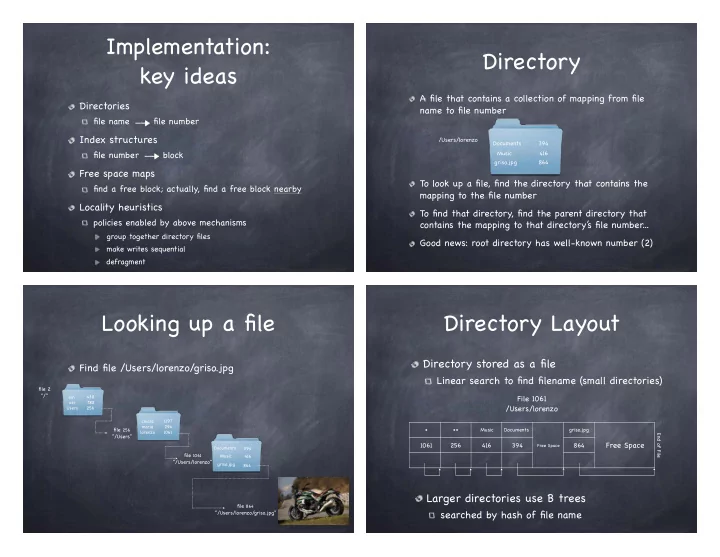
Implementation: Directory key ideas A file that contains a collection of mapping from file Directories name to file number file name file number Index structures /Users/lorenzo Documents 394 file number block Music 416 griso.jpg


slide-1
SLIDE 1

Implementation: key ideas

Directories

file name file number

Index structures

file number block

Free space maps

find a free block; actually, find a free block nearby

Locality heuristics

policies enabled by above mechanisms

group together directory files make writes sequential defragment

Directory

A file that contains a collection of mapping from file name to file number To look up a file, find the directory that contains the mapping to the file number To find that directory, find the parent directory that contains the mapping to that directory’ s file number... Good news: root directory has well-known number (2)

Documents Music griso.jpg 394 416 864 /Users/lorenzo

Find file /Users/lorenzo/griso.jpg

Looking up a file

file 2 “/”

bin 438 usr Users 256 782 chiara 1197 maria lorenzo 1061 294

file 256 “/Users” file 1061 “/Users/lorenzo”

Documents griso.jpg 394 416 864 Music

file 864 “/Users/lorenzo/griso.jpg”

Directory Layout

Directory stored as a file

Linear search to find filename (small directories)

256 416 394 864

. ..

Music

File 1061 /Users/lorenzo

Documents griso.jpg

1061

Free Space

Free Space

End of File

Larger directories use B trees

searched by hash of file name

slide-2
SLIDE 2

Finding data

Index structure provides a way to locate each of the file’ s blocks

usually implemented as a tree for scalability

Free space map provides a way to allocate free blocks

  • ften implemented as a bitmap

Locality heuristics group data to maximize access performance

Case studies

FAT late 70s; Microsoft key idea: linked list Today: flash sticks Unix FFS mid 80’ s

key idea: tree-based multi-level index Today: Linux ext2 and ext3

NTFS early 1990s; Microsoft.

Key idea: variable size extents instead of fixed size blocks Today: Windows 7, Linux ext4, Apple HFS

ZFS early 2000; open source.

Key idea: copy on write (COW)

FAT File system Microsoft, late 70s

File Allocation Table (FAT)

started with MSDOS in FAT-32, supports 228 blocks and files of 232-1 bytes

file 9 block 3 file 9 block 0 file 9 block 1 file 9 block 2 file 12 block 0 file 12 block 1 file 9 block 4

FAT Data blocks

1 2 3 4 5 6 7 8 9 10 11 12 13 14 15 16 17 18 20 19

Index Structures File Allocation Table (FAT) array of 32-bit entries file represented as a linked list

  • f FAT entries

file # = index of first FAT entry Free space map If data block i is free, then FAT[i] = 0 find free blocks by scanning MFT Locality heuristics As simple as next fit: scan sequentially from last allocated entry and return next free entry Can be improved through defragmentation

FAT File system Microsoft, late 70s

File Allocation Table (FAT)

started with MSDOS in FAT-32, supports 228 blocks and files of 232-1 bytes

file 9 block 3 file 9 block 0 file 9 block 1 file 9 block 2 file 12 block 0 file 12 block 1 file 9 block 4

FAT Data blocks

1 2 3 4 5 6 7 8 9 10 11 12 13 14 15 16 17 18 20 19

Advantages simple! used in many USB flash keys used even within MS Word! Disadvantages Poor locality next fit? seriously? Poor random access needs sequential traversal Limited access control no file owner or group ID metadata any user can read/write any file No support for hard links metadata stored in directory entry Volume and file size are limited FAT entry is 32 bits, but top 4 are reserved no more than 228 blocks with 4kB blocks, at most 1TB volume file no bigger than 4GB No support for transactional updates

slide-3
SLIDE 3

FFS: Fast File System

Unix, 80s

Smart index structure

multilevel index allows to locate all blocks of a file

efficient for both large and small files

Smart locality heuristics

block group placement

  • ptimizes placement for when a file data and metadata, and
  • ther files within same directory, are accessed together

reserved space

gives up about 10% of storage to allow flexibility needed to achieve locality

File structure

Each file is a fixed, asymmetric tree, with fixed size data blocks (e.g. 4KB) as its leaves The root of the tree is the file’ s inode

contains file’ s metadata

  • wner, permissions (rwx for owner, group other), type, creation time, etc

setuid: run with temporarily elevated privileges

file is executed with the permissions of the owner, not the caller add flexibility but can introduce security risks

setgid: like setuid for groups

contains a set of pointers

typically 15 first 12 point to data block last three point to intermediate blocks, themselves containing pointers

13: indirect pointer 14: double indirect pointer 15: triple indirect pointer

Multilevel index

Inode Array Inode

File metadata Data blocks

}

12 x 4KB = 48KB

indirect block

contains pointers to data blocks 4 Bytes entries

}

1K x 4KB = 4MB

double indirect block

contains pointers to indirect blocks

}

1K x 1k x 4KB = 4GB

triple indirect block

contains pointers to double indirect blocks

}

1K x 1k x 1k x 4KB = 4TB at known location on disk file number = inode number = index in the array

Multilevel index: key ideas

Tree structure

efficient in finding blocks

High degree

efficient in sequential reads

  • nce an indirect block is read,

can read 100s of data block

Fixed structure

simple to implement

Asymmetric

supports efficiently files big and small

File metadata Inode array Data blocks

slide-4
SLIDE 4

Example: variations

  • n the FFS theme

In BigFS an inode stores 4kb blocks, 8 byte pointers

12 direct pointers 1 indirect pointer 1 double indirect 1 triple indirect 1 quadruple indirect

What is the maximum size of a file?

File metadata Inode array Data blocks

Through direct pointers 12 x 4kb = 48KB Indirect pointer 512 x 4kb = 2MB Double indirect pointer 5122 x 4kb = 1GB Triple indirect pointer 5123 x 4kb = 512GB Quadruple indirect pointer 5124 x 4kb = 256TB Total = (256 + .5 + 10-6 + 2 x 10⁻⁹ + 4.8 x 10⁻¹¹) ≈ 256.5 TB

Free space management

Easy

a bitmap with one bit per storage block bitmap location fixed at formatting time i-th bit indicates whether i-th block is used or free

Locality heuristics: block group placement

Divide disk in block groups

sets of nearby tracks

Distribute metadata

  • ld design: free space bitmap and inode map in a

single contiguous region

lots of seeks when going from reading metadata to reading data

FFS: distribute free space bitmap and inode array among block groups. Keep a superblock copy in each block group

Place file in block group

when a new file is created, FFS looks for inodes in the same block as the file’ s directory when a new directory is created, FFS places it in a different block from the parent’ s directory

Place data blocks

first free heuristics trade short term for long term locality

Free s p a c e bitmap I n

  • d

e s

Block group 0 Block group 1 Block group 2

Free s p a c e b i t m a p Inodes Inodes Free s p a c e b i t m a p

Data blocks in /a /d /b/c Data blocks in /b /a/g /z for files for files Data blocks in for files /d/ q /c /a/p

SB S B SB

Locality heuristics: block group placement

Divide disk in block groups

sets of nearby tracks

Distribute metadata

  • ld design: free space bitmap and inode map in a

single contiguous region

lots of seeks when going from reading metadata to reading data

FFS: distribute free space bitmap and inode array among block groups. Keep a superblock copy in each block group

Place file in block group

when a new file is created, FFS looks for inodes in the same block as the file’ s directory when a new directory is created, FFS places it in a different block from the parent’ s directory

Place data blocks

first free heuristics trade short term for long term locality Start of block group In use Free

Free s p a c e bitmap I n

  • d

e s

Block group 0 Block group 1 Block group 2

Free s p a c e b i t m a p Inodes Inodes Free s p a c e b i t m a p

Data blocks in /a /d /b/c Data blocks in /b /a/g /z for files for files Data blocks in for files /d/ q /c /a/p

SB S B SB

slide-5
SLIDE 5

Locality heuristics: block group placement

Start of block group Small file

Divide disk in block groups

sets of nearby tracks

Distribute metadata

  • ld design: free space bitmap and inode map in a

single contiguous region

lots of seeks when going from reading metadata to reading data

FFS: distribute free space bitmap and inode array among block groups. Keep a superblock copy in each block group

Place file in block group

when a new file is created, FFS looks for inodes in the same block as the file’ s directory when a new directory is created, FFS places it in a different block from the parent’ s directory

Place data blocks

first free heuristics trade short term for long term locality

Free s p a c e bitmap I n

  • d

e s

Block group 0 Block group 1 Block group 2

Free s p a c e b i t m a p Inodes Inodes Free s p a c e b i t m a p

Data blocks in /a /d /b/c Data blocks in /b /a/g /z for files for files Data blocks in for files /d/ q /c /a/p

SB S B SB

Locality heuristics: block group placement

Start of block group Large file

Divide disk in block groups

sets of nearby tracks

Distribute metadata

  • ld design: free space bitmap and inode map in a

single contiguous region

lots of seeks when going from reading metadata to reading data

FFS: distribute free space bitmap and inode array among block groups. Keep a superblock copy in each block group

Place file in block group

when a new file is created, FFS looks for inodes in the same block as the file’ s directory when a new directory is created, FFS places it in a different block from the parent’ s directory

Place data blocks

first free heuristics trade short term for long term locality

Free s p a c e bitmap I n

  • d

e s

Block group 0 Block group 1 Block group 2

Free s p a c e b i t m a p Inodes Inodes Free s p a c e b i t m a p

Data blocks in /a /d /b/c Data blocks in /b /a/g /z for files for files Data blocks in for files /d/ q /c /a/p

SB S B SB

Locality heuristics: reserved space

When a disk is full, hard to

  • ptimize locality

file may end up scattered through disk

FFS presents applications with a smaller disk

about 10%-20% smaller user write that encroaches on reserved space fails super user still able to allocate inodes to clean things up

Free s p a c e bitmap I n

  • d

e s

Block group 0 Block group 1 Block group 2

Free s p a c e b i t m a p Inodes Inodes Free s p a c e b i t m a p

Data blocks in /a /d /b/c Data blocks in /b /a/g /z for files for files Data blocks in for files /d/ q /c /a/p

SB S B SB

FFS: A Perspective

Pros

Efficient storage for both small and large files Locality for both small and large files Locality for metadata Fixed structure lead to simple implementation

Cons

Inefficient for tiny file

need both inode and data block

Inefficient encoding for mostly contiguous files Needs 10%-20% unutilized to prevent fragmentation
slide-6
SLIDE 6

NTFS: Flexible Tree with Extents

Index structure: extents and flexible tree

extents

track ranges of contiguous blocks rather than single blocks

flexible tree

file represented by variable depth tree

large file with few extents can be stored in a shallow tree

MFT (Master File Table)

array of 1 KB records holding the trees’ roots similar to inode table (but one file can have multiple MFT entries) each record stores sequence of variable-sized attribute records

both data and metadata are attributes attributes can be resident (fit in the record) or nonresident

Microsoft, mid 90s

Example of NTFS index structure

Master File Table MFT Record

  • Std. Info

File Name Data (nonresident) free Data Extent

+ +

Data Extent

Start Length Start + Length Start Length Start + Length

file creation time access time

  • wner ID

security identifier file name and number of parent directory

  • ne file name attribute per

hard link

Basic file with two data extents

Example of NTFS index structure

Master File Table MFT Record

  • Std. Info

File Name Data (resident) free

file creation time access time

  • wner ID

security specifier file name and number of parent directory

  • ne file name attribute per

hard link

Small file where data is resident

Example of NTFS Index Structure

Master File Table MFT Record (part 1)

  • Std. Info
  • Attr. list

File name free

name name data

  • Std. Info

Data (nonresident) free File name

+

Data Extent

+

Data Extent

+

Data Extent

MFT Record (part 2)

A file’ s attributes can span multiple records

slide-7
SLIDE 7

Small, Normal, and Big Files

Master File Table

  • Std. Info ...

Data (resident)

  • Std. Info ...

Data (nonresident)

  • Std. Info
  • Attr. list

...

Data (nonresident)

  • Std. Info

Data (nonresident)

  • Std. Info

Data (nonresident)

  • Std. Info

Data (nonresident)

...and for really huge (or really badly fragmented) files, even the attribute list can become nonresident!

atribute list split in separate extents