
SLIDE 1
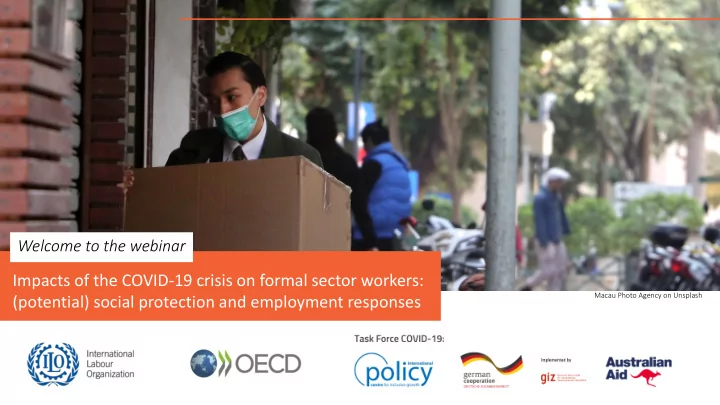
Impacts of the COVID-19 crisis on formal sector workers: (potential) social protection and employment responses
Welcome to the webinar
Macau Photo Agency on Unsplash
Impacts of the COVID-19 crisis on formal sector workers: Macau Photo - - PowerPoint PPT Presentation
Welcome to the webinar Impacts of the COVID-19 crisis on formal sector workers: Macau Photo Agency on Unsplash (potential) social protection and employment responses Social protection responses to #COVID19 This joint effort is inspired by
Impacts of the COVID-19 crisis on formal sector workers: (potential) social protection and employment responses
Welcome to the webinar
Macau Photo Agency on Unsplash
This joint effort is inspired by colleagues and
issemin inate and dis iscu cuss th the e mos
ecent con
esponses es to
19. The initiative has three major components:
1. A weekly special edition of a dedicated ne newsle letter, featuring a compilation of relevant information from all over the world on social protection initiatives dealing with COVID-19; 2. Weekly web ebin inars to foster discussions and exchanges; 3. An Onl Onlin ine Co Communit ity to systematise the information gathered
Alex Boyd / Unsplash
#SPcovid19 #COVID19 #SPresponses
Photo: Macau Photo Agency on Unsplash
Thursday, 30 April, at 8 am EDT/GMT-4
COVID OVID-19 9 Expe perience ience of Coun untries ies ahead d of the he Global
e:
Coun untr try-to to-Co Coun untry Lear arni ning ng and Sout uth-Sout South h Coope peration
socialprotection.org presents:
Panellist: Sebastian Königs, Labour Economist / Social Policy Analyst, OECD Mohammed Noor Khrais, Social Security Cooperation of Jordan Raden Muhamad Purnagunawan, Head of Economy Working Group, Secretariat of the National Team for the Acceleration of Poverty Reduction (TNP2K), Indonesia Johannes Schweighofer, Austrian Ministry of Labour and Social Affairs Moderator: Luca Pellerano, Senior Social Protection Specialist, ILO
Presenter
Sebastian Königs
OECD
Impacts of the COVID-19 crisis on formal sector workers: (potential) social protection and employment responses
Sebastian Königs is an Economist at the OECD, Directorate for Employment, Labour and Social Affairs and a Research Affiliate at IZA, Bonn. He previously worked as a part-time researcher at Statistics Norway and as a consultant for the OECD and the World Bank. He holds a DPhil (PhD) in Economics from the University of Oxford. His main research interests are in income and wealth inequalities and income support policies.
Presenter
Mohammed Noor Khrais
Social Security Cooperation of Jordan
Impacts of the COVID-19 crisis on formal sector workers: (potential) social protection and employment responses
Mohammed Noor Khrais is the Head of Research and Studies Department at Social Security Corporation, Jordan. He holds an MSc in Corporate Finance from the University of Salford, UK, and has many years of experience in research, policy advisory, monitoring & evaluation and project management. Khrais worked for more than 15 years at the Jordanian Social Security Corporation (JSSC), from 1999 to 2016, before rejoining the institution in 2019. He also works as a senior consultant for the ILO. Over the years, he represented JSSC in committees responsible for the formulation, implementation, and review of national policies and strategies, such as the National Agenda 2006 – 2015, National Employment Strategy 2012-2020, Poverty Reduction Strategy, Gender Equality & Mainstreaming, and Jordan vision 2025, and National Social Protection Strategy. He has previously worked for UNDP as a Deputy Team Leader for Social Cohesion and Community Support.
Presenter
Raden Muhamad Purnagunawan
National Team for the Acceleration of Poverty Reduction (TNP2K), Indonesia
Impacts of the COVID-19 crisis on formal sector workers: (potential) social protection and employment responses
the National Team for the Acceleration of Poverty Reduction (TNP2K), a policy think tank under the Office of the Vice President of the Republic of Indonesia. He is also associate professor in the Department of Economics, Padjadjaran University at West Java, Indonesia. He has been a researcher at Center for Economics and Development Studies (CEDS), Padjadjaran University since 1999. He earned his Ph.D in economics from Australian National University, Australia in
poverty, financial inclusion, and MSMEs development and policy.
Presenter
Johannes Schweighofer
Austrian Ministry of Labour and Social Affairs
Impacts of the COVID-19 crisis on formal sector workers: (potential) social protection and employment responses
Johannes Schweighofer, a senior official in the Austrian Ministry of Labour, Family, Youth, is working in the field of international labour market policies, mainly with the EU, OECD and ILO and in the area of labour market research, e.g. profiling in labour market policies, substitution effects of immigration, programme evaluations.
Moderator
Luca Pellerano
ILO
Impacts of the COVID-19 crisis on formal sector workers: (potential) social protection and employment responses
Luca Pellerano is a development economist with comprehensive experience in social protection policy design, programme implementation and evaluation. Prior to joining the ILO Luca was a Senior Consultant and leader of the Poverty and Social Protection team at Oxford Policy Management (OPM) and a Research Economist at the Centre for Evaluation
provided technical assistance to the design, implementation and evaluation of social protection/social security strategies and programmes in Mozambique, Zambia, Malawi and Lesotho.
#SPorgWebinar #SPcovid19 #COVID19 #SPresponses
type them in the chat bar
Also, interact with us on Twitter (@SP_Gateway):
Impacts of the COVID-19 crisis on formal sector workers: (potential) social protection and employment responses
‘Resilience’ ‘Adaptation’
‘e.g. Safety measures, exceptional financing, surge capacity, change in legislation…etc.
Adequacy
e.g. Higher amounts, early payments/waived waiting, longer period
Coverage
e.g. Easier access, relaxed eligibility, extending to non- standard workers
Comprehensiveness
e.g. Layering other measures or instituting measures where missing Some examples already in-act for COVID 19:
rents, loans, financial obligations
Social Insurance - Contributory Social Assistance - Non-Contributory Labour market polices/interventions
SOCIAL PROTECTION COMPONENTS AND INSTRUMENTS
Intersection of 4 key areas for social protection of workers in the context of COVID crisis
Crisis response requires coherent whole-government approach It is of paramount importance that measures in 4 critical areas are well coordinated, consistent and mutually reinforcing
Advancing social justice, promoting decent work
12
Business Continuity Support Labour Protection Contributory Social Protection Non Contributory Social Protection
Social protection to workers is available in a comprehensive and timely manner Businesses fabric and productive capacity preserved Cost-effectiveness in use of public resources 1 2 3
NB Manually place “ilo.org” device in front of image
Key concerns for integrated response for labour protection, income support, social protection and business continuity
Advancing social justice, promoting decent work
13
Preserve and protect the employment relationship, where possible.
Support should be provided to businesses so that they retain workers. This provides essential relief to workers and businesses, while allowing both to retain skills and organizational knowledge needed to quickly resume economic activity after the crisis.
Not all workers and business are affected equally.
Factors such a firm’s size and its access to liquidity, the sector in which it is engaged and degree to which economic activity has been halted, as well as the different levels of labour and social protections for workers in different types of employment arrangements all play a role in determining their vulnerability to the crisis. No one size fits all.
Universality in income protection requires multiple instruments.
A plurality of approaches and support mechanisms to tailor support to the unique needs of workers and businesses affected differently by the crisis. By best combining business continuity support, labor protection, and multiple mechanisms for income support.
Labour protection must be maintained, not eroded.
Government support to business facing challenges in complying with labour law obligations (e.g. sick leave/pay; end-of-service indemnities) without removing legal protection as that could having lasting adverse long-term effects.
Provide rapid relief without sacrificing accountability.
Key to remove administrative and bureaucratic barriers to facilitate access to essential
potential abuse of critical response with limited public resources.
Social Dialogue.
On-going prior and post consultation of worker and employers (at national, sector and firm level) for proper targeting, acceptability and sustainability of the package of measures
1 2 3 4 5 6
NB Manually place “ilo.org” device in front of image
Response needs to take into account different business conditions
Businesses ability to pay wages varies depending on:
the sector’s permission to operate (primarily a function of public health considerations) business ability to operate including through work-from-home or delivery (a function of size, legal status,
informal/formal business model, liquidity, market demand, etc.). Permission and ability for businesses to operate will dynamically change over time as crisis evolves Four categories of businesses/activities:
Advancing social justice, promoting decent work
14
Fully operational businesses (including work from home) OR not operational but business can afford payroll Partly operational businesses “Suspended” business not functioning and not paying any salaries, but not bankrupt Businesses definitively closing or going bankrupt, or workers being dismissed
NB Manually place “ilo.org” device in front of image
Response needs to take into account different workers conditions
Key social protection needs from worker perspective:
Financial access to healthcare (testing and treatment) Wage security/Income replacement in case of incapacity to work due to a) sickness or medical quarantine Wage security/Income replacement in case of reduced income generation capacity due to b) economic lock
down (including associated caring responsibilities), and c) economic crisis Four groups of workers:
Advancing social justice, promoting decent work
15
Workers subject to labour protection and registered with contributory social insurance systems (generally employees) Undeclared workers who should be subject to labour and social insurance, but are not because of non- compliance (de-jure covered?) Other workers (own- account, employers, temporary, casual, etc.) registered with social insurance (mandatorily or voluntarily) Other workers (own- account, temporary, casual, etc.) with limited/no labour protection and social insurance
Conceptual framework for COVID social protection response for workers
Multiple strategies for income support, according to labour market and business status
Advancing social justice, promoting decent work
16
Types of Worker Types of business/activity
(a) Employees subject to labour protection and registered with social insurance (b) Workers who should be subject to labour and social insurance, but are not because of non- compliance (de-jure covered) (c) Other workers (own-account, employers, temporary and casual) registered with social insurance (e) Other workers (daily, casual, short-term, etc.) with limited/no labour protection and no social insurance
Businesses not disrupted or with sufficient liquidity;
severely affected Wages and benefits can continue to be paid No clear rationale for use of public funds No immediate need for income support for economic reasons May require income support for public health reasons: sickness cash benefits Businesses disrupted or with insufficient liquidity;
and payroll affected Businesses that temporarily suspend operations Income support for employees best provided via Business Continuity measures: Relaxed payments, Payroll Loans, Wage subsidy or extended use of Unemployment Insurance where available + Labour/wage protection status for sick, quarantined and idle workers Coverage for unemployment and sickness cash benefits varies across jurisdictions. Extended protection can be provided via social insurance system OR tax/social assistance system (expanded) Tax-funded social assistance For those not eligible to tax funded social assistance (tough nut!): Relaxed payments; Individual/SMEs Loans; use the tax system; retroactive extension of social insurance in expectation of formalization (risk!) Businesses cannot remain viable and close/go bankrupt Workers lawfully or unlawfully laid off Support via existing systems for Unemployment insurance OR Severance pay Recognition of de-jure labour protection and extension of social insurance to de-jure covered (risk?) Or treat as other informal?
Some key issues for country experiences and the discussion
1.
How have business-continuity, labour protection and social protection measure been combined in practice?
2.
How have countries managed the trade off between the need to tailor the response to specific businesses and workers situations on the one hand, and need for speed and universality in protection on the other?
3.
What forms of complementarity between contributory, non-contributory social protection systems and tax system are emerging?
4.
How have social insurance systems been adapted to the crisis context in a what that is compatible with their contributory nature (i.e. incentives to contribute, financial sustainability)?
5.
Are countries leveraging on the COVID response as an opportunity for formalize and improve compliance with social insurance obligations and how?
Advancing social justice, promoting decent work
17
– Employment and social-policy responses to COVID-19 in OECD countries –
Sebastian Königs Labour and Social Policy Economist OECD, Directorate for Employment, Labour and Social Affairs Webinar on impacts of the COVID-19 crisis on formal sector workers socialprotection.org
28 April 2020
Per cent of GDP at constant prices
SAU ZAF CHN IND BRA ARG AUS IDN RUS CAN TUR KOR USA FRA ITA GBR ESP DEU MEX
Estimated direct reduction in GDP for the duration of the partial or full shutdowns
Source: OECD (2020). Evaluating the initial impact of COVID-19 containment measures on economic activity 19
1 000 000 2 000 000 3 000 000 4 000 000 5 000 000 6 000 000
Initial claims for unemployment benefits in the United States April 2007 to April 2020
20
Source: US Department of Labor
In the United States… As in many other countries:
Canada: 2.13 million new claims in first 2 weeks of March, equivalent to total for 2018-19 Denmark: Claims 3x higher than same days on avg. in 2015-2019. Norway: In the first 3 months more than 2x claims as in the entire 2019 United Kingdom: Claims 10 times higher than in normal times
Short-time work schemes:
France: 785,000 new company claims of chômage partiel for 9.6 million workers: ½ of private sector employees Germany: 650,000 new company claims of Kurzarbeit in March (20x the largest increase during the GFC)
Peak during the global financial crisis 24 million new UI claims in the first 5 weeks
20
It’s rather the “Great Revealer”
the virus
“economic immunity”
Source: Miles Corak using Statistics Canada, Labour Force Survey, March 2020 (https://milescorak.com/2020/04/13/covid-19-is-not-the-great-leveller-its-the-great-revealer/)
Employment in Canada, 2000-20
21
Income support to sick or quarantined workers Reducing workers’ exposure to Covid-19 Helping dealing with unforeseen care needs
legislation or introduce new options for telework.
teleworking capacity, including in cooperation with tech companies.
safety requirements.
duration notably for non-standard workers and include quarantine.
they provide paid sick leave to quarantined workers.
certification requirements
arrangements and financial support.
employers who provide workers with paid leave.
requirements to workers’ caring responsibilities.
22
23
Income support to workers losing their jobs or self-employment income Short-time work schemes to preserve jobs Financial support to firms affected by a drop in demand
temporarily relaxing access requirements.
and provide easy access to
unemployment benefits, including to non-standard workers.
homes.
contribution payments.
facilities to temporarily support companies’ liquidity.
OECD Policy Briefs on the health and social and employment dimension of COVID-19:
response (oe.cd/covid19briefsocial) + overview policy table with countries’ policy responses (oe.cd/covid19tablesocial)
For more information, please contact: Sebastian.Koenigs@oecd.org Follow us on Twitter at @OECD_Social and @sebkoenigs www.oecd.org/els and http://www.oecd.org/coronavirus/
24
Response to COVID-19 Crisis 28th of April, 2020
Work Injuries, and Maternity. In addition to small loans to pensioners;
✓ Waged and salaried workers;
✓ Around 1.4 millions; ✓ 65% of workers in Jordan; and ✓ Jordanians & Non-Jordanians. ✓ Female 29%, and 71% male.
To insure:
Through: ✓Business Continuity Support; ✓Labour Protection; ✓Contributory Social Protection; and ✓Non Contributory Social Protection Principles:
different support mechanisms;
and accountability mechanisms; and
➢ Crisis management team; ➢ Call Center to receive applications and inquiries; ➢ Electronic & Online Services; ➢ Working from home procedures; ➢ Coordinating with the National Social Protection Team; SSC, NAF, MoSD, CBJ, and MoL; and ➢ Coordinating with Military and others.
➢ The choice of relaxing and stop contribution for firms under Ola Age Insurance for 3 months. This choice to all or to part of covered employees, and in case firms choose to benefit from this choice, they obliged to pay 5.25% contribution rate instead of 21.75%. ➢ Give the employees whom their mandatory contribution with Old Age section suspended, the choice to contribute voluntary under this section for the specified period. ➢ Continuation of covering employees with Disability, Death, Unemployment, and Maternity insurances. ➢ Give the firms the choice to pay contributions amounts based on installments system until end of year 2023.
➢ Cash transfers & In kind support, allocation (50%) of Maternity Insurance Contributions of the 2020 to be used to support vulnerable groups, mainly from old age and sick people; and ➢ Targeted; Daily workers & elderly people +70. ➢ Coupons / Food stamps/ Packages.
➢ Solidarity Program One: provide unemployment insurance benefits to employees their firms already covered & registered. ➢ Solidarity Program Two: provide unemployment insurance benefits to employees their firms NOT registered. This is very important to enhance formality and more SS coverage to most vulnerable workers. ➢ Supportive Program: Non-Jordanians and Voluntary Contributors. ➢Extension of scope of UI coverage to workers still on payroll, less strict eligibility conditions
Companies who are authorized to work Companies authorized to “reduce operations” Companies authorized to go into “hibernation” or workers who are dismissed Voluntarily registered self- employed
Labour protection aspects Full monthly salary unless consensus for reduction up to a maximum of 30% Salary for “idle workers” reduced by maximum of 50% or capped by JOD220 whichever is higher Activities suspended and employers are not requested to pay the salaries, or worker loses job Nature of Social Security Corporation engagement Wage subsidy from SSC, provided co-financing from employer If registered with SSC for at least 12 months (reduced eligibility), SSC covers 50% of monthly salary through UI If the employee is not registered or registered for less than 12: reduced unemployment benefit Employees (including non Jordanian) with 36 months or more contributions: reduced unemployment benefit Employees (including non Jordanian) with less than 36 months contributions: can draw from the saving balance account of the employee's UI Normally not eligible for unemployment insurance Can ask for a loan from previous contributions Special SSC measures Solidarity Programme 1 and 2 Support Programme 1 and 2 Support Programme 3
agencies.
daily workers.
Moh
r Khr Khrais is Hea ead of
esearch & Stud tudies Dep ept JS JSSC khr hrais is76@gmail. l.com
Solidarity Program One
Eligibility: Firms already registered and covered under SSC, employing Jordanians, Gaza Strip, and sons/daughters of the Jordanian women, has the right to apply for UI benefits for it’s covered employees:
date of Defense Order # 9.
(12) contributions or more. 4. Beneficiary or employee covered should not be working in the firms place or from home/interruption of work/unemployed. 5. Beneficiary or employee should not has a PASS PERMIT before 16th of April, 2020 through the firm that he/she is working at. 6. Apply before 31/5/2020. 1. Within the same firm, all unemployed workers benefit from this program, if they are (10) or less. 2. If they are more than (10) workers, only 70% of them can benefit.
Benefits
50% of the covered wage for April & May,2020 Monthly 165 JODs, at minimum Monthly 500 JODs, at maximum
Employers contribution
20% of the covered wage with celling of 250 JODs Firm can benefit from CBJ credit scheme, and Gov bear the interest cost Should be transferred to SSC before disbursing UI benefits
Solidarity Program Two
Eligibility: Firms NOT covered under SSC and after registering, employing Jordanians, Gaza Strip, and sons/daughters of the Jordanian women, has the right to apply for UI benefits for it’s covered employees:
working in the firms place
from home/interruption of work/unemployed.
agency or regulator and valid until 31/12/2019. 4. Beneficiary or employee should not has a PASS PERMIT before 16th of April, 2020 through the firm that he/she is working at. 5. Apply before 31/5/2020.
Benefits
150 JODs for April & May,2020
Employers contribution
Monthly 50 JODs Firm can benefit from CBJ credit scheme, and Gov bear the interest cost Should be transferred to SSC before disbursing UI benefits
1. Firm should pay (140) JODs for each worker and paid for one time only. 2. Can be paid through free of interest installments until 31/12/2022.
Supportive Program
in his/her saving account.
1. To be contributed NOT less than (12) contributions. 2. The voluntary contributions amounts should be fully paid. 3. Prove interruption of coverage in case of mandatory contribution. 4. Covered wage NOT exceeds (500) JODs.
Disbursement from the savings account Draw from the Lump-Sum Compensation
Insured person (Jor and Non-Jor) whom living in Jordan can apply to disburse from his/her saving account (UI): The disbursed amount should not exceed 60% of the balance, with a celling of 450 JODs. Benefits: 5% of the total covered wages with a celling of 450 JODs distributed over three months. Benefits: A celling of 450 JODs distributed over three months.
44
28 April 2020
The National Team for the Acceleration of Poverty Reduction/ Tim Nasional Percepatan Penanggulangan Kemiskinan (TNP2K)
Raden Muhamad Purnagunawan (muhamad.purnagunawan@tnp2k.go.id)
45
Indonesia
Sn Snapshot of f Ind Indonesia Lab Labor Mar arket, 20 2019
Population Working Age (15+) 197.9 Mio Working 126.5 Mio Formal 44.28% Informal 55.72% Unemployment Rate 5.28% Youth (15-24) unemployment rate 18.62% Ministry of Finance
Oxford Economics 1.3% World Bank
IMF 0.5% IndoTERM
Laid off & Forced Unpaid Leave Workers in COVID-19 outbreak period Total 2.08 Mio Formal 1.54 Mio Informal 0.54 Mio
Eco Economic Gr Growth Pr Proje jection for for 20 2020
* as of 20th April 2020 Source: www.worldometers.info
46 Source: Coordinating Ministry for Economy Press Conference March 26, Indonesia President Press Conference March 31st, and Minister of Finance Press Conference April 1st Currency exchange US$1 = IDR15.662 as per 14 April 2020
Economic Stimulus Policies and Compensation Programs to Mitigate Covid-19 Pandemic Impacts
Government of Indonesia (GoI) has prepared and provided several economic stimulus policies and compensation programs to mitigate the unprecedented impacts of Covid-19 Pandemic with a total budget of IDR563 Trillion (USD35.9 Billion):
IDR10 Trillion (US$0.638 Billion)
IDR148 Trillion (US$9.4 Billion)
IDR405 Trillion (US$24.7 Billion)
47
3rd Economic Stimulus Compensation Policies and Programs to Mitigate Covid-19 Impact (as of March 31st )
Source: Indonesia President Press Conference, March 31 Currency exchange US$1 = IDR15.662 as per 14 Apr 2020
No. Program Budget allocation Rp-Trillion US$-Billion 1 Social Safety Net (Social Protection) 110 6.7 2 Health Assistance Program 75 4.6 3 Supports for Industries 220 13.4 Total budget 405 24.7
48
Social Welfare Unified Database
40 40% electricity subsidy recipients 20 20 mill illio ion HH/ 10 103.2 mill illion peop people (32% 32% of f the the low
t) non-cash food voucher program (BPNT) 15 15.2 .2 HH/ 78 78.4 .4 mill illion
people (25 25% of f the the low
t) BPNT/food voucher recipients through 84,476 e-warong (partner merchant) already connected to banking 10 10 HH/ / 51 51.6 .6 mill illion
people (20 20% of f the the low
t) Family Conditional Cash Transfer Program (PKH) recipients 24 24.8 .8 mill illio ion peop people (9. 9.22%) ) Indonesia Poverty Line (September 2019) Add Addit itio ion II: 9 9 mill illion HH
not having bank account
Add Addit itio ion I: : 4. 4.8 8 mill illion HH
not having bank account
15 15.2 .2 HH
having bank account and debit card as banking transaction tool
49
Policy Scheme for Formal Wokers
Program Scheme Tax exemption
Pre-employment Card
4 months after training finished
Loan Relaxation
dismissal for 6 months
Other Program
with 900 VA
50
bmafj.gv.at
Johannes Schweighofer Austrian Ministry of Labour, Family, Youth Wien, 24. April 2020
bmafj.gv.at
Covid19 in Austria – Labour Market Response 52
▪ Economic Forecasts – extreme uncertainties! Look at very short-term developments (daily figures)! ▪ Stabilize Expectations (Austro-Keynesianism)! ▪ Short-time work helpful in the short run (3-6 months), but very high cost in the medium to long run!
bmafj.gv.at
Economic and Labour Market Outlook
Covid19 in Austria – Labour Market Response 53
▪ -7 % in GDP 2020 (Source: IMF) ▪ Unemployment rate up to 5,5% ▪ Government Deficit: - 6,6% of GDP (Source:
Fiscal Council Austria)
bmafj.gv.at
Unemployment figures – historical increase
3 April – leveling out of the increase!
Covid19 in Austria – Labour Market Response 54
Blüml: „What ever it takes“ (10% of GDP, 18/03/2020)
bmafj.gv.at
Total Labour Supply in Tourism Sector and Total Economy
Covid19 in Austria – Labour Market Response 55
bmafj.gv.at
Corona-Short-Time Work – Regulations in Austria
Covid19 in Austria – Labour Market Response 56
reducing their working hours by 10-90% for 3+3 months
agreement is a prerequisite
2685) and 80% (between € 2685 and € 5370) of the previous net salary; 100% in case of apprentices; SSC of previous income! financial burden of the companies close to zero.
and one month beyond
application informations!
bmafj.gv.at
Short-Time Work: 30% of Employed Persons affected, Expenditures more than 2% of GDP, 78% planned working time reduction
Covid19 in Austria – Labour Market Response 57
bmafj.gv.at
Johannes Schweighofer Austrian Ministry of Labour, Family, Youth Johannes.schweighofer@sozialministerium.at
bmafj.gv.at
Covid19 in Austria – Labour Market Response 59
bmafj.gv.at
Covid19 in Austria - Current State: ~200.000 tested persons ~15.000 positiv, ~11.500 Recovered ~500 Deaths (Pop=8 Mio)
Covid19 in Austria – Labour Market Response 60
Current Patients Dead People Recovered Persons
bmafj.gv.at
Covid19 in Austria: Current State – Random Sample 1550 Persons tested – 5 positiv
Covid19 in Austria – Labour Market Response 61
bmafj.gv.at
Unemployment: Who has been affected so far? Low qualified Persons and Tourism Sector
Covid19 in Austria – Labour Market Response 62
No Qualification 10048 Compulsary School 84501 Apprenticeship 80120 Intermediate Training 12002 Secondary School 23825 Tertiary Education 10410
By Educational Attainment Inflow to Unemployment, March 2020
Accomodation and Food Service 68448 Other Sectors 28294 Other Service Activities 24751 Wholesale and Retail Trade 24215 Construction 22236
Inflow to Unemployment, March 2020 NACE
bmafj.gv.at
In March 2020: Historical Decrease in Employment by 5%
Covid19 in Austria – Labour Market Response 63
bmafj.gv.at
Working Conditions in Times of Covid-19: By Educational Attainment
Covid19 in Austria – Labour Market Response 64
bmafj.gv.at
Daily Figures for Short-Time Work: Applying Companies: 88.344
Covid19 in Austria – Labour Market Response 65
Impacts of the COVID-19 crisis on formal sector workers: (potential) social protection and employment responses
Photo: Macau Photo Agency on Unsplash
Thursday, 30 April, at 8 am EDT/GMT-4
COVID OVID-19 9 Expe perience ience of Coun untries ies ahead d of the he Global
e:
Coun untr try-to to-Co Coun untry Lear arni ning ng and Sout uth-Sout South h Coope peration
Make sure to answer our webinar survey, available after the session!