SLIDE 1
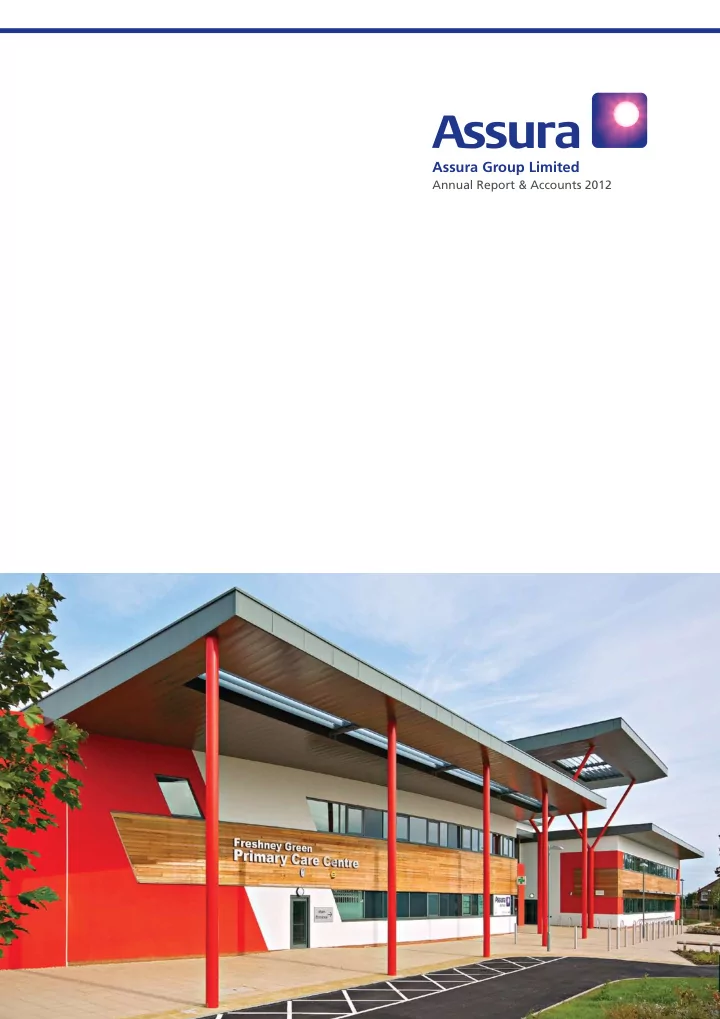
Assura Group Limited
Annual Report & Accounts 2012
SLIDE 2
1 2 4 20 21 35 42 43 44 45 46 47 48 87 88 95 98
Highlights Chairman’s Statement Chief Executive’s Report and Operating Financial Review Board of Directors Report of the Directors incorporating Corporate Governance Remuneration Committee Report Independent Auditor’s Report on the Group Financial Statements Consolidated Income Statement Consolidated Statement of Comprehensive Income Consolidated Balance Sheet Consolidated Statement of Changes in Equity Consolidated Cash Flow Statement Notes to the Consolidated Financial Statements Independent Auditor’s Report on the Company Financial Statements Company Financial Statements Glossary Corporate Information
Contents
SLIDE 3 Highlights
Refocused activity with the sale of Pharmacy and LIFT Consultancy businesses sold for £36.3 million Closure of NAB interest rate swap for a cash cost of £69 million, financed partly through the Rights Issue, which raised £33.5 million net of expenses and disposal proceeds 10 year secured bond issue £110 million, refinancing maturing NAB facility. Average debt maturity now 12.3 years (2011: 9.4 years) Gross profit from continuing activities has grown 50.0% to £30.9 million (2011: £20.6 million) Underlying profit has increased to £7.1 million (2011: £0.7 million) Adoption of a progressive dividend policy, payable on a quarterly basis, with the first quarterly payment of 0.285 pence per share payable on 25 July 2012 Loss for the year £60.7 million (2011: profit £15.1 million) after charging exceptional swap costs of £54.7 million and other exceptionals of £20.3 million (2011: £6.3 million) Adjusted NAV at 31 March 2012 is 36.3 pence per share (2011: 55.5 pence per share), reduction is due to the loss for the year after exceptional items
Business Corporate & Refinancing Activity Financial
Total property assets £549 million (2011: £519 million) Rent roll has risen 12.2% to £34.9 million (core £32.2 million) at 31 March 2012, from £31.1 million (core £28.4 million) at 31 March 2011 99 rent reviews settled in year (29.0% of portfolio by rental value): whole portfolio 3.41% uplift (core portfolio 3.12%) Core portfolio of 158 medical centres, with a weighted average lease length of 15.8 years (2011: 15.9 years) Net initial yield on core portfolio stable at 5.89% (2011: 5.87%), non-core net initial yield of 14.03% (2011: 10.37%) Core portfolio total return of 7.4% compared to IPD Primary Healthcare benchmark of 6.6% over 5 years 9 new developments completed at a total cost of £37.4 million, with 7.3% yield on cost. At 31 March 2012, 6 current projects on site with a committed cost to complete of £8.5 million, and a pipeline of a further 8 projects Board has concluded to progress with conversion to REIT status
1 Annual Report & Accounts for the year ending 31 March 2012 See page 8 Investment Property Databank Net Asset Value - Note 13
1 2 3
1 1 3 2
SLIDE 4 2 Assura Group
In the ten months that I have been Chairman, the Group has reaffirmed its strategic focus on primary care property and concluded the final steps to becoming a pure play property company once more. Policy statements and legislation from successive Governments have all encouraged a greater share of health services to be delivered in the community, in the belief that General Practitioners and local health professionals are the key to driving greater efficiency and quality of patient experience. On the other hand, in
- rder to make a step change in reducing NHS expenditure,
the Government urgently needs to address the shortfall in modern, purpose-built primary care buildings. Investing now will generate sustained efficiency savings and improved patient care. This combination of circumstances underlies the confidence the Board has in the focus of the business and that our prospects remain good to deliver excellent risk adjusted returns to our shareholders. The last year has been one of great change in the Group. The Pharmacy and LIFT Consultancy businesses have been sold, and the acquisition of AH Medical Properties (AHMP) fully incorporated into Assura. Revenue from continuing operations increased by 40.3% to £34.1 million following the AHMP acquisition and the Group underlying profits were up to £7.1 million (2011: £0.7 million). Assura is unique amongst listed primary care investment vehicles in being internally managed so that shareholders enjoy scale benefits and suffer no leakage of fees to a third party manager. The company had a number of legacy issues to deal with this year. Most importantly there was an interest rate swap that had become excessive compared to the liability that it was intended to hedge. In the context of falling interest rates and the need to secure refinancing, the Board had no option but to close this out at a cash cost
- f £69 million. In order to achieve this we launched a
Rights Issue in November 2011, raising £33.5 million net of expenses. I would like to record the Board’s sincere gratitude to our loyal shareholders for this support. Following the cancellation of the swap we were successful in issuing a £110 million 10 year Bond, which replaced a maturing facility and extended our average debt maturity to 12.3 years. It also enabled us to lock in lower interest rates, where our average cost of debt is now 5.26%. Substantially all our debt is now at fixed rates or is fixed through economically effective swaps.
Chairman’s Statement
SLIDE 5 3
Our financial strength is underpinned by our core portfolio
- f 322 leases on 158 investment properties, with a
weighted average unexpired lease length of 15.8 years,
- f which 90% is backed by the NHS covenant.
This degree of income and debt security is exceptional in the property sector. Our core portfolio delivered 3.12% growth on reviews settled in the year, though we observe a slowing in the rate of growth in rents, which we believe will be a relatively short term feature of the market. The Board has reviewed whether Assura should convert to REIT status and concluded that this would be in the best long term interests of shareholders. Following the abolition of the conversion charge anticipated with Royal Assent to the Finance Act this July, we intend to progress the various steps to enable us to make this election. A key feature of REITs and the attraction of our business model is the importance of paying sustainable and growing dividends. In March we announced that we would in future pay dividends quarterly to reflect our three monthly rental income cycle. Our first dividend in July 2012 will be 0.285 pence per share, an annualised amount equivalent to 1.14 pence per share. Whilst reserving the ability to change the rate at any time, it is our intention to announce changes to the quarterly dividend rate once a year, normally in June. We will also introduce a scrip dividend programme on conversion to REIT status for those who would prefer equity rather than cash dividends. Our Board has changed completely over the course of the year and I would like to thank my predecessor, Rodney Baker-Bates, our previous CEO, Nigel Rawlings, and the non-executive directors Peter Pichler and Clare Hollingsworth for their hard work and dedication to the Group over many years. I am delighted that we have been able to attract new directors of the quality of Graham Roberts, our new CEO, David Richardson, Chair
- f the Audit Committee, and Jenefer Greenwood, Chair
- f the Remuneration Committee. Graham Roberts, who
spent almost ten years as a main board director of British Land, brings a fine mind and deep property knowledge to lead Assura in the years to come. I am very excited to be able to work with such a strong Board. I would also like to thank our 25 staff for their dedication and focus during a year of unprecedented strain and
- change. They have my admiration in continuing to deliver
sector-leading performance in such a tough environment. Simon Laffin
Chairman’s Statement
Annual Report & Accounts for the year ending 31 March 2012
SLIDE 6 4 Assura Group
Primary care property is an attractive asset class especially in the current uncertain economic climate – one of the few benefitting from supply and demand imbalances and experiencing rental growth. On the demand side, public policy is driving the need for a different property solution for community based healthcare. On the supply side much of the existing stock is insufficient for current needs. The primary care property sector has proven resilient through a period of unprecedented economic and financial turmoil, with lower volatility than gilts and total returns of 6% comparing favourably against all commercial property which delivered minus 0.7% over the last 5 turbulent years. This is not surprising with primary healthcare’s low default risk and lease periods extending well into the middle of the next decade. Since joining as Chief Executive three months ago, I have been impressed with the depth of professionalism and enthusiasm of the team, the track record in the core business activity and the strength of relationships with health professionals, a key success factor in this market. Assura is well placed to succeed and to deliver excellent risk adjusted returns to shareholders.
Chief Executive’s Report and Operating & Financial Review
The Assura business is much simpler now and I will explain the new structure below. Our property rental business is now split between our core holding of 158 primary care properties and our non-core assets, mainly acquired for the purposes of past businesses rather than property investment. We are investors in 6 LIFT companies (Local Improvement Finance Trusts) and are
- ne of the largest investors in these important and
successful public private partnerships supporting community based medical and related developments. These are shown as a separate segment as they differ from our core holdings as the tenant has a right to buy back the property at a later date; and control of the companies rests with the public sector.
SLIDE 7 We achieved on average 3.12% annualised growth on rent reviews settled in the year, 2.5% excluding RPI and fixed uplift leases. These reviews date back to rent review dates from a range of periods. Analysing the 2.5% open market review uplifts by calendar year of review shows a slowing trend. For 2010, 2011, 2012 calendar years the annualised rental growth
- n rent reviews settled in the financial year to March
2012 was 4.36%, 1.49% and 0.48% respectively. We believe this trend is in line with the market. With 21.8% of our portfolio benefiting from RPI and fixed uplifts, and our track record of outperforming the primary care market, we would expect rents nonetheless to progress in the current year albeit at a more modest rate. The core portfolio was valued by either Savills or DTZ at a total of £505.7 million (2011: £449.8 million). As at 31 March, our core portfolio produced a net initial yield of 5.89% (2011: 5.87%) and a net equivalent yield of 6.11% (2011: 6.12%) – with 90% of our income backed by government reimbursement, this is a healthy yield premium of over 3% on the equivalent maturity government bond. The like for like valuation increase was £6.4 million or 1.4%. This compares with IPD for the sector of 0.8%. ERV of the core portfolio, which is a forward looking indicator increased by £315,000 or 1% (IPD 1%). There was some £52.9 million of net investment additions comprising £45.9 million of developments completed and transferred to investments, £9.1 million
- f new acquisitions, less £2.1 million of disposals.
In addition, when the Pharmacy division was sold during the first half year, £9.2 million of property, previously shown as owner occupied land and buildings, reverted back to investment property. We completed 9 projects this year at a development cost
- f £37.4 million, a yield on cost of over 7.3% and a profit
- n cost of 14.3%. We have 6 new centres underway and
a further 8 prospects we expect to commence this year, mostly using external development resource, with an aggregate development cost of some £41.7 million. Development costs to complete on committed projects amount to £8.5 million.
Chief Executive’s Report and Operating & Financial Review
Core: £505.7 million invested in 158 medical centres, ERV £34.0 million, weighted average unexpired lease length outstanding 15.8 years, initial yield 5.89%
Our own core portfolio of 158 medical centres is well-
- placed. Our task with the core portfolio is to continue to
generate good returns. We will do this by a disciplined approach to sourcing new investments and in evaluating
- developments. Where existing core investments are
expected to underperform we will also apply discipline in evaluating hold or sale decisions. £32.2M Rental Profile for Core Portfolio
£22.0m: GPs - Reimbursed by NHS £6.9m: NHS Body £2.2m: Pharmacy £1.1m: Other (Retail, Charities, Local Authorities, Dentists) 5 Annual Report & Accounts for the year ending 31 March 2012
4
Estimated Rental Value
4
SLIDE 8 6 Assura Group
Leading GPs recognise the operational improvements that can be achieved through investing in their premises infrastructure enabling them to deliver more community- based services. In that context we are confident that renewed attention will be given to approvals for new primary care centre developments, reversing an
- bservable decline over the last 18 months as the
commissioning bodies within the NHS began to be reorganised. We have a strong track record in identifying opportunities and will position ourselves to benefit from the pickup in development activity in due course. The core portfolio contributed to earnings before interest and exceptional items in the year as follows: Relative to the IPD Primary Healthcare benchmark we have outperformed over 5 years at a total return level of 7.4% versus 6.6% and with rental value growth of 2.4% versus 2.1%. Much of this outperformance derives from the performance of the new additions to the portfolio, and
- ur focus on rent reviews for the core portfolio.
An important criterion for success in this market is the maintenance of sound relationships with GPs. New premises take up to 4 years to bring to a resolution and involve multiple stakeholders. We already do well at these relationships. In light of its significance we will introduce a customer satisfaction survey during 2012/13 so as to introduce a continuous improvement approach to our tenant interaction. Scale benefits
£549m total property assets
15.8 years lease length Track record of out performance and rental growth Good reputation and relationships with GP community Development capability and strong pipeline Internally managed Knowledgeable, motivated and focused team
Other income Direct property costs Net rental income % recovery Valuation movement Total Property Return 30.9 0.7 (2.0) 29.6 96% 8.5 38.1 21.4 0.5 (2.9) 19.0 89% 12.6 31.6 2012 £m 2011 £m Completed developments Development on site Immediate pipeline 11,400 4,900 9,000
Size m Total Development Cost £m Development Cost to Come (excl. Interest) £m Annual Rental Income £m
37.4 16.2 26.0
24.3 2.7 1.1 1.8
Development Summary
Chief Executive’s Report and Operating & Financial Review
IPD 5 Year Return to December 2011
8% 7% 6% 5% 4% 3% 2% 1% 0% Income Return
Assura Primary Healthcare Benchmark
Capital Growth Total Return
Source: IPD
Rental Value Growth
6.1% 6.2% 7.4% 6.6% 2.4% 2.1% 1.2% 0.4%
SLIDE 9 LIFT £8.7 million loan notes and £1.8 million equity stakes in public-private consortia.
We have some attractive investments in 6 LIFT companies, comprising loan notes and equity. Local Improvement Finance Trusts are companies held by the public and private sector to develop and own medical centres predominantly let on long term inflation linked leases to Primary Care Trusts (PCTs). The PCTs have the right to buy back the building at the end of the lease on a formula which is based on fair value but incorporates a discount to fair value usually dependent on performance relative to a residual value estimate at the outset of the
- contract. The Group receives most of its current returns
through its £8.7 million of loan stock. The carrying value
- f the LIFT investments at 31 March 2012 is £1.8 million,
interest received was £0.9 million and our share of the profit in the consortia companies was £0.7 million contributing £1.6 million to underlying profit. We need to remain close to this market as the NHS begins to reshape its estate. LIFT companies have priority for funding developments in their local areas and offer us the opportunity for adding value through development funding.
Non-core: £26.3 million (comprising £14.9 million investment property, £2.3 million vacant properties and £9.1 million of land sites), ERV £2.3 million, weighted average unexpired lease length 8.1 years.
We have surplus land and buildings and some legacy assets that relate to business activities we have exited. Our approach to non-core assets is that they need to deliver a better return over the medium term than our core holdings. Those that do not meet this criteria are considered available for sale although the timing of their sale will depend on market conditions and asset specific considerations. The non-core portfolio declined in value by £7.0 million
- ver the period and produced a net initial yield of
14.03% and net equivalent yield of 11.74% on the income earning assets. These are mostly secondary assets and with very limited debt finance available for secondary assets these are difficult assets to realise in the current market. The non-core portfolio contributed to earnings in the year as follows: The non-core portfolio includes the former head office, which was acquired in March 2008 and comprises a circa 55,000 square foot modern office building on the Daresbury business park near the M56. It is let on a lease with a break in 2016 and is currently part occupied on sub
- leases. The valuation of £6.2 million reflects an initial yield
- f 12.83% due to a difficult office rental market in the
North West area. The passing rent is £860,000 per annum
- r £15 per square foot. Demand remains subdued in the
region and rental levels are reducing due to an oversupply
The non-core also includes three retail malls (valued at £5.3 million) in hospitals which are held on short leases which expire on average in 18 years. The valuation movement therefore reflects the fact that value is eroded
- ver the life of the head-lease and also that there are
limited buyers for such assets. These are challenging retail assets and have high direct property costs due to vacancies. Their valuation yields at 31 March 2012 were initial 15.97% (2011: 11.43%) and equivalent 13.16% (2011: 9.41%). Other properties within non-core comprise surplus land of £9.1 million (2011: £9.9 million). Conditional sale agreements have been exchanged on over £5.5 million where the conditions relate to the purchaser progressing through the final stages of a planning process. There are also 20 other buildings with an estimated value of £5.7 million (2011: £8.8 million). Gross rental income Direct property costs Net rental income % recovery Valuation movement Total Property Return 2.5 (1.2) 1.3 52% (7.0) (5.7) 2.4 (0.8) 1.6 67% 1.3 2.9 Total 2012 £m Total 2011 £m
Chief Executive’s Report and Operating & Financial Review
7 Annual Report & Accounts for the year ending 31 March 2012
SLIDE 10 8 Assura Group
Core Non-core Investment portfolio Investment property under construction Properties held for sale Pharmacy lease premiums Finance leases Total Balance sheet classification Investment property Land and buildings held for sale Fixed assets - pharmacy occupied premises Total 505.7 14.9 520.6 8.4 11.4 5.7 3.1 549.2 537.8 11.4
449.8 20.0 469.8 35.0 9.8 3.2 1.0 518.8 499.8 9.8 9.2 518.8 2012 £m 2011 £m
Total property assets
Net rental income Core Non-core LIFT and joint ventures Interest receivable Share of profits Administration Share based payment credit Other finance revenue Finance costs Underlying profit 29.6 1.3 30.9 0.9 0.6 1.5 (4.5)
(21.2) 7.1 19.0 1.6 20.6 0.9 0.3 1.2 (5.5) 0.2 0.6 (16.4) 0.7 2012 £m 2011 £m
Underlying profit
Chief Executive’s Report and Operating & Financial Review
SLIDE 11 Administrative costs
Administration costs have been reduced substantially in recent periods as a result of the disposal of several major businesses over the last three years. The reduction in central costs of £1.0 million or 18% is the partial benefit
- f the office relocation and cost savings. Headcount has
reduced from 66 at 31 March 2010 to 25 at 31 March 2012.
Discontinued businesses
During the year, the Pharmacy and LIFT Consultancy businesses were sold for an aggregate consideration of £36.3 million and realising a profit of £3.1 million. Some £9.6 million of deferred consideration and vendor loans remains outstanding and is due in instalments over the next 2 years. Details are set out in note 32 to the accounts. The contribution to profits before tax in the year from discontinued businesses amounts to £1.2 million (2011: £3.2 million). Other restructuring costs and costs related to acquisition activities amounted to £0.3 million (2011: £3.7 million).
Goodwill
Following changes to commissioning arrangements in the NHS and the strategic changes in the group, including the disposal of the Pharmacy and LIFT Consultancy businesses, the Group is now purely an investment property company and is managed as such by the Board. In a period when the market for new developments is tighter, the company has adapted and many current projects have been sourced and built out in partnership with development partners who introduce projects to us. In addition, the volume of deals in the near term entirely derived from in-house development, and so supporting the carrying value of goodwill, is uncertain. Prospectively the development activity will also not be reported as a separate segment as it is regarded as just one means of sourcing new investment properties. All these factors have led to a need to reassess goodwill and accordingly its carrying value has been fully impaired by £20.0 million.
Finance
Whilst financing remains challenging to many property businesses in these markets, it is pleasing that major insurance companies continue to have an appetite for primary care property lending, including development. We currently experience no shortage of debt finance. However the financial structure of the group remains concentrated in a small number of lending institutions and we would seek to encourage new entrants so as to improve diversity. We also intend over time to reduce the level of loan to value. Loans
- Aviva loans
- 10 year senior secured bond
- Santander facilities
- RBS loan
- NAB loan
Total loans Issue costs 213.1 110.0 52.4 4.0
(3.9) 375.6 191.6
5.6 126.0 363.2 (1.4) 361.8 2012 £m 2011 £m Our debt finance at the year-end comprised:
Chief Executive’s Report and Operating & Financial Review
9 Annual Report & Accounts for the year ending 31 March 2012
SLIDE 12 10 Assura Group
Details of the facilities and their covenants are set out in note 24 to the accounts. The NAB loan was repaid in December 2011 at the same time as the related swap was terminated at a cash cost
- f £69.5 million giving rise to a realisation of the mark to
market and an exceptional financing charge of £52.7 million in the current year. The background to the swap termination was set out in the Chairman’s letter to investors contained in the Rights Issue prospectus dated 2 December 2011. Net interest costs in the year amounted to £19.9 million (2011: £14.9 million) included in both years £0.9 million receivable on LIFT loan notes. The increase is attributable to the net effect of the acquisition of AHMP and reduced interest rates as a result of the closure of the NAB swap. The average interest rate at 31 March was 5.26% (2011: 5.49% rising with the then NAB swaps to 6.79%). The loan to value (note 33) at 31 March was 64% (2011: 63%) and the average debt maturity 12.3 years (2011: 9.4 years).
Taxation Current year taxation
There is no tax charge with respect to current year results as a result of losses incurred in the year.
Deferred tax
As a result of the Board’s decision to convert to REIT status the deferred tax asset carried forward amounts to £1.3 million representing the tax relief anticipated against property rental profits until the expected date of conversion to REIT status and also on any non REIT income thereafter. The charge for the year of £1.5 million (2011: £3.4 million) is offset by tax losses foregone
- n business disposals of £1.5 million. The movement in
the year is £1.0 million (2011: £3.4 million). At the half year the deferred tax asset was £13.0 million, the reduction being due to the decision to convert to REIT status. This is an accounting difference only as the REIT status will allow the Group to operate largely free from taxes
- n rental income and capital gains from investment
property disposals.
Cash flow
Net cash inflow from operating activities was £13.4
- million. New investments were made of £23.3 million
which were largely debt financed. The swap close out resulted in an outflow of £69.3 million, £16.6 million of which was provided at the previous year end, which was funded by rights issue net proceeds of £33.5 million and existing cash resources which had been increased by disposal proceeds of assets and businesses of £24.9
- million. A bond issue of £110 million and an increased
loan of £10.0 million from Santander, refinanced the NAB bank loan of £120 million. Dividends paid were £5.1
- million. Cash and cash equivalents reduced by £17.5
million.
Earnings per share
The adjusted basic and diluted earnings per share for the year is 2.70 pence (2.35 pence earnings from continuing operations and 0.35 pence profit from discontinued operations) (2011: 4.40 pence profit – 3.34 pence profit from continuing operations and 1.06 pence profit from discontinued operations).
Dividends
The Group has adopted a progressive dividend policy, payable on a quarterly payment cycle in line with the timing of its rental receipts and has declared its first quarterly dividend of 0.285 pence per share to be payable on 25 July 2012. On conversion to a REIT it is intended to introduce a scrip dividend programme providing investors with the option to receive shares rather than cash.
Chief Executive’s Report and Operating & Financial Review
SLIDE 13
Net asset value at 31 March 2011 Operating profit pre goodwill impairment Profit from discontinued operations Dividend Rights issue proceeds Swap costs Other finance costs Deferred tax Goodwill impairment Other Net asset value at 31 March 2012 EPRA adjustments (note 13) EPRA net asset value at 31 March 2012 220.1 31.3 1.6 (5.1) 33.5 (54.7) (19.9) 1.0 (20.0) 0.1 187.9 4.3 192.2 £m Net Asset Value declined year on year as follows:
Group key performance indicators
The Group did not meet its key performance indicators as set out in last year’s Annual Report. In particular as a result of movements in long term interest rates, the long term derivative position which exceeded the NAB loan amount by both value and maturity, created a substantial loss of £52.7 million in the current year. In view of the terms agreed with the bank, this loss would become due and payable over the short term. The Board responded by asking for support from shareholders by way of a rights issue to raise the funds to close the derivative. The effect of the above was negative on performance and in addition the gearing level of the company has risen above the level targeted. The entire Board of directors has changed and the new directors intend to report in 2012/13 against the following metrics: Capital returns and growth in net asset value per share; Income returns and growth in earnings per share; Operating cost ratios; Portfolio qualities: lease length, strength of tenant covenant; and Financial metrics: interest cover and loan to value.
Chief Executive’s Report and Operating & Financial Review
11 Annual Report & Accounts for the year ending 31 March 2012
SLIDE 14 Risk Management
Principal risks and uncertainties
Risk management is integral to the way we operate. With a small Head Office team and a flat structure emerging risks are identified and existing risks monitored
- constantly. The Board regularly reviews all of the major
existing risks and newly identified risks, including the mitigation action for each major risk. A summary of the more critical risks identified through that review and identified by the Board as having potential to affect the Group’s operating results, financial control and/or the trading price of its shares is given below.
Principal risks
Risks relating to real estate investment property Any weakening of rental yields and valuations could have an adverse impact on the Group’s future profits The Group has reported an increase in the value of its core medical centre investment properties in the year ended 31 March 2012. While the Board believes that its property investments represent robust, defensive assets in the current market due to their long lease length and NHS backed covenant, any weakening of rental yields could adversely impact the valuations and so reduce the Group’s future profits and net assets. Property is inherently difficult to value Property and property related assets are inherently difficult to value due to the individual nature of each
- property. As a result valuers’ opinions may differ and
there can be no guarantee that the estimates resulting from the valuation process will reflect sale prices in the future. The Group may be exposed to cost overruns, completion delays and financing shortfalls on developments The Group can find that development risks require more money to be committed to the relevant development than originally planned. Where a development may not be fully pre-let, should no tenants be found for the surplus space, the Group can be left with empty space in buildings with limited alternative use. The Group’s current policy is to engage in developments that are substantially pre-let with fixed price build contracts (or contracts with a price ceiling) in place at their inception. Risks relating to corporate acquisitions The future growth of the Group will in part be dependent on its ability to successfully identify, negotiate and integrate corporate acquisitions The Group’s success in growing its portfolio and taking advantage of acquisition opportunities will be dependent
- n its ability to identify, negotiate, fund and integrate
purchases into its existing business without significant
- disruption. For that reason acquisitions require board
approval and are subject to appropriate scrutiny. Failure to negotiate a sensible transaction or integrate a new business effectively in a way that maximises value could have a negative impact on the results of operations and/or financial condition of the Group.
12 Assura Group
Chief Executive’s Report and Operating & Financial Review
SLIDE 15 Risks relating to regulation, Government Policy and tax Changes in NHS procurement and funding could adversely affect the Group The Group is operating in the primary healthcare market. Cuts in the funding available for rent of medical centres, delays and uncertainty while the Health & Social Care Act is implemented, or other uncertainties such as future rental reimbursement mechanisms to GPs by the NHS, or changes to the LIFT operating models, may reduce expenditure available to fund services provided by the Group. Risks relating to financing Uncertainty within the European financial markets The current uncertainty within the European financial markets and the future of the Euro could impact the Group through bank lending capacity for investments, development or refinancing and may also impact on yields due to potential changes in investor sentiment. A fall in asset value or revenues may result in the breach of financial covenants A significant fall in the Group’s underlying asset values or income may result in the Group breaching one or more of the financial covenants given to its lenders, and as a result the Group may be required to repay on demand these borrowings in whole or in part together with any costs. Assets may need to be divested at unfavourable prices in
- rder to effect such repayments.
Access to new debt financing will depend on market conditions and the company’s credit standing If conditions in credit markets are unfavourable or if the Group’s credit worthiness is weakened, new sources of funding may not be available or may be only available at higher cost.
Residual risk
In implementing its processes for identification, evaluation and management of significant risks, the Board has put in place a system which is designed to manage rather than eliminate risk of failure to achieve business objectives whilst accepting that such a system can only provide reasonable and not absolute assurance against material misstatement and loss. The Board believes appropriate internal controls and risk management processes are in place and have been throughout the period covered by the Board.
Chief Executive’s Report and Operating & Financial Review
13 Annual Report & Accounts for the year ending 31 March 2012
SLIDE 16 Primary care overview and trends
There are estimated to be around 8,300 GP practices in England occupying some 7,500 buildings, with approximately 60% still owned by GPs, 20% by investors and 20% held by the public sector. In terms of quality of stock, around 75% are substandard in terms of size and amenities by reference to the NHS guidelines and whilst up to 50% of those are purpose built, many are small and date back decades. From 2013 GP premises will also fall under the regulatory regime of the Care Quality Commission adding to pressure to meet minimum standards. With around 25% of surgeries being single GP units and an estimated 40% of current GP stock needing replacing in the next 5 years to meet modern standards and market expectation, there has been a Government backed focus
- n upgrading primary care services and delivery, with a
fresh emphasis on local needs and a move away from a hospital setting. The NHS Health and Social Care Act empowers local Clinical Commissioning Groups comprising GPs and other health professionals to commission services from a range of providers increasing accessibility, convenience and quality of service closer to the home of the patient thus continuing the shift of service provision from the secondary sector into primary care. Successive Governments have shown commitment through considerable funding of the NHS and recent years have seen the delivery of new primary care surgeries which are being developed through a mix of private development in conjunction with investment companies like Assura Group and also through the Local Improvement Finance Trusts ("LIFT") initiative, which is designed to attract private finance into public facilities. The pace of change has been slowed by the credit crisis and many schemes came to a virtual standstill but the need for replacement stock has not gone away.
Investor appeal of primary care
Under the current system of reimbursement funding, primary care is viewed as a Government backed long term income stream by both investors and their lenders and has become more attractive in recent years where
- ther sectors have faltered. Leases are typically for 21
years with no breaks. 3 yearly reviews by the District Valuer may be triggered by the landlord on rents that are upwards or downwards adjusting. Usually leases are internal repairing and insuring. There are of course variations on these themes including RPI linked leases.
14 Assura Group
Chief Executive’s Report and Operating & Financial Review
Yield outlook
Primary care property yields have been less volatile than all-property Yield gap with long-dated gilts now very significant
Assura Net Initial Yield IPD UK Property Quarterly Index Net Initial Yield 20 Year Gilt
8% 7% 6% 5% 4% 3% 2% 1% 0% Jun 06 Jun 07 Mar 08 Mar 09 Mar 10 Mar 11 Mar 12
SLIDE 17 Asset class has proven its relative value
Income certainty delivers impressive returns
Yield stability
Low cyclicality Attributable to
Long leases
Negligible default No oversupply Access to finance Rental outlook positive
Growing demand
Inadequate supply at or above inflation during a period when other markets have only seen declines. Most importantly for specialist buildings the residual value risk is low for purpose-built units. This is a once in several generations investment programme and once established these centres will remain the centre of local community care. GPs are not free to move away from their communities at a whim and public funding for a new building at the end of the first lease is remote as long as the building is structurally fit for purpose. GPs themselves are not likely to fund another building either. These distinctive lease and tenant features are partly responsible for the yield stability to date and the bespoke nature of these premises ensure there is no supply-side
- bubble. Thus the sector avoided the cyclicality visible in
retail and office rents. This is clear looking at recent
- experience. The commercial and residential markets
suffered peak to trough total return corrections of 34.5% and 16.8% respectively compared to 2.5% for primary healthcare. With the amount of aged stock in the system, there has been a strong supply of GPs looking to upgrade, expand and relocate providing opportunities for investors and
- developers. Helpfully, in comparison to other sectors,
the planning regime is relatively benign due to the community benefits. The track record of the sector is exemplary and has
- ffered relatively strong yield stability with insignificant
default risk. Peak yields reached around 5.2% for prime and 6.2% at the trough. The 5 year total return of the IPD primary healthcare benchmark to December 2011 was 6.6% compared with minus 0.7% for all commercial
- property. Although the market is development led, the
supply is controlled location by location, patient community by patient community, so there is not a significant risk of oversupply. Rental growth has been
Chief Executive’s Report and Operating & Financial Review
Annual Report & Accounts for the year ending 31 March 2012 Total Return index from
130 120 110 100 90 80 70 60 J u n
D e c
J u n
D e c
J u n
D e c
J u n
D e c
J u n
1 D e c
1
Commercial Primary healthcare Residential
Source: IPD
SLIDE 18 NHS restructuring and outlook
In the words of Health Secretary, Andrew Lansley, modernising the NHS is "a necessity, not an option". The key aim of the Health and Social Care Act 2012 is to increase patient choice over their care and the choice of
- provider. Underpinning this is the resolve to pass a
reported £80 billion (two thirds) of NHS budget over to newly formed GP Consortia by 2013 under the guidance
- f a new NHS Commissioning Board. Over four years the
NHS budget is targeted to remain flat in real terms and there is a requirement to save £20 billion per annum off the budget by 2014, with clear pressure to make further savings over the following decade. The Act does not cover the procurement of new buildings and facilities or the replacement for the reimbursement system that would necessarily follow the abolition of the
- ld organisational structures (PCT's), but rather its focus
is on the commissioning of services. As such there is some uncertainty about how some aspects of decision making on new projects and funding will be made. If the core of the new policy is to improve quality of care for the patients, then this must also require improvements to the physical environment from which the service is
- delivered. Government funding looks doubtful given the
budgetary constraints on capital spending and so private sector capital will inevitably be needed. The size of projects do not lend themselves well to PFI-style arrangements, suggesting a continued strong role for investors and developers like Assura. In the meantime, investors and developers continue to promote new schemes and opportunities and we believe that once the GP Consortia have control over the budget, the pace of development will again pick up.
Impact of the credit crunch and Euro crisis
Banks continue to take a much more cautious approach to financing with many effectively withdrawing from the
- market. Others are willing to fund those applicants with
a track record on modest sized transactions. The lending divisions of insurance companies have shown a willingness to lend to investment companies like Assura but not to GPs themselves. This factor is likely to increase the trend for ownership by GPs to
- reduce. Currently we are experiencing continued
appetite from our lenders for new lending and on reasonable terms. The Euro crisis is likely to persist for some time. Our business is not exposed to European assets nor reliant on European banks. Nonetheless a meltdown of financial markets could further reduce liquidity in the system putting pressure on yields and making lenders more cautious. In extremis this could lead to pressure from the group’s banking covenants.
Rental market
Rents for purpose built doctors' surgeries have tended to increase by 3% to 5% per annum in recent years, although some good quality older surgeries have achieved higher increases as they experience ‘catch-up'
- reviews. However, rent increases in 2012 have come in
lower and it is likely that a weaker growth environment with some overrenting will prevail in the sector for a while as the GP Commissioning Groups get themselves
Rents for modern purpose built surgeries are driven by the cost of surgery construction and are 'appraisal led'. Government policy is to deliver first class primary care in new surgeries and over the past ten years there has been a concerted drive to develop and provide public funding and backing for these developments. As a result, the rents agreed between developers and District Valuers (acting for the Primary Care Organisation) have reflected the economic cost of construction.
16 Assura Group
Chief Executive’s Report and Operating & Financial Review
NHS directions
General Practitioners’ right to rent reimbursement and other premises cost reimbursement from the NHS is embodied within The National Health Service (General Medical Services - Premises Costs) (England) Directions 2004. In particular Part 5 - Recurring Premises Costs, states, where in the case of rental costs arising under a lease agreed or varies on or after 1st April 2004, and the PCT is satisfied, where appropriate in consultation with the the District Valuer, that the terms represent good value for money, then the PCT must consider that application and in appropriate cases, grant the application.
SLIDE 19 Over the medium term we need to position the company to benefit from whatever form the reconfiguration of NHS property takes.
Cautionary statement
This Operating and Financial Review contains certain forward-looking statements. These statements are made by the directors in good faith based on the information available to them up to the time of their approval of this report and such statements should be treated with caution due to the inherent uncertainties, including both economic and business risk factors, underlying any such forward-looking information. Graham Roberts
Business model
Our focus is on the acquisition, development and management of primary healthcare properties. Our competitive strengths lie in our detailed knowledge
- f and experience with the building requirements and
leasing structure applicable to these specialist buildings, the rental income growth potential and District Valuer procedures as well as our relationships with our customers, General Practitioners and NHS bodies. We source finance from the equity and debt markets. Debt has proven more readily available in this sector than
- ther commercial property markets, largely due to the
reimbursement regime through the NHS and the insignificant default experience in the sector. We are an internally managed property business.
Priorities
Our current priorities are to focus on operational excellence ensuring we deliver the basics well, whether property, finance or in our dealings with our customers. Our company has not had high visibility in the investment market and we will invest time and energy in promoting the investment case widely. Conversion to REIT status is an important step on this road. We shall look to create value through our developments and in our choice of assets. Here we should recycle assets where necessary based on disciplined analysis.
Chief Executive’s Report and Operating & Financial Review
17 Annual Report & Accounts for the year ending 31 March 2012
Basis of rent reviews
Upward/downward review basis - tenant can instigate 6% (£2.1m) Upward/downward review basis - landlord only trigger 18% (£5.8m) Upward only review basis 76% (£24.5m) % Portfolio by rental value
90% 80% 70% 60% 50% 40% 30% 20% 10% 0% OMR £26.3m £3m £2.1m £0.9m RPI Fixed Other
SLIDE 20 Testimonial
- Dr. Steve Parr-Burman, GP
Moor Park Health Centre “Our new facilities have significantly enhanced what we can offer to the local community. The new buildings are a vast improvement to our previous practice, with much more light and space available. It is evident that patients were at the heart of the design; the flexible and open- plan space is relaxing and purpose-built to cater for a high footfall and a stress free experience. It is fantastic to see patients benefitting from all aspects of the new build.” Health centre comprising 3 GP practices, PCT outpatient services, dental, pharmacy and cafe. Developed by Assura and its development partner LSP Developments, following a procurement process undertaken by the GP practices and NHS Blackpool. The selected site was owned by Blackpool Council adjacent to the existing leisure centre, which was also refurbished and greatly extended. The partnership approach of the local authority and the PCT were critical in the delivery enabling the shared vision of a truly integrated health and community facility being provided for patients and local residents. The three storey building incorporates dedicated space for children’s services, minor surgery suites, x-ray department and diagnostics, health visitor and district
- nurses. In addition there is a dental suite and
multi-purpose accommodation. The building was awarded the “Best New Build 2011” by Blackpool Civic Trust for not only providing a beautiful building but also one which has delivered the aspirations
- f the community with a visionary approach and solution.
18 Assura Group
Case Study Moor Park Health Centre, Blackpool
SIZE: 5,257SQM COMPLETED: JULY 2011
Development Team
Assura: Developer and long term landlord LSP: Development Partner
SLIDE 21
19 Annual Report & Accounts for the year ending 31 March 2012
Size: 1,650sqm Completed: April 2011 Ireland Wood Surgery Leeds Size: 5,257sqm Completed: July 2011 Moor Park Health Centre Blackpool Size: 2,565sqm Completed: November 2011 Mannock Medical Centre Wellingborough Size: 1,200sqm Completed: June 2011 Chellaston Medical Centre Derby
Core Portfolio
SLIDE 22 Simon Laffin, Non-Executive Chairman
Simon Laffin (aged 53 and appointed in August 2011) is a non-executive director
- f Aegis Group plc and Quintain Estates & Development plc, an advisor to CVC
Capital Partners and Chairman of Hozelock Group. Previously he has served as non-executive Chairman of Mitchells & Butlers plc and as a director of Northern Rock plc, as part of the rescue team. Between 1995 and 2004 he was Group CFO
- f UK grocery retailer Safeway plc, latterly also responsible for property, which he
joined in 1990. Prior to that, Simon held a variety of finance and management roles in Mars Confectionery, Rank Xerox and BP . He is a qualified accountant.
Graham Roberts, Chief Executive Officer
Graham Roberts (aged 54 and appointed in March 2012) was Finance Director at The British Land Company PLC from 2002 to 2011, and before that was Senior Partner for Real Estate at Arthur Andersen, where he also headed up the public sector assurance practice, which included clients such as NHS Estates and a number
- f NHS trusts. His early career was at Binder Hamlyn. He is currently non-executive
director and Chairman of the Audit Committee at Balfour Beatty plc.
Jenefer Greenwood, Non-Executive Director
Jenefer Greenwood (aged 54 and appointed in May 2012) was appointed to the Board of The Crown Estate in 2004, and chairs its Remuneration Committee. Jenefer is a Chartered Surveyor and started her career at Hillier Parker. She has worked for Grosvenor since 2003, having also been Chair of the National Skills Academy for Retail and President of the British Council of Shopping Centres.
David Richardson, Non-Executive Director
David Richardson (aged 61 and appointed in January 2012) is currently the Senior Independent Director of Serco Group plc, Chairman of Bilfinger Berger Global Infrastructure sicav SA and a Board member of Worldhotels AG. Previously he spent 22 years at Whitbread PLC where he was the Strategic Planning Director for eight years and the Finance Director for four years. At Whitbread he played a pivotal role in transforming the Group from a brewing and pubs company into a market leader in hotels, restaurants and leisure clubs. Following this he has held a number of non-executive roles in FTSE listed companies including Forth Ports PLC, Tomkins plc, Dairy Crest plc and De Vere Group plc. He is a Chartered Accountant.
20 Assura Group
Board of Directors
SLIDE 23 21 Annual Report & Accounts for the year ending 31 March 2012
Report of the Director’s incorporating Corporate Governance
The directors of Assura Group Limited (“Assura Group“) present their annual report on the affairs of the group, together with the financial statements and auditor’s report, for the year ended 31 March 2012. The Corporate Governance Statement set
- ut on pages 24 to 34 forms part of
this report.
Principal activities
Assura Group is the UK’s leading listed primary healthcare property group. It
- wns and procures good quality primary
healthcare properties across the UK. The subsidiary and associated undertakings principally affecting the profits or net assets of the group in the year are listed in note 14 to the financial statements.
Business review
The Group is required to include a business review in this report. The information that fulfills the requirements
- f the business review can be found on
pages 4 to 17, which are incorporated in this report by reference.
Dividends
Details of the dividend can be found on page 10.
Capital structure
Strong financial capital management is an integral part of the directors’ strategy to achieve the group’s stated objectives. The directors review financial capital reports
- n a monthly basis and the group treasury
function do so on a daily basis, ensuring that the group has adequate liquidity. Further information on the Group’s capital structure is provided in note 33 to the financial statements, including details of how the Group manages risk in respect
- f capital, interest rates and liquidity.
A debt maturity profile is also included.
Supplier payment policy
The Group has not signed up to any specific supplier payment code; it is Assura’s policy to comply with the terms
- f payment agreed with its suppliers.
Where specific payment terms are not agreed, the Group endeavours to adhere to the suppliers’ standard payment terms. As at 31 March 2012, the average number
- f days taken by the Group to pay its
suppliers was 15 days (2011: 56 days).
Political and charitable donations
We recognise the importance and benefits of supporting charities and local communities. In the year to 31 March 2012 we donated £10,000 to charities (2011: £1,000), all of which were located in the UK, and no contributions were made for political purposes (2011: nil).
Company share schemes
The Assura Group Employee Benefit Trust holds 4,218,219 (0.8%) of the issued share capital of the Company on trust for the benefit of employees of the Group and their dependents. The voting rights in relation to these shares are exercised by the Trustees who will take into account any recommendation made to them by the board of Assura Group Limited.
SLIDE 24 22 Assura Group
Report of the Director’s incorporating Corporate Governance continued
Corporate Responsibility
The Group plays an important role in the
- community. It takes seriously its corporate
responsibilities and in particular the requirement to maintain high standards
- f governance and probity in all of its
dealings with Government, the public, its workforce and its customers. Details of the Company’s initiatives and policies and procedures in this area are set out below. Employees Assura is not a large employer of staff, but it relies heavily on the experience, skills and capabilities of its employees to operate its business successfully. Staff are encouraged to maximise their individual contribution to the Group. In addition to competitive remuneration packages, they participate in an annual bonus scheme which links personal contribution to the goals of the business. Outperformance against the annual targets can result in a bonus of up to 20% for all staff below the executive board. Employees are provided with information regarding progress against the budget, financial and economic factors affecting the business’s performance and other matters
- f concern to them regularly. The views of
employees are taken into account when making decisions that might affect their
- interests. Assura encourages openness
and transparency, with staff having regular access to the Chief Executive and being given the opportunity to express views and opinions. The Group has a pro-active approach to the promotion of equal opportunities, supported by its Equality of Opportunity and Valuing Diversity Policy. The policy reflects both current legislation and best practice. It highlights the Group’s
- bligations to race, gender and disability
- equality. Full and fair consideration is
given to applications for employment from disabled persons and appropriate training and career development is provided. Environmental policy The Group is committed to minimising the environmental impact of its activities and achieving continual improvement in its environmental performance by:
- Openly addressing the environmental
risks of the work carried out and identifying and managing the environmental risks associated with the business on an on-going basis;
- Setting and reviewing annual
environmental objectives and targets, and monitoring performance;
Major shareholder notifications
As at 1 June 2012 the Company had been notified pursuant to rule 5 of the FSA’s Disclosure and Transparency Rules of the following interests representing 3% or more of its issued Ordinary Share capital.
31/03/2012 01/06/2012 Name of shareholder Number of shares % of Ordinary Shares Number of shares % of Ordinary Shares Somerston Investments Limited 157,499,999 29.74 157,499,999 29.74 INVESCO Asset Management 97,273,477 18.37 96,783,097 18.28 Aviva Investors 47,176,088 8.91 46,924,050 8.90 Artemis Investment Management 45,861,453 8.66 45,861,453 8.66 Laxey Partners 28,165,733 5.32 28,165,733 5.32 Moore Capital Management 26,159,036 4.94 26,159,036 4.94 Jupiter Asset Management 21,607,331 4.08 21,607,331 4.08
SLIDE 25 23 Annual Report & Accounts for the year ending 31 March 2012
- Complying with applicable
environmental legislation and
- ther requirements relevant to the
Group’s operations;
- Gaining certifjcation to the
ISO14001:2004 management standard and carrying out regular internal and external audits to ensure good performance and identify opportunities for improvement;
- Working with partners, sub-contractors
and suppliers to promote good environmental management and performance;
- Reducing the environmental impacts
- f new developments by achieving
a Building Research Establishment Environmental Assessment Method (‘BREEAM’) excellent rating where possible;
- Reducing the environmental impacts
- f all owned and leased premises by
adopting or promoting reasonable controls for preventing pollution, improving resource efficiency, reducing waste and reducing the Group’s carbon footprint; and
- Training employees appropriately and
promoting environmental awareness and commitment amongst all staff. This policy is reviewed and updated annually by the Board of Directors and is available to the public. The Group is currently at the first stage
- f implementing its formal Environmental
Management System and is aiming for certification by August 2012. Health and safety The Group is committed to maintain safe working environments, and regularly undertakes programmes to identify, evaluate and eliminate risk in the work place and on site. Risk reviews, supported by executive management reporting are presented to the board on a regular basis. Social and community matters Assura Group aspires to operate in a responsible, professional, ethical and reliable manner and is trusted as a provider of services and facilities. Reflecting the nature of the Group’s customer base, Assura intends to align itself increasingly with the wider corporate and social responsibility interests of the
- NHS. Accordingly, the Group has taken
the decision to implement a formal Environmental Management System and will be seeking certification to the ISO14001: 2004 standard. The Group’s role in developing new medical facilities in the community, thereby bringing services closer to the patient, helps to improve quality of life. In developing a new medical centre, the Group enters into consultation with local communities. Many
- f the Group’s developments are part of
regeneration schemes that enhance the facilities for local communities. Responsibility for reporting to the Board
- n environmental, social and community
matters sits with the Chief Executive Officer, who has a responsibility to maintain attention on policy and ensure
- implementation. Current examples of work
in this area include the recently completed development at Balsall Common which achieved BREEAM excellent rating. In addition other schemes about to start on site are targeted to achieve excellent rating. A new health centre being developed by the Company in Leicester and recently commenced construction on site will incorporate a ‘Biodiversity Roof’ and wetlands Sustainable Urban Drainage System area, with the aim of creating a habitat which encourages local wildlife. Similarly in Maidstone where the Company has just commenced on site the new health centre there will feature a combined heat and power plant, photovoltaic cells and a “green wall” to enhance biodiversity. Assura supports two charities close to its Head Office which are heavily involved with the local communities.
SLIDE 26 24 Assura Group
Report of the Director’s incorporating Corporate Governance continued
Conduct of business The Group is committed to maintaining the highest standards of integrity and corporate governance practices, and conducts its business in an honest and ethical manner. The Group has adopted policies on:
- Corporate compliance, including
ethical procurement, donations and corporate entertaining;
- Share dealing;
- Whistle blowing; and
- Fraud and theft reporting.
Key contractual relationships include those with the Group’s principal developer partners, contractors and professional
- firms. As the Group works with several
such firms, no particular relationship or contract is critical to the business. Significant agreements The Company is party to a number of banking agreements which upon a change of control of the Company are terminable by the bank. The Company is not party to any other significant agreements which take effect, alter or terminate upon a change of control of the Company following a takeover bid. There are no agreements between the company and its directors or employees providing for compensation for loss of office or employment that occurs because of a takeover bid.
UK Corporate Governance Code and conduct of the Board
The Company is both committed and accountable to shareholders for high standards of corporate governance. Statement of compliance with the UK Corporate Governance Code Throughout the year ended 31 March 2012, the company has been in compliance with the provisions set out in the 2010 UK Corporate Governance Code (the “Code”). Statement about applying the principles of the Code The company has applied the principles set out in the Code, including both the Main Principles and the supporting principles, by complying with the Code as reported above. Further explanation
- f how the Main Principles have been
applied is set out below and in the Directors’ remuneration report. The current Corporate Governance Compliance Statement (‘the Compliance Statement’) is available on the Company’s
- website. The Board has determined that,
in line with the concept of ‘comply or explain’, it will seek as a guiding principle to ‘comply’ with the UK Corporate Governance Code or, where it deviates from the Combined Code, it will ‘explain’ any such departures so that shareholders and other interested stakeholders can fully understand the reasons. Directors The directors who served during the year were:
- Rodney Baker-Bates (Chairman until
8 September 2011)
- Simon Laffjn (appointed 8 August 2011
and appointed Chairman on 8 September 2011)
- Nigel Rawlings (resigned 29 March 2012)
- Graham Roberts (appointed
29 March 2012)
- Clare Hollingsworth (Chairman of the
Remuneration Committee resigned 22 May 2012)
- Peter Pichler (Senior Independent
Director and Chairman of the Audit Committee until 31 January 2012)
- David Richardson (appointed
3 January 2012) Jenefer Greenwood was appointed on the 8 May 2012.
SLIDE 27 25 Annual Report & Accounts for the year ending 31 March 2012
Other than Mr Rawlings and Mr Roberts, all of the Directors were Non-Executive Directors throughout their period of tenure. More details about the continuing Directors are contained on page 20. Details of the interests of the Directors required to be notified under Disclosure and Transparency Rule (DTR) 3.1.2R are set
- ut in the Remuneration Committee Report
- n page 35.
Leadership and effectiveness Operation of the Board The Board meets six times per annum for scheduled board meetings. The Board also meets as required to consider any important additional or urgent business. The Board has approved a schedule of matters reserved for decision by the Board, a copy of which is set out in the Compliance Statement. The latter includes all corporate acquisitions or corporate disposals, debt raising above £50 million, remuneration policy, annual budget approval and amendments to delegated
- authorities. Delegated authority, within
strict parameters, for day-to-day operation
- f the Group has been granted to the
Executive Board. Appointments to the Board Under the Articles of Incorporation of the Company, Directors may be appointed, either to fill a vacancy or as an additional director, either by the Company by way
- f ordinary resolution, or by the board,
subject, in each case, to any maximum number of directors. Any director appointed by the Board shall retire at the next Annual General Meeting. The Company’s Articles of Incorporation include provisions whereby Directors are, to the extent permitted by Guernsey Company Law, indemnified against liabilities to third parties as a result of any act or omission in carrying out their duties
- r in any other way in connection with
their duties, powers or posts. Board Committees To assist in the proper discharge of its corporate governance responsibilities, the Board has established standing Committees. In the year under review the Committees comprised the following members:
– Peter Pichler (Chairman of the Committee until 31 January 2012) – David Richardson (Chairman of the Committee from 1 February 2012) – Clare Hollingsworth (retired 22 May 2012) – Rodney Baker-Bates (retired 8 September 2011) – Simon Laffin (appointed 8 August 2011) – Jenefer Greenwood (appointed 8 May 2012)
– Rodney Baker-Bates (Chairman of the Committee until 8 September 2011) – Simon Laffin (Chairman of the Committee from 8 September 2011) – Peter Pichler (retired 31 January 2012) – Clare Hollingsworth (retired 22 May 2012) – David Richardson (appointed 3 January 2012) – Jenefer Greenwood (appointed 8 May 2012)
SLIDE 28 26 Assura Group
Report of the Director’s incorporating Corporate Governance continued
– Clare Hollingsworth (Chairman of the Committee until 22 May 2012) – Jenefer Greenwood (Chairman of the Committee from 22 May 2012) – Simon Laffin (appointed 8 August 2011) – Peter Pichler (retired 31 January 2012) – Rodney Baker-Bates (retired 8 September 2011) – David Richardson (appointed 3 January 2012) In relation to these committees the Board is aware that its non-executive members now serve on all committees. This is a necessary consequence of the relatively small size of the Board. Roles of the Chairman and Chief Executive Officer The roles of the Chairman and the Chief Executive Officer are distinct. Mr Laffin is the non-executive Chairman, and Mr Roberts is the Chief Executive Officer. Mr Laffin is responsible for setting the Board’s agenda and ensuring that adequate time is available for discussion of all agenda items, in particular strategic issues. Mr Laffin promotes a culture of openness and debate by facilitating the effective contribution of non-executive directors in particular and ensures constructive relations between the executive and non- executive directors. He is also responsible for ensuring that the directors receive accurate, timely and clear information. Senior Independent Director Mr Richardson is the senior independent director and has agreed that, if requested, he will be available for discussions with shareholders independently of other directors or management. Non-executive Directors The Non-executive directors scrutinise the performance of management in meeting agreed goals and objectives and monitor the reporting of performance. They satisfy themselves on the integrity of financial information and that financial controls and systems of risk management are robust and defensible. They are responsible for determining appropriate levels of remuneration of executive directors and have a prime role in appointing and, where necessary, removing executive directors, and in succession planning. Board and Board Committee Attendance The table below shows the number of meetings of the Board and of each of its standing committees during the year covered by this report and the number of such meetings attended by each director. The committee columns are only populated with attendance by their members and are based on meetings which occurred during their appointment.
Name Board (10 meetings) Remuneration Committee (5 meetings) Audit Committee (7 meetings) Nominations Committee (4 meetings) Rodney Baker-Bates 3/3 3/3 4/4 1/1 Simon Laffin 7/7 2/2 3/3 3/3 Nigel Rawlings 10/10 – – – Clare Hollingsworth 9/10 5/5 7/7 4/4 Peter Pichler 9/10 5/5 7/7 2/2 David Richardson 1/1 – 2/2 1/1
SLIDE 29 27 Annual Report & Accounts for the year ending 31 March 2012
Board Performance Evaluation Due to the considerable amount of change to the board during the year no evaluation has been performed. An evaluation of the performance of the board will be carried
- ut during the current financial year.
Delegations of Authority To facilitate efficient and where necessary, swift operational management decisions without the necessity of convening a meeting of the full Board, the Board has granted delegated authority (within clearly described parameters) to the Chief Executive Officer and the Company Secretary in relation to day to day
All Directors have access to the advice and services of the Company Secretary who is responsible for ensuring Board procedures and internal authorisations are complied with and for the correct application of delegated authorities. In addition, and to ensure efficient and effective discharge
- f the administrative affairs of the Group,
the Board has formally delegated authority to the Company Secretary in relation to a series of administrative matters. Internal Control and Risk Management The Board accepts and acknowledges that it is both accountable and responsible for ensuring that the Group has in place appropriate and effective systems, procedures, policies and processes for internal control of its activities which properly reflect the nature, scope and risks
- f those activities in compliance with good
corporate governance practice. In particular the Board recognises that it is appropriate to comply with The Turnbull Guidance and accordingly has implemented a risk management framework. In carrying out its review of the effectiveness of the Group’s system of internal controls, which includes those of a financial, operational and compliance controls nature as well as the overall risk management systems, the Board has recognised and put in place processes to ensure that any weaknesses or failings in its internal controls are identified and appropriate remedial actions are, or can be, promptly implemented. The review process included presentations by appropriate staff to the Board and part of a Board meeting specially allocated to consider the effectiveness of the Company’s system of internal controls. In relation to internal controls:
- there is in place a comprehensive set
- f internal procedures reviewed and
approved by the Audit Committee and communicated across the Group;
- the Board has implemented a formal
budget preparation process which leads to the adoption of an annual budget;
- a clear defjnition of authority levels
and segregation of responsibilities between relevant individuals and managers exists;
- management accounts and key
performance indicators are prepared
- n a monthly basis and distributed
internally and reviewed by the Board;
- detailed sales and forecasting policies
and procedures are in place;
- general ledger and management
reporting systems are in place;
- a process for consolidating the accounts
which ensures that information is collated and presented in a consistent way, and facilitating regular financial reporting has been adopted;
- a comprehensive property management
system which integrates with the general ledger system is in place; and
- an electronic document fjling system
is operated.
SLIDE 30 28 Assura Group
Report of the Director’s incorporating Corporate Governance continued
The Company encourages all employees and other stakeholders to operate professionally and honestly in all their dealings with or on behalf of the Company and to report any concerns which they may feel should be brought to the attention
The Company has adopted a whistle blowing policy and a fraud and theft reporting policy. These policies are reviewed on an annual basis. The Company’s Equal Opportunities policy is described on page 22. The code of ethics, whistle blowing policy and fraud and theft reporting policy are available within the Company’s internal policies and procedures enabling any such matters to be raised through appropriate
- channels. In addition the Company
Secretary is available to provide advice to any member of staff on any matter which may give rise to cause for concern. Responsibility for the implementation
- f the Group’s internal controls and
risk management policies has been delegated by the Board to the key management personnel. The key management personnel consider risk management at each of its regular meetings according to an assurance framework which is summarised below. The key management personnel continually identifies risks to which the Company is exposed and seeks to ensure that the risks identified are assessed and analysed and that appropriate mitigation is implemented
- r, where not capable of mitigation, that the
main Board is fully aware of the nature of the inherent risks remaining to the Group. Risks are mapped into key categories and given scores by reference to their impact and likelihood. Controls are identified to mitigate each risk, or the risk is identified as one which is outside of the control of the Group, and the sources of assurance are noted which can demonstrate the effectiveness of the controls that are in
- place. In this way any gaps in controls or
assurance that the controls are in place are identified and action plans are agreed and monitored to reduce the risks. The key management personnel have responsibility for risk management. This involves:
- regularly reviewing, monitoring and
evaluating the nature and extent of the risks to which the Group is exposed;
- reviewing the overall and detailed
corporate risk profile of the Group;
- identifying emerging risks as the
nature and scope of the Group’s activities evolves;
- recommending appropriate risk
management strategies to the Board and managing their implementation;
- supervising the effectiveness of those
risk strategies; and
- reporting to the Board major risks and
mitigating action in place to minimise their impact. The Board regularly reviews all of the major risks, those newly identified risks, and the mitigation action for each major risk. By virtue of these risk identification and management strategies the Group has in place a risk reporting regime which has created and sustains an environment for the regular review, development and improvement of risk management procedures across the Group. Risk identification is supported by incident reporting and management systems, with staff actively encouraged to report
- incidents. Risk assessment, audit and
evaluation tools are also in place. Results from these activities are used to inform and further develop the risk register, actively test the controls in place and provide assurances of their effectiveness.
SLIDE 31 29 Annual Report & Accounts for the year ending 31 March 2012
In implementing its processes for identification, evaluation and management
- f significant risks, the Board has put
in place a system which is designed to manage rather than eliminate risk of failure to achieve business objectives whilst accepting that such a system can
- nly provide reasonable and not absolute
assurance against material misstatement and loss. Throughout the period covered by this report and up to the date of this report the Board believes that there have been appropriate internal controls and risk management processes in place which have been reviewed and updated as outlined in this report. This process ensures that the Company and the Group complies with the relevant corporate governance requirements and best practice on risk management including the Turnbull Guidance.
Audit Committee Report
The Board is satisfied that both Mr Pichler and Mr Richardson have the requisite recent and relevant financial experience to be Chairman of the Audit Committee and are independent Non-Executive
- Directors. Mr Laffin, who is Company
Chairman, sits on the committee, under the smaller company rule, and brings a wealth of financial experience. The Board is satisfied that each of the other members
- f the committee is an independent non-
executive director and has appropriate experience, understanding and knowledge
- f financial, risk and accounting matters to
contribute effectively and appropriately to the work of the Committee. On a regular basis, the Chief Executive Officer is invited to attend the meetings
Summary of the role of the Audit Committee The Audit Committee is appointed by the board from the Non-Executive Directors of the company. The Audit Committee’s terms
- f reference include all matters indicated by
Disclosure and Transparency Rule 7.1 and the UK Corporate Governance Code. The terms of reference are considered annually by the Audit Committee and are then referred to the board for approval. The Audit Committee is responsible for:
- monitoring the integrity of the fjnancial
statements of the Group and any formal announcements relating to the Group’s financial performance and reviewing significant financial reporting judgements contained therein;
- reviewing the Group’s internal fjnancial
controls and the Group’s internal control and risk management systems;
- making recommendations to the board
- n the appointment of the external
auditor and the approval of the remuneration and terms of engagement
- f the external auditor;
- reviewing and monitoring the external
auditor’s independence and objectivity and the effectiveness of the audit process, taking into consideration relevant UK professional and regulatory requirements; and
- developing and implementing a policy
- n the engagement of the external
auditor to supply non-audit services, taking into account relevant guidance regarding the provision of non-audit services by the external audit firm. The Audit Committee is required to report its findings to the Board, identifying any matters on which it considers that action
- r improvement is needed, and make
recommendations on the steps to be taken. Numbers of Meetings The Terms of Reference require there to be at least four meetings of the Committee a year. During the year under review, the Committee met seven times.
SLIDE 32 30 Assura Group
Report of the Director’s incorporating Corporate Governance continued
At those meetings of the Committee at which the external auditors present their findings, members of the Committee meet with the external auditors without management being present. The Committee uses these opportunities to discuss any issues that the auditors have identified that reflect on the conduct
- f the business or financial reporting by
- management. Any relevant issues are then
reported to the full Board. Terms of Reference The terms of reference for the Committee, as approved by the Board, are presented in the Compliance Statement on the Company’s website. They include all matters that an audit committee is recommended to address by the FRC’s “Guidance for Audit Committees”, dated December 2010. Furthermore at the meeting which considers the Annual Report and Accounts the Company Secretary sets out for the committee the way in which the terms of reference have been met over the course
Auditors Following a competitive tender process, which included a non ‘Big Four‘ firm, Deloitte LLP were appointed as auditor
- f the Group and Company in January
2012 in place of Ernst & Young LLP who were the Group’s previous auditor. The committee thanks both firms for facilitating a smooth transition. Internal Audit The Committee does not consider that there are any trends or current factors relevant to the group’s activities, markets
- r other aspects of its external environment
that have increased, or are expected to increase, the risks faced by the group. The Group has extensive and documented internal systems and controls which are regularly updated. The Chief Executive Officer has overall responsibility for the review and implementation of these controls. The decision not to set up an internal audit function is reviewed by the Audit Committee on an annual basis. The Audit Committee is satisfied that the current level
- f control and risk management within the
business adequately meets the Group’s current needs. Policy for Non-Audit Services The Committee has developed and adopted a policy for the provision of non- audit services by its external auditors and approves, before any significant non-audit services are commissioned from its external auditors, the fees payable for such services. This process is in accordance with the Committee’s agreed policy of ensuring that the independence and objectivity of the external auditors is not impaired by such non-audit services or fees but recognises that, in certain circumstances, it is in the group’s interests to use the firm’s particular skills or knowledge. In relation to non-audit work, the company’s auditors are not permitted to carry out certain types of work for the Group including:
- Bookkeeping
- Financial information system design
- r implementation
- Appraisals or valuations
- Internal audit outsourcing
- Management functions
- Executive recruitment services
- Legal services
Level of Fees for Non-Audit Work All audit fees and any material non- audit services fees require approval from the Audit Committee. For this purpose,
SLIDE 33 31 Annual Report & Accounts for the year ending 31 March 2012
materiality is set at cost, before VAT and expenses, in excess of £25,000 or 20% of the audit fee, whichever is the lower. The threshold for large consultancy contracts to be considered for specific procurement review is set at cost in excess of £50,000 before VAT and expenses. Audit / Non-Audit Fees Payable to External Auditors An analysis of the fees earned by the Group’s external auditors (divided between audit and non-audit services) is disclosed in note 7(a) to the audited accounts on page 58. Deloitte LLP were commissioned to carry
- ut some work on the Group’s Capital
Allowances prior to their appointment as auditor. Whistleblowing The Committee reviewed the arrangements for individuals to report matters confidentially to the Group and was satisfied that they were effective. Significant Financial Reporting Matters During the year the Group renegotiated some of its borrowing and hedging arrangements, as explained on page 9. The Committee discussed the appropriate accounting for these transactions with the auditors to ensure that they are correctly treated in the Report and Accounts. Following the disposal of the company’s Pharmacy Business and its LIFT Consultancy Business in 2011 the Board has revised the disclosed segmentation. The Committee has satisfied itself that the current disclosures are appropriate. The significant reduction in the Development Business, and its profitability, has led the Board to the view that the goodwill acquired on the acquisition
- f Berrington in 2006 should be fully
- impaired. The Committee carefully
considered this decision and discussed the appropriateness of the accounting treatment and disclosure with the auditor. As set out on page 3 the Board is recommending that the Company convert to a REIT. In view of this the Board took the decision to reduce any carried forward deferred tax balances to those which it reasonably expects to recover within the following 5 years. The Committee discussed the appropriateness of this treatment and the disclosure with the auditor. Re-Appointment of Auditor The Committee considers that Deloitte is independent and will review the quality of their audit annually. The Committee has recommended to the Board that Deloitte LLP are re-appointed as auditor. Nominations Committee Report The Committee, which is currently chaired by Mr Laffin, is made up entirely of independent Non-Executive Directors. The
- ther members of the Committee are Mr
Richardson and Ms Greenwood. Terms of Reference The Committee’s terms of reference, a copy of which is set out in the Company’s Corporate Governance Compliance Statement, are reviewed annually. Role of the Committee The principal roles of the Committee are to:
- review prospective candidates for
appointment to the Board;
- ensure that prospective candidates
are of a sufficient calibre and have the correct level of experience and understanding of the Group’s activities and market place;
- review the structure and composition
- f the Board to ensure planned and
progressive refreshing of the Board; and
- review the structure and composition
- f the Executive Board.
SLIDE 34 32 Assura Group
Report of the Director’s incorporating Corporate Governance continued
Training and Induction for Board Members On appointment, new Directors receive a full briefing on the role, duties and responsibilities of a director of a listed company and on the Company and its Board and an induction pack with important information is provided. The Board has received detailed independent authoritative training on corporate governance and regular updates are
- provided. Training needs will be reviewed
annually as part of the Board evaluation. Board Appointments The Company has made four appointments since the date of the last annual report being Mr Laffin as Chairman, Mr Roberts as Chief Executive, Mr Richardson and Ms Greenwood as Non-Executive Directors. Independent Advice The Board has an agreed policy to permit Directors to take professional advice on any matter which relates to their position, role and responsibilities as a Director (but not on personal matters) at the cost of the Group. Shareholder Communication The Board welcomes open communication with its shareholders and works with its stockbrokers, Investec Securities Limited and Espirito Santo Investment Bank to ensure an appropriate level
- f communication is maintained. The
dialogue with shareholders is facilitated by a series of investor relations mechanisms including regular meetings between senior members of the Company’s executive management with institutional investors and sales teams and industry/sector
- analysts. Feedback from these meetings
is regularly relayed to the Board in order to ensure that all Board members and Non-Executive Directors in particular, develop an understanding of the views of major shareholders. This process augments the regular dissemination of annual and quarterly interim management statements. Copies of these announcements and any accompanying presentational materials are available on the Company’s website at www.assuragroup.co.uk. The Board responds to ad-hoc requests for information from shareholders and all shareholders have access to the Board and senior management, with an opportunity to raise questions, at the Annual General Meeting and other shareholder meetings. During the period under review both Executive and Non-Executive Directors, including the Chairman and the Chief Executive Officer have held meetings with a number of the Company’s institutional and private shareholders. Statement of Directors’ Responsibilities The Directors are responsible for preparing the Annual Report and the financial statements in accordance with applicable law and regulations. Guernsey company law requires the Directors to prepare financial statements for each financial year. Under that law the Directors are required to prepare the group financial statements in accordance with International Financial Reporting Standards (IFRSs) as adopted by the European Union and Article 4 of the IAS Regulation and have also chosen to prepare the parent company financial statements under IFRSs as adopted by the European Union. Under company law the Directors must not approve the accounts unless they are satisfied that they give a true and fair view
- f the state of affairs of the company and
- f the profit or loss of the company for
that period. In preparing these financial statements, International Accounting Standard 1 requires that directors:
- properly select and apply
accounting policies;
- present information, including
accounting policies, in a manner that provides relevant, reliable, comparable and understandable information;
SLIDE 35 33 Annual Report & Accounts for the year ending 31 March 2012
- provide additional disclosures
when compliance with the specific requirements in IFRSs are insufficient to enable users to understand the impact
- f particular transactions, other events
and conditions on the entity’s financial position and financial performance; and
- make an assessment of the company’s
ability to continue as a going concern. The directors are responsible for keeping adequate accounting records that are sufficient to show and explain the company’s transactions and disclose with reasonable accuracy at any time the financial position of the company and enable them to ensure that the financial statements comply with The Companies (Guernsey) Law, 2008. They are also responsible for safeguarding the assets
- f the company and hence for taking
reasonable steps for the prevention and detection of fraud and other irregularities. The directors are responsible for the maintenance and integrity of the corporate and financial information included on the company’s website. Legislation in Guernsey and the United Kingdom governing the preparation and dissemination of financial statements may differ from legislation in
Each of the Directors in office at the date of approval of this report has confirmed that:
- The fjnancial statements, prepared in
accordance with IFRS as adopted by the European Union, give a true and fair view of the assets, liabilities, financial position and profit of the Group and its undertakings included in the consolidation taken as a whole; and
- The Chief Executive’s Report and
Operating and Financial Review includes a fair review of the development and performance of the business and the position of the Group and its undertakings included in the consolidation taken as a whole, together with a description of the principal risks and uncertainties that they face. The Directors acknowledge their responsibilities for the accuracy of this
- Report. All sections of this Annual Report,
including the Chairman’s Statement, Chief Executive’s Statement and Operating and Financial Review, Corporate Governance Report and Directors’ Remuneration Committee Report, are regarded as forming one and the same Directors’ Report which is the management report for the purpose of DTR 4.1.8R. Going Concern The Group’s business activities together with factors likely to affect its future performance are set out above. In addition, note 33 to the financial statements includes the Group’s objectives, policies and processes for managing its capital, its financial risk management objectives, details of its financial instruments and its exposure to credit risk and liquidity risk. The Group has facilities from three banks, none of which are repayable before March 2013 other than modest annual amortisation and much of the debt is not repayable before 2021. In addition to surplus available cash of £12.2 million at 31 March 2012 (2011: £26.9 million), the Group has surplus security comprising un-mortgaged property assets totalling £2.8 million at that date (2011: £7.2 million). The Group’s medical centre property developments in progress are all substantially pre-let and in the main have funding in place.
SLIDE 36 34 Assura Group
Report of the Director’s incorporating Corporate Governance continued
The Group has benefited from periodic sales of medical centre property investments in both the year under review and in prior years. These represent marketable assets that can be readily sold if cash constraints necessitate sales. The Group has headroom in its banking
- covenants. The Group has been in
compliance with all financial covenants on its loans throughout the year. The Group’s properties are substantially let with rent paid or reimbursed by the NHS and they benefit from a weighted average lease length of 15.2 years. They are also diverse both geographically and by lot size and therefore represent excellent security. The Group’s financial forecasts show that borrowing facilities are adequate and the business can operate within these facilities and meet its obligations when they fall due for the foreseeable future. The Directors believe that the business is well placed to manage its current and possible future risks successfully despite the current economic climate. The financial statements have been prepared on a going concern basis. Amendments to the Articles
The Articles of Incorporation of the Company may be amended by special resolution of the Company. Annual General Meeting The notice convening the Annual General Meeting of the Company, which will be held at the offices of Addleshaw Goddard, 60 Chiswell Street, London EC1Y 4AG on 11 September 2012 at 11am, has been sent to shareholders as a separate document along with this Report. Auditor Each of the persons who is a director at the date of approval of this annual report confirms that:
- so far as the Director is aware, there is
no relevant audit information of which the company’s auditor is unaware; and
- the Director has taken all the steps
that he/she ought to have taken as a director in order to make himself/herself aware of any relevant audit information and to establish that the company’s auditor is aware of that information. The Directors, on recommendation from the Audit Committee, intend to place a resolution before the Annual General Meeting to re-appoint Deloitte LLP as auditor for the year ending 31 March 2013. By order of the Board
Carolyn Jones
Company Secretary 25 June 2012
SLIDE 37 35 Annual Report & Accounts for the year ending 31 March 2012
This report has been prepared in accordance with the relevant requirements
- f the Listing Rules of the FSA and
describes how the Board has applied the principles of good governance relating to directors’ remuneration as set out in the UK Corporate Governance Code. A resolution to approve the report will be proposed at the Annual General Meeting of the company at which the financial statements will be approved. The Act requires the auditor to report to the company’s members on certain parts of the Directors’ remuneration report and to state whether in their opinion those parts
- f the report have been properly prepared
in accordance with the Accounting
- Regulations. The report has therefore been
divided into separate sections for audited and unaudited information.
Unaudited Information
Role of the Committee The Remuneration Committee is responsible for determining the pay and benefits and contractual arrangements for the senior management team, which comprises the Chief Executive Officer and
- ther senior executives. The Committee’s
aims are to develop remuneration policy and recommend remuneration strategies that drive performance and reward it
- appropriately. The Committee operates
under the delegated authority of the Board and its terms of reference are contained in the Compliance Statement which is available at www.assuragroup.co.uk. Membership and advice During the year under review, the Committee comprised Ms Hollingsworth (Chair), Mr Pichler, Mr Baker-Bates (until 8 September 2011), Mr Laffin (from 8 September 2011) and Mr Richardson (from 3 January 2012 until 31 January 2012.) Ms Hollingsworth retired from the Board
- n 22 May 2012. From that date Ms
Greenwood was appointed Chair of the
- Committee. None of the Committee has
any personal financial interest (other than as shareholders), conflicts of interests arising from cross-directorships or day-to- day involvement in running the business. During the year the Committee received, upon invitation, assistance from Mr Rawlings the former Chief Executive Officer, from the Company’s legal advisors, Addleshaw Goddard, and PwC. No executive took part in discussions in respect of matters relating directly to their
Remuneration Policy & Principles The Company’s Remuneration policy continues to be based on 5 key principles:
- 1. An effective Remuneration structure
aligns the interests of shareholders and management;
- 2. Remuneration policy must be set in a
manner which ensures that effective risk management is given due consideration and excessive risk taking is discouraged;
- 3. Executive remuneration is set at
levels that retain and motivate, based
- n selection and interpretation of
appropriate benchmarks;
- 4. There should be no reward for poor
performance; and
- 5. Remuneration policy must promote the
long term interests of the company. The Committee has reviewed the policy for the year ahead and has concluded that the key features of the remuneration policy remain appropriate.
Remuneration Committee Report
SLIDE 38 36 Assura Group
The Committee takes into account the market sector, companies of a similar size and complexity, individual job function and size, as well as individual and Company performance when setting remuneration for the executive senior management team. In addition the pay, employment conditions and salary reviews for other parts of the Company are taken into consideration. Data is regularly reviewed from independent sources with the use of
- ccasional benchmarking audits. The
Committee seeks to ensure that, in line with best practice, the incentive structure for executive directors will not raise environmental, social or governance risks by inadvertently motivating irresponsible behaviour, recognising that strict, largely government set methods of operation control the activities of the company. The Committee will also ensure that remuneration policy does not encourage inappropriate operational risk taking. A significant proportion of an executive’s remuneration package is dependent on the attainment of demanding performance
- bjectives, both short and long term.
The annual bonus scheme is designed to incentivise and reward the achievement
- f demanding near term financial and
business related objectives. The long term share based incentive plan (‘LTIP’) is designed to align the interests of executive directors and senior management with the longer term interests of shareholders by rewarding them for delivering sustained increased shareholder value. It is the Company’s intention to position the total packages of its key people who deliver superior performance at the median point
- f the appropriate comparator groups.
Remuneration for executive directors and
- ther members of the senior management
team comprises four elements:
- Basic salary;
- Annual bonus;
- Other market standard benefjts; and
- Long Term Incentive Plan (LTIP).
The Committee is aware of the UK Corporate Governance Code’s recommendation that executive pay should normally be clearly aligned with pay practices across the Group and takes into account pay and conditions elsewhere in the Group when considering directors’ pay awards with the aim of paying all employees fairly, taking into account their respective roles and responsibilities.
The basic salary of the Chief Executive Officer, any other executive serving on the main board and the other members of the senior management team is determined by the Remuneration Committee taking into account the roles, responsibilities, performance and experience of each
- individual. Basic salary is normally reviewed
annually in July of each year. Occasional reviews of appropriate benchmark data provided and interpreted by the Group’s advisors are considered from time to time. The fees and expenses, comprising car allowance and private health insurance, payable to the Executive Director during the year are set out below.
Remuneration Committee Report continued
Executive Basic salary and fees £’000 Bonus/ retention £’000 Benefits £’000 Pension contribution £’000 Total for 12 months to 31 March 2012 £’000 Total for 12 months to 31 March 2011 £’000 Nigel Rawlings 236 100 12 47 395 314 Graham Roberts 2 – – 1 3 –
SLIDE 39 37 Annual Report & Accounts for the year ending 31 March 2012
From 1 July 2011 the base salary of Nigel Rawlings, the former Chief Executive Officer, was £250,000. He received a bonus and retention payment of £100,000 in January 2012, which was determined by the Remuneration Committee at its meeting in July 2011 reflecting his exceptional contribution in the disposal
- f the Pharmacy division and the need
to retain Mr Rawlings during a period of change at Board level. Mr Rawlings resigned from the Board on 29 March 2012 and did not receive a bonus for the Group’s performance for the financial year. After a short handover period agreed with Mr Rawlings, he received on 30 April 2012 a payment reflecting his notice period plus April, pension, other contractual benefits and holiday entitlement of £218,000. All entitlements under long term incentive plans were forfeited. Graham Roberts was appointed Chief Executive Officer with effect from 29 March 2012 on a salary of £300,000. His entitlements to annual bonus and pension are set out below. He is also entitled to other market standard benefits equivalent to those of Mr Rawlings.
Mr Roberts may earn an annual cash bonus of up to 100% of salary based on demanding performance criteria. This will be based on the performance for the year ended 31 March 2013. The Executive Board and staff are able to earn a bonus based on agreed performance criteria relevant to their respective contribution to group performance. The maximum potential bonus is 50% for the Executive Board (excluding Mr Roberts) and 20% for staff. The annual bonus award for the year under review for the Executive Board excluding the Chief Executive amounts to 30% of salary and for staff 12%.
- 3. Pensions and other Benefits
No director nor any member of staff is entitled to a defined benefit pension
- arrangement. Mr Rawlings was entitled to
receive pension contributions equivalent to 20% of salary. Mr Roberts is also entitled to receive payments in lieu of pension payments equivalent to 20% of salary. One member of the Executive Board received pension contributions equivalent to 12.5%
- f salary. There were no other pension
benefits accruing during the year. With effect from 1 July 2012 it is intended to introduce a defined contribution scheme for all staff, after a minimum qualifying period with a commencing contribution rate of 2% from the Group and 1% from staff. The contribution rates will be increased in subsequent years to achieve the minimum savings targets set out in the 2012 Pension Reform. The Group offers health insurance and death in service benefits to all staff. In addition a number of employees also benefit from company car allowances.
- 4. Long Term Incentive Plan
The long-term incentive arrangements are structured so as to align the incentives
- f relevant executives with the long
term performance of the business and to motivate and retain key members
- f staff. To the extent practicable long
term incentives are provided through the use of share based (or share-fulfilled) remuneration to provide alignment
- f objectives with the Company’s
- shareholders. Long-term incentive
awards are granted by the Remuneration Committee who review award levels on a case by case basis. In the view of the loss for the year, the rights’ issue and new leadership, the Company will be consulting with shareholders on new long term incentive arrangements and details will be included in next year’s Remuneration Report. In respect of the existing schemes in place,
- ne award was made and no awards
vested in the year.
SLIDE 40 38 Assura Group
Following forfeiture, cancellations and expiries only 725,000 units in the existing scheme remain outstanding as at 31 March 2012. These relate to grants on 18 February 2011 and 29 July 2011 which are for performance periods ending on 31 March 2013 and 31 March 2014 respectively. No executive director had an interest in these units as at 31 March 2012. Mr Roberts has yet to receive any long term incentive award having joined the Company
- n the 29 March 2012. Mr Rawlings
forfeited his interests on his retirement from the Board. Key management personnel had interests in 725,000 units at 31 March 2012. Two distinct performance conditions apply to the units granted on 18 February
- 2011. 50% of an award will be subject
to a performance condition measuring the Company’s annual earnings per share growth over a three year period commencing on 1 April 2010. A sliding scale will apply such that the EPS for the last financial year of the performance period, as derived from the published accounts for that period shows a growth
- ver the Performance Period measured
against an EPS of 3.5 pence of between 15% and 35%, this will result in between 20% to 50% of the awards vesting. The remaining 50% of an award will be subject to a performance condition measuring the Company’s relative net asset value over the same three year period commencing
- n 1 April 2010. A sliding scale will
apply such that the cumulative growth in Company’s annual percentage total primary care property return as calculated by IPD measured against the IPD Primary Healthcare Index in the Performance Period is between equal to the Index and 125% of the Index, this will result in 10% to 50% of the awards vesting. For the awards granted on 29 July 2011, the vesting conditions further require Total Shareholder Return (TSR) over 3 years to exceed 25% and the EPS conditions were modified to exclude revaluation surpluses or deficits arising from the investment portfolio (but surpluses or deficits arising on the development portfolio will not be excluded). Executive Directors’ Contracts The notice period for Mr Roberts’s contract as Chief Executive Officer, dated 29 March 2012, is six months but not earlier than 31 March 2013. Termination payments within executives’ contracts are limited to salary and contractual benefits only. In determining the amount
- f any compensation paid to a departing
executive, the Committee will take into account to the extent possible the executive’s obligation to mitigate his
- loss. Notice periods are not extendable
in takeover situations. Other directorships Executive Directors may hold other non- executive appointments and retain the associated fees, with the prior approval of the Board. Mr Roberts is a non-executive director of Balfour Beatty plc for which he receives fees of £64,000 pa. Non-Executive Directors’ Terms of Engagement Non-executive Directors are appointed for an initial period of three years although either the Company or the Director may terminate the appointment by giving six months written notice. They are subject to re-election at an Annual General Meeting at least every three years under the Company’s Articles of Incorporation and annually under the UK Corporate Governance Code (applicable to the Company for the year ending 31 March 2012 and subsequent financial years). They do not have service contracts and may not participate in any bonus scheme, share scheme or pension scheme operated by the Company.
Remuneration Committee Report continued
SLIDE 41 39 Annual Report & Accounts for the year ending 31 March 2012
The fees for the non-executive Directors are determined by the Executive Director and based on information on fees paid in similar companies, taking into account the time commitments and responsibilities involved. The annual fees for the Chairman were increased in August 2011 from £75,000 to £120,000. Fees payable to other non-executive Directors are made up of a base fee of £34,000 for serving as a non-executive director with the following additional fees payable for additional services: Senior Independent Director – £8,000 Audit and Remuneration Committee Chair – £8,000 Representative on the Board of Virgin Healthcare Holdings Limited – £16,000 (until December 2011)
Non-Executive directors’ Fees for the year 31 March 2012 £’000 31 March 2011 £’000 Non-executive Mr Rodney Baker-Bates 30 75 Mr Simon Laffin 79 – Ms Clare Hollingsworth 54 55 Mr Peter Pichler 47 57 Mr David Richardson 11 – Mr Graham Chase – 34 Dr John Curran – 32 Mr Colin Vibert – 17
Performance Graph The graph below shows the Company’s performance, measured by total shareholder return, compared with the performance of the FTSE All Share, which was selected as the appropriate comparator as it represents the equity market index in which the Company’s shares are listed. Share price performance Total Share Return – 5 years
120 110 100 90 80 70 60 50 40 30 20 10 Mar 2007 Mar 2008
Assura Group Ltd FTSE AllShare
Rebased to 100 Source: Thomson Datastream Mar 2009 Mar 2010 Mar 2011 Mar 2012
SLIDE 42
40 Assura Group
Directors’ Interests As at 31 March 2012 the interests of the Directors and connected persons in the share capital of the Company are shown in the table below. There have been no changes to Directors’ Interests since that date up until the date of this report.
Name 31 March 2012 31 March 2011 Simon Laffin 986,096 – Clare Hollingsworth 187,643 145,945 David Richardson 167,805 – Graham Roberts – – Nigel Rawlings and family 1,512,9391 1,512,939 Peter Pichler 171,9652 133,751 Rodney Baker-Bates 230,9333 230,933
1 On 29 March 2012 date of cessation of office 2 On 31 March 2012 date of cessation of office 3 On 8 September 2011 date of cessation of office
The Company’s policy is that executive Directors should maintain an interest in shares in the Company of at least one times their annual salary. On appointment allowance is made for new directors to increase their holding over a reasonable period of time.
Audited information
Directors’ emoluments:
Name of director Fees/ Basic salary £’000 Benefits £’000 Pension Contribution £’000 Bonuses £’000 Notice period payment £’000 2012 total £’000 2011 total £’000 Executive Nigel Rawlings 236 12 47 100 218 613 314 Graham Roberts 2 – 1 – – 3 – 238 12 48 100 218 616 314 Non-executive Simon Laffin1 79 – – – 79 – David Richardson 11 – – – 11 – Clare Hollingsworth 54 – – – 54 55 Rodney Baker-Bates 30 – – – 30 75 Peter Pichler 47 – – – 47 57 John Curran – – – – – 32 Colin Vibert – – – – – 17 Graham Chase – – – – – 34 Aggregate emoluments 459 12 48 100 218 837 584
1 Mr Laffin’s fees are paid to Simon Laffin Business Services Limited
Remuneration Committee Report continued
SLIDE 43
41 Annual Report & Accounts for the year ending 31 March 2012
LTIP Details of the LTIP awards granted during the year are as follows:
Name of director Scheme Number of awards granted Market price at award date Nigel Rawlings Assura Group Executive Scheme 350,000 41.69
The above awards were forfeited on the retirement of Nigel Rawlings from the Board, as set out below:
Name of director Scheme 1 April 2011 Granted Forfeited 29 March 2012 Nigel Rawlings Assura Group Long Term Incentive Plan 850,000 350,000 (1,200,000) –
There have been no variations to the terms and conditions or performance criteria for the LTIP schemes during the financial year. By order of the Assura Group Limited Remuneration Committee
Jenefer Greenwood
Chairman 25 June 2012
SLIDE 44 42 Assura Group
Independent Auditor’s Report
We have audited the Group Financial Statements of Assura Group Limited (“The Group”) for the year ended 31 March 2012 which comprise the Consolidated Income Statement, the Consolidated Statement of Comprehensive Income, the Consolidated Balance Sheet, the Consolidated Statement of Changes in Equity, the Consolidated Cash Flow Statement and the related Notes 1 to 35. The financial reporting framework that has been applied in their preparation is applicable law and International Financial Reporting Standards (IFRSs) as adopted by the European Union. This report is made solely to the Company’s members, as a body, in accordance with section 262 of The Companies (Guernsey) Law, 2008. Our audit work has been undertaken so that we might state to the company’s members those matters we are required to state to them in an auditor’s report and for no other purpose. To the fullest extent permitted by law, we do not accept or assume responsibility to anyone other than the Company and the Company’s members as a body, for
- ur audit work, for this report, or for the
- pinions we have formed.
Respective Responsibilities of Directors and Auditor
As explained more fully in the Statement of Directors’ Responsibilities set out on page 32, the Directors are responsible for the preparation of the Group financial statements and for being satisfied that they give a true and fair view. Our responsibility is to audit and express an opinion on the Group Financial Statements in accordance with applicable law and International Standards on Auditing (UK and Ireland). Those standards require us to comply with the Auditing Practices Board’s Ethical Standards for Auditors.
Scope of the Audit of the Group Financial Statements
An audit involves obtaining evidence about the amounts and disclosures in the Group Financial Statements sufficient to give reasonable assurance that the Group Financial Statements are free from material misstatement, whether caused by fraud or error. This includes an assessment of: whether the accounting policies are appropriate to the Company’s circumstances and have been consistently applied and adequately disclosed; the reasonableness of significant accounting estimates made by the Directors; and the overall presentation of the financial statements. In addition, we read all the financial and non-financial information in the Annual Report to identify material inconsistencies with the audited financial statements. If we become aware of any apparent material misstatements or inconsistencies we consider the implications for our report.
Opinion on Financial Statements
In our opinion the Group Financial Statements:
- give a true and fair view of the
state of the Group’s affairs as at 31 March 2012 and of its loss for the year then ended;
- have been properly prepared in
accordance with IFRSs as adopted by the European Union; and
- have been properly prepared
in accordance with the requirements of The Companies (Guernsey) Law, 2008.
Matters on which we are required to report by exception
We have nothing to report in respect of the following matters where The Companies (Guernsey) Law, 2008 requires us to report to you if, in our opinion:
- proper accounting records have
not been kept by the Group; or
- the Group’s fjnancial statements
are not in agreement with the accounting records; or
- we have not received all the
information and explanations we require for our audit. We have also reviewed:
- the directors’ statement, contained
within Report of the Director’s incorporating Corporate Governance, in relation to going concern;
- the part of the Corporate
Governance Statement relating to the company’s compliance with the nine provisions of the UK Corporate Governance Code specified for our review; and
- certain elements of the report to
shareholders by the Board on directors’ remuneration.
Other Matters
We have reported separately on the Parent Company Financial Statements
- f Assura Group Limited for the year
ended 31 March 2012.
Alan Fendall
Senior Statutory Auditor For and on behalf of Deloitte LLP, Manchester 25 June 2012
SLIDE 45
43 Annual Report & Accounts for the year ending 31 March 2012
Notes 2012 £m 2011 (re-presented)5 £m Continuing operations Revenue 5 34.1 24.3 Cost of sales 6 (3.2) (3.7) Gross profit 30.9 20.6 Administrative expenses 7 (4.5) (5.5) Group trading profit 26.4 15.1 Revaluation gains 15 1.5 13.9 Gain on sale of investment property 0.1 0.4 Share of profits/(losses) of associates and joint ventures 16 3.6 (0.3) Share based payment credit 26 – 0.2 Exceptional items 10 (20.3) (6.3) Operating profit 11.3 23.0 Finance revenue 8 1.3 1.5 Finance costs 9 (21.2) (16.4) Loss on derivative financial instrument 25 (54.7) – (Loss)/profit before taxation (63.3) 8.1 Taxation 11 1.0 3.4 (Loss)/profit for the year from continuing operations (62.3) 11.5 Discontinued operations Profit for the year from discontinued operations 32 1.6 3.6 (Loss)/profit for the year and attributable to equity holders of the parent (60.7) 15.1 (Loss)/earnings per share (pence) p p Basic and diluted (loss)/earnings per share from continuing operations 12 (13.81) 2.31 Adjusted basic and diluted earnings per share from continuing operations 12 2.35 3.34 Basic and diluted (loss)/earnings per share on (loss)/profit for the year 12 (13.46) 3.37 Adjusted basic and diluted earnings per share on (loss)/profit for the year 12 2.70 4.40
5 The Consolidated Income Statement has been re-presented for the year to 31 March 2011 to transfer profits and losses from the Pharmacy and LIFT consultancy divisions to profit for the year from discontinued operations.
Consolidated Income Statement
for the year from 1 April 2011 to 31 March 2012
SLIDE 46
44 Assura Group
Consolidated Statement of Comprehensive Income
for the year from 1 April 2011 to 31 March 2012
2012 £m 2011 £m (Loss)/profit for the year (60.7) 15.1 Revaluation of land and buildings – 1.1 Other comprehensive income for the year, net of tax – 1.1 Total comprehensive (loss)/profit for the year net of tax attributable to equity holders of the parent (60.7) 16.2
SLIDE 47
45 Annual Report & Accounts for the year ending 31 March 2012
Notes 2012 £m 2011 £m Non-current assets Investment property 15 537.8 499.8 LIFT investments and associates 16 10.5 9.9 Intangible assets 17 – 44.5 Property, plant and equipment 18 0.2 13.2 Derivative financial instruments at fair value 25 – 0.2 Deferred tax asset 30 1.3 1.8 549.8 569.4 Current assets Cash, cash equivalents and restricted cash 19 21.4 38.9 Trade and other receivables 20 13.8 12.0 Pharmacy inventories – 2.3 Property assets held for sale 15 11.4 9.8 46.6 63.0 Total assets 596.4 632.4 Current liabilities Trade and other payables 21 13.0 20.4 Borrowings 24 6.9 3.1 Derivative financial instruments at fair value 25 0.2 3.3 Deferred revenue 22 7.8 7.4 Provisions 23 0.1 0.5 28.0 34.7 Non-current liabilities Borrowings 24 368.7 358.7 Obligations due under finance leases 21 3.1 0.9 Derivative financial instruments at fair value 25 2.3 14.2 Deferred revenue 22 5.5 3.0 Provisions 23 0.9 0.8 380.5 377.6 Total liabilities 408.5 412.3 Net assets 187.9 220.1 Capital and reserves Share capital 26 53.0 41.2 Own shares held 26 (1.9) (2.0) Share premium 77.1 55.4 Distributable reserve 205.5 210.6 Retained earnings (149.7) (89.0) Revaluation reserve 3.9 3.9 Total equity 187.9 220.1 Basic and diluted net asset value per Ordinary Share 13 35.48p 50.53p Adjusted basic and diluted net asset value per Ordinary Share 13 36.30p 55.51p
The financial statements were approved at a meeting of the Board of Directors held on 25 June 2012 and signed on its behalf by: Graham Roberts Simon Laffin Executive Director Chairman
Consolidated Balance Sheet
as at 31 March 2012
SLIDE 48
46 Assura Group
Consolidated Statement of Changes in Equity
for the year from 1 April 2011 to 31 March 2012
Share Capital £m Own Shares Held £m Share Premium £m Distributable Reserve £m Retained Earnings £m Revaluation Reserve £m Total Equity £m 1 April 2010 31.8 (5.1) 23.2 213.7 (104.2) 3.3 162.7 Revaluation of land and buildings – – – – – 1.1 1.1 Profit for the year – – – – 15.1 – 15.1 Total comprehensive income – – – – 15.1 1.1 16.2 Dividends paid – – – (3.1) – – (3.1) Issue of Ordinary Shares 9.4 – 33.4 – – – 42.8 Issue costs – – (1.2) – – – (1.2) Sale of own shares held – 3.1 – – (0.1) – 3.0 Depreciation transfer for land and buildings – – – – 0.5 (0.5) – Cost of employee share-based incentives – – – – (0.3) – (0.3) 31 March 2011 41.2 (2.0) 55.4 210.6 (89.0) 3.9 220.1 Loss for the year – – – – (60.7) – (60.7) Total comprehensive loss – – – – (60.7) – (60.7) Dividends paid – – – (5.1) – – (5.1) Issue of Ordinary Shares 11.8 – 23.5 – – – 35.3 Issue costs – – (1.8) – – – (1.8) Sale of own shares held – 0.1 – – – – 0.1 31 March 2012 53.0 (1.9) 77.1 205.5 (149.7) 3.9 187.9
SLIDE 49
47 Annual Report & Accounts for the year ending 31 March 2012
Note Year ended 31 March 2012 £m Year ended 31 March 2011 £m Operating Activities Rent received 36.8 27.4 Revenue from pharmacies 10.2 34.1 Fees received 2.8 4.2 LIFT and bank interest received 1.6 1.2 Cash paid to suppliers and employees (10.8) (21.2) Purchases by pharmacies (6.9) (23.4) Acquisition costs (0.3) (3.7) Interest paid and similar charges (20.0) (15.7) Net cash inflow from operating activities 28 13.4 2.9 Investing Activities Purchase of investment property (5.1) (0.9) Development spend (18.9) (19.0) Proceeds from sale of property 2.6 11.1 Proceeds from sale of businesses 22.3 – Investment in property, plant and equipment (0.3) (1.5) Proceeds from sale of other fixed assets 0.5 0.7 Costs associated with securing pharmacy licenses – (0.2) Cash acquired on acquisition of subsidiaries – 1.2 Loans advanced to associated companies (0.5) (1.8) Loans advanced to joint ventures (0.1) (0.1) Subsidiaries acquired 31 (0.5) (6.9) Net cash outflow from investing activities – (17.4) Financing Activities Issue of Ordinary Shares 35.3 23.4 Issue costs paid on issuance of Ordinary Shares (1.8) (1.2) Own shares sold 0.1 3.0 Dividends paid (5.1) (3.1) Repayment of loan (146.1) (11.0) Long-term loans and bond drawdown 159.0 20.2 Swap cash settlement (69.5) – Loan issue costs (2.8) (0.2) Repayment of convertible loan – (2.1) Net cash (outflow)/inflow from financing activities (30.9) 29.0 (Decrease)/increase in cash and cash equivalents (17.5) 14.5 Opening cash and cash equivalents 38.9 24.4 Closing cash and cash equivalents 19 21.4 38.9
Consolidated Cash Flow Statement
for the year from 1 April 2011 to 31 March 2012
SLIDE 50 48 Assura Group
Notes to the Consolidated Financial Statements
for the year from 1 April 2011 to 31 March 2012
- 1. Corporate information and operations
Assura Group Limited (“Assura”) was incorporated in Guernsey as a closed-ended investment company with its investment
- bjective to achieve capital growth and rising rental income from the ownership and development of a diversified portfolio
- f primary health care properties.
The Company is domiciled in England & Wales for taxation purposes. The Company’s Ordinary Shares are traded on the London Stock Exchange.
- 2. Principal accounting policies
Basis of preparation The financial statements of the Group and Company have been prepared in conformity with International Financial Reporting Standards (IFRS) as adopted by the European Union and in accordance with The Companies (Guernsey) Law, 2008, and reflect the following policies: Consolidation The consolidated financial statements have been prepared on a historical cost basis, except for investment properties including investment properties under construction and land and derivative financial instruments that have been measured at fair value. The financial statements are presented in pounds sterling to the nearest 0.1 million. The Group financial statements consolidate the financial statements of Assura and its subsidiary undertakings drawn up to 31 March 2012. All intra-Group balances, transactions, income and expenses and profits and losses resulting from intra-Group transactions that are recognised in assets, are eliminated in full. Subsidiaries are fully consolidated from the date of acquisition, being the date on which the Group obtains control, and continue to be consolidated until the date that such control ceases. Control comprises the power to govern the financial and operating policies of the investee so as to obtain benefit from its activities and is achieved through direct or indirect
- wnership of voting rights, currently exercisable or convertible potential voting rights, or by way of contractual agreement.
The financial statements of subsidiaries used in the preparation of the consolidated financial statements are prepared for the same reporting period as the parent company and are based on consistent accounting policies. Acquisition-related costs are recognised in profit or loss as incurred. Joint ventures and associates The results of joint ventures or associates acquired or disposed of during the year are included based on the proportion of
- wnership from the effective date of acquisition or to the effective date of disposal. Accounting practices of subsidiaries,
joint ventures or associates which differ from Group accounting policies are adjusted on consolidation. Joint ventures and associates are accounted for under the equity method, whereby the consolidated balance sheet incorporates the Group’s share of the net assets of its joint ventures and associates. The consolidated income statement incorporates the Group’s share of joint venture and associate profits after tax upon elimination of upstream transactions. Their results include revaluation movements on investment properties and fair value movements on derivatives. Interests in associates include long term loans receivable, which are held at amortised cost less provision for any impairment. Going concern The financial statements are prepared on a going concern basis. This is disclosed in more detail on page 33. Properties Properties are externally valued on an open market basis as at the balance sheet date. Investment and owner-occupied properties are recorded at valuation. Any surplus or deficit arising on revaluing investment and development properties is recognised in the income statement.
SLIDE 51 49 Annual Report & Accounts for the year ending 31 March 2012
Any surplus arising on revaluing owner-occupied properties above cost is recognised in equity and any deficit arising in revaluation below cost is recognised in the income statement. The cost of properties in the course of development includes attributable interest and other associated outgoings. Interest is calculated on the development expenditure by reference to specific borrowings where relevant and otherwise on the average rate applicable to short-term loans. Interest is not capitalised where no development activity is taking place. A property ceases to be treated as a development property on practical completion. Disposals are recognised on completion: profits and losses arising are recognised through the income statement, the profit on disposal is determined as the difference between the sales proceeds and the carrying amount of the asset at the commencement of the accounting period plus additions in the period. In determining whether leases and related properties represent operating or finance leases, consideration is given to whether the tenant or landlord bears the risks and rewards of ownership. The market value of investment property as estimated by an external valuer is increased for the unamortised pharmacy lease premium held at the balance sheet. Intangible assets Intangible assets are measured initially at fair value and impaired as appropriate. Goodwill Goodwill arising on consolidation represents the excess of the cost of acquisition over the Group’s interest in the fair value of the identifiable assets and liabilities of the subsidiary, associate or jointly controlled entity at the time of acquisition. Goodwill is reviewed for impairment on an annual basis. Financial assets and liabilities Trade receivables and payables are initially recognised at fair value and subsequently measured at amortised cost and discounted as appropriate. Other investments are shown at amortised cost and held as loans and receivables. Loans and receivables are measured at amortised cost using the effective interest method, less any impairment. Interest income is recognised by applying the effective interest rate. Where an investment property is held under a head lease it is initially recognised as an asset as the sum of the premium paid on acquisition and the present value of minimum ground rent payments. The corresponding rent liability to the head leaseholder is included in the balance sheet as a finance lease obligation. Property assets held for sale are measured at fair value with gains or losses included in the consolidated income statement. Debt instruments are stated at their net proceeds on issue. Finance charges including premiums payable on settlement or redemption and direct issue costs are spread over the period to redemption, using the effective interest method. Financial Instruments Where the Group uses derivative financial instruments, in the form of interest rate swaps, to hedge its risks associated with interest rate fluctuations they are initially recognised at fair value on the date a derivative contract is entered into and are subsequently re-measured at their fair value. The resulting gains or losses are recognised through the Consolidated Income Statement. Derivatives are carried as assets when the fair value is positive and as liabilities when the fair value is negative. The fair value
- f interest rate swap contracts is determined by reference to market values for similar instruments.
Cash equivalents are limited to instruments with a maturity of less than three months.
SLIDE 52 50 Assura Group
Notes to the Consolidated Financial Statements
for the period from 1 April 2011 to 31 March 2012 continued
- 2. Principal accounting policies continued
Net rental income Rental revenue – rental income arising from operating leases on investment properties is accounted for on a straight line basis over the lease term and is shown net of VAT. Pharmacy lease premiums received from tenants are spread over the lease term, even if the receipts are not received on such a basis. The lease term is the non-cancellable period of the lease. Property management fees – income is accounted for on an accruals basis. Taxation Current tax is based on taxable profit for the year and is calculated using tax rates that have been enacted or substantively
- enacted. Taxable profit differs from net profit as reported in the income statement because it excludes items of income or
expense that are not taxable (or tax deductible). Deferred tax is provided on items that may become taxable at a later date, on the difference between the balance sheet value and tax base value, on an undiscounted basis. On business combinations, the deferred tax effect of fair value adjustments is incorporated in the consolidated balance sheet. Property, plant and equipment Land and buildings are measured at fair value less depreciation on buildings and impairment charged subsequent to the date of the revaluation. Fair value is based on independent values of the property apportioned between that element used for the business of the Group and that element rented to third parties. Plant and equipment is stated at cost, excluding the costs of day to day servicing, less accumulated depreciation and accumulated impairment in value. Depreciation is provided on a straight line basis at rates calculated to write off the cost less estimated residual value of each asset over its useful life, as follows:
Buildings 50 years Fixtures, fittings and furniture Between 4 and 25 years depending on the nature of the asset Computer, medical and other equipment Between 3 and 10 years depending on the nature of the equipment
Valuations are performed frequently to ensure that the fair value of a revalued asset does not differ materially from its carrying amount. Any revaluation surplus is credited to the asset Revaluation Reserve included in the equity section of the balance sheet, except to the extent that it reverses a revaluation decrease of the same asset previously recognised in the Consolidated Income Statement, in which case the increase is recognised in the Consolidated Income Statement. A revaluation deficit is recognised in the Consolidated Income Statement, except that a deficit directly offsetting a previous surplus on the same asset is directly offset against the surplus in the asset revaluation reserve. An annual transfer from the asset Revaluation Reserve to retained earnings is made for the difference between depreciation based on the revalued carrying amount of the assets and depreciation based on the asset’s original cost. Additionally, accumulated depreciation as at the revaluation date is eliminated against the gross carrying amount of the asset and the net amount is restated to the revalued amount of the asset. Upon disposal, any revaluation reserve relating to the particular asset being sold is transferred to retained earnings. The assets’ residual values, useful lives and methods of depreciation are reviewed, and adjusted if appropriate, at each financial year end. Leases Group as a lessee Assets held under finance leases, which transfer to the Group substantially all the risks and benefits incidental to ownership
- f the leased item, are capitalised at the inception of the lease, with a corresponding liability being recognised for the lower
- f the fair value of the leased asset and the present value of the minimum lease payments. Lease payments are apportioned
between the reduction of the lease liability and finance charges in the Consolidated Income Statement so as to achieve a constant rate of interest on the remaining balance of the liability. Assets held under finance leases are depreciated over the shorter of the estimated useful life of the asset and the lease term.
SLIDE 53 51 Annual Report & Accounts for the year ending 31 March 2012
Leases where the lessor retains a significant portion of the risks and benefits of ownership of the asset are classified as operating leases and rentals payable are charged in the Consolidated Income Statement on a straight line basis over the lease term. Group as a lessor The Group has entered into commercial property leases on its investment property portfolio. The Group has determined, based on an evaluation of the terms and conditions of the arrangements, that it retains all the significant risks and rewards
- f ownership of these properties and so accounts for the leases as operating leases.
Provisions A provision is recognised when the Group has a legal or constructive obligation as a result of a past event, it is probable that an outflow of economic benefits will be required to settle the obligation and a reliable estimate can be made of the amount of the obligation. If the effect is material, expected future cash flows are discounted using a current pre-tax rate that reflects, where appropriate, the risks specific to the liability. Share-based payment transactions Employees (including senior executives) of the Group receive remuneration in the form of share-based payment transactions, whereby employees render services as consideration for equity instruments (‘equity settled transactions’). In situations where some or all of the goods or services received by the entity as consideration for equity instruments cannot be specifically identified, they are measured as the difference between the fair value of the share-based payment and the fair value of any identifiable goods or services received at the grant date. For cash-settled transactions, the liability is measured at each reporting date until settlement. Equity-settled transactions The cost of equity-settled transactions with employees, for awards granted, is measured by reference to the fair value at the date on which they are granted. The fair value is determined by reference to market price on the date of grant. In valuing equity-settled transactions, no account is taken of any vesting conditions, other than conditions linked to the price
- f the shares of the company (market conditions).
The cost of equity-settled transactions is recognised by a charge in the Consolidated Income Statement, together with a corresponding credit in Retained Earnings, over the period in which the performance and/or service conditions are fulfilled, ending on the date on which the relevant employees become fully entitled to the award (‘the vesting date’). The cumulative expense recognised for equity-settled transactions at each reporting date until the vesting date reflects the extent to which the vesting period has expired and the Group’s best estimate of the number of equity instruments that will ultimately
- vest. The Consolidated Income Statement charge or credit for a period represents the movement in cumulative expense
recognised as at the beginning and end of that period. No expense is recognised for awards that do not ultimately vest, except for awards where vesting is conditional upon a market vesting condition or a non-vesting condition, which are treated as vesting irrespective of whether or not the market vesting conditions or non-vesting conditions are satisfied, provided that all other non-market vesting conditions are satisfied. Where the terms of an equity-settled award are modified, the minimum expense recognised is the expense if the terms had not been modified. An additional expense is recognised for any modification, which increases the total fair value of the share-based payment arrangement, or is otherwise beneficial to the employee as measured at the date of modification. Where an equity-settled award is cancelled, it is treated as if it had vested on the date of cancellation, and any cost not yet recognised in the Consolidated Income Statement for the award is expensed immediately. Any compensation paid up to the fair value of the award at the cancellation or settlement date is deducted from equity, with any excess over fair value being treated as an expense in the Consolidated Income Statement. An equity-settled award is deemed to be forfeited when an employee is either made redundant or resigns from the
- Company. In the event of forfeiture the cumulative expense recognised in the Consolidated Income Statement since the
date of grant is reversed immediately.
SLIDE 54 52 Assura Group
Notes to the Consolidated Financial Statements
for the period from 1 April 2011 to 31 March 2012 continued
- 2. Principal accounting policies continued
Share-based payment transactions continued Cash-settled transactions The cost of cash-settled transactions is measured initially at fair value at the grant date using a binomial model. This fair value is expensed over the period until vesting with recognition of a corresponding liability. The fair value of equity-settled share-based payments to employees is determined at the date of grant and is expensed on a straight-line basis over the vesting period based on the Group’s estimate of shares or options that will eventually vest. In the case of options granted, fair value is measured by a Black-Scholes pricing model. Compensation linked to performance fees accrued by the Group is amortised over the vesting period. Adoption of new and revised Standards In the current year, the following new and revised Standards and Interpretations have been adopted and have affected the amounts reported in these financial statements. Standards affecting the financial statements The following amendments were made as part of Improvements to IFRSs (2010). Amendment to IFRS 7 Financial Instruments: Disclosures – the amendment clarifies the required level of disclosure around credit risk and collateral held and provides relief from disclosure of renegotiated financial assets. The impact of this amendment has been to reduce the level of disclosure provided on collateral that the entity holds as security on financial assets that are past due or impaired. Standards not affecting the reported results nor the financial position The following new and revised Standards and Interpretations have been adopted in the current year. Their adoption has not had any significant impact on the amounts reported in these financial statements but, with the exception of the amendment to IFRS 1, may impact the accounting for future transactions and arrangements. Amendment to IFRS 1 – Limited Exemption from Comparative IFRS 7 Disclosures for First–time Adopters The amendment provides a limited exemption for first-time adopters from providing comparative fair value hierarchy disclosures under IFRS 7. IAS 24 (2009) – Related Party Disclosures The revised standard has a new, clearer definition of a related party, with inconsistencies under the previous definition having been removed. Amendment to IAS 32 – Classification of Rights Issues Under the amendment, rights issues of instruments issued to acquire a fixed number of an entity’s own non-derivative equity instruments for a fixed amount in any currency and which otherwise meet the definition of equity are classified as equity. Amendments to IFRIC 14 – Prepayments of a Minimum Funding Requirement The amendments now enable recognition of an asset in the form of prepaid minimum funding contributions. Improvements to IFRSs 2010 – Aside from those items already identified above, the amendments made to standards under the 2010 improvements to IFRSs have had no impact on the group. Standards in issue not yet effective At the date of authorisation of these financial statements, the following Standards and Interpretations which have not been applied in these financial statements were in issue but not yet effective (and in some cases had not yet been endorsed by the EU):
- IFRS 7 (amended): Disclosures – Transfers of Financial Assets
- IFRS 9: Financial Instruments
- IFRS 10: Consolidated Financial Statements
- IFRS 11: Joint Arrangements
SLIDE 55 53 Annual Report & Accounts for the year ending 31 March 2012
- IFRS 12: Disclosure of Interests in Other Entities
- IFRS 13: Fair Value Measurement
- IAS 1 (amended): Presentation of Items of Other Comprehensive Income
- IAS 12 (amended): Deferred Tax: Recovery of Underlying Assets
- IAS 19 (revised): Employee Benefjts
- IAS 27 (revised): Separate Financial Statements
- IAS 28 (revised): Investments in Associates and Joint Ventures
The directors do not expect that the adoption of the standards listed above will have a material impact on the financial statements of the group in future periods, except as follows:
- IFRS 9 will impact both the measurement and disclosures of Financial Instruments;
- IFRS 12 will impact the disclosure of interests the group has in other entities; and
- IFRS 13 will impact the measurement of fair value for certain assets and liabilities as well as the associated disclosures.
Beyond the information above, it is not practicable to provide a reasonable estimate of the effect of these standards until a detailed review has been completed.
- 3. Critical accounting policies and key sources of estimation uncertainty
The Group makes estimates and assumptions regarding the future. Estimates and judgements are continually evaluated based
- n historical experience and other factors including reasonable future expectations. Those estimates and assumptions which
could have a material impact on the carrying value of assets and liabilities within the next financial year are discussed below. Judgements, estimates and assumptions (a) Valuation of investment property and investment property under construction (IPUC) All investment properties are stated at fair values, which have been determined based on valuations undertaken by independent valuers on the basis of open market value (see note 15). IPUC are fair valued to the extent that reliable information exists. This requires estimation of fair value in its current state which is judgemental. (b) Impairment of goodwill and intangible assets The Group tests annually whether goodwill may have suffered impairment utilising value in use calculations whereby future cash flows are estimated and discounted, using an appropriate discount rate, to their net present value. See note 17. (c) Derivative financial instruments The fair value of interest rate swap contracts is determined by reference to market values for similar instruments. See note 25. (d) Deferred tax asset Management use judgment to determine the amount of deferred tax assets that can be recognised based upon the likely timing and level of future taxable profits together with assessment of the effect of future tax planning. See note 30. (e) Valuation of financial assets The Group has used estimates to estimate the carrying value of its loan to, and of its investment in, Virgin Healthcare Holdings Limited based on the likely timing of future projected cash flows. See note 16. (f) Onerous lease provision Onerous lease provisions are determined by calculating minimum lease payments up to the shorter of the next break clause contained within the lease and the likely period in which a sub lease could be put in place as advised by letting agents. See note 23. The estimation of the fair value is based on reasonable assumptions but these can vary from time to time.
SLIDE 56 54 Assura Group
Notes to the Consolidated Financial Statements
for the period from 1 April 2011 to 31 March 2012 continued
Following the adoption of IFRS 8, the Group’s operating segments are internally reported to the Chief Executive based on three business segments being core, non-core and LIFT. All the Group’s activities and investments in primary healthcare properties and related activities are situated in the UK and in Guernsey. The following table presents revenue, profit and certain assets and liability information regarding the Group’s business segments: Year ended 31 March 2012:
Core £m LIFT £m Non-Core £m Continuing £m Discontinued £m Total £m Gross rental income 30.9 – 2.5 33.4 – 33.4 Non rental income 0.7 – – 0.7 12.1 12.8 Direct property costs (2.0) – (1.2) (3.2) – (3.2) Other cost of sales – – – – (7.4) (7.4) Gross profit 29.6 – 1.3 30.9 4.7 35.6 Administration costs (4.5) – – (4.5) (3.5) (8.0) Share of profits/(losses) of associates and joint ventures – 0.7 (0.1) 0.6 (3.1) (2.5) Underlying operating profit/(loss) 25.1 0.7 1.2 27.0 (1.9) 25.1 Net finance (cost)/revenue (19.8) 0.9 (1.0) (19.9) – (19.9) Underlying profit/(loss) 5.3 1.6 0.2 7.1 (1.9) 5.2 Unrealised surplus/(deficit) on revaluation 8.5 – (7.0) 1.5 – 1.5 Realised surplus on disposal of assets held for sale – – 0.1 0.1 – 0.1 Release of provision against associates – 3.1 – 3.1 – 3.1 Revaluation of derivative in associates – (0.1) – (0.1) – (0.1) Exceptional items (note 10) (20.3) – – (20.3) 3.1 (17.2) Segment result (6.5) 4.6 (6.7) (8.6) 1.2 (7.4) Revaluation of derivative financial instruments (54.7) – (54.7) Taxation 1.0 0.4 1.4 (Loss)/profit for the year (62.3) 1.6 (60.7)
The Core segment invests in, manages and develops primary care premises. LIFT companies develop and invest in medical centres in partnership between the public and private sectors. All these companies are associated companies which have financial investments in the LIFT companies. The non-core segment actively manages the assets to realise maximum value through both income and capital receipts from
- sales. Unrealised surpluses or deficits on revaluation of investment properties are split between core and non-core, based upon
the properties to which they relate. The discontinued segment includes the results of the pharmacy, LIFT consultancy divisions and the former equity accounted interest in Virgin Healthcare Holdings Limited.
SLIDE 57
55 Annual Report & Accounts for the year ending 31 March 2012
Year ended 31 March 2011:
Core £m LIFT £m Non-Core £m Continuing £m Discontinued £m Total £m Gross rental income 21.4 – 2.4 23.8 – 23.8 Non rental income 0.5 – – 0.5 37.8 38.3 Direct property costs (2.9) – (0.8) (3.7) – (3.7) Other cost of sales – – – – (24.2) (24.2) Gross profit 19.0 – 1.6 20.6 13.6 34.2 Administration costs (5.0) – (0.5) (5.5) (9.9) (15.4) Cost of employee share-based incentives 0.2 – – 0.2 0.1 0.3 Share of profits/(losses) of associates and joint ventures – 0.7 (0.4) 0.3 (2.4) (2.1) Underlying operating profit 14.2 0.7 0.7 15.6 1.4 17.0 Net finance (cost)/revenue (14.8) 0.9 (1.0) (14.9) – (14.9) Underlying profit (0.6) 1.6 (0.3) 0.7 1.4 2.1 Unrealised surplus on revaluation 12.6 – 1.3 13.9 – 13.9 Realised surplus on disposal of assets held for sale – – 0.4 0.4 – 0.4 Revaluation of derivative in associates – (0.6) – (0.6) – (0.6) Exceptional items (note 10) (6.3) – – (6.3) 1.8 (4.5) Segmental result 5.7 1.0 1.4 8.1 3.2 11.3 Revaluation of derivative financial instruments – – – Taxation 3.4 0.4 3.8 Profit for the year 11.5 3.6 15.1
SLIDE 58 56 Assura Group
Notes to the Consolidated Financial Statements
for the period from 1 April 2011 to 31 March 2012 continued
- 4. Segmental information continued
Assets and liabilities at 31 March 2012
Core £m LIFT £m Non-Core £m Continuing £m Discontinued £m Total £m Fixed assets 520.4 – 17.6 538.0 – 538.0 Investments and loan stock – 10.5 – 10.5 – 10.5 Current assets 34.4 – 12.2 46.6 – 46.6 Segment assets 554.8 10.5 29.8 595.1 – 595.1 Deferred tax asset 1.3 – 1.3 Total assets 596.4 – 596.4 Segment liabilities Current liabilities (29.1) – (4.3) (33.4) – (33.4) Derivative financial instruments (2.4) – (2.4) Non-current liabilities (372.7) – (372.7) Total liabilities (408.5) – (408.5) Other segmental information Capital expenditure: Property, plant and equipment – – – – 0.4 0.4 Depreciation 0.1 – – 0.1 0.1 0.2
Assets and liabilities at 31 March 2011
Core £m LIFT £m Non-Core £m Continuing £m Discontinued £m Total £m Intangibles 17.1 – – 17.1 27.5 44.6 Fixed assets 483.7 – 25.7 509.4 3.8 513.2 Investments and loan stock – 6.7 – 6.7 3.2 9.9 Current assets 40.5 – 10.4 50.9 12.0 62.9 Segment assets 541.3 6.7 36.1 584.1 46.5 630.6 Deferred tax asset 1.8 – 1.8 Total assets 585.9 46.5 632.4 Segment liabilities Current liabilities (27.8) – (1.7) (29.5) (8.2) (37.7) Derivative financial instruments (14.2) – (14.2) Non-current liabilities (360.4) – (360.4) Total liabilities (404.1) (8.2) (412.3) Other segmental information Capital expenditure: Property, plant and equipment 0.6 – – 0.6 1.2 1.8 Intangible assets – – – – 6.7 6.7 Depreciation 0.7 – – 0.7 0.3 1.0
SLIDE 59 57 Annual Report & Accounts for the year ending 31 March 2012
Continuing
£m Discontinued
£m Total 2012 £m Continuing
£m Discontinued
£m Total 2011 £m Rental revenue – core 30.9 – 30.9 21.4 – 21.4 Rental revenue – non-core 2.5 – 2.5 2.4 – 2.4 Pharmacy sales – 10.0 10.0 – 34.1 34.1 LIFT consultancy fees – 2.1 2.1 – 3.7 3.7 Other income 0.7 – 0.7 0.5 – 0.5 Total revenue 34.1 12.1 46.2 24.3 37.8 62.1 LIFT interest 0.9 – 0.9 0.9 – 0.9 Bank and other interest 0.4 – 0.4 0.6 – 0.6 1.3 – 1.3 1.5 – 1.5 Total 35.4 12.1 47.5 25.8 37.8 63.6
Continuing
£m Discontinued
£m Total 2012 £m Continuing
£m Discontinued
£m Total 2011 £m Property expenses arising – from core portfolio 2.0 – 2.0 2.9 – 2.9 – from non-core portfolio 1.2 – 1.2 0.8 – 0.8 Purchases by pharmacies – 6.9 6.9 – 23.4 23.4 LIFT consultancy costs – 0.5 0.5 – 0.8 0.8 3.2 7.4 10.6 3.7 24.2 27.9
SLIDE 60 58 Assura Group
Notes to the Consolidated Financial Statements
for the period from 1 April 2011 to 31 March 2012 continued
- 7. Administrative expenses
Continuing
£m Discontinued
£m Total 2012 £m Continuing
£m Discontinued
£m Total 2011 £m Wages and salaries 1.0 2.3 3.3 1.7 6.1 7.8 Social security costs 0.2 0.2 0.4 0.3 0.6 0.9 1.2 2.5 3.7 2.0 6.7 8.7 Auditor’s remuneration Note 7(a) 0.3 – 0.3 0.3 – 0.3 Directors’ fees pg 40 0.8 – 0.8 0.6 – 0.6 Other admin expenses 2.1 0.9 3.0 1.9 2.9 4.8 Depreciation 0.1 0.1 0.2 0.7 0.3 1.0 4.5 3.5 8.0 5.5 9.9 15.4
a) Auditor’s remuneration
Continuing
£m Discontinued
£m Total 2012 £m Continuing
£m Discontinued
£m Total 2011 £m Group audit including interim 0.1 – 0.1 0.1 – 0.1 Statutory audit 0.1 – 0.1 0.1 – 0.1 Total audit fees 0.2 – 0.2 0.2 – 0.2 Tax services – compliance – – – 0.1 – 0.1 Tax services – advisory 0.1 – 0.1 – – – 0.3 – 0.3 0.3 – 0.3
Audit and related fees in 2012 relate to Deloitte LLP and in 2011 relate to Ernst & Young LLP . Any fees paid to EY in 2012 are included in other admin expenses. The average monthly number of employees during the year was made up as follows:
Number Number Number Number Number Number Property 28 – 28 31 – 31 Pharmacy – 77 77 – 255 255 LIFT consultancy – 16 16 – 24 24 28 93 121 31 279 310
SLIDE 61 59 Annual Report & Accounts for the year ending 31 March 2012
Key management are the executive director and other key management personnel.
Continuing
£m Discontinued
£m Total 2012 £m Continuing
£m Discontinued
£m Total 2011 £m Key management staff Salaries, pension, holiday pay, PILON and bonus 0.9 0.2 1.1 0.5 0.7 1.2 Post-employment benefits 0.1 – 0.1 – – – Cost of employee share-based incentives – – – 0.3 (0.1) 0.2 Social security costs 0.1 – 0.1 0.1 0.1 0.2 1.1 0.2 1.3 0.9 0.7 1.6
Continuing
£m Discontinued
£m Total 2012 £m Continuing
£m Discontinued
£m Total 2011 £m LIFT interest 0.9 – 0.9 0.9 – 0.9 Bank and other interest 0.4 – 0.4 0.6 – 0.6 1.3 – 1.3 1.5 – 1.5
Continuing
£m Discontinued
£m Total 2012 £m Continuing
£m Discontinued
£m Total 2011 £m Interest payable 21.9 – 21.9 17.0 – 17.0 Interest capitalised on developments (1.0) – (1.0) (0.8) – (0.8) Amortisation of loan issue costs 0.3 – 0.3 0.2 – 0.2 21.2 – 21.2 16.4 – 16.4 Loss on closing out derivative financial instrument (note 25) 54.7 – 54.7 – – – 75.9 – 75.9 16.4 – 16.4
Interest was capitalised on property developments between 5–6% (2011: 6%).
SLIDE 62 60 Assura Group
Notes to the Consolidated Financial Statements
for the period from 1 April 2011 to 31 March 2012 continued
Note Continuing
£m Discontinued
£m Total 2012 £m Continuing
£m Discontinued
£m Total 2011 £m Goodwill impairment 17 (20.0) – (20.0) (2.9) – (2.9) Surplus on disposal of pharmacy business 32 – 3.4 3.4 – – – Loss on disposal of LIFT consultancy business 32 – (0.3) (0.3) – – – Acquisition costs (0.3) – (0.3) (1.9) – (1.9) Reversal of impairment on pharmacy licences 17 – – – – 1.2 1.2 Negative goodwill on acquisition
- f AH Medical Properties plc
– – – 0.4 – 0.4 AH Medical Properties plc employee termination payments – – – (0.4) – (0.4) AH Medical Properties plc asset management agreement termination fee – – – (1.5) – (1.5) Assura Pharmacy (South West) Limited revaluation of assets on step acquisition – – – – 0.2 0.2 Reversal of impairment of property, plant and equipment 18 – – – – 0.4 0.4 Restructuring costs – – – (0.3) – (0.3) Premises provision 23 – – – 0.3 – 0.3 (20.3) 3.1 (17.2) (6.3) 1.8 (4.5)
SLIDE 63 61 Annual Report & Accounts for the year ending 31 March 2012
Consolidated income tax 2012 £m 2011 £m Current Tax Current income tax charge – – Deferred Tax Relating to origination and reversal of temporary differences (1.0) (0.1) Release of deferred tax on revaluation arising on acquisition – (3.4) Relating to changes in tax rates – 0.1 Income tax (credit) reported in consolidated income statement (1.0) (3.4)
The differences from the standard rate of tax applied to the profit before tax may be analysed as follows:
2012 £m 2011 £m (Loss)/profit from continuing operations before taxation (63.3) 8.1 Profit from discontinued operations before taxation 1.2 3.2 Net (loss)/profit before taxation (62.1) 11.3 UK income tax at rate of 26% (2011: 28%) (16.1) 3.2 Effects of: Capital losses (26.8) – Non-taxable income (1.4) – Unrealised surplus not tax deductible on revaluation of other investments – 0.1 Expenses not deductible for tax purposes 5.7 0.9 Arising on acquisition of AH Medical Properties plc – (3.4) Utilisation of losses brought forward (0.7) – Gain on disposal of investments/assets (0.9) – Movement in unrecognised deferred tax 38.9 (4.4) Adjustment in respect of prior years 0.3 0.2 (1.0) (3.4)
With effect from 3 April 2008 the Group’s affairs have been conducted such that it is resident in the UK for tax purposes. All profits are therefore subject to Corporation Tax at 26% (2011: 28%). In his budget of 21 March 2012, the Chancellor of the Exchequer confirmed the elimination of the conversion charge for applying for REIT status. As the directors expect to elect to REIT status within the foreseeable future, deferred tax on losses during the year have only been recognised for the expected period to conversion. In addition the Chancellor announced a reduction of the corporation tax rate to 24% from 1 April 2012. Further changes, which are expected to be enacted separately each year, propose to reduce the tax rate by 1% per annum from 24% to 22% by 1 April 2014. The 24% rate was substantively enacted at the year end and therefore is reflected in the balance sheet; however the further changes have not been substantively enacted at the balance sheet date and are therefore not recognised in the financial statements. Based on a closing deferred tax asset of £1.3 million at the balance sheet date, the proposed reduction of 24% to 22% would have £0.1 million impact. At the half year the deferred tax asset was £13.0 million, the reduction is due to the decision to convert to REIT status.
SLIDE 64 62 Assura Group
Notes to the Consolidated Financial Statements
for the period from 1 April 2011 to 31 March 2012 continued
- 12. (Loss)/earnings per Ordinary Share
Basic & diluted EPS per ordinary share from continuing
Year ended 31 March 2012 £m Adjusted basic & diluted EPS per
from continuing
Year ended 31 March 2012 £m Basic & diluted EPS per ordinary share from continuing
Year ended 31 March 2011 £m Adjusted basic & diluted EPS per
from continuing
Year ended 31 March 2011 £m (Loss)/profit attributable to equity holders of the parent (62.3) (62.3) 11.5 11.5 Goodwill impairment – 20.0 – 2.9 Realised loss on derivative financial instrument – 54.7 – – Revaluation of the derivative financial instrument of associates – 0.1 – 0.6 (62.3) 12.5 11.5 15.0 Weighted average number of shares in issue – basic and diluted 462,801,601 462,801,601 341,017,531 341,017,531 (Loss)/earnings per ordinary share from continuing operations (13.81)p 2.35p 2.31p 3.34p Earnings per ordinary share from discontinued operations 0.35p 0.35p 1.06p 1.06p (Loss)/earnings per ordinary share (13.46)p 2.70p 3.37p 4.40p Year ended 31 March 2011 Weighted average number of ordinary shares for basic earnings per share 322,429,574 Adjustment for rights issue 18,587,957 341,017,531
The denominators for the purposes of calculating basic and adjusted earnings per share have been adjusted to reflect the rights issue in November 2011.
SLIDE 65 63 Annual Report & Accounts for the year ending 31 March 2012
- 13. Net asset value per Ordinary Share
Basic & diluted NAV per
2012 £m Adjusted basic & diluted NAV per
2012 £m Basic & diluted NAV per
2011 £m Adjusted basic & diluted NAV per
2011 £m Net assets 187.9 187.9 220.1 220.1 Own shares held – 1.9 – 2.0 Derivative financial instruments – 2.5 – 17.3 Derivative financial instruments of associates – 1.2 – 4.2 Deferred tax – (1.3) – (1.8) NAV in accordance with EPRA 187.9 192.2 220.1 241.8 Number of shares in issue 529,548,924 529,548,924 435,615,634 435,615,634 Net asset value per share 35.48p 36.30p 50.53p 55.51p Number of shares in issue at 31 March 2011 411,871,386 Adjustment for rights issue 23,744,248 Adjusted number of shares in issue at 31 March 2011 435,615,634
The denominators for the purposes of calculating basic and adjusted net asset value have been adjusted to reflect the rights issue in November 2011.
Adjusted basic & diluted NAV per
2012 £m Adjusted basic & diluted NAV per
2011 £m EPRA NAV 192.2 241.8 Mark to market of derivative financial instrument (3.7) (21.5) Mark to market of fixed rate debt (29.6) 0.5 EPRA NNNAV 158.9 220.8 EPRA NNNAV per share 30.0p 50.7p
The EPRA measures set out above are in accordance with the guidance of the European Property Real Estate Associates dated August 2011.
SLIDE 66 64 Assura Group
Notes to the Consolidated Financial Statements
for the period from 1 April 2011 to 31 March 2012 continued
- 14. Investments in subsidiaries
A table listing all the principal subsidiaries of Assura Group Limited is below:
Name of Subsidiary Place of incorporation Share-holding Business Activity Assura Properties Plc England 100% Property Investment Assura Properties UK Limited England 100% Property Investment Assura Medical Centres Limited England 100% Property Investment Assura Health Investments Limited England 100% Property Investment Medical Properties Limited England 100% Property Investment
(a) Investment property and Investment property under construction (IPUC) Properties are stated at fair value, which has been determined for the Company by Savills Commercial Limited and DTZ Debenhams Tie Leung as at 31 March 2012. The properties have been valued individually and on the basis of open market value in accordance with RICS valuation – Professional Standards 2012 (the “Red Book”). Access for buyers to debt finance
- n reasonable commercial terms has also been assumed.
Initial yields mainly range from 5.75% to 6.25% (2011: 5.75% and 6.25%) for prime units. For properties with weaker tenants and poorer units, the yields range between 6.25% and 16% (2011: 6.25% and 10%). The higher yields are in the non-core portfolio. Unless stated at cost, the fair value of investment property under construction has been determined on a market value basis in accordance with International Valuation Standards, as set out by the IVSC. In arriving at their estimates of market values the values have used their market knowledge and professional judgment and not only relied on historical transactional
- comparable. The values had reference to the Proposed Guidance Note ‘The Valuation of Investment Property under
Construction’ issued by the IVSC in August 2009. In deriving these values, significant judgement is applied due to the relatively small number of recent comparable market
- transactions. The valuations are stated after deducting 5.8% (2011: 5.8%) for assumed purchasers’ costs.
A 0.25% shift of valuation yield would have approximately a £20.5 million (2011: £18.6 million) impact on the investment property valuation.
SLIDE 67
65 Annual Report & Accounts for the year ending 31 March 2012
Investment 2012 £m IPUC 2012 £m Total 2012 £m Investment 2011 £m IPUC 2011 £m Total 2011 £m Opening fair value 463.8 35.0 498.8 314.8 27.7 342.5 Additions: – directly acquired 4.6 – 4.6 0.4 – 0.4 – business combination 4.5 – 4.5 125.6 6.2 131.8 – improvements 0.5 – 0.5 0.4 – 0.4 9.6 – 9.6 126.4 6.2 132.6 Development costs – 18.8 18.8 – 19.4 19.4 Transfers 45.9 (45.9) – 19.2 (19.2) – Transfer from land & buildings (note 18) 9.2 – 9.2 3.4 – 3.4 Transfer from/(to) assets held for sale 0.6 (2.2) (1.6) (0.2) (2.9) (3.1) Capitalised interest – 1.0 1.0 – 0.8 0.8 Disposals (2.1) (0.5) (2.6) (8.3) (2.4) (10.7) Unrealised (deficit)/ surplus on revaluation (0.7) 2.2 1.5 8.5 5.4 13.9 Closing market value 526.3 8.4 534.7 463.8 35.0 498.8 Add finance lease obligations recognised separately 3.1 – 3.1 1.0 – 1.0 Closing fair value of investment property 529.4 8.4 537.8 464.8 35.0 499.8
Investment property occupied by the Pharmacy business prior to disposal in July 2011 were classed as land and buildings.
2012 £m 2011 £m Market value as estimated by external valuer 520.6 460.6 Add IPUC 8.4 35.0 Add pharmacy lease premiums 5.7 3.2 Add finance lease obligations recognised separately 3.1 1.0 Fair value for financial reporting purposes 537.8 499.8
(b) Property assets held for sale
2012 £m 2011 £m Investment property 2.3 3.1 Land 9.1 6.7 11.4 9.8
13 non-core property investments and 10 land sites are held as available for sale (2011: 10 non-core property investments and 4 land sites).
SLIDE 68 66 Assura Group
Notes to the Consolidated Financial Statements
for the period from 1 April 2011 to 31 March 2012 continued
- 16. LIFT investments and joint ventures
The Group has the following investments in associated entities under the Local Improvement Finance Trust Initiative:
Name of Associate % held Investment GBConsortium 1 Limited 35% Holds 60% of the share capital in the Barnet, Enfield and Haringey, and Liverpool and Sefton LIFT Companies GBConsortium 2 Limited 39% Holds 60% of the share capital in the Coventry LIFT Company GB Primary Care Limited 67% Holds 60% of the share capital in the South East Essex LIFT Company GB Primary Care (SWH) Limited 71% Holds 60% of the share capital in the South West Hampshire LIFT company Infracare (Midlands) Limited 43% Holds 60% of the share capital in the Dudley South LIFT Company Merseycare Development Company Limited 39% Development company
Infracare (Midlands) Limited has a financial year ended 30 September, all others are 31 March. All of these companies are incorporated in England. Despite owning levels exceeding 50% in some cases these companies are treated as associate entities rather than subsidiaries due to certain restrictions on exercising control in the shareholder agreement. All transfers
- f funds and distributions from the associated LIFT companies, including non-scheduled loan repayments and dividends,
require approval by all shareholders. The investments underlying the group’s interest in its associates can be summarised as follows:
2012 Group share £m 2011 Group share £m Equity in LIFT companies: Financial investments in medical centres 79.4 80.6 Current assets 7.2 9.1 Share of gross assets 86.6 89.7 Current liabilities (5.6) (9.0) Non-current liabilities (79.2) (82.6) Share of gross liabilities (84.8) (91.6) Share of net assets/(liabilities) of LIFT companies 1.8 (1.9) LIFT loan stock 8.7 8.7 Total LIFT interests 10.5 6.8 Loan receivable from Virgin Healthcare Holdings Limited – 3.1 Carrying amount of associates 10.5 9.9
SLIDE 69 67 Annual Report & Accounts for the year ending 31 March 2012
The Group’s share of the gross revenue of associates was £18.1 million (2011: £19.1 million).
Continuing
2012 £m Discontinued
2012 £m Total 2012 £m Continuing
2011 £m Discontinued
2011 £m Total 2011 £m Associates Share of profits of associated LIFT companies 0.7 – 0.7 0.7 – 0.7 Release of provision against associates 3.1 – 3.1 – – – Unrealised profit on revaluation of derivative financial instrument of associated LIFT companies (0.1) – (0.1) (0.6) – (0.6) Virgin Healthcare Holdings Limited – (3.1) (3.1) – (2.6) (2.6) Share of post tax profits/(losses) of associates 3.7 (3.1) 0.6 0.1 (2.6) (2.5) Joint ventures Assura Pharmacy (South West) Limited – – – – 0.2 0.2 AH Scarborough Health Park Limited (0.1) – (0.1) (0.4) – (0.4) Share of post tax (losses)/profits of joint ventures (0.1) – (0.1) (0.4) 0.2 (0.2) Share of profits/(losses) of associates and joint ventures 3.6 (3.1) 0.5 (0.3) (2.4) (2.7)
The movement on investments in associates during the year was as follows:
2012 Group £m 2011 Group £m Opening balance 9.9 10.4 Investments disposed of in year (0.5) – Net loans advanced or transferred 0.5 2.0 Share of profits of continuing associates (before derivative movements) 0.7 0.7 Share of losses of discontinued activities (3.1) (2.6) Release of provision against associates 3.1 – Share of derivative movements in continuing associates (0.1) (0.6) Closing balance 10.5 9.9
On the 1 December 2011 the Board decided not to participate further in the Virgin Healthcare business and did not subscribe for further equity in the rights issue to fund further investment. As a result Virgin Healthcare ceased to be an associated company and consequently is now classified as an investment. On reclassification the recoverable amount was reassessed in the light of current trading performance and as a result has been fully impaired. The Group retains a 6% holding (book value £nil). Joint Ventures The Group had a 50% interest in a joint venture during the year, AH Scarborough Health Park Limited (“AHSHPL”), a property investment company incorporated in England, which it sold in April 2012 for £1. The company had net liabilities of £0.4 million and its bank debt had been guaranteed by the purchaser. AHSHPL owned a site valued at £3.4 million and had no income. The joint venture was carried in the balance sheet at nil value and no profit or loss arose on the disposal.
SLIDE 70 68 Assura Group
Notes to the Consolidated Financial Statements
for the period from 1 April 2011 to 31 March 2012 continued
Goodwill 2012 £m Pharmacy licences 2012 £m Total 2012 £m Cost At 1 April 2011 38.9 21.2 60.1 Intangible asset disposal on sale of LIFT business (5.9) – (5.9) Intangible asset disposal on sale of pharmacy business (2.5) (21.2) (23.7) At 31 March 2012 30.5 – 30.5 Impairment At 1 April 2011 15.6 – 15.6 Disposals on sale of LIFT business (5.1) – (5.1) Impairment during the year 20.0 – 20.0 At 31 March 2012 30.5 – 30.5 Net book value at 31 March 2012 – – – 2011 £m 2011 £m 2011 £m Cost At 1 April 2010 38.9 14.3 53.2 Intangible asset additions – 0.2 0.2 Intangible asset additions acquired as part of a business combination – 6.7 6.7 At 31 March 2011 38.9 21.2 60.1 Impairment At 1 April 2010 12.7 1.2 13.9 Impairment during the period – property development 2.9 – 2.9 Write back of previous impairment during the period – (1.2) (1.2) At 31 March 2011 15.6 – 15.6 Net book value at 31 March 2011 23.3 21.2 44.5
Impairment of goodwill The Group tests annually whether goodwill has suffered any impairment. Following the changes to commissioning arrangements in the NHS and the strategic changes in the group, including the disposal of the pharmacy and LIFT consultancy businesses, the group is now purely an investment property company and is managed as such by the Board. In a period when the market for new developments is tighter, the company has adapted and many current projects have been sourced and built out in partnership with development partners who introduce projects to us. In addition the volume of deals in the near term entirely derived from in-house development, and so supporting the carrying value of goodwill, is uncertain. Prospectively the development activity will also not be reported as a separate segment as it is regarded as just one means of sourcing new investment properties. All these factors have led to a need to reassess goodwill and as a result its carrying value has been fully impaired. Pharmacy licences Pharmacy licences represent an ongoing open ended relationship with local PCTs to provide drugs and services on behalf
- f the NHS. They are therefore considered to have an indefinite useful life.
SLIDE 71 69 Annual Report & Accounts for the year ending 31 March 2012
- 18. Property, plant and equipment
Land and buildings 2012 £m Computer, medical and
2012 £m Fixtures, fittings and furniture 2012 £m Total 2012 £m Cost or valuation At 1 April 9.8 1.0 3.9 14.7 Transfer to investment property (note 15) (9.2) – – (9.2) Additions at cost – 0.1 0.3 0.4 Disposed on sale of business (0.6) (0.7) (4.1) (5.4) At 31 March – 0.4 0.1 0.5 Depreciation At 1 April – 0.8 0.7 1.5 Depreciation for the year – 0.1 0.1 0.2 Disposal on sale of business – (0.6) (0.8) (1.4) At 31 March – 0.3 – 0.3 Net book value at 31 March 2012 – 0.1 0.1 0.2 2011 £m 2011 £m 2011 £m 2011 £m Cost or valuation At 1 April 12.8 1.4 3.5 17.7 Transfer to investment property (note 15) (4.0) – – (4.0) Additions at cost 0.3 0.5 0.7 1.5 Disposals at cost – (0.9) (0.9) (1.8) Acquired as part of business combination 0.1 – 0.2 0.3 Reversal of impairment – – 0.4 0.4 Revaluation 0.6 – – 0.6 At 31 March 9.8 1.0 3.9 14.7 Depreciation At 1 April 0.8 1.1 0.9 2.8 Transfer to investment property (note 15) (0.6) – – (0.6) Depreciation for the year 0.3 0.5 0.2 1.0 Disposals – (0.8) (0.4) (1.2) Revaluation (0.5) – – (0.5) At 31 March – 0.8 0.7 1.5 Net book value at 31 March 2011 9.8 0.3 3.2 13.2
Land and buildings comprised interests in Pharmacy premises used by group companies until the pharmacy business disposal in July 2011. They are now included as investment properties.
SLIDE 72 70 Assura Group
Notes to the Consolidated Financial Statements
for the period from 1 April 2011 to 31 March 2012 continued
- 19. Cash, cash equivalents and restricted cash
2012 £m 2011 £m Cash held in current account 12.2 26.9 Restricted cash 9.2 12.0 21.4 38.9
Restricted cash arises where there are interest payment guarantees, cash is ring-fenced for committed property development expenditure, which is released to pay contractors invoices directly, or under the terms of security arrangements under the Group’s banking facilities or its bond.
- 20. Trade and other receivables
2012 £m 2011 £m Trade receivables 2.2 3.7 VAT recoverable – 1.1 Prepayments and accrued income 1.2 5.4 Deferred consideration 2.6 – Loan note 1.0 – Other debtors 0.8 1.8 7.8 12.0 Loan note due after more than 1 year 6.0 – 13.8 12.0
Trade and other receivables disclosed above are classified as loans and receivables and are therefore measured at amortised cost. The loan note is an interest bearing loan of £7.0 million granted to the purchaser of the pharmacy business upon completion of the sale. Interest is charged on the loan at a rate of 6.5% and is payable quarterly. The loan is repayable in three stage payments. £1.0 million is due by 30 June 2012, a further £3.0 million by 30 June 2013 with the balance to be settled on 30 June 2014. The company’s principal customers are invoiced and pay quarterly in advance, usually on the English quarter days. Other debtors are generally on 30–60 days’ terms. No bad debt provision was required (2011: £nil). As at 31 March 2012 and 31 March 2011, the analysis of trade debtors that were past due but not impaired is as follows:
Past due but not impaired Total £m Neither past due nor impaired £m >30 days £m >60 days £m >90 days £m >120 days £m 2012 2.2 1.9 0.1 0.1 – 0.1 2011 3.7 2.5 0.7 0.2 0.1 0.2
The bulk of the Group’s income derives from the NHS or is reimbursed by the NHS, hence the risk of default is minimal.
SLIDE 73 71 Annual Report & Accounts for the year ending 31 March 2012
- 21. Trade and other payables
2012 £m 2011 £m Trade creditors 1.8 10.2 Other creditors and accruals 10.2 10.1 VAT creditor 0.9 – Payments due under finance leases 0.1 0.1 13.0 20.4
Finance lease arrangements are in respect of investment property held by the Group on leasehold property. The amounts due above that are more than one year, which total £3.1 million (2011: £0.9 million) have been disclosed in non-current liabilities on the consolidated balance sheet. The maturity of trade and other payables and the minimum payments due under finance leases is disclosed in note 33. The fair value of the group’s lease obligations is approximately equal to their carrying value.
2012 £m 2011 £m Arising from rental received in advance 7.5 7.2 Arising from pharmacy lease premiums received in advance 5.8 3.2 13.3 10.4 Current 7.8 7.4 Non-current 5.5 3.0 13.3 10.4
2012 £m 2011 £m At 1 April 1.3 2.0 Arising during the year – 0.2 Utilisation of provision (0.3) (0.5) Reversal of unused amounts – (0.4) At 31 March 1.0 1.3 Analysed as: Current 0.1 0.5 Non-current 0.9 0.8 1.0 1.3
Provisions relate to the onerous property lease on the former Pall Mall office and represent management’s best estimate of the group’s liability.
SLIDE 74 72 Assura Group
Notes to the Consolidated Financial Statements
for the period from 1 April 2011 to 31 March 2012 continued
2012 £m 2011 £m Secured bank loans At 1 April 361.8 255.8 Amount issued or drawn down in year 159.0 20.2 Amount repaid in year (146.1) (11.0) Acquired with acquisition of subsidiaries 3.4 96.8 Loan issue costs (2.8) (0.2) Amortisation of loan issue costs 0.3 0.2 At 31 March 375.6 361.8 Due within one year 6.9 3.1 Due after more than one year 368.7 358.7 At 31 March 375.6 361.8
The Group has the following bank facilities:
- 1. 10 year senior secured bond for £110 million at a fixed interest rate of 4.75% maturing in December 2021. The secured
bond carries an LTV covenant of 75% (70% at the point of substitution of an investment property or cash) and an interest cover requirement of 1.15 times (1.5 times at the point of substitution).
- 2. Loans from Aviva with an aggregate balance of £213.1 million at 31 March 2012 (2011: £191.6 million). The Aviva
loans are partially amortised by way of quarterly instalments and partially repaid by way of bullet repayments falling due between 2021 and 2041 with a weighted average term of 15.6 years to maturity, £2.9 million is due within a year. These loans are secured by way of charges over specific medical centre investment properties with cross collaterisation between the loans and security. The loans are subject to fixed all in interest rates ranging between 4.50% and 6.66%, and a weighted average of 5.78% and do not have loan to value covenants. Interest cover required varies between 0.90 times to 1.03 times.
- 3. Loans from Santander with an aggregate balance of £52.4 million at 31 March 2012 (2011: £40.0 million). This
comprises a £50 million Investment facility available until November 2016 and carries interest at 1.95% above LIBOR and a £10 million development facility available until November 2014 and carries interest at 2.75% above LIBOR. On Practical Completion of the development property, the development facility is converted and added to the investment facility. A £50 million interest rate swap at a rate of 2.575% has been taken out to hedge the interest on the existing investment facility. The loan must not exceed 75% of the value of the security, interest cover must be above 1.7 times and debt service cover must be above 1.05 times.
- 4. Term loan with Royal Bank of Scotland PLC (RBS) secured on the Group’s former head office building in Daresbury.
The balance on this loan was £4.0 million at 31 March 2012 (2011: £5.6 million) and is due within a year. The asset is categorised as non-core. The loan from RBS is available until March 2013 and carries interest at 1.2% above LIBOR. Surplus rental income from the property is used to amortise the loan. An interest rate swap at a rate of 5.1% is in place to hedge the interest rate on the loan. The NAB loan of £120 million was repaid in full in December 2011 along with the associated SWAP . The Group has been in compliance with all financial covenants on all of the above loans as applicable through the year.
SLIDE 75 73 Annual Report & Accounts for the year ending 31 March 2012
- 25. Derivative financial instrument at fair value through profit or loss
Interest rate swaps (NAB) £m Interest rate swap (RBS) £m Interest rate swaps (Santander) £m Total derivative financial instruments
£m Liability at 1 April 2011 16.6 0.5 0.2 17.3 Movement in year 52.7 (0.1) 2.1 54.7 Cash settlement (69.3) (0.2) – (69.5) Liability at 31 March 2012 – 0.2 2.3 2.5
The table above includes the net position of derivative financial instruments at the balance sheet date. These are presented under the following captions on the Consolidated Balance Sheet:
2012 £m 2011 £m Non-current assets – (0.2) Current liabilities 0.2 3.3 Non-current liabilities 2.3 14.2 2.5 17.3
Fair value hierarchy The Group uses the following hierarchy for determining and disclosing the fair value of financial instruments by valuation technique: Level 1: quoted (unadjusted) prices in active markets for identical assets or liabilities; Level 2: other techniques for which all inputs which have a significant effect on the recorded fair value are observable, either directly or indirectly; and Level 3: techniques which use inputs which have a significant effect on the recorded fair value that are not based on
At 31 March 2012 and 31 March 2011 and throughout the two year period the financial liabilities measured have been determined and valued as level 2. During the reporting years ending 31 March 2012 and 31 March 2011, there were no transfers between Level 1 and Level 2 fair value measurements, and no transfers into and out of the Level 3 fair value measurements.
SLIDE 76 74 Assura Group
Notes to the Consolidated Financial Statements
for the period from 1 April 2011 to 31 March 2012 continued
Authorised 2012 2012 £m 2011 2011 £m Ordinary Shares of 10p each 3,000,000,000 300.0 3,000,000,000 300.0 Preference Shares of 10p each 20,000,000 2.0 20,000,000 2.0 302.0 302.0 Ordinary Shares issued and fully paid Number of Shares 2012 Share Capital 2012 £m Number of Shares 2011 Share Capital 2011 £m At 1 April 411,871,386 41.2 317,467,036 31.8 Issued during the year 117,677,538 11.8 94,404,350 9.4 At 31 March 529,548,924 53.0 411,871,386 41.2 Own shares held (4,218,219) (1.9) (4,373,219) (2.0) Total Share Capital 525,330,705 51.1 407,498,167 39.2
Own shares held comprise shares held by the Employee Benefit Trust (EBT). During the year £33.5 million (net of expenses) was raised through a 2 for 7 Rights Issue of 117,677,538 new shares at 30.0 pence per share. Long term incentive scheme As at 31 March 2012 the EBT held a total of 4,218,219 (2011: 4,373,219) Ordinary Shares of 10p each in Assura Group
- Limited. Previous long term incentive schemes have lapsed without vesting.
The units outstanding in respect of the current long term incentive plan is as follows:
2012 Units 2011 Units Outstanding as at the start of the year 1,580,000 4,065,500 Granted during the year 750,000 925,000 Expired during the year – (844,500) Exercised during the year (155,000) – Cancelled during the year – (1,475,000) Forfeited during the year in respect of leavers (1,450,000) (1,091,000) Outstanding as at the end of the year 725,000 1,580,000 Units exercisable at the end of the year – –
The long-term incentive arrangements are structured so as to align the incentives of relevant executives with the long term performance of the business and to motivate and retain key members of staff. To the extent practicable long term incentives are provided through the use of share based (or share-fulfilled) remuneration to provide alignment of objectives with the Company’s shareholders. Long-term incentive awards are granted by the Remuneration Committee who review award levels
In respect of the existing schemes in place, one award was made and no awards vested in the year.
SLIDE 77 75 Annual Report & Accounts for the year ending 31 March 2012
Following forfeiture, cancellations and expiries only 725,000 units (equivalent to one share) in the existing scheme remain
- utstanding as at 31 March 2012. These relate to grants on 18 February 2011 and 29 July 2011 which are for performance
periods ending on 31 March 2013 and 31 March 2014 respectively. No executive director had an interest in these units as at 31 March 2012. Mr Roberts has yet to receive any long term incentive award having joined the Company on the 29 March 2012. Mr Rawlings forfeited his interests on his retirement from the Board. Key management personnel had 725,000 units at 31 March 2012. Two distinct performance conditions apply to the units granted on 18 February 2011. 50% of an award will be subject to a performance condition measuring the Company’s annual earnings per share growth over a three year period commencing on 1 April 2010. A sliding scale will apply such that the EPS for the last financial year of the performance period, as derived from the published accounts for that period shows a growth over the Performance Period measured against an EPS of 3.5 pence
- f between 15% and 35%, this will result in between 20% to 50% of the awards vesting. The remaining 50% of an award
will be subject to a performance condition measuring the Company’s relative net asset value over the same three year period commencing on 1 April 2010. A sliding scale will apply such that the cumulative growth in Company’s annual percentage total primary care property return as calculated by IPD measured against the IPD Primary Healthcare Index in the Performance Period is between equal to the Index and 125% of the Index, this will result in 10% to 50% of the awards vesting. For the awards granted on 29 July 2011, the vesting conditions further require Total Shareholder Return (TSR) over 3 years to exceed 25% and the EPS conditions were modified to exclude revaluation surpluses or deficits arising from the investment portfolio (but surpluses or deficits arising on the development portfolio will not be excluded). For units outstanding as at 31 March 2012, the weighted average remaining contractual life is 1.55 years (2011: 1.59 years). The weighted average fair value of units granted during the period was £0.21 (2011: £0.46). The fair value of equity settled units is estimated as at the date of grant using a Black Scholes model, taking into account the terms and conditions upon which units were granted. The following table lists the inputs to the model used for the year ended 31 March 2012 and the year ended 31 March 2011.
2012 2011 Dividend yield (%) – – Expected share price volatility (%) n/a n/a Risk-free interest rate (%) 0.78 n/a Expected life of units (years) 2.7 2.1 Weighted average share price (p) 21.4 45.8
The expected volatility reflects the assumption that the historical volatility is indicative of future trends, which may not necessarily be the actual outcome. The fair value of the units granted in the period, is £160,400 (2011: £423,200) based on the market price at the date the units were granted. This cost is allocated over the vesting period. The cost allocation for all outstanding units in the period was a charge of £16,000 (2011: credit of £264,000), due to the number of forfeits by leavers.
- 27. Description of reserves
Distribution reserve This reserve was created by means of a transfer from the share premium reserve during the 2006 year end as approved by the Royal Court in Guernsey. Any dividends paid to shareholders are shown as a movement through this reserve.
SLIDE 78 76 Assura Group
Notes to the Consolidated Financial Statements
for the period from 1 April 2011 to 31 March 2012 continued
- 28. Note to the Consolidated Cash Flow Statement
2012 £m 2011 £m Reconciliation of net (loss)/profit before taxation to net cash inflow from operating activities: Net (loss)/profit before taxation (Loss)/profit from continuing activities (63.3) 8.1 Profit from discontinued activities 1.2 3.2 (62.1) 11.3 Adjustment for non-cash items: Depreciation 0.2 1.0 Decrease in debtors 4.2 1.9 Increase in creditors 3.1 1.7 Decrease in provisions (0.3) (0.7) Increase in pharmacy inventories (0.1) – Surplus/(deficit) on revaluation of investment property 0.7 (8.5) Development property revaluation surplus (2.2) (5.4) Interest capitalised on developments (1.0) (0.8) Loss on revaluation of financial instrument 54.7 – Profit on disposal of investment properties – (0.5) Profit on disposal of pharmacy business (3.4) – Loss on disposal of LIFT business 0.3 – Profit on disposal of assets (0.5) (0.1) Goodwill impairment 20.0 2.3 Licences impairment reversal – (1.2) Impairment reversal of property, plant and equipment – (0.4) Interest on loan to associate – (0.3) Share of (profits)/ losses of associates and joint ventures (3.6) 2.7 Impairment of investments – discontinued 3.1 – Reversal of employee share-based incentive costs – (0.3) Amortisation of loan issue costs 0.3 0.2 Net cash inflow from operating activities 13.4 2.9
- 29. Dividends paid on Ordinary Shares
Number of Ordinary Shares Rate pence 2012 £m Number of Ordinary Shares Rate pence 2011 £m Interim dividend for year ended 31 March 2011 – – – 306,427,150 1.0 3.1 Interim dividend for the year ended 31 March 2011 411,871,386 1.25 5.1 – – – 5.1 3.1
Dividends on ‘own shares held’ of £0.1 million (2011: £0.1 million) are recognised in distributable reserves. An approved quarterly dividend for 2012/13 of 0.285 pence per share is to be paid on 25 July 2012 to shareholders on the share register at 6 July 2012. This equates to a total cash payment of £1.5 million.
SLIDE 79 77 Annual Report & Accounts for the year ending 31 March 2012
Deferred tax consists of the following:
2012 £m 2011 £m At 1 April 1.8 1.5 Capital allowances in excess of depreciation (0.3) (0.1) Trading losses carried forward 1.3 0.4 Disposals (1.5) – At 31 March 1.3 1.8
The amount of deductible temporary differences and unused tax losses are as follows:
Consolidated balance sheet 2012 £m 2011 £m Tax losses 250.7 86.7 Other timing differences (11.9) 7.9 Deficit on revaluation of investment properties in the UK 57.7 45.7 296.5 140.3
Recognised tax losses of £6.2 million were transferred with Assura Pharmacy Limited on 12 July 2011 on its disposal. Unrecognised tax losses of £0.6 million were transferred with Assura LIFT Holdings Limited on its disposal. The following deferred tax assets have not been recognised due to uncertainties around future recoverability: The tax effect of these unrecognised assets is as follows:
Consolidated balance sheet 2012 £m 2011 £m Tax losses 60.2 22.5 Other timing differences (2.9) 2.0 Deficit on revaluation of investment properties in the UK 13.9 11.9 71.2 36.4
SLIDE 80 78 Assura Group
Notes to the Consolidated Financial Statements
for the period from 1 April 2011 to 31 March 2012 continued
- 31. Business combinations
On 18 August 2011, the Group acquired 100% of the Ordinary Share Capital of PH Investments (No 1) Limited and its subsidiary company Riddings Pharmco Limited, private companies based in England. The companies are involved in property investment and development and the acquisition has enlarged the existing investment portfolio of the group. The consideration of £522,000 was satisfied by cash as shown below. The fair values of identifiable assets and liabilities of PH Investments (No 1) Limited & its subsidiary as at the date of acquisition were:
Fair value £m Investment properties 4.5 Current liabilities (0.5) Long term loans (3.4) Total identifiable net assets at fair value 0.6 Negative goodwill arising on acquisition (0.1) Total purchase consideration transferred 0.5 Purchase consideration: Cash 0.5 Total purchase consideration 0.5 Analysis of cash flows on acquisition: Cash paid as consideration (included within cash flows from investing activities) (0.5) Net cash flow on acquisition (0.5)
The fair value of the trade receivables amounts to £15,000. The gross amount of trade receivables is £15,000. None of the trade receivables have been impaired and it is expected that the full contractual amount can be collected. Total transaction costs of £46,000 have been expensed and are included within exceptional items. Negative goodwill
- f £58,000 has been taken to the Consolidated Income Statement and is shown within exceptional items.
From the date of acquisition to 31 March 2012, PH Investments (No 1) Limited and its subsidiary have contributed £0.2 million of revenue and £nil to the profit after tax of the Group. If the combination had taken place at the beginning
- f the year, the consolidated loss for the period from continuing operations of the Group would have been £60.7 million
and revenue from continuing operations would have been £34.2 million. The fair value of assets acquired is considered to be final.
SLIDE 81 79 Annual Report & Accounts for the year ending 31 March 2012
- 32. Discontinued operations
During the current year the Group discontinued operating its Pharmacy, LIFT Consultancy business and its effective interest in Virgin Healthcare Holdings Limited.
Period to 12 July 2011 £m Year ended 31 March 2011 £m Pharmacy division 4.4 5.4 LIFT Consultancy division – 0.4 Losses in connection with Virgin Healthcare Holdings Limited (note 16) (3.1) (2.6) Deferred tax 0.3 0.4 Profit for the year from discontinued operations 1.6 3.6
Pharmacy disposal On 12 July 2011 the Group completed the sale of the Pharmacy division to Gorgemead Limited, part of the Cohens Group. The accounting policies applicable to the Pharmacy business are as follows: Pharmacy sales – revenue from the sale of goods is recognised when the significant risks and rewards of ownership of the goods have passed to the buyer, on the date of sale. Pharmacy inventories are valued at the lower of cost and net realisable value. Net realisable value is the estimated selling price in the ordinary course of business, less estimated costs of completion and the estimated costs necessary to make the
- sale. Cost is defined as average purchase price.
The results of the pharmacy division which have been included in the consolidated income statement are presented below:
Period to 12 July 2011 £m Year ended 31 March 2011 £m Revenue 10.0 34.1 Cost of sales (6.9) (23.4) Administrative expenses (2.1) (7.2) Operating profit 1.0 3.5 Cost of employee share based incentives – 0.1 Share of losses of joint venture – 0.2 Reversal of impairment of property, plant and equipment – 0.4 Revaluation of pharmacy licences – 1.2 1.0 5.4 Profit on disposal of discontinued operations 3.4 – Profit for the period from discontinued operations 4.4 5.4
SLIDE 82 80 Assura Group
Notes to the Consolidated Financial Statements
for the period from 1 April 2011 to 31 March 2012 continued
- 32. Discontinued operations continued
The net cash flows attributable to the pharmacy division were as follows:
Period to 12 July 2011 £m Year ended 31 March 2011 £m Operating activities 0.5 2.3 Investing activities 21.7 (1.7) Net cash inflow 22.2 0.6
The total disposal consideration and major classes of assets and liabilities sold are analysed as follows:
As at 12 July 2011 £m Assets and liabilities disposed of other than cash Pharmacy licences and goodwill 23.7 Property, plant and equipment 4.0 Deferred tax asset 1.5 Inventories 2.3 Debtors 5.0 Cash and cash equivalents 3.3 Creditors (7.6) Net assets 32.2 Net assets sold – 100% 32.2 Fair value of proceeds 36.8 Costs (1.2) Net proceeds 35.6 Profit on disposal 3.4 Fair value of proceeds: £m Cash 24.5 Deferred consideration (received on completion) 1.4 Loan notes (note 20) 7.0 Deferred consideration – pipeline 3.5 Deferred consideration – net assets adjustment 0.4 36.8
Deferred consideration of £7.8 million was receivable based upon a pipeline of pharmacy developments and an adjustment for any increase in net asset value. The £7.8 million is split between property premiums of £2.5 million and pharmacy proceeds of £5.3 million. £4.2 million of deferred consideration has been received relating to £1.5 million of property premium, £2.3 million of pharmacy proceeds and a £0.4 million adjustment for increase in net asset value. The remaining balance of £4.0 million will be received when each pharmacy development completes.
SLIDE 83
81 Annual Report & Accounts for the year ending 31 March 2012
LIFT disposal On 26 October 2011 the Group completed the sale of the LIFT consulting business to GB Partnerships Investments Limited. At the same time the Group made a 15% investment in GB Partnerships Limited and loaned that company £0.2 million via a loan note which pays interest at 5%. The results of the LIFT consulting business for the period to its date of sale are presented below:
Period to 26 October 2011 £m Year ended 31 March 2011 £m Revenue 2.1 3.7 Cost of sales (0.4) (0.8) Administrative expenses (1.4) (2.5) Operating profit 0.3 0.4 Loss on disposal of discontinued operations (0.3) – Profit for the period from discontinued operations – 0.4
At the date of disposal the net assets of the LIFT consulting business were £1.0 million. The net cash flows attributable to the LIFT consulting business were as follows:
Period to 26 October 2011 £m Year ended 31 March 2011 £m Operating activities 0.3 0.4 Net cash inflow 0.3 0.4
Deferred consideration of £0.2 million is payable based upon the financial close of the Merseycare scheme, this has not currently been recognised and will be recognised when financial close is reached and the deferred consideration is considered to be receivable. The total disposal consideration and major classes of assets and liabilities sold are analysed as follows:
As at 26 October 2011 £m Assets and liabilities disposed of other than cash Goodwill 0.8 Debtors 0.6 Cash and cash equivalents 0.3 Creditors (1.1) Net assets 0.6 Net assets sold – 85% 0.5 LIFT investments sold 0.5 1.0 Fair value of proceeds – cash 0.8 Costs (0.1) Net proceeds 0.7 Loss on disposal (0.3)
SLIDE 84 82 Assura Group
Notes to the Consolidated Financial Statements
for the period from 1 April 2011 to 31 March 2012 continued
- 33. Derivatives and other financial instruments
The Group holds cash and liquid resources as well as having debtors and creditors that arise directly from its operations. The main risks arising from the Group’s financial instruments and properties are credit risk, liquidity risk, interest rate risk and equity price risk. The Board regularly reviews and agrees policies for managing each of these risks and these are summarised below. Credit risk Credit risk is the risk that an issuer or counterparty will be unable or unwilling to meet a commitment that it has entered into with the Group. In the event of a default by an occupational tenant, the Group will suffer a rental income shortfall and may incur additional costs, including legal expenses, in maintaining, insuring and re-letting the property. Given the nature of the Company’s tenants and enhanced rights of landlords who can issue proceedings and enforcement by bailiffs, defaults are rare and potential defaults are managed carefully by the credit control department. The maximum credit exposure in aggregate is one quarter’s rent of circa £8 million, however this amount derives from all the tenants in the portfolio and such a scenario is hypothetical. The Group’s credit risk is well spread across circa 250 tenants at any one time. Furthermore the bulk of the Group’s property income derives from the NHS or is reimbursed by the NHS and primary care trusts, who have an obligation to ensure that patients can be seen and treated and step in when GPs are unable to practice, hence the risk of default is minimal. The maximum credit risk exposure relating to financial assets is represented by their carrying values as at the balance sheet date. Liquidity risk Liquidity risk is the risk that the Group will encounter in realising assets or otherwise raising funds to meet financial
- commitments. Investments in property are relatively illiquid however the Group has tried to mitigate this risk by investing
in modern purpose built medical centres which are well let to GPs and PCTs. In order to progress its property investment and development programme, the Group needs access to bank and equity finance, both of which may be difficult to raise notwithstanding the quality, long lease length, NHS backing and geographical and lot size diversity of its property portfolio. The Group manages its liquidity risk by ensuring it has a spread of sources and maturities. The Group has entered into commercial property leases on its investment property portfolio. These non-cancellable leases have remaining terms of up to 29 years and have a weighted average lease length of 15.2 years. All leases are subject to revision of rents according to various rent review clauses. Future minimum rentals receivable under non-cancellable
- perating leases along with trade and other receivable as at 31 March are as follows:
As at 31 March 2012 On demand £m Less than 3 months £m 3 to 12 months £m 1 to 5 years £m >5 years £m Total £m Non-cancellable leases – 8.7 26.2 137.1 398.4 570.4 Trade and other receivables – 3.6 1.6 9.2 – 14.4 – 12.3 27.8 146.3 398.4 584.8
SLIDE 85
83 Annual Report & Accounts for the year ending 31 March 2012
The table below summarises the maturity profile of the Group’s financial liabilities, including interest, at 31 March 2012 and 31 March 2011 based on contractual undiscounted payments at the earliest date which the group can be required to pay.
As at 31 March 2012 On demand £m Less than 3 months £m 3 to 12 months £m 1 to 5 years £m >5 years £m Total £m Non-derivative financial liabilities: Interest bearing loans and borrowings – 7.1 19.3 142.5 449.4 618.3 Trade and other payables – 12.9 0.1 0.1 2.9 16.0 – 20.0 19.4 142.6 452.3 634.3 Derivative financial liabilities: Interest rate swap – 0.3 0.9 5.2 – 6.4 – 0.3 0.9 5.2 – 6.4 Total financial liabilities – 20.3 20.3 147.8 452.3 640.7 As at 31 March 2011 On demand £m Less than 3 months £m 3 to 12 months £m 1 to 5 years £m >5 years £m Total £m Non-derivative financial liabilities: Interest bearing loans and borrowings – 6.3 19.0 257.8 347.5 630.6 Trade and other payables – 20.4 0.1 0.4 0.5 21.4 – 26.7 19.1 258.2 348.0 652.0 Derivative financial liabilities: Interest rate swap – 1.6 8.0 24.0 75.0 108.6 – 1.6 8.0 24.0 75.0 108.6 Total financial liabilities – 28.3 27.1 282.2 423.0 760.6
SLIDE 86 84 Assura Group
Notes to the Consolidated Financial Statements
for the period from 1 April 2011 to 31 March 2012 continued
- 33. Derivatives and other financial instruments continued
Interest rate risk The Group’s exposure to market risk for changes in interest rates relates primarily to the Group’s cash deposits and, as debt is utilised, long term, debt obligations. The Group’s policy is to manage its interest cost using fixed rate debt or by interest rate swaps (see below). The swaps are revalued to their market value by reference to market interest rates at each balance sheet date. The ageing analysis of the financial assets and liabilities excluding trade receivables and payables of the Group at 31 March 2012 was as follows:
Within 1 year £m 1 to 5 years £m More than 5 years £m Total £m Floating rate asset/(liability) Cash 21.4 – – 21.4 Santander – investment facility – (50.0) – (50.0) Santander – development facility – (2.4) – (2.4) RBS (4.0) – – (4.0) Interest rate swap (0.2) (2.3) – (2.5) Fixed rate (all liabilities) Long-term loans: Bond – – (110.0) (110.0) Aviva (2.9) (14.9) (195.3) (213.1) Payments due under finance leases (0.1) (0.1) (2.9) (3.1)
During the year the Group issued a £110.0 million 10 year senior secured bond at 4.75%. Aviva loans were increased during the period to £213.1 million (2011: £191.6 million). The Aviva loans are partially amortised by way of quarterly instalments and partially repaid by way of bullet repayments falling due between 2021 and
- 2041. £2.9 million is due within a year. These loans are secured by way of charges over specific medical centre investment
properties with cross collaterisation between the loans and security. The loans are subject to fixed all in interest rates ranging between 4.50% and 6.66%. In November 2011 the Group entered into an interest rate swap with Santander for a principal of £50.0 million at 2.575% plus 1.95% margin for five years. This replaced the previous swap held with Santander. The RBS loan has an interest rate swap with a principal amount of £4.0 million which expires in March 2013. The swap rate is 5.1% plus 1.20% margin.
SLIDE 87
85 Annual Report & Accounts for the year ending 31 March 2012
The ageing analysis of the financial assets and liabilities excluding trade receivables and payables of the Group at 31 March 2011 was as follows:
Within 1 year £m 1–5 years £m More than 5 years £m Total £m Floating rate asset/(liability) Cash 39.0 – – 39.0 NAB – (126.0) – (126.0) Santander – (39.6) – (39.6) RBS (0.7) (4.9) – (5.6) Interest rate swap (3.3) (0.7) (13.3) (17.3) Fixed rate (all liabilities) Long-term loans: Aviva (2.4) (26.3) (162.0) (190.6) Payments due under finance leases (0.1) (0.4) (0.5) (1.0) Book value Fair value 2012 £m 2011 £m 2012 £m 2011 £m Cash 21.4 39.0 21.4 39.0 Interest rate swap (2.5) (17.3) (2.5) (17.3) Long term loan (375.6) (361.8) (405.2) (361.3) Payments due under finance leases (3.1) (1.0) (3.1) (1.0)
Sensitivity analysis The group has largely eliminated its exposure to interest rate movements affecting income by the use of fixed rate debt and interest rate swaps. The group is 99% fixed such that a 0.25% movement in interest rate has a negligible impact on underlying profits. The group is exposed to the valuation impact on investor sentiment of long term interest rate expectations, which can impact transactions in the market and increase or decrease valuations accordingly.
SLIDE 88 86 Assura Group
Notes to the Consolidated Financial Statements
for the period from 1 April 2011 to 31 March 2012 continued
- 33. Derivatives and other financial instruments continued
Capital risk The Group manages its capital structure and makes adjustments to it, in light of changes in economic conditions. To maintain or adjust the capital structure, the Group may make disposals, adjust the dividend payment to shareholders, return capital to shareholders or issue new shares. The Group monitors capital structure with reference to loan to value (LTV), which is calculated as net debt divided by total property and LIFT value. The LTV percentage on this basis is 64% at 31 March 2012 (63% at 31 March 2011).
2012 £m 2011 £m Investment property 529.4 464.8 Investment property under construction 8.4 35.0 Held for sale – Investment property 2.3 3.1 Held for sale – Land 9.1 6.7 LIFT 10.5 6.8 Total property and LIFT 559.7 516.4 2012 £m 2011 £m Loans 375.6 361.8 Finance lease 3.1 1.0 Cash (21.4) (39.0) Net debt 357.3 323.8 LTV 64% 63%
At the year end the Group had 6 developments on-site with a contracted total expenditure of £16.2 million (2011: £36.2 million) of which £7.7 million (2011: £21.7 million) had been expended.
During the year £0.1 million was paid to AH Scarborough Health Park Limited, a joint venture company, to cover 50%
- f overdraft interest and bank charges. Details of transactions and balances at the balance sheet date in respect of
associates and joint ventures are detailed in note 16.
SLIDE 89 87 Annual Report & Accounts for the year ending 31 March 2012
Independent Auditor’s Report
to the Members of Assura Group Limited
We have audited the Parent Company Financial Statements of Assura Group Limited for the year ended 31 March 2012 which comprise the Company Income Statement, the Company Statement of Comprehensive Income, the Company Balance Sheet, the Company Statement of Changes in Equity, the Company Cash Flow Statement and the related Notes A to M. The financial reporting framework that has been applied in their preparation is applicable law and International Financial Reporting Standards (IFRSs) as adopted by the European Union. This report is made solely to the Company’s members, as a body, in accordance with section 262 of the Companies (Guernsey) Law, 2008. Our audit work has been undertaken so that we might state to the Company’s members those matters we are required to state to them in an auditor’s report and for no other purpose. To the fullest extent permitted by law, we do not accept or assume responsibility to anyone other than the company and the Company’s members as a body, for our audit work, for this report, or for the opinions we have formed.
Respective Responsibilities of Directors and Auditors
As explained more fully in the Statement of Directors’ Responsibilities set out on page 32, the Directors are responsible for the preparation of the Company financial statements and for being satisfied that they give a true and fair view. Our responsibility is to audit and express an opinion on the Company Financial Statements in accordance with applicable law and International Standards on Auditing (UK and Ireland). Those standards require us to comply with the Auditing Practices Board’s Ethical Standards for Auditors.
Scope of the Audit of the Company Financial Statements
An audit involves obtaining evidence about the amounts and disclosures in the Company Financial Statements sufficient to give reasonable assurance that the Company Financial Statements are free from material misstatement, whether caused by fraud or error. This includes an assessment of: whether the accounting policies are appropriate to the Company’s circumstances and have been consistently applied and adequately disclosed; the reasonableness of signifjcant accounting estimates made by the Directors; and the overall presentation of the fjnancial statements. In addition, we read all the fjnancial and non-fjnancial information in the Annual Report to identify material inconsistencies with the audited financial statements. If we become aware of any apparent material misstatements or inconsistencies we consider the implications for our report.
Opinion on Financial Statements
In our opinion the Company Financial Statements:
- give a true and fair view of the state of the Company’s affairs as at 31 March 2012 and of its loss for the year then ended;
- have been properly prepared in accordance with IFRSs as adopted by the European Union; and
- have been properly prepared in accordance with the requirements of the Companies (Guernsey) Law, 2008.
Matters on which we are required to report by exception
We have nothing to report in respect of the following matters where the Companies (Guernsey) Law, 2008 requires us to report to you if, in our opinion:
- proper accounting records have not been kept by the Company; or
- the Company’s fjnancial statements are not in agreement with the accounting records; or
- we have not received all the information and explanations we require for our audit.
Other Matter
We have reported separately on the Group Financial Statements of Assura Group Limited for the year ended 31 March 2012. Alan Fendall Senior Statutory Auditor For and on behalf of Deloitte LLP , Manchester 25 June 2012
SLIDE 90
88 Assura Group
Notes 2012 £m 2011 £m Revenue Interest receivable from subsidiary companies 4.0 18.6 Bank and other interest receivable 0.1 – Total revenue 4.1 18.6 Administration costs 2.0 4.3 Loss on sale of businesses C 8.6 – Interest payable and similar charges B – 12.2 Total operating expenses 10.6 16.5 Operating (loss)/profit (6.5) 2.1 (Provision)/reversal of provision for diminution in value of investments in subsidiaries (21.1) 10.3 Provision against subsidiary loan balances (30.8) – (Loss)/profit before taxation (58.4) 12.4 Taxation – – (Loss)/profit attributable to equity holders (58.4) 12.4
Company Income Statement
for the year from 1 April 2011 to 31 March 2012
Company Statement of Comprehensive Income
for the year from 1 April 2011 to 31 March 2012
2012 £m 2011 £m (Loss)/profit for the year (58.4) 12.4 Other comprehensive income for the year, net of tax – – Total comprehensive (expense)/income for the year, net of tax attributable to equity holders of the parent (58.4) 12.4
SLIDE 91
89 Annual Report & Accounts for the year ending 31 March 2012
Notes 2012 £m 2011 £m Non-current assets Investments in subsidiary companies C 87.3 61.8 Loans to subsidiary companies D – 64.8 87.3 126.6 Current assets Cash and cash equivalents E 2.2 6.2 Other receivables F 0.4 0.5 Loans to subsidiary companies G 111.2 108.5 113.8 115.2 Total assets 201.1 241.8 Current liabilities Other payables H 0.7 0.9 Loans from subsidiary companies I 12.5 23.1 Total liabilities 13.2 24.0 Net assets 187.9 217.8 Represented by: Capital and reserves Share capital 26 53.0 41.2 Own shares held (1.9) (2.0) Share premium 77.1 55.4 Distributable reserve 205.5 210.6 Retained deficit J (145.8) (87.4) Total equity 187.9 217.8
The financial statements were approved at a meeting of the Board of directors held on 25 June 2012 and signed on its behalf by: Graham Roberts Simon Laffin Chief Executive Officer Chairman
Company Balance Sheet
as at 31 March 2012
SLIDE 92
90 Assura Group
Company Cash Flow Statement
for the year from 1 April 2011 to 31 March 2012
Notes 2012 £m 2011 £m Net cash inflow from operating activities K 2.0 2.1 Investing Activities Increase in share capital of subsidiaries (55.7) (24.0) Proceeds from disposal of subsidiary 0.5 – Net loans received from/(paid to) subsidiaries 20.8 (16.8) Net cash outflow from investing activities (34.4) (40.8) Financing Activities Issue of Ordinary Shares for cash 35.3 42.8 Issue costs paid on issuance of Ordinary Shares (1.8) (1.2) Own shares sold – 3.0 Dividends paid (5.1) (3.1) Net cash inflow from financing activities 28.4 41.5 (Decrease)/increase in cash and cash equivalents (4.0) 2.8 Cash and cash equivalents at 1 April 6.2 3.4 Cash and cash equivalents at 31 March E 2.2 6.2 Share Capital £m Own Shares Held £m Share Premium £m Distributable Reserve £m Retained Earnings £m Total £m 1 April 2010 31.8 (5.1) 23.2 213.7 (99.4) 164.2 Profit attributable to equity holders – – – – 12.4 12.4 Total comprehensive income – – – – 12.4 12.4 Issue of ordinary shares 9.4 – 33.4 – – 42.8 Issue costs – – (1.2) – – (1.2) Sale of own shares held – 3.1 – – (0.1) 3.0 Dividends paid – – – (3.1) – (3.1) Cost of employee share-based incentives – – – – (0.3) (0.3) 31 March 2011 41.2 (2.0) 55.4 210.6 (87.4) 217.8 Profit attributable to equity holders – – – – (58.4) (58.4) Total comprehensive income – – – – (58.4) (58.4) Dividends paid – – – (5.1) – (5.1) Sale of own shares held – 0.1 – – – 0.1 Issue of ordinary shares 11.8 – 23.5 – – 35.3 Issue costs – – (1.8) – – (1.8) 31 March 2012 53.0 (1.9) 77.1 205.5 (145.8) 187.9
Company Statement of Changes in Equity
for the year from 1 April 2011 to 31 March 2012
SLIDE 93 91 Annual Report & Accounts for the year ending 31 March 2012
Notes to the Company Financial Statements
for the year from 1 April 2011 to 31 March 2012
The accounts of the Company are separate to those of the Group. The accounting policies of the Company are consistent with those of the Group which can be found on pages 48 to 53.
- B. Interest payable and similar charges
2012 £m 2011 £m Interest payable to subsidiary companies – 12.2
- C. Investments in subsidiary companies
2012 £m 2011 £m Cost 227.7 181.1 Provision for diminution in value (140.4) (119.3) 87.3 61.8
New investments of £55.7 million were made in subsidiaries and during the year investments of £9.1 million were disposed
- f for £0.5 million realising a loss on disposal of £8.6 million.
The investment carrying values are reviewed annually by reference to the net assets of the subsidiary companies and any required impairment is provided for as a diminution in value. An impairment of £21.1 million has been recognised in the year (2011: reversal of impairment of £10.3 million). Details of principal subsidiaries as at 31 March 2012 are shown on page 63.
- D. Loans to subsidiary company
2012 £m 2011 £m Assura Property Limited – 64.8
These comprise unsecured subordinated loans issued in support of property acquisitions. Interest is charged at the applicable swap rate plus a margin of 2%.
- E. Cash and cash equivalents
2012 £m 2011 £m Cash held in current account 2.2 6.2
SLIDE 94 92 Assura Group
Notes to the Company Financial Statements
for the year from 1 April 2011 to 31 March 2012
2012 £m 2011 £m Prepayments and other debtors 0.4 0.5
- G. Loans to group undertakings
2012 £m 2011 £m Amounts owed by group undertakings 111.2 108.5
The above loans are unsecured, non-interest bearing and repayable upon demand.
2012 £m 2011 £m Trade creditors 0.2 0.6 Other creditors & accruals 0.5 0.3 0.7 0.9
- I. Loans from group undertakings
2012 £m 2011 £m Amounts owed to group undertakings 12.5 23.1
The above loans are unsecured, non-interest bearing and repayable upon demand.
See note 27 of the Group accounts for a description of the nature and purpose of each of the Company’s reserves as detailed in the Company Statement of Changes in Equity on page 88. Retained deficit
2012 £m 2011 £m At 1 April (87.5) (99.4) Net (loss)/profit for the year (58.3) 12.4 Sale of own shares held – (0.1) Employee share-based incentives released – (0.3) At 31 March (145.8) (87.4)
SLIDE 95 93 Annual Report & Accounts for the year ending 31 March 2012
- K. Note to the Cash Flow Statement
2012 £m 2011 £m Reconciliation of net (loss)/profit before taxation to net cash inflow from operating activities: Net (loss)/profit before taxation (58.4) 12.4) Adjustment for non-cash items: Decrease/(increase) in receivables 0.2 (0.2) (Increase)/decrease in payables (0.1) 0.2 Provision/(release of) for impairment of investments and loan from a subsidiary 51.7 (10.3) Loss on sale of subsidiary 8.6 – Net cash inflow from operating activities 2.0 2.1
- L. Related party transactions
Interest Receivable £m Interest Payable £m Amounts Owed By £m Amounts Owed To £m Group undertakings 2012 4.0 – 111.2 12.5 2011 18.6 12.2 173.3 23.0
The above transactions are with subsidiaries.
Credit risk Credit risk is the risk that an issuer or counterparty will be unable or unwilling to meet a commitment that it has entered into with the Company. Credit risks within the Company derive from non-payment of loan balances. However as the balances are receivable from a subsidiary companies the risk of default is considered minimal. The maximum credit risk exposure relating to financial assets is represented by the carrying value as at the balance sheet date. The company balance sheet largely comprises illiquid assets in the form of investments in subsidiaries and loans to subsidiaries, which have been used to finance property investment and development activities. Accordingly the realisation of these assets may take time and may not achieve the values at which they are carried in the balance sheet. The company’s other assets are cash of £2.2 million (2011: £6.2 million). Its trade payables amount to £0.9 million at 31 March 2012 (2011: £0.9 million) all of which are due within 3 months. There are no differences between the book value of cash and trade payables, nor is there any meaningful interest rate sensitivity.
SLIDE 96 94 Assura Group
Glossary
Adjusted Earnings per Ordinary Share from Continuing Operations (Adjusted EPS) is the profit attributable to equity holders of the parent adjusted for non-recurring items including goodwill impairment, realised loss on settlement of swaps and revaluation losses on derivative financial instruments (including associates) divided by the diluted weighted average number of shares in issue during the period. Average Debt Maturity is each tranche of Group debt multiplied by the remaining period to its maturity and the result divided by total Group debt in issue at the year end. Average Interest Rate is the Group loan interest and derivative costs per annum at the year end, divided by total Group debt in issue at the year end. BREEAM (Building Research Establishment Environmental Assessment Method) assesses the sustainability of buildings against a range of criteria. Care Quality Commission (CQC) is the independent regulator of all health and social care services in England and whose job is to make sure that care provided by hospitals, dentists, ambulances, care homes and services in people’s own homes and elsewhere meets government standards of quality and safety. Clinical Commissioning Groups (CCG) is the groups of GPs and other healthcare professionals that will take over commissioning of primary and secondary healthcare from Primary Care Trusts in England. Company is Assura Group Limited. Direct Property Costs comprise ground rents payable under head leases, void costs, other direct irrecoverable property expenses, rent review fees and valuation fees. District Valuer (DV) is the District Valuer Service being the commercial arm of the Valuation Office Agency (VOA). It provides professional property advice across the public sector and in respect of Primary Healthcare represents PCT’s
- n matters of valuation, rent reviews and initial rents on
new developments. Earnings per Ordinary Share from Continuing Operations (EPS) is the profit attributable to equity holders of the parent divided by the diluted weighted average number of shares in issue during the period. EPRA is the European Public Real Estate Association, the industry body for European REITs. EPRA net assets (EPRA NAV) are the balance sheet net assets excluding own shares held, mark-to-market derivative financial instruments (including associates) and deferred taxation. EPRA NNNAV is the EPRA NAV adjusted to reflect the fair value of debt and derivatives. Equivalent Yield is a weighted average of the net initial yield and reversionary yield and represents the return a property will produce based upon the timing of the income received. Estimated Rental Value (ERV) is the external valuers’
- pinion as to the open market rent which, on the date of
valuation, could reasonably be expected to be obtained on a new letting or rent review of a property. Gross Rental Income is the gross accounting rent receivable. Group is Assura Group Limited and its subsidiaries. IFRS is International Financial Reporting Standards as adopted by the European Union. Interest Cover is the number of times net interest payable is covered by underlying profit before net interest. Interest Rate Swap is a contract to exchange fixed payments for floating payments linked to an interest rate, and is generally used to manage exposure to fluctuations in interest rates. IPD is the Investment Property Databank Ltd which provides performance analysis for most types of real estate and produces an independent benchmark of property returns. IPD “Primary Healthcare” is the Investment Property Databank’s UK Annual Healthcare Property Index. LIBOR is the London Interbank Offered Rate, the interest rate charged by one bank to another for lending money. LIFT is “Local Improvement Finance Trust” an initiative from the Department of Health whose aim is to develop and encourage investment in primary care and community based facilities and services. Similar to Private Finance Initiative, Lift involves financing and management of public sector infrastructure and services and partnering with the public sector into exclusive long-term contracts with private sector companies but differs as the ownership is shared with private businesses taking 60% of the ownership with 20% by the relevant PCT and 20% by the Department of Health.
SLIDE 97 95 Annual Report & Accounts for the year ending 31 March 2012
Loan to Value (LTV) is the ratio of net debt to the total value of property and LIFT assets. Mark to Market (MtM) is the difference between the book value of an asset or liability and its market value. NAB is National Australia Bank. Net Initial Yield is the annualised rents generated by an asset, after the deduction of an estimate of annual recurring irrecoverable property outgoings, expressed as a percentage
- f the asset valuation (after notional purchaser’s costs).
Development properties are not included. Net Rental Income is the rental income receivable in the period after payment of direct property costs. Net rental income is quoted on an accounting basis. NHS Commissioning Board will be established in October 2012 before it takes on its full statutory responsibilities in April 2013 where it will be nationally accountable for the
- utcomes achieved by the NHS, and provide leadership for
the new commissioning system. Primary Care Trust (PCT) is a type of NHS trust, part of the National Health Service in England. PCTs commission primary, community and secondary care from providers. Primary Care Trusts are scheduled for abolition on 31 March 2013 when the Clinical Commissioning Groups will take responsibility for commissioning Primary and Secondary healthcare. Primary Care Property is the property occupied by health services providers who act as the principal point of consultation for patients such as GP practices, dental practices, community pharmacies and high street optometrists. Real Estate Investment Trust (REIT) is a listed property company which qualifies for and has elected into a tax regime, which exempts qualifying UK profits from property rental income and gains on investment property disposals from corporation tax. Rent Reviews take place at intervals agreed in the lease (typically every three years) and their purpose is usually to adjust the rent to the current market level at the review date. Rent Roll is the passing rent being the total of all the contracted rents reserved under the leases. Reversionary Yield is the anticipated yield, which the initial yield will rise to once the rent reaches the estimated rental value and when the property is fully let. It is calculated by dividing the ERV by the valuation. RPI is “Retail Price Index” and is the official measure of the general level of inflation as reflected in the retail price
- f a basket of goods and services such as energy, food,
petrol, housing, household goods, traveling fare, etc. RPI is commonly computed on a monthly and annual basis. RPI Linked Leases are those leases which have rent reviews which are linked to changes in the Retail Price Index. Secured Bond is a type of bond that is secured by the issuer’s pledge of a specific asset, which is a form of collateral on the loan. In the event of a default, the bond issuer passes title of the asset or the money that has been set aside onto the bondholders. Total Return is calculated as the change in capital value, less any capital expenditure incurred, plus net income, expressed as a percentage of capital employed over the period, as calculated by IPD. Total Shareholder Return (TSR) is the return obtained by a shareholder calculated by combining both share price movements and dividend receipts. Underlying Profit is the pre-tax earnings measure adjusted for non-recurring items such as revaluation gains, settlement
- f swaps, associates provisions and exceptional items.
Weighted Average Lease Length is the average lease term remaining to first break, or expiry, across the portfolio weighted by contracted rental income.
SLIDE 98
96 Assura Group
Head Office and Principal Place of Business
The Brew House Greenalls Avenue Warrington Cheshire WA4 6HL
Company Secretary
Carolyn Jones
Registered Office
Old Bank Chambers La Grande Rue St Martin’s Guernsey GY4 6RT
Auditor
Deloitte LLP 2 Hardman Street Manchester M60 2AT
Legal Advisers
Addleshaw Goddard LLP 100 Barbirolli Square Manchester M2 3AB
Stockbrokers
Investec Securities Limited 2 Gresham Street London EC2V 7QP Execution Noble Banco Espírito Santo de Investimento, S.A. London Stock Exchange Building 10, Paternoster Square, 3rd floor London EC4M 7AL
Bankers
Aviva Group plc (Norwich Union Commercial Finance) Santander Global Banking Royal Bank of Scotland plc
Corporate Information
SLIDE 99
SLIDE 100