Impact of QCD and PDF uncertaintjes on Standard Model Measurements - - PowerPoint PPT Presentation

impact of qcd and pdf uncertaintjes on standard model
SMART_READER_LITE
LIVE PREVIEW

Impact of QCD and PDF uncertaintjes on Standard Model Measurements - - PowerPoint PPT Presentation

Impact of QCD and PDF uncertaintjes on Standard Model Measurements a theory heory/PD PDF a ana nalysi sis p s per ersp spectjv ectjve. e. Tim Hobbs, SMU/CTEQ and JLab EIC Center July 17 th 2019 Collaboratjon with Bo-Ting g Wang, Pavel


slide-1
SLIDE 1

Impact of QCD and PDF uncertaintjes on Standard Model Measurements

Tim Hobbs, SMU/CTEQ and JLab EIC Center

a theory heory/PD PDF a ana nalysi sis p s per ersp spectjv ectjve. e.

QCD@LHC ‘19. Bufgalo, NY; July 15-19, 2019. QCD@LHC ‘19. Bufgalo, NY; July 15-19, 2019.

Collaboratjon with Bo-Ting g Wang, Pavel N el Nadols lsky, Fred O Oln lness …and CTEQ-TEA…

July 17th 2019 July 17th 2019

slide-2
SLIDE 2

LHC C has has ac accumulated cop

  • pious

ious hi high- h-precis ision ion data ta this data is an opportunity, but also a challenge: → PDF uncertaintjes are a doub

  • uble-

le-ed edged ed sw sword

(i.e., quantjtjes for which PDF uncertaintjes are large are also PDF-sensitjve, and can be constraining)

→ to reach precision objectjves for HL-LHC, it will be crucial

to understand pulls/tensions in modern PDF analyses

“data a deluge...”

this talk (mainly):

2

slide-3
SLIDE 3

3

slide-4
SLIDE 4

LHC Run-1 data drive important PDF improvements, including for the gluon at high-, low-x

understanding LHC implicatjons for PDF fjts (and vice versa)

BUT BUT: p per erforming/ ming/comp mparing ing fjt fjts is is insuffj ffjcien ent for und understandin ing P g PDF DF sensitjv tjvitje tjes

4

slide-5
SLIDE 5

qui uickly evaluate a HEP data set according to its PDF sens nsitj tjvity,

P D F S e n s e : an impact-study framework complementary to reweighing approaches

map these sensitjvitjes in a kinematjcal parameter space to quantjfy/visualize origin and interplay of pulls and tensions

("correl elatj tjon n 2.0 .0"): an easy-to-compute fj fjgu gure- e-of-mer merit it for data point sensitjvity to PDFs in the presence of experimental errors 1. . Mapping ing t the sens ensitj itjvit ity o

  • f h

hadronic e experimen iments t to n nucleo eon s n structure B.-T. Wang, T.J. Hobbs, S. Doyle, J. Gao, T.-J. Hou, P. M. Nadolsky, F. I. Olness Phys.R .Rev. D9 . D98 ( (2018) 0 094030 2. . The c e comin ming s g syner nergy gy b betwee een la lattjc ttjce Q QCD and h high igh-ener energy gy p phenomeno menolo logy T.J. Hobbs, Bo-Ting Wang, Pavel Nadolsky, Fredrick Olness arXiv:1904.0 .00222 3. . Mapping ing t the PDF PDF s sens ensitj itjvit ity o

  • f futur

ure f e facil cilitj itjes es ( (HL-LHC, LH LHeC, a and E EIC IC) T.J. Hobbs, Bo-Ting Wang, Pavel Nadolsky, Fredrick Olness arxiv iv:1907.0 .00988 (more detailed work in preparatjon) T O D A Y

(See e P U M P talk by C. Schmidt.) 5

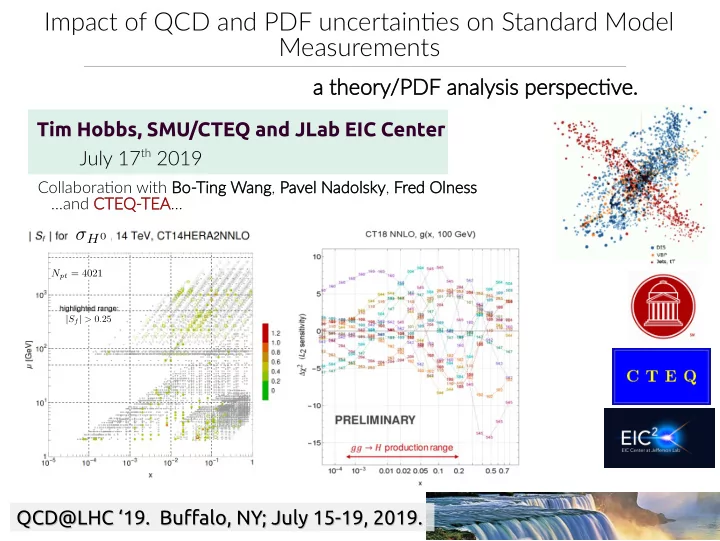
map these sensitjvitjes in a kinematjcal parameter space to quantjfy/visualize origin and interplay of pulls and tensions an n expanding ing set of calculatjons tjons:
slide-6
SLIDE 6

6

slide-7
SLIDE 7

P D F S e n s e guided the selectjon and implementatjon of these data for CT18

7

slide-8
SLIDE 8
  • idea : study the statjs

tjstjc tjcal correlatjon tjon between PDFs and the quality of the fjt at a measured data point(s); fjt quality encoded in a (Theory) – (shifued Data) residual :

ho how i is t s thi his d s done

  • ne? … examine and map the sensitjvitjes based on

knowledge of Hessian PD PDFs and resi esidua ual variatjons

  • for each data point, calculate the correlatjon (and sensitjvity) between the

residual and PDFs based on Hessian variatjon over PDF replicas,

  • map these in kinematjcal parameter space where, e.g., for DIS,

8

slide-9
SLIDE 9

9

slide-10
SLIDE 10

the sensitivity reveals a richer landscape than the correlation!

e.g., the substantjal impact of inclusive jet data on gluon PDF is identjfjed by

sens nsitjv tjvity maps reveal:

(i) highest impact data points for specifjc PDFs/observables (ii) tensions/complementaritjes among data sets (iii) physical origin of PDF constraints

10

slide-11
SLIDE 11

CM CMS jet jets HERA

  • heavy quark

production proceeds through boson fusion diagrams: charm sensitivities closely track the gluon plot

BCD BCDMS, CCFR CCFR

11

slide-12
SLIDE 12

[arXiv:1803.02777]

12

slide-13
SLIDE 13

we use this technology to examine imp implic icatjo tjons ns for HEP EP phe henome menology gy at t LHC

esp., EW EW p phen heno., H Hig iggs s physics ics, g g(x) (x), …

13

Mapping ing t the sensitj itjvity o

  • f h

hadronic e ic exper erimen iments t to n nucl ucleo eon n structure B.-T. Wang, T.J. Hobbs, S. Doyle, J. Gao, T.-J. Hou, P. M. Nadolsky, F. I. Olness Phys.R .Rev. D9 . D98 ( (2018) 0 094030 The c e coming s g synergy b between la en lattjc ttjce QCD and high high-ener energy gy p pheno enomeno menolo logy gy T.J. Hobbs, Bo-Ting Wang, Pavel Nadolsky, Fredrick Olness arXiv iv:1904.0 .00222v2 (coming soon) L2 sensitjvity details in

slide-14
SLIDE 14

14

slide-15
SLIDE 15

important PDF correlatjons for the ATLAS extractjon of It is instructjve to explore the data pulls on

15

…as a follow-on to Alesandro’s EW-focused overview:

slide-16
SLIDE 16

CT14N 14NNL NLO PDF sensitjvity of from 7 TeV ATLAS data

CTEQ-TEA sensitjvitjes to

16

slide-17
SLIDE 17

17

slide-18
SLIDE 18

rather than the costly LM scans, we can examine a “cheaper” measure which yields comparable informatjon the L2 sensitjvity

  • r,

…extent to which total χ2

E of specifjc expts. correlates with x-dep. of PDFs

18

slide-19
SLIDE 19

strong

  • nger

(antj tj-)correlatjon tjon strong

  • ng corr.

19

tension between LHCb W/Z data (245, 250); fjxed-target DIS, Drell-Yan (CDHSW F3 [109], E866pp [204])

slide-20
SLIDE 20

strong

  • ng corr.

20

again, tensions observed between, e.g., NMC ratjo data and CDHSW, E866pp tension between LHCb W/Z data (245, 250); fjxed-target DIS, Drell-Yan (CDHSW F3 [109], E866pp [204])

slide-21
SLIDE 21

…this analysis can be extended to MW, extractjons of which are dependent upon s(x), through Z-calibratjon

21

corr.

slide-22
SLIDE 22

22

corr.

slide-23
SLIDE 23

pronoun unced ed e efg fgect ect o

  • f ATLAS 7 TeV Z

Z/W data!

23

corr.

slide-24
SLIDE 24

Accardi et al., EPJC76, 471 (2016).

σH crucially limited by PDF and αS uncertaintjes

  • there remains considerable dependence (as large as ~13%) upon PDF

paramatrization and running coupling → the situation is such that precision in Higgs phenom. is significantly PDF-limited → enhancing the discovery potential in the Higgs sector will require improving these uncertainties!

24

Higgs, g(x)

slide-25
SLIDE 25

CT14 → CT18 modestly shifus Higgs cross sectjons and slightly reduces PDF uncertaintjes can we disentangle elements of the global analysis responsible for these improvements?

25

slide-26
SLIDE 26
  • afuer the

aggregated HERA data, incl nclus usive j e jet et prod

  • ductj

uctjon

  • n have

greatest total sensitjvity!

large correlatjons for E86 866, BCDMS, CCFR FR, CMS S WAS ASY, Z pT and tub tubar ar productjon, but smaller numbers of highly-sensitjve points

26

slide-27
SLIDE 27

we use the Higgs region g(x) to validate P D F S e n s e

  • PDFSense identjfjes the most sensitjve experiments with high confjdence

and in accord with other methods such as the LM scans. It works the best when the uncertaintjes are nearly Gaussian, and experimental constraints agree among themselves [arXiv:1803.02777] …for the gluon PDF in the Higgs region,

27

slide-28
SLIDE 28

28

slide-29
SLIDE 29

29

slide-30
SLIDE 30

30

slide-31
SLIDE 31

31

(a a conse sequ quence of usi using ng a a "sa saturatj tjon" fac actorizatj tjon scale in n NN NNLO DIS S for CT18 18Z)

slide-32
SLIDE 32

more speculatjvely, BSM searches and SMEFT represent possibilitjes for analogous sensitjvity analyses

BSM (?)

dependent upon Wilson coffjcients for dim-6 operators:

  • SMEFiT analyses fjt a generic parametrizatjon of BSM physics,

e.g., van Beek, Nocera, Rojo, Slade, arXiv:1906.05296

with error replicas in the space of {ci

(k)}, one could analyze data pulls

  • n SMEFiT ingredients à la P

D F S e n s e

32

slide-33
SLIDE 33

CT14HERA2 NN NNLO

the future: towa ward precision

  • n PDFs
  • very high luminosity DIS

colliders, like the electron- ion collider (EIC) at JLab/BNL or LHeC could provide a new generatjon

  • f very precise data in the

fjxed-target region

‘cleaner’ leptonic probes free of nuclear efgects OR, understand nuclear medium (for CCFR, NuTeV, ...)

a systematjc approach to reconcile LHC experiments will be imperatjve to reducing PDF uncertaintjes for the precision EW era at HL HL-LHC HC

33

slide-34
SLIDE 34

conclud cluding o

  • bserv

ervatj tjons

  • ns

fast; pub ublic code: : htup:/ /metapdf.hepforge.org/PDFSense

  • P

D F S e n s e produces kinematjc maps and summary charts of data-point sensitjvitjes to PDFs and PDF-dependent quantjtjes; readily extendable

  • PDF uncertaintjes of HEP observables can be opportuntjes for

sensitjve PDF measurements

  • heightened constraining power (on sin2θW, σH, …) will require

smoothing data tensions that are now being explored

sin2θW driven by uval, dval, which, e.g., E866pp, BCDMS have opposing pulls

34

a commu munity efg efgort t to und nder erstand nd s systema ematj tjc c tensions nee needed ed

  • dealing with these issues will be essentjal for HL-LHC program

we fjnd important improvements σH from incl. jet prod.; resolutjon of tensions will further tjghten constraints

TH THAN ANKS KS!!

slide-35
SLIDE 35

supplemental material

slide-36
SLIDE 36

HERA CM CMS jet jets

±(PDF)ri

relatively

large at high and low x for the gluon distribution

  • measurements

at high/low x are therefore most sensitive;

  • esp. Run 2

HERA points and CMS jet production at 7, 8 TeV

BC BCDMS, CCF CCFR

11

slide-37
SLIDE 37

33

slide-38
SLIDE 38

34

slide-39
SLIDE 39

PDF sensitjvity of

slide-40
SLIDE 40

2nd aside: kinematical matchings

  • residual-PDF correlations and sensitivities are evaluated at parton-level

kinematics determined according to leading-order matchings with physical scales in measurements

deeply-inelastic scattering: hadron-hadron collisions: single-inclusive jet production: pair production: measurements:

etc...

slide-41
SLIDE 41

PDFs determined by fjts to data; e.g., “CT14H2” pQCD matrix elements – specifjed by theoretical formalism in a given fjt

the goal is to quantify the strength of the constraints placed on a particular set

  • f PDFs by both individual and aggregated measurements without direct fjtting
  • for single-particle hadroproduction of gauge bosons at, e.g., LHC, factorization

gives

  • idea : study the statistical correlation between PDFs and the quality of the fjt at a

measured data point(s); fjt quality encoded in a (Theory) – (shifted Data) residual :

7

slide-42
SLIDE 42

a brief statistical aside, i

  • the CTEQ-TEA global analysis relies on the Hessian formalism for its error

treatment

nuisance parameters to handle correlated errors these result in systematic shifts to data central values: use this basis to compute 56- component “normalized” residuals :

where

  • a 56-dimensional parametric basis is obtained by diagonalizing the Hessian

matrix H determined from

(following a 28-parameter fjt)

CT10

8

slide-43
SLIDE 43

PDF prediction for ith empirical measurement kinematically matched to a specifjc (xi, μi)

a brief statistical aside, i [a]

use this basis to compute 56- component “normalized” residuals :

where

  • a 56-dimensional parametric basis is obtained by diagonalizing the Hessian

matrix H determined from

(following a 28-parameter fjt)

CT10

… … …

c

  • r

r e l a t e d ? error replicas

9

slide-44
SLIDE 44

a brief statistical aside, ii

  • … but how does the behavior of these residuals relate to the fjtted PDFs and

their uncertainties? for example, how does the PDF uncertainty (at specifjc x, μ*) correlate with the residual associated with a theoretical prediction at the same x, μ*?

examine the Pearson correlation over the 56-member PDF error set between a PDF of given fmavor and the residual X Y

[X,Y] are exactly (anti-)correlated at the far (right) left above.

  • we may then evaluate correlations between arbitrary PDF-derived quantities
  • ver the ensemble of error sets ([X,Y] may be PDFs, cross sections, residuals,… ):

10

slide-45
SLIDE 45

independent of some fjtting/reweighting ambiguities – e.g., the tolerance

11

slide-46
SLIDE 46

more tomorrow on LHC implicatjons

today: what t about t fu futur ture experime iments?

e. e.g., ., HL HL-LHC LHC, , LH LHeC, and and beyond

  • nd…

Mapping ing t the PDF PDF s sens ensitj itjvit ity o

  • f futur

ure f e facil cilitj itjes es ( (HL-LHC, LH LHeC, a and E EIC IC) T.J. Hobbs, Bo-Ting Wang, Pavel Nadolsky, Fredrick Olness arxiv:1907.0 .00988 (more detailed work in preparatjon)

15

slide-47
SLIDE 47

a high energy EIC, LHeC

 an electron-proton (or electron-ion) collider to achieve high luminosities

times that of HERA access a wide range of x, including explore the dynamics of gluon saturation; greatly improve PDF precision; perform SM tests; and many other physics goals

 can perform a sensitivity analysis of Monte Carlo generated reduced NC/CC

cross sections (Klein & Radescu, LHeC-Note-2013-002 PHY)

 to minimize the impact of large of unfjtted data (especially at low x), we

study the sensitivities for fmuctuated data – i.e., pseudodata randomly fmuctuated about the PDF4LHC15 NNLO prediction according to putative LHeC uncorrelated errors – based on 100 fb-1 of data

16

slide-48
SLIDE 48

HERA Frontier

  • very strong

sensitivities along the frontier of the HERA Run II data, however, there are important constraints in general for …and high PRELIMINARY

PDF4LHC15 NNLO

17

slide-49
SLIDE 49

 LHeC’s high

luminosity may give it a reach to high enough

x to help

resolve the stubborn d/u question

J.F. Owens, PAVI11

 …without a

nuclear target…

PRELIMINARY

PDF4LHC15 NNLO

18

slide-50
SLIDE 50

HL-LHC

W/Z prod. Z pT sets top jet, γ production

PRELIMINARY

  • very large integrated

luminosities:

(CMS/ATLAS) (LHCb)

What about HL-LHC?

Many thanks to Jun Gao for the pseudodata!

PDF4LHC15 NNLO

19

slide-51
SLIDE 51

PDF4LHC15 NNLO PDF4LHC15 NNLO

LHeC LHeC HL-LHC HL-LHC

now directly compare the LHeC vs. HL-LHC fmavor sensitjvitjes*

*notjng the much larger integrated luminosity of the HL-LHC pseudo-data

→! we compare both kinematic regions of especially strong sensitivity, and the aggregated impact of each experiment:

20

slide-52
SLIDE 52

PDF4LHC15 NNLO PDF4LHC15 NNLO

LHeC LHeC HL-LHC HL-LHC

even with a small (pseudo)data set, LHeC enjoys strong sensitivity to down-type distributions!

→! especially in a fashion complementary to HL-LHC, at very high/low x

21

slide-53
SLIDE 53

PDF4LHC15 NNLO PDF4LHC15 NNLO

LHeC LHeC HL-LHC HL-LHC

→ LHeC especially portends signifjcantly heightened knowledge

  • f nucleon strangeness

 CTEQ-TEA constraints come primarily through older fjxed-

target data and Tevatron data (and LHC Run I)

22

slide-54
SLIDE 54

PDF4LHC15 NNLO PDF4LHC15 NNLO

LHeC LHeC HL-LHC HL-LHC

in the SU(2) quark sea, the LHeC 100 fb-1 set imposes constraints of magnitude comparable to HL-LHC

…these again predominate at the extrema of x

23

slide-55
SLIDE 55

CT14 HERA2 NNLO

 the impact of an

EIC upon the theoretical predictions for inclusive Higgs production arises from a very broad region of the kinematical space it can access

epil ilog

  • gue: a US

US-based EIC wil will ha have im important HEP cons nsequ quenc nces, e.g., on n Hig iggs physic ics

 impact rather closely

tied to that of the integrated gluon PDF:

24

slide-56
SLIDE 56
  • latt

attice ce QC QCD calculations continue to improve and will be increasingly useful as

inputs into QCD global analyses

PDF-Lattice whitepaper – Lin et al., PPNP100, 107 (2018); arXiv:1711.07916.

  • the PDF-Lattice relationship will be synergistic :

→! PDF phenomenologists deliver improving benchmarks to challenge the Lattice →! Lattice calculations for PDF Mellin moments and quasi-PDF DFs can be theoretical priors for QCD global fjts

PDFSense analysis – Hobbs, Wang, Nadolsky and Olness, arXiv:1904.00022.

  • lattice can also now compute x-dependent quantities – the quasi-PDFs (qPDFs):
  • moments from lattice can help unravel PDF fmavor dependence, constrain phenom. PDFs:

(i) (ii)

4

slide-57
SLIDE 57
  • in lattice gauge theory, the accessible moments are C-odd/even combinations,

PDF Mellin moments gauge-covariant derivatives

  • the PDF moments are related to hadronic matrix elements of twist-2 operators:

PDF moments can be evaluated on the QCD lattice

(i)

5

slide-58
SLIDE 58

the status of lattice QCD calculations

PDF-Lattice whitepaper – Lin et al., Prog. Part. Nucl. Phys. 100, 107 (2018).

summarize...

  • depending upon fmavor and order, lattice

extractions of Mellin moments have varying status (above, FLAG evaluations)

→! e.g., the fjrst isovector moment has been computed by numerous groups →! but the second, by relatively few

  • systematic lattice efgects are similarly widely

varied however, improvement nts are re being ng made ra rapidly!

6

slide-59
SLIDE 59

sensitivity to Mellin moments

we show Mellin moments computable

  • n the lattice

at the scale HERA, BCDM CDMS, NM NMC, E866 DY DY pair pro roduc uction are most sensitive to the moments

9

slide-60
SLIDE 60

sensitivity maps: isovector moments

  • We focus on isovect

ctor (u-d) PDF combinations

  • n the lattice, these are more

readily computed since fmavor non-singlet combinations do not receive disconnected insertions

1 10

  • Moments of higher order are

constrained by higher xi fjxed-target data:

x

(grows with moment order, n)

10

slide-61
SLIDE 61

2019-02-05

total sensitivity to matched quasi-PDFs

13

Liu et al., arXiv:1807.06566.

slide-62
SLIDE 62

An EIC would drive lattice phenomenology

  • Many of the experiments most sensitive to PDF Mellin moments and qPDFs involve nuclear

targets eA A data fr from EIC would sharpen knowledge of f nucl clear correct ctions

isovector 1st moment isovector qPDF

  • A high-luminosity lepton-hadron collider will impose very tight constraints on many lattice
  • bservables; below, the isovector fjrst moment and qPDF

“EIC impact on tomography and HEP phenom.,” Session C09: Sat., April 13th – 1:30pm 15