
SLIDE 1
LIFL ¡& ¡INRIA ¡Lille University ¡of ¡Lille, ¡FRANCE
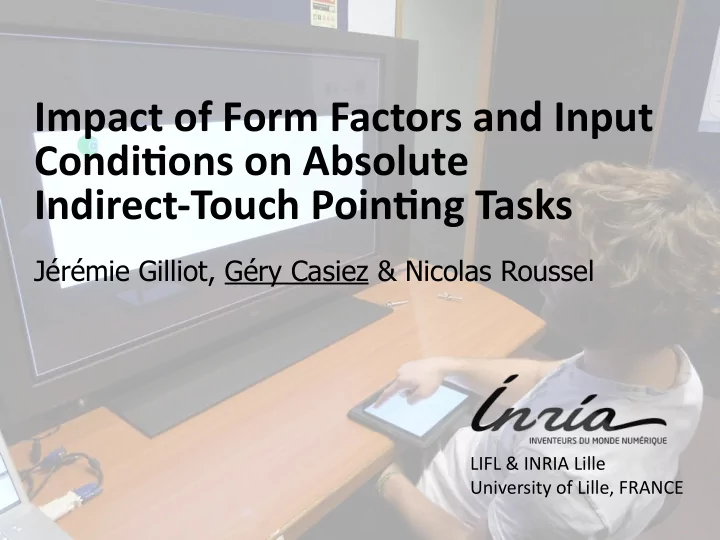
Impact ¡of ¡Form ¡Factors ¡and ¡Input ¡ Condi2ons ¡on ¡Absolute Indirect-‑Touch ¡Poin2ng ¡Tasks ¡
Jérémie Gilliot, Géry Casiez & Nicolas Roussel
Impact of Form Factors and Input Condi2ons on Absolute - - PowerPoint PPT Presentation
Impact of Form Factors and Input Condi2ons on Absolute Indirect-Touch Poin2ng Tasks Jrmie Gilliot, Gry Casiez & Nicolas Roussel LIFL & INRIA Lille University of
LIFL ¡& ¡INRIA ¡Lille University ¡of ¡Lille, ¡FRANCE
Jérémie Gilliot, Géry Casiez & Nicolas Roussel
Absolute Relative Direct Indirect
2
Absolute Relative Direct Indirect
2
Absolute Relative Direct Indirect
+ directness + multitouch
2
Absolute Relative Direct Indirect
+ directness + multitouch
2
Absolute Relative Direct Indirect
+ directness + multitouch
+ precision + fatigue
2
Absolute Relative Direct Indirect
+ directness + multitouch
+ precision + fatigue
2
Absolute Relative Direct Indirect
+ directness + multitouch
+ precision + fatigue
+ fatigue + multitouch
2
Absolute Relative Direct Indirect
+ directness + multitouch
+ precision + fatigue
+ fatigue + multitouch
2
(a) (b)
Malik et al. UIST’05 Schmidt et al. Interact’09 McCallum et al. UIST’09
Figure 1: This user operates his mobile phone in his “clock”
Gustafson et al. UIST’11
quire something completely different?
Benko et al. GI’10 Moscovich et al. GI’06
3
Screen
4
Screen
4
Screen
4
5
5
device, ability to use both hands)
5
device, ability to use both hands)
ratio, target size)
5
6
Hypothesis:
6
Hypothesis:
would help position the index finger
6
Hypothesis:
would help position the index finger
position the finger if users were unable to look at the device
6
7
7
7
7
7
7
8
12 participants
8
12 participants x 3 input conditions (1 hand, 1hand-blinders, 2handsBlinders)
8
12 participants x 3 input conditions (1 hand, 1hand-blinders, 2handsBlinders)
8
12 participants x 3 input conditions (1 hand, 1hand-blinders, 2handsBlinders)
8
12 participants x 3 input conditions (1 hand, 1hand-blinders, 2handsBlinders)
8
12 participants x 3 input conditions (1 hand, 1hand-blinders, 2handsBlinders) x 2 device size (iPod, iPad)
8
12 participants x 3 input conditions (1 hand, 1hand-blinders, 2handsBlinders) x 2 device size (iPod, iPad) x 3 blocks
8
12 participants x 3 input conditions (1 hand, 1hand-blinders, 2handsBlinders) x 2 device size (iPod, iPad) x 3 blocks x 3 target size (10, 20, 40 mm)
8
12 participants x 3 input conditions (1 hand, 1hand-blinders, 2handsBlinders) x 2 device size (iPod, iPad) x 3 blocks x 3 target size (10, 20, 40 mm) x 9 target position
1 3 9 10 13 11 19 22 25
8
12 participants x 3 input conditions (1 hand, 1hand-blinders, 2handsBlinders) x 2 device size (iPod, iPad) x 3 blocks x 3 target size (10, 20, 40 mm) x 9 target position x 3 repetitions = 17,496 total trials
8
0%# 10%# 20%# 30%# 40%# 50%# 60%# 70%# 80%# 90%# 100%#
1HANDBLINDERS# 2HANDSBLINDERS# 1HAND# SMALL# LARGE# WS# WM# WL# 1# 3# 9# 10# 11# 13# 19# 22# 25#
INPUT&CONDITION&&&DEVICE&SIZE&&&&&&&TARGET&SIZE&&&&&&&&&&&&&&&&&&&&&&&&&TARGET&POSITION&
Number&of& failed&a<empts&
5# 4# 3# 2# 1# 0#
1 3 9 10 13 11 19 22 25
10, 20, 40 mm
9
0%# 10%# 20%# 30%# 40%# 50%# 60%# 70%# 80%# 90%# 100%#
1HANDBLINDERS# 2HANDSBLINDERS# 1HAND# SMALL# LARGE# WS# WM# WL# 1# 3# 9# 10# 11# 13# 19# 22# 25#
INPUT&CONDITION&&&DEVICE&SIZE&&&&&&&TARGET&SIZE&&&&&&&&&&&&&&&&&&&&&&&&&TARGET&POSITION&
Number&of& failed&a<empts&
5# 4# 3# 2# 1# 0#
1 3 9 10 13 11 19 22 25
10, 20, 40 mm
9
0%# 10%# 20%# 30%# 40%# 50%# 60%# 70%# 80%# 90%# 100%#
1HANDBLINDERS# 2HANDSBLINDERS# 1HAND# SMALL# LARGE# WS# WM# WL# 1# 3# 9# 10# 11# 13# 19# 22# 25#
INPUT&CONDITION&&&DEVICE&SIZE&&&&&&&TARGET&SIZE&&&&&&&&&&&&&&&&&&&&&&&&&TARGET&POSITION&
Number&of& failed&a<empts&
5# 4# 3# 2# 1# 0#
1 3 9 10 13 11 19 22 25
10, 20, 40 mm
9
0%# 10%# 20%# 30%# 40%# 50%# 60%# 70%# 80%# 90%# 100%#
1HANDBLINDERS# 2HANDSBLINDERS# 1HAND# SMALL# LARGE# WS# WM# WL# 1# 3# 9# 10# 11# 13# 19# 22# 25#
INPUT&CONDITION&&&DEVICE&SIZE&&&&&&&TARGET&SIZE&&&&&&&&&&&&&&&&&&&&&&&&&TARGET&POSITION&
Number&of& failed&a<empts&
5# 4# 3# 2# 1# 0#
1 3 9 10 13 11 19 22 25
10, 20, 40 mm
9
0%# 10%# 20%# 30%# 40%# 50%# 60%# 70%# 80%# 90%# 100%#
1HANDBLINDERS# 2HANDSBLINDERS# 1HAND# SMALL# LARGE# WS# WM# WL# 1# 3# 9# 10# 11# 13# 19# 22# 25#
INPUT&CONDITION&&&DEVICE&SIZE&&&&&&&TARGET&SIZE&&&&&&&&&&&&&&&&&&&&&&&&&TARGET&POSITION&
Number&of& failed&a<empts&
5# 4# 3# 2# 1# 0#
1 3 9 10 13 11 19 22 25
10, 20, 40 mm
9
10
10
0" 2" 4" 6" 8" 10" 12" 14" 1HANDBLINDERS" 2HANDSBLINDERS" 1HAND" TARGETING(ERROR(((((((()( INPUT(CONDITION(
SMALL" LARGE"
11
0" 2" 4" 6" 8" 10" 12" 14" 1HANDBLINDERS" 2HANDSBLINDERS" 1HAND" TARGETING(ERROR(((((((()( INPUT(CONDITION(
SMALL" LARGE"
11
0" 2" 4" 6" 8" 10" 12" 14" 1HANDBLINDERS" 2HANDSBLINDERS" 1HAND" TARGETING(ERROR(((((((()( INPUT(CONDITION(
SMALL" LARGE"
11
0" 2" 4" 6" 8" 10" 12" 14" 1HANDBLINDERS" 2HANDSBLINDERS" 1HAND" TARGETING(ERROR(((((((()( INPUT(CONDITION(
SMALL" LARGE"
11
0" 2" 4" 6" 8" 10" 12" 14" 1HANDBLINDERS" 2HANDSBLINDERS" 1HAND" TARGETING(ERROR(((((((()( INPUT(CONDITION(
SMALL" LARGE"
11
0" 1" 2" 3" 4" 5" 6" 7" 8" 9" 10" 1" 3" 9" 10" 11" 13" 19" 22" 25" TARGETING(ERROR(((((((()( TARGET(POSITION(
1 3 13 11 9 10 19 25 22
12
0" 1" 2" 3" 4" 5" 6" 7" 8" 9" 10" 1" 3" 9" 10" 11" 13" 19" 22" 25" TARGETING(ERROR(((((((()( TARGET(POSITION(
1 3 13 11 9 10 19 25 22
12
Minimal target size in motor space participants can select on first attempt with a 95% probability
13
Minimal target size in motor space participants can select on first attempt with a 95% probability
INPUT CONDITION 1HAND 2HAND 1HAND BLINDERS BLINDERS DEVICE SIZE SMALL 22.3 23.2 16.8 LARGE 45.2 41.3 27.8 Table 1: Minimum target size (in mm) to acquire a target on first attempt
13
Minimal target size in motor space participants can select on first attempt with a 95% probability
INPUT CONDITION 1HAND 2HAND 1HAND BLINDERS BLINDERS DEVICE SIZE SMALL 22.3 23.2 16.8 LARGE 45.2 41.3 27.8 Table 1: Minimum target size (in mm) to acquire a target on first attempt
13
14
Hypothesis:
14
Hypothesis: 1.The size of targets relative to that of the display would have no impact on performance
14
Hypothesis: 1.The size of targets relative to that of the display would have no impact on performance 2.Similar input and output aspect ratios would lead to better performance
14
15
16
12 participants
16
12 participants x 3 workspace height (74, 147, 294 mm)
16
12 participants x 3 workspace height (74, 147, 294 mm) x 3 aspect ratio (4:3, 16:9, 32:10)
4:3 x 0,5 32:10 x 1 x 2 16:9
16
12 participants x 3 workspace height (74, 147, 294 mm) x 3 aspect ratio (4:3, 16:9, 32:10) x 3 blocks
16
12 participants x 3 workspace height (74, 147, 294 mm) x 3 aspect ratio (4:3, 16:9, 32:10) x 3 blocks x 2 target size (20 and 40 mm)
16
12 participants x 3 workspace height (74, 147, 294 mm) x 3 aspect ratio (4:3, 16:9, 32:10) x 3 blocks x 2 target size (20 and 40 mm) x 4 target position
1 3 9 10 13 11 19 22 25
16
12 participants x 3 workspace height (74, 147, 294 mm) x 3 aspect ratio (4:3, 16:9, 32:10) x 3 blocks x 2 target size (20 and 40 mm) x 4 target position x 3 repetitions
16
12 participants x 3 workspace height (74, 147, 294 mm) x 3 aspect ratio (4:3, 16:9, 32:10) x 3 blocks x 2 target size (20 and 40 mm) x 4 target position x 3 repetitions = 7,776 total trials
16
0" 2" 4" 6" 8" 10" 12" 14" 1" 13" 19" 22" TARGETING(ERROR(((((((()(
TARGET(POSITION( RM" RL" RXL"
1 3 9 10 13 11 19 22 25
17
0" 2" 4" 6" 8" 10" 12" 14" 1" 13" 19" 22" TARGETING(ERROR(((((((()(
TARGET(POSITION( RM" RL" RXL"
1 3 9 10 13 11 19 22 25
17
WM WORKSPACE HEIGHT HS HM HL ASPECT RATIO RM 20×20 10×10 5×5 RL 15×20 17.5×10 3.7×5 RXL 8.3×20 4.2×10 2.1×5 WL WORKSPACE HEIGHT HS HM HL ASPECT RATIO RM 40×40 20×20 10×10 RL 30×40 15×20 7.5×10 RXL 16.7×40 8.3×20 4.2×10 Table 3: Target size in motor space (in mm) corresponding to the dis-
18
WM WORKSPACE HEIGHT HS HM HL ASPECT RATIO RM 20×20 10×10 5×5 RL 15×20 17.5×10 3.7×5 RXL 8.3×20 4.2×10 2.1×5 WL WORKSPACE HEIGHT HS HM HL ASPECT RATIO RM 40×40 20×20 10×10 RL 30×40 15×20 7.5×10 RXL 16.7×40 8.3×20 4.2×10 Table 3: Target size in motor space (in mm) corresponding to the dis-
29.9 mm 31.2 mm
18
15” monitor touchpad
19
15” monitor touchpad
21 mm 62 mm
19
15” monitor touchpad
21 mm 62 mm
19
touchpad
20
touchpad
20
touchpad
20
touchpad
20
30x30 mm screen 70x70 mm touchpad
21
30x30 mm screen 70x70 mm touchpad
21
22
even if nothing is displayed on it helps => the boundaries of the surface should be clearly distinguishable
22
even if nothing is displayed on it helps => the boundaries of the surface should be clearly distinguishable
account for all absolute indirect-touch pointing tasks.
22
even if nothing is displayed on it helps => the boundaries of the surface should be clearly distinguishable
account for all absolute indirect-touch pointing tasks.
aspect ratios do.
22
even if nothing is displayed on it helps => the boundaries of the surface should be clearly distinguishable
account for all absolute indirect-touch pointing tasks.
aspect ratios do.
and use it to check whether the on-screen interactors can be reliably acquired.
22