
SLIDE 1
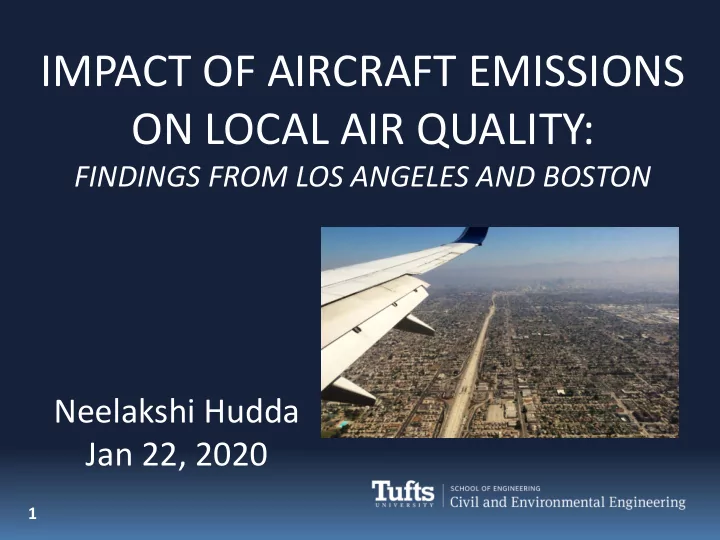
IMPACT OF AIRCRAFT EMISSIONS ON LOCAL AIR QUALITY:
FINDINGS FROM LOS ANGELES AND BOSTON
Neelakshi Hudda Jan 22, 2020
1
IMPACT OF AIRCRAFT EMISSIONS ON LOCAL AIR QUALITY: FINDINGS FROM - - PowerPoint PPT Presentation
IMPACT OF AIRCRAFT EMISSIONS ON LOCAL AIR QUALITY: FINDINGS FROM LOS ANGELES AND BOSTON Neelakshi Hudda Jan 22, 2020 1 AVIATION EMISSIONS IMPACT AIR QUALITY AT GLOBAL TO LOCAL SPATIAL SCALES Globally, - Climate change impacts - Emissions
1
Globally,
Nationally,
2
Locally,
3
Vast amount of literature exits on the matter
also been associated with:
4
Vast amount of literature exits on the matter
also been associated with:
5
EVEN MORE!!! Vast amount of literature exits on the matter
unstudied
Air Pollution Impact & Exposure Assessment Association with health
Recognition, Accountability, Mitigation
6
Increasingly, in context of aviation emissions, local ≡ 10 kilometer Our work shows that the impacts extend much farther than spatial scales that had been studied previously (~3.5 km pre- 2014). ❑ In Los Angeles we detected impacts up to 20 km ❑ In Boston we detected impacts up to 7.5 km Not all airports are the same.
7
concentration outside the zone of impact (spatial differences) concentration in the absence of the impact (temporal differences)
8
❑ jet engine-exhaust and non-exhaust emissions + GSE ❑ regulated and unregulated pollutants
9
10
❑100-900% increase in PNC extended 20 km downwind ❑Concentrations increased by about 35,000 particles/cm3
area
11
12
13
14
15
16
Short-term: We studied 16 homes in two different communities Long-term: We studied 3 central sites
17
When were the concentrations highest/air-pollution worst?
Chelsea Site, 4 km Roxbury Site, 7.3 km Boston Globe Site 6.5 km
18
19
20
A home in a Winthrop which is situation similar to JFK-Inwood
21
Concentrations of many pollutants highest when residence is downwind of the airport
22
Indoor concentrations only 25% lower than outdoors Highest during evening to nighttime hours
23
Concentrations highest when planes were landing overhead
24
25
26
27
Tae Hong Park, Ph.D. New York University www.getnoisy.io
January 2020
M e a s u r i n g | S c a l i n g | U n d e r s t a n d i n g
§Global issue
2015: 50% live around urban centers 2050: ~70% will live around urban centers May 29, 2019
§Health impact
Global phenomenon negatively affecting residents and families Cardiovascular complications, productivity, children’s learning, sleep deprivation, property devaluation, …
§Airplane noise
“Most annoying amongst transportation groups” [1].
[1] H. Miedema and H. Vos, “Exposure-response relationships for transportation noise,” J. Acoust. Soc., 1998.
M e a s u r i n g | S c a l i n g | U n d e r s t a n d i n g
§ Launched in 2011 – Citygram Project § 9 years of research and development § Over 25 publications and patent applications § From lab to real world: NOISY
§ Noise measurement at source § plug-and-sense sensor network system § High value, low bandwidth data § Inclusive design philosophy § (1) accessible window § (2) home WiFi § (3) electrical outlet
§ Community-driven scaling § 24/7, 365, 1 sec § High value, low bandwidth data § Artificial Intelligence (AI)
§ Automatic airplane noise detection § Ignores all other noise types
Soundmaps
64 day aircraft noise events: dBA, timestamp, day from NOISY sensor network
Robustness, objectivity, reliability
24-hour airplane event (ORD) Hourly distribution example from NOISY sensor
NOISY airplane tracking software module
Automatic airplane noise event tracking dBA (+ additional acoustic feature options) Date and time of event Latitude, longitude, altitude Airplane type & airline Speed Verification Noise triangulation ADS-B Visualizations: current and historical data web browser
Community-Driven Data-Driven Existing models augmented with measurements Rapid scaling and spatiotemporal granularity Automation and AI Adoptable at (almost) any airport and community
Federal Aviation Administration
Overview Briefing & Flight Path Changes
January 22, 2020 NYCAR
Federal Aviation Administration
to make the Northeast Corridor (NEC) a priority region in the FAA's
system in the NEC operationally benefits the entire US aviation system
~50% of the delays across the system emanate from this area
Boston, including Philadelphia and the New York metropolitan area
December 2021
2
Federal Aviation Administration
execution of today’s operation
weather conditions
goals
reduced emissions
3
Federal Aviation Administration
that improve efficiency of today’s airspace/airport operation; explore
support tools, and processes that enhance controller information and decision-making such that operational performance is improved in all
deployed tools, routes, and processes to improve movement of air traffic into, out of, and within the NEC during periods of exceptionally high demand and severe weather
buildings, and air traffic towers that enable improved surface operations and airport throughput
4
Federal Aviation Administration
that may lead to implementation
FAA Industry Airports Totals Total Milestones 51 41 12 104 Completed Milestones 40 10 4 54
5
Federal Aviation Administration
6
Federal Aviation Administration
amendment would enhance safety and efficiency
traverse more directly over the Van Wyck Expressway
May 21, 2020
7
Federal Aviation Administration
LGA
Proposed GLDMN6 / NTHNS5 GLDMN5 / NTHNS4 Flights shifted ~1,700 feet to the West
N
MITRE Projected New Flight Tracks
GLDMN/NTHNS Departures “Current vs Proposed”
8
Federal Aviation Administration
GLDMN/NTHNS Departures “Current vs Proposed”
LGA
N
Proposed GLDMN6 / NTHNS5 GLDMN5 / NTHNS4 Flights shifted ~1,700 feet to the West Projected New Flight Tracks
0.5 NM 4 NM
Flushing Flushing Meadows – Corona Park
*Maps from NYC Open Data
9
Van Wyck Expressway
Federal Aviation Administration
1 NM
4 NM
GLDMN
CRI
NTHNS TRISK MASTT KIWIE WP103 WP188
GLDMN6 (Proposed) NTHNS4 (Current) GLDMN5 (Current) NTHNS5 (Proposed) LGA
Projected New Flight Tracks
GLDMN/NTHNS Departures “Current vs Proposed”
10
Project Scope:
Redesign airspace and route structure in offshore airspace east
Expected Outcomes:
Increase offshore airspace capacity via additional sector and segregation of flows in tight airspace between Warning Areas
NEC Initiative: Implement Satellite-Based Route Structure in Offshore Airspace East of NY
11
Federal Aviation Administration
NEC Initiative:
East Coast Satellite-Based (PBN) High-Altitude Routes
Initiative Objective Design high-altitude (above 24,000 ft) PBN Route structure to segregate flows and better manage traffic to/from major airports on East Coast Northeast Corridor Mid-Atlantic States to New England
Florida Metroplex Southern States to Puerto Rico
12
Federal Aviation Administration
proposed effective date: 11/5/2020
13
Not all Central and Western U.S. routes are depicted
Legacy ground-based routes depicted in blue New satellite-based routes depicted in green
Federal Aviation Administration
We will continue to keep you and your communities updated Please follow the link below to view the latest report titled “Phase 2 Addendum to Priorities for Improving Operational Performance in the Northeast Corridor (NEC) through CY2021”
Approved by the NextGen Advisory Committee in June 2018
https://www.faa.gov/about/office_org/headquarters_offices/ang/nac/media/ NEC_Report_Jun2018.pdf
14
FAA Reauthorization Act of 2018
1
Signed into law by President Trump on Oct. 5, 2018
Title I – Authorizations Subtitle D – Airport Noise and Environmental Streamlining
Alternative airplane noise metric evaluation deadline
evaluation of alternative metrics to the current Day Night Level (DNL) 65 standard.
Addressing community noise concerns
procedure that would direct aircraft between the surface and 6,000 feet above ground level
consider the feasibility of dispersal headings or other lateral track variations to address community noise concerns.
Community involvement if FAA NextGen projects located in metroplexes
Federal Aviation Administration shall complete a review of the Federal Aviation Administration’s community involvement practices for Next Generation Air Transportation System (NextGen) projects located in metroplexes identified by the Administration. The review shall include, at a minimum, a determination of how and when to engage airports and communities in performance-based navigation proposals.
submit to the appropriate committees of Congress a report on— ✓ how the Administration will improve community involvement practices for NextGen projects located in metroplexes; ✓ how and when the Administration will engage airports and communities in performance-based navigation proposals; and ✓ lessons learned from NextGen projects and pilot programs and how those lessons learned are being integrated into community involvement practices for future NextGen projects located in metroplexes
FAA Reauthorization Act of 2018
2
Lead emissions
National Academies of Sciences, Engineering, and Medicine under which the National Research Council will study aviation gasoline.
✓ existing non-leaded fuel alternatives to the aviation gasoline used by piston-powered general aviation aircraft; ✓ ambient lead concentrations at and around airports where piston-powered general aviation aircraft are used; and ✓ mitigation measures to reduce ambient lead concentrations, including increasing the size of run-up areas, relocating run-up areas, imposing restrictions on aircraft using aviation gasoline, and increasing the use of motor gasoline in piston-powered general aviation aircraft.
submit to the appropriate committees of Congress the study developed by the National Research Council pursuant to this section.
Terminal sequencing and spacing
Federal Aviation Administration shall provide a briefing to the appropriate committees of Congress on the status of Terminal Sequencing and Spacing (TSAS) implementation across all completed NextGen metroplexes with specific information provided by airline regarding the adoption and equipping of aircraft and the training of pilots in its use.
Airport noise mitigation and safety study
Federal Aviation Administration shall initiate a study to review and evaluate existing studies and analyses of the relationship between jet aircraft approach and takeoff speeds and corresponding noise impacts on communities surrounding airports.
✓ whether a decrease in jet aircraft approach or takeoff speeds results in significant aircraft noise reductions; ✓ whether the jet aircraft approach or takeoff speed reduction necessary to achieve significant noise reductions ✓ if it jeopardizes aviation safety ✓ decreases the efficiency of the National Airspace System, including lowering airport capacity, increasing travel times, or increasing fuel burn;
FAA Reauthorization Act of 2018
3 ✓ the advisability of using jet aircraft approach or takeoff speeds as a noise mitigation technique; and ✓ if the Administrator determines that using jet aircraft approach or takeoff speeds as a noise mitigation technique is advisable, whether any of the metropolitan areas specifically identified in section 189(b)(2) would benefit from such a noise mitigation technique without a significant impact to aviation safety or the efficiency of the National Airspace System.
shall submit to the appropriate committees of Congress a report on the results of the study initiated.
Regional ombudsmen
the Federal Aviation Administration, the Regional Administrator for that region shall designate an individual to be the Regional Ombudsman for the region.
✓ serve as a regional liaison with the public, including community groups, on issues regarding aircraft noise, pollution, and safety; ✓ make recommendations to the Administrator for the region to address concerns raised by the public and improve the consideration of public comments in decision-making processes; and ✓ be consulted on proposed changes in aircraft operations affecting the region, including arrival and departure routes, in order to minimize environmental impacts, including noise.
Mandatory use of the New York North Shore Helicopter Route
✓ Not later than 30 days after the date of enactment of this Act, the Administrator shall initiate a review of the regulations described in subsection (a)(1) that assesses the— ✓ noise impacts of the regulations for communities, including communities in locations where aircraft are transitioning to or from a destination or point of landing; ✓ enforcement of applicable flight standards, including requirements for helicopters
✓ availability of alternative or supplemental routes to reduce the noise impacts of the regulations, including the institution of an all water route over the Atlantic Ocean.
FAA Reauthorization Act of 2018
4
Stage 3 aircraft study
General of the United States shall initiate a review of the potential benefits, costs and
General shall submit to the appropriate committees of Congress a report on the results of the review.
Aircraft noise exposure
relationship between aircraft noise exposure and its effects on communities around the airports.
submit to Congress a report containing the results of the review.
Study regarding day-night average sound levels
day-night level standard, such as the use of actual noise sampling and other methods to address community airplane noise concerns.
shall submit to the appropriate committees of Congress a report on the results of the study. Sec 189 Study on potential health and economic impacts of overflight noise
Federal Aviation Administration shall enter into an agreement with an eligible institution
✓ The study shall include an examination of the incremental health impacts attributable to noise exposure that result from aircraft flights, including sleep disturbance and elevated blood pressure. ✓ Be focused on residents in the metropolitan areas of: Boston, Chicago, the District of Columbia, New York, the Northern California Metroplex, Phoenix, the Southern California Metroplex, Seattle
FAA Reauthorization Act of 2018
5 ✓ consider, in particular, the incremental health impacts on residents living partly or wholly underneath flight paths most frequently used by aircraft flying at an altitude lower than 10,000 feet, including during takeoff or landing; ✓ include an assessment of the relationship between a perceived increase in aircraft noise, including as a result of a change in flight paths that increases the visibility of aircraft from a certain location, and an actual increase in aircraft noise, particularly in areas with high or variable levels of non-aircraft-related ambient noise; ✓ consider the economic harm or benefits to businesses located party or wholly underneath flight paths most frequently used by aircraft flying at an altitude lower than 10,000 feet, including during takeoff or landing.
an agreement the results of the study, including any source materials used.
administrator shall submit to the appropriate committees of Congress the study and a summary of the results.