
SLIDE 1
Image: ‘Mawu, African Mother of Us All’ by Swedish artist Monica Sjöö
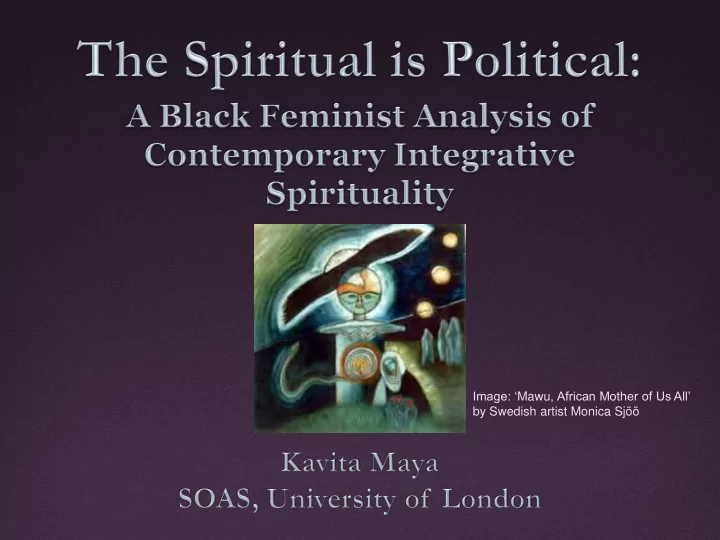
Image: Mawu , African Mother of Us All by Swedish artist Monica Sj - - PowerPoint PPT Presentation
Image: Mawu , African Mother of Us All by Swedish artist Monica Sj What is spirituality? Does spirituality have any innate meaning? Not a universal category, but represented in different ways, implicated in power
Image: ‘Mawu, African Mother of Us All’ by Swedish artist Monica Sjöö
Marion Bowman argues distinction between ‘alternative’ and mainstream’ no longer useful. Emphasises ‘vernacular religion’ and ‘integrative spirituality’ Lifestyle choices combine ‘a wide variety of religious, historic, indigenous and esoteric traditions in order to produce highly personalised forms of religiosity.’ – ‘The Value of Analysing Avalon’, Religion (2009: 166)
Distinguishable from theology through association with scientific method, the ‘study of religion’ was founded against a backdrop of Christianity and western imperialism Enlightenment universalist ideology: a social formation underpinning colonial expansion and the categorization
Gendered, racialised colonial constructs: the ‘mystic East’, the African ‘dark continent’ & European prehistoric matriarchal civilisation Silencing / erasure of black gendered & WoC postcolonial subject positions
Associated with ‘second-wave’ feminism (1970s/80s): women’s and ecofeminist spirituality, the female body as sacred, the divine feminine, the Great Mother; individual goddesses as well as ‘Goddess’ A contemporary, ‘post-Christian’ western phenomenon, more widespread in North America, not to be conflated with the worship of goddesses within Hindu and Buddhist traditions Linked to but not synonymous with Neo- Paganism (an ‘umbrella term’ including Wicca, Witchcraft, Druidry, nature religion etc.)
Starhawk’s The Spiral Dance, first published 1979, hugely influenced the western Goddess movement
Glastonbury Goddess Temple, Beltane 2014 Wheel of Britannia altar in the Goddess Temple
themselves as reclaiming the tutelary ‘indigenous’ goddess of the land of Britain from her misrepresentation by both ancient Roman and recent British patriarchal colonisers
prehistoric Britannia: a romanticized connection between land, ancestry and lost matriarchal culture
‘Britannia’ by Marion von Eupen, teacher of the Priestess of Brighde training course
Post-Enlightenment romanticism imagines a prehistoric lost golden age, wild, rural and feminine, associated with symbols such as the moon, the night, serpents, the Earth; an antidote to techno- scientific, alienated modernity
Linked to the idea of the ‘volk’ who are culturally ‘rooted’ in the land of their ancestry Ethnocentric and exclusionary: forecloses recognition of European WoC as subjects of gendered, racialised, (post)colonial histories of
‘Lady of Avalon’ sculpture by artist Rhea Silvia in the Goddess Temple
Ceremonial fire priestesses at the Glastonbury Goddess Conference Lammas (harvest) ritual; later celebration with singing, drumming & dancing, 31st July 2013
Black feminists and WoC need to counter colonial gendered & racialised representations of spirituality. ‘For each of us as women, there is a dark place within, where hidden and growing our true spirit rises….These places of possibility within ourselves are dark because they are ancient and hidden; they have survived and grown strong through that darkness. Within these deep places, each one of us holds an incredible reserve of creativity and power, of unexamined and unrecorded emotion and feeling. The woman’s place of power within each of us is neither white nor surface; it is dark, it is ancient, and it is deep.’