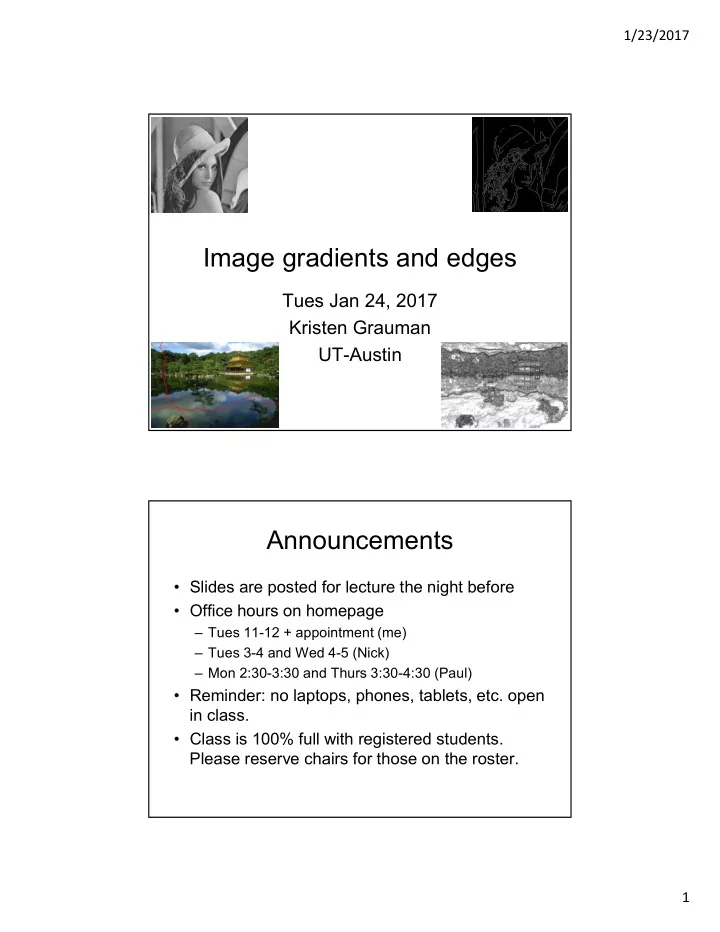
Image gradients and edges Tues Jan 24, 2017 Kristen Grauman - - PDF document

image gradients and edges
SMART_READER_LITE
LIVE PREVIEW

Image gradients and edges Tues Jan 24, 2017 Kristen Grauman - - PDF document

1/23/2017 Image gradients and edges Tues Jan 24, 2017 Kristen Grauman UT-Austin Announcements Slides are posted for lecture the night before Office hours on homepage Tues 11-12 + appointment (me) Tues 3-4 and Wed 4-5 (Nick)


slide-1
SLIDE 1

1/23/2017 1

Image gradients and edges

Tues Jan 24, 2017 Kristen Grauman UT-Austin

Announcements

  • Slides are posted for lecture the night before
  • Office hours on homepage

– Tues 11-12 + appointment (me) – Tues 3-4 and Wed 4-5 (Nick) – Mon 2:30-3:30 and Thurs 3:30-4:30 (Paul)

  • Reminder: no laptops, phones, tablets, etc. open

in class.

  • Class is 100% full with registered students.

Please reserve chairs for those on the roster.

slide-2
SLIDE 2

1/23/2017 2

Last time

  • Various models for image “noise”
  • Linear filters and convolution useful for

– Image smoothing, removing noise

  • Box filter
  • Gaussian filter
  • Impact of scale / width of smoothing filter
  • Separable filters more efficient
  • Median filter: a non-linear filter, edge-preserving

Image filtering

  • Compute a function of the local neighborhood at

each pixel in the image

– Function specified by a “filter” or mask saying how to combine values from neighbors.

  • Uses of filtering:

– Enhance an image (denoise, resize, etc) – Extract information (texture, edges, etc) – Detect patterns (template matching)

Adapted from Derek Hoiem

Today

slide-3
SLIDE 3

1/23/2017 3

Edge detection

  • Goal: map image from 2d array of pixels to a set of

curves or line segments or contours.

  • Why?
  • Main idea: look for strong gradients, post-process

Figure from J. Shotton et al., PAMI 2007

What causes an edge?

Depth discontinuity:

  • bject boundary

Change in surface

  • rientation: shape

Cast shadows Reflectance change: appearance information, texture

slide-4
SLIDE 4

1/23/2017 4

Edges/gradients and invariance

Derivatives and edges

image intensity function (along horizontal scanline) first derivative edges correspond to extrema of derivative

Source: L. Lazebnik

An edge is a place of rapid change in the image intensity function.

slide-5
SLIDE 5

1/23/2017 5

Derivatives with convolution

For 2D function, f(x,y), the partial derivative is: For discrete data, we can approximate using finite differences: To implement above as convolution, what would be the associated filter?

 

) , ( ) , ( lim ) , ( y x f y x f x y x f     

1 ) , ( ) , 1 ( ) , ( y x f y x f x y x f     

Partial derivatives of an image

Which shows changes with respect to x?

  • 1

1 1

  • 1
  • r

?

  • 1 1

x y x f   ) , ( y y x f   ) , (

(showing filters for correlation)

slide-6
SLIDE 6

1/23/2017 6

Image gradient

The gradient of an image: The gradient points in the direction of most rapid change in intensity The gradient direction (orientation of edge normal) is given by: The edge strength is given by the gradient magnitude

Slide credit Steve Seitz

Effects of noise

Consider a single row or column of the image

  • Plotting intensity as a function of position gives a signal

Where is the edge?

Slide credit Steve Seitz

slide-7
SLIDE 7

1/23/2017 7

Where is the edge?

Solution: smooth first

Look for peaks in

Derivative theorem of convolution

Differentiation property of convolution.

Slide credit Steve Seitz

slide-8
SLIDE 8

1/23/2017 8

 

1 1  

 

0.0030 0.0133 0.0219 0.0133 0.0030 0.0133 0.0596 0.0983 0.0596 0.0133 0.0219 0.0983 0.1621 0.0983 0.0219 0.0133 0.0596 0.0983 0.0596 0.0133 0.0030 0.0133 0.0219 0.0133 0.0030

) ( ) ( h g I h g I      Derivative of Gaussian filters Derivative of Gaussian filters

x-direction y-direction

Source: L. Lazebnik

slide-9
SLIDE 9

1/23/2017 9

Laplacian of Gaussian

Consider

Laplacian of Gaussian

  • perator

Where is the edge? Zero-crossings of bottom graph

Slide credit: Steve Seitz

2D edge detection filters

  • is the Laplacian operator:

Laplacian of Gaussian Gaussian derivative of Gaussian

Slide credit: Steve Seitz

slide-10
SLIDE 10

1/23/2017 10

Smoothing with a Gaussian

Recall: parameter σ is the “scale” / “width” / “spread” of the Gaussian kernel, and controls the amount of smoothing.

… Effect of σ on derivatives

The apparent structures differ depending on Gaussian’s scale parameter. Larger values: larger scale edges detected Smaller values: finer features detected

σ = 1 pixel σ = 3 pixels

slide-11
SLIDE 11

1/23/2017 11

So, what scale to choose?

It depends what we’re looking for.

Mask properties

  • Smoothing

– Values positive – Sum to 1  constant regions same as input – Amount of smoothing proportional to mask size – Remove “high-frequency” components; “low-pass” filter

  • Derivatives

– ___________ signs used to get high response in regions of high contrast – Sum to ___  no response in constant regions – High absolute value at points of high contrast

slide-12
SLIDE 12

1/23/2017 12

Seam carving: main idea

[Shai & Avidan, SIGGRAPH 2007]

Content-aware resizing Traditional resizing

Seam carving: main idea

[Shai & Avidan, SIGGRAPH 2007]

slide-13
SLIDE 13

1/23/2017 13

Seam carving: main idea Real image example

slide-14
SLIDE 14

1/23/2017 14

Content-aware resizing

Seam carving: main idea

Intuition:

  • Preserve the most “interesting” content

 Prefer to remove pixels with low gradient energy

  • To reduce or increase size in one dimension,

remove irregularly shaped “seams”

 Optimal solution via dynamic programming.

  • Want to remove seams where they won’t be very

noticeable:

– Measure “energy” as gradient magnitude

  • Choose seam based on minimum total energy

path across image, subject to 8-connectedness.

Seam carving: main idea

 ) ( f Energy

slide-15
SLIDE 15

1/23/2017 15

Let a vertical seam s consist of h positions that form an 8-connected path. Let the cost of a seam be: Optimal seam minimizes this cost: Compute it efficiently with dynamic programming.

Seam carving: algorithm

h i i

s f Energy Cost

1

)) ( ( ) (s ) ( min * s s

s

Cost 

s1 s2 s3 s4 s5

 ) ( f Energy

How to identify the minimum cost seam?

  • First, consider a greedy approach:

6 2 5 9 8 2 3 1

Energy matrix (gradient magnitude)

slide-16
SLIDE 16

1/23/2017 16

row i-1

Seam carving: algorithm

  • Compute the cumulative minimum energy for all possible

connected seams at each entry (i,j):

  • Then, min value in last row of M indicates end of the

minimal connected vertical seam.

  • Backtrack up from there, selecting min of 3 above in M.

 

) 1 , 1 ( ), , 1 ( ), 1 , 1 ( min ) , ( ) , (        j i j i j i j i Energy j i M M M M

j-1 j row i M matrix: cumulative min energy (for vertical seams) Energy matrix (gradient magnitude) j j+1

Example

6 2 5 9 8 2 3 1

Energy matrix (gradient magnitude) M matrix (for vertical seams)

14 5 8 9 8 3 3 1

 

) 1 , 1 ( ), , 1 ( ), 1 , 1 ( min ) , ( ) , (        j i j i j i j i Energy j i M M M M

slide-17
SLIDE 17

1/23/2017 17

Example

6 2 5 9 8 2 3 1

Energy matrix (gradient magnitude) M matrix (for vertical seams)

14 5 8 9 8 3 3 1

 

) 1 , 1 ( ), , 1 ( ), 1 , 1 ( min ) , ( ) , (        j i j i j i j i Energy j i M M M M

Real image example

Original Image Energy Map

Blue = low energy Red = high energy

slide-18
SLIDE 18

1/23/2017 18

Real image example

Other notes on seam carving

  • Analogous procedure for horizontal seams
  • Can also insert seams to increase size of image

in either dimension

– Duplicate optimal seam, averaged with neighbors

  • Other energy functions may be plugged in

– E.g., color-based, interactive,…

  • Can use combination of vertical and horizontal

seams

slide-19
SLIDE 19

1/23/2017 19

Results from Eunho Yang

Example results from prior classes

Seam carving result Original image

Results from Martin Becker

Conventional resize

slide-20
SLIDE 20

1/23/2017 20

Seam carving result Conventional resize Original image

Results from Martin Becker Results from Jay Hennig

Original image (599 by 799) Conventional resize (399 by 599) Seam carving (399 by 599)

slide-21
SLIDE 21

1/23/2017 21

Results from Donghyuk Shin

Removal of a marked object Removal of a marked object

Results from Eunho Yang

slide-22
SLIDE 22

1/23/2017 22

“Failure cases” with seam carving

By Donghyuk Shin

“Failure cases” with seam carving

By Suyog Jain

slide-23
SLIDE 23

1/23/2017 23

Gradients -> edges

Primary edge detection steps:

  • 1. Smoothing: suppress noise
  • 2. Edge enhancement: filter for contrast
  • 3. Edge localization

Determine which local maxima from filter output are actually edges vs. noise

  • Threshold, Thin

Thresholding

  • Choose a threshold value t
  • Set any pixels less than t to zero (off)
  • Set any pixels greater than or equal to t to one

(on)

slide-24
SLIDE 24

1/23/2017 24

Original image Gradient magnitude image

slide-25
SLIDE 25

1/23/2017 25

Thresholding gradient with a lower threshold Thresholding gradient with a higher threshold

slide-26
SLIDE 26

1/23/2017 26

Canny edge detector

  • Filter image with derivative of Gaussian
  • Find magnitude and orientation of gradient
  • Non-maximum suppression:

– Thin wide “ridges” down to single pixel width

  • Linking and thresholding (hysteresis):

– Define two thresholds: low and high – Use the high threshold to start edge curves and the low threshold to continue them

  • MATLAB: edge(image, ‘canny’);
  • >>help edge

Source: D. Lowe, L. Fei-Fei

The Canny edge detector

  • riginal image (Lena)

Slide credit: Steve Seitz

slide-27
SLIDE 27

1/23/2017 27

The Canny edge detector

norm of the gradient

The Canny edge detector

thresholding

slide-28
SLIDE 28

1/23/2017 28

The Canny edge detector

thresholding How to turn these thick regions of the gradient into curves?

Non-maximum suppression

Check if pixel is local maximum along gradient direction, select single max across width of the edge

  • requires checking interpolated pixels p and r
slide-29
SLIDE 29

1/23/2017 29

The Canny edge detector

thinning (non-maximum suppression)

Problem: pixels along this edge didn’t survive the thresholding

Credit: James Hays

slide-30
SLIDE 30

1/23/2017 30

Hysteresis thresholding

  • Use a high threshold to start edge curves,

and a low threshold to continue them.

Source: Steve Seitz

Credit: James Hays

slide-31
SLIDE 31

1/23/2017 31

Recap: Canny edge detector

  • Filter image with derivative of Gaussian
  • Find magnitude and orientation of gradient
  • Non-maximum suppression:

– Thin wide “ridges” down to single pixel width

  • Linking and thresholding (hysteresis):

– Define two thresholds: low and high – Use the high threshold to start edge curves and the low threshold to continue them

  • MATLAB: edge(image, ‘canny’);
  • >>help edge

Source: D. Lowe, L. Fei-Fei

Background Texture Shadows

Low-level edges vs. perceived contours

slide-32
SLIDE 32

1/23/2017 32

Low-level edges vs. perceived contours

Berkeley segmentation database:

http://www.eecs.berkeley.edu/Research/Projects/CS/vision/grouping/segbench/

image human segmentation gradient magnitude

Source: L. Lazebnik

Credit: David Martin Berkeley Segmentation Data Set David Martin, Charless Fowlkes, Doron Tal, Jitendra Malik

slide-33
SLIDE 33

1/23/2017 33

slide-34
SLIDE 34

1/23/2017 34

[D. Martin et al. PAMI 2004]

Human-marked segment boundaries

Learn from humans which combination of features is most indicative of a “good” contour?

slide-35
SLIDE 35

1/23/2017 35

[D. Martin et al. PAMI 2004]

What features are responsible for perceived edges?

Feature profiles (oriented energy, brightness, color, and texture gradients) along the patch’s horizontal diameter

Kristen Grauman, UT-Austin

[D. Martin et al. PAMI 2004]

What features are responsible for perceived edges?

Feature profiles (oriented energy, brightness, color, and texture gradients) along the patch’s horizontal diameter

Kristen Grauman, UT-Austin

slide-36
SLIDE 36

1/23/2017 36

Credit: David Martin

slide-37
SLIDE 37

1/23/2017 37

[D. Martin et al. PAMI 2004]

Kristen Grauman, UT-Austin

Computer Vision Group UC Berkeley

Contour Detection

Source: Jitendra Malik: http://www.cs.berkeley.edu/~malik/malik-talks-ptrs.html

Prewitt, Sobel, Roberts Canny Canny+opt thresholds Learned with combined features Human agreement

slide-38
SLIDE 38

1/23/2017 38

Recall: image filtering

  • Compute a function of the local neighborhood at

each pixel in the image

– Function specified by a “filter” or mask saying how to combine values from neighbors.

  • Uses of filtering:

– Enhance an image (denoise, resize, etc) – Extract information (texture, edges, etc) – Detect patterns (template matching)

Adapted from Derek Hoiem

Filters for features

  • Map raw pixels to an

intermediate representation that will be used for subsequent processing

  • Goal: reduce amount of data,

discard redundancy, preserve what’s useful

slide-39
SLIDE 39

1/23/2017 39

Template matching

  • Filters as templates:

Note that filters look like the effects they are intended to find --- “matched filters”

  • Use normalized cross-correlation score to find a

given pattern (template) in the image.

  • Normalization needed to control for relative

brightnesses.

Template matching

Scene Template (mask)

A toy example

slide-40
SLIDE 40

1/23/2017 40

Template matching

Template Detected template

Template matching

Detected template Correlation map

slide-41
SLIDE 41

1/23/2017 41

Where’s Waldo?

Scene Template

Where’s Waldo?

Detected template Template

slide-42
SLIDE 42

1/23/2017 42

Where’s Waldo?

Detected template Correlation map

Template matching

Scene Template

What if the template is not identical to some subimage in the scene?

slide-43
SLIDE 43

1/23/2017 43

Template matching

Detected template Template

Match can be meaningful, if scale, orientation, and general appearance is right. How to find at any scale?

Recap: Mask properties

  • Smoothing

– Values positive – Sum to 1  constant regions same as input – Amount of smoothing proportional to mask size – Remove “high-frequency” components; “low-pass” filter

  • Derivatives

– Opposite signs used to get high response in regions of high contrast – Sum to 0  no response in constant regions – High absolute value at points of high contrast

  • Filters act as templates
  • Highest response for regions that “look the most like the filter”
  • Dot product as correlation
slide-44
SLIDE 44

1/23/2017 44

Summary

  • Image gradients
  • Seam carving – gradients as “energy”
  • Gradients  edges and contours
  • Template matching

– Image patch as a filter – Chamfer matching

  • Distance transform

Coming up

  • A1 out tonight, due in 2 weeks
  • Thursday: binary image analysis
  • Friday: A0 due