If you cant see it, you cant hit it, and if you cant hit it, you - - PDF document

if you can t see it you can t hit it and if you can t hit
SMART_READER_LITE
LIVE PREVIEW

If you cant see it, you cant hit it, and if you cant hit it, you - - PDF document

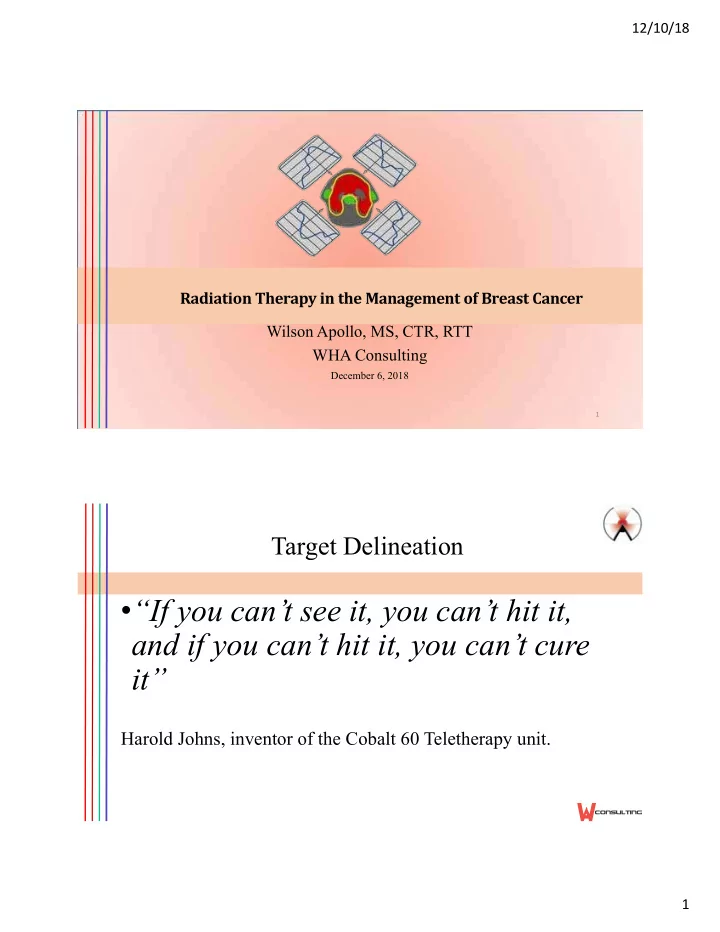
12/10/18 Radiation Therapy in the Management of Breast Cancer Wilson Apollo, MS, CTR, RTT WHA Consulting December 6, 2018 1 Target Delineation If you cant see it, you cant hit it, and if you cant hit it, you cant cure


slide-1
SLIDE 1

12/10/18 1

Radiation Therapy in the Management of Breast Cancer Wilson Apollo, MS, CTR, RTT WHA Consulting

December 6, 2018

1

Consulting

Target Delineation

  • “If you can’t see it, you can’t hit it,

and if you can’t hit it, you can’t cure it”

Harold Johns, inventor of the Cobalt 60 Teletherapy unit.

slide-2
SLIDE 2

12/10/18 2

Consulting

Objectives

  • Describe the various radiation therapy delivery systems

for treating breast cancer,

  • Distinguish between 3D-Conformal, IMRT,
  • Describe tangential breast EBRT,
  • Explore NCCN Guidelines for EBRT for breast cancer,
  • Apply the 2018 STORE Manual RT coding rules to

clinical scenarios.

Door to treatment room

Calibrating lasers

slide-3
SLIDE 3

12/10/18 3

Consulting

Equipment used to deliver RT to Breast

  • EBRT
  • photons,
  • Electrons,
  • Gamma rays,
  • Gamma Pod
  • Low-energy Kv photons (Zeiss Intrabeam, XOFT Axxent)
  • IORT:
  • HDR brachytherapy,
  • electron,
  • electronic brachytherapy
  • Low-energy Kv photons (Zeiss Intrabeam, XOFT Axxent)

Prepared by Wilson Apollo, MS, RTT, CTR

LINACS

slide-4
SLIDE 4

12/10/18 4

Linac Console

Collimators

Prepared by Wilson Apollo, MS, RTT, CTR

Gammapod Tomotherapy Zeiss Intrabeam

slide-5
SLIDE 5

12/10/18 5

Consulting

GAMMAPOD

By Xcision Medical Systems

Consulting

GAMMAPOD

By Xcision Medical Systems

  • Granted FDA clearance in December 2017,
  • Invented & developed by Xcision founder, Cedric Yu,
  • Optimized for non-invasive partial breast treatments, SBRT,
  • Powered by multisource Cobalt-60 SRS system,
  • Rotates about the target, allowing targeting by thousands of beam

angles, consisting of gamma rays,

  • Treatment couch can be manipulated during treatment for dose

painting,

  • Can deliver treatment w/in a few fractions only.
slide-6
SLIDE 6

12/10/18 6

Consulting

GAMMAPOD

By Xcision Medical Systems

Pt immobilization is critical. § Vacuum-assisted, dual cup system,

Consulting

GAMMAPOD

By Xcision Medical Systems

  • Uses gamma rays; Code

as 02, External beam, photons.

  • Planning Technique for

SBRT is 06, Stereotactic Radiotherapy or Radiosurgery, NOS.

slide-7
SLIDE 7

12/10/18 7

IORT

INTRAOPERATIVE RADIATION THERAPY

Consulting

Zeiss INTRABEAM System

  • It is an intraoperative (IORT) brachytherapy platform,
  • FDA approved for IORT since 1999,
  • It is basically a small version of a linac & operates @ 50 kVp

for breast IORT and 40 kVp for brain IORT,

  • Miniature X-ray source with a gold target @ tip of probe,
  • Typical prescribed dose of 20 Gy to lumpectomy cavity,
  • Can take 20-40 minutes for single fraction,
  • Also known as electronic brachytherapy.

14

slide-8
SLIDE 8

12/10/18 8

Zeiss INTRABEAM

15

Because of the manner in which the x-rays are generated in this system (very much like a linac), and taking into account the low energies produced, this treatment modality should be coded 12, Brachytherapy, electronic.

XOFT Axxent eBx System

16

  • Another system used to

deliver IORT treatments. Also known as electronic brachytherapy.

  • Works similarly to Zeiss

Intrabeam,

  • Miniature x-ray unit

used to generate low energy (KV) photons.

slide-9
SLIDE 9

12/10/18 9

XOFT Axxent eBx System

17

  • Treatment is

delivered via a miniature linac with energy in the KV range.

  • Should be coded 12,

Electronic Brachytherapy.

LIAC & NOVAC Linear Accelerators

18

  • Electron linear

accelerators

  • Used for IORT or

IOERT

  • Since treatment

modality is electron, code to 04, External beam, electrons.

slide-10
SLIDE 10

12/10/18 10

Consulting

Strut assisted volume implant (SAVI)

Device has 7-11 "struts" or catheters through which the iridium seed travels. The struts are expanded after the device is inserted into the lumpectomy cavity.

§ HDR Intracavitary Brachytherapy. Uses Ir-192 HDR seeds. Look for multiple sessions (fractions).

slide-11
SLIDE 11

12/10/18 11

Consulting

Mammosite

  • Balloon is inserted into the lumpectomy cavity and inflated. The
  • riginal Mammosite balloon had a single lumen (catheter). The

Mammosite ML has four lumens through which the iridium seed

  • travels. After each treatment the ‘seed’ is removed from the balloon,

and the patient does not receive radiation until the next seed is inserted during the next session.

  • If she undergoes MammoSite brachy twice a day (BID) for five days,

it means she receives 10 SEPARATE FRACTIONS (important for coding).

Consulting

Mammosite

slide-12
SLIDE 12

12/10/18 12

Consulting

mammosite

Consulting

Contura MLB

slide-13
SLIDE 13

12/10/18 13

Consulting

Accelerated partial breast irradiation

Regional Tx Modality Code Modality 09, Brachytherapy, Intracavitary, HDR SAVI, Contura MLB, MammoSite

Consulting

IORT Delivery Technology & Coding

Based on FORDS Manual

Equipment Dose Delivery Method Modality Code Comments Zeiss Intrabeam 50 kVp Linac Orthovoltage 21 Isotope-free. No radioactive source used. XOFT Axxent 50 kVp Linac Orthovoltage 21 Isotope-free. No radioactive source used. LIAC 10 by Sordina IORT Electron Accelerator Electron 28 Max energy is 10 MeV LIAC 12 by Sordina IORT Electron Accelerator Electron 28 Max energy is 12 MeV NOVAC by Sordina IORT Electron Accelerator Electron 28 Mobetron Electron Accelerator Electron 28 Electron energies of 6 MeV, 9 MeV, 12 MeV Strut Assisted Volume Implant (SAVI) Ir-192 source HDR 52 Most applications are HDR, intracavitary Mammosite Ir-192 source HDR 52 Most applications are HDR, intracavitary Contura MLB Ir-192 source HDR 52 Most applications are HDR, intracavitary

slide-14
SLIDE 14

12/10/18 14

Consulting

IORT Delivery Technology & Coding

Based on STORE Manual

Equipment Dose Delivery Method RT Modality Planning Code Comments Zeiss Intrabeam 50 kVp Linac 12, Brachytherapy, electronic 02 Isotope-free. No radioactive source used. XOFT Axxent 50 kVp Linac 12, Brachytherapy, electronic 02 Isotope-free. No radioactive source used. LIAC 10 by Sordina IORT Electron Accelerator 04, Electron 01 Max energy is 10 MeV LIAC 12 by Sordina IORT Electron Accelerator 04, Electron 01 Max energy is 12 MeV NOVAC by Sordina IORT Electron Accelerator 04, Electron 01 Mobetron Electron Accelerator 04, Electron 01 Electron energies of 6 MeV, 9 MeV, 12 MeV Strut Assisted Volume Implant (SAVI) Ir-192 source 09, Brachytherapy, intracavitary, HDR 88 Most applications are HDR, intracavitary Mammosite Ir-192 source 09, Brachytherapy, intracavitary, HDR 88 Most applications are HDR, intracavitary Contura MLB Ir-192 source 09, Brachytherapy, intracavitary, HDR 88 Most applications are HDR, intracavitary

Consulting

Accuboost: Non-invasive Breast Brachytherapy (NIBB)

slide-15
SLIDE 15

12/10/18 15

Consulting

Accuboost: Non-invasive Breast Brachytherapy (NIBB)

  • Allows for non-invasive approach to delivering a boost dose to

lumpectomy cavity for breast cancer pts,

  • Dose is delivered via Ir-192 HDR sources,
  • Note that sources are not inserted into patient,
  • Utilizes mammography for treatment planning,
  • Advantage of technique is that it avoids irradiating lung, heart,
  • Cosmesis is comparable to that of conventional electron & photon boost.
  • How do you code this modality? Best choice: 07, Brachytherapy, NOS.
  • J. Schuster, et al. Updated feasibility and reproducibility results of multi-institutional study of noninvasive breast tumor bed boost. Brachytherapy

2016; 2-8.

Consulting

Objectives

  • Describe the various radiation therapy delivery systems

for treating breast cancer,

  • Distinguish between 3D-Conformal, IMRT,
  • Describe tangential breast EBRT,
  • Explore NCCN Guidelines for EBRT for breast cancer,
  • Apply the 2018 STORE Manual RT coding rules to

clinical scenarios.

slide-16
SLIDE 16

12/10/18 16

Consulting

Treatment Approaches/Techniques for Breast Cancer

  • VMAT
  • RapidArc
  • 3D-Conformal
  • HT: Helical Tomotherapy
  • Electronic brachytherapy
  • HDR brachytherapy
  • GammaPod SRS,
  • Proton

Consulting

3D-Conformal

  • 3D-Conformal RT is essentially the predecessor to IMRT.

Using MLC leaves, treatment planners can sculpt the shape of the beam to conform to the shape of the target volume.

  • The main difference between IMRT and 3D-Conformal plans is

that when the latter is used, the MLC leaves remain stationary. It still uses multiple fields as with IMRT, and each field conforms to the shape of the target as seen from various angles, but the collimator leaves are static through the duration of treatment.

slide-17
SLIDE 17

12/10/18 17

Consulting

Dynamic MultiLeaf Collimators (DMLC)

Consulting

Target Delineation-3D

  • Treatment Modality

Code: 02, External beam photons.

  • Planning Technique: 04,

Conformal or 3D Conformal.

slide-18
SLIDE 18

12/10/18 18

Consulting

IMRT

  • Technology made

possible by DMLC,

  • IMRT not always

mentioned in RT Treatment Summary. Important to look in Treatment Plan.

Consulting

Fraction size

  • Standard fraction size = 180-200 cGy/fx, typically seen

when prescription calls for multiple fractions (anywhere from 10 to 40+).

  • Hypofractionation = > 200 cGy/fx, ex: 500 cGy x 5 fx,
  • ften used for SBRT treatments, which calls for large

fraction size and only a few fractions (1-6 max).

  • Hyperfractionation = < standard fractionation. Ex: 125

cGy/fx. Sometimes used for H&N treatments.

slide-19
SLIDE 19

12/10/18 19

Consulting

Hypofractionation-catching on

  • Remember, standard fractionation = 180-200 cGy/fx
  • Hypofractionation > 200 cGy/fx
  • Ablative doses delivered in a shorter period of time, 1-2 wks,
  • Must use restrictive pt immobilization techniques or adjust to

patient/organ motion (Stereotactic Body Radiation Therapy, SBRT, or Stereotactic Ablative Radiotherapy, SABR),

  • High degree of certainty of tumor volume extent,

Consulting

Objectives

  • Describe the various radiation therapy delivery systems

for treating breast cancer,

  • Distinguish between 3D-Conformal, IMRT,
  • Describe tangential breast EBRT,
  • Explore NCCN Guidelines for EBRT for breast cancer,
  • Apply the 2018 STORE Manual RT coding rules to

clinical scenarios.

slide-20
SLIDE 20

12/10/18 20

Consulting

Breast Tangent Technique

  • Typically two tangential fields when no LN involvement,
  • A third supraclavicular (S’clav) field added with LN involved,
  • Concern w/ cardiac toxicity when LT breast treated.
  • Risk of cardiac disease increases by 7.4% and 4% per Gy in

mean heart dose. Darby, S.C.; Ewertz, M.; McGale, P.; et al. Risk of ischemic

heart disease in women after radiotherapy for breast cancer. N. Engl. J. Med. 368(11):987–98; 2013.

  • Among approaches used for heart-sparing RT are DIBH, IMRT,

VMAT, 3D-conformal, prone technique.

Beam orientation

RL LL

AP

PA

RAO LAO

LPO RPO SUPINE

WA Consulting

slide-21
SLIDE 21

12/10/18 21

Tangential beam orientation

RL LL PA

LAO

RPO SUPINE

WA Consulting

Breast Tangents Technique have no impact on Planning Technique coding!

Breast Tangents

slide-22
SLIDE 22

12/10/18 22

Parallel-Opposed Fields

Consulting

Breast Tangent Simulation

slide-23
SLIDE 23

12/10/18 23

Oblique Angles

Consulting

Supraclavicular Field(S’clav)

slide-24
SLIDE 24

12/10/18 24

Consulting

EBRT: IMRT/3D-Comformal

  • Standard EBRT generally includes a regional dose in the

range of 4680 cGy to 54 Gy with a boost (typically electron) in the range of 700 cGy to 14 Gy, with standard fraction size of 180-200 cGy.

  • Canadian Protocol (Accelerated Partial Breast Irradiation-

APBI): 266 cGy x 16 fx= 42.5 Gy, over 21 days.

  • 10-yr local relapse rate of 6.2% w/ APBI (3 wks) vs. 6.7% in conventional 50 Gy

(5-6 wks).

47

Consulting

Breast Tangents RT Techniques

Abbreviation Term Radiation Planning Technique Code H-IMRT Hybrid IMRT Code to 05: IMRT T-IMRT Tangential IMRT T-VMAT Tangential VMAT M-IMRT Multifield IMRT HT Helical Tomotherapy FiF Field-in-Field, Forward IMRT planning, Static IMRT Code to 04: 3D- Conformal

slide-25
SLIDE 25

12/10/18 25

FFF?

Flattening- Filter-Free

Varian calls it High Intensity Mode. Available with 6MV & 10MV energy

  • n TrueBeam Linacs.

Filtration: 0.8 mm brass Elekta: 6MV & 10MV on Versa HD Linac. Referst to it as High Dose Rate Mode. Filtration: 2 mm stainless steel

slide-26
SLIDE 26

12/10/18 26

Breast Board with Vacuum loc

Electron Cut-out

slide-27
SLIDE 27

12/10/18 27

Attachment below collimators to hold Electron Cones for electron therapy

Electron Cone with Electron Cut-out (Copper) En-face technique: place the electron cut-out as close to patient’s skin as possible.

slide-28
SLIDE 28

12/10/18 28

Consulting

Isocenter Central axis (cax) Build-up region concept

slide-29
SLIDE 29

12/10/18 29

Consulting

Field-in-Field Forward Planning

ØIn Field-in-Field Technique, the treatment field starts out as a basic tangential field with collimators used to reduce dose to lung and/or heart (blue). ØThe beam is turned on initially with only the blue blocks in the irradiated field. ØAfter a set number of monitor units (MU) have been delivered, the beam is briefly turned off to give time for the collimator leaves (in green) to move into position to reduce dose to specific areas within the PTV. ØOnce the collimator leaves (green) are in position, the beam will automatically turn on until the prescribed dose/fraction is delivered. ØKeep in mind that once the beam is on, the collimator leaves do not move in and out of the irradiated field (3D-Conformal).

slide-30
SLIDE 30

12/10/18 30

FiF: With initial open field (LT), we can determine areas of hot spots (doses in excess of 100% of prescribed dose). Adding collimator segments (RT) during treatment will reduce hot spots to produce a more homogeneous dose distribution.

Consulting

Objectives

  • Describe the various radiation therapy delivery systems

for treating breast cancer,

  • Distinguish between 3D-Conformal, IMRT,
  • Explore NCCN Guidelines for EBRT for breast cancer,
  • Apply the 2018 STORE Manual RT coding rules to

clinical scenarios.

slide-31
SLIDE 31

12/10/18 31

Consulting

NCCN Guidelines-Invasive Breast Cancer

v3.2018

  • Whole Breast RT
  • 45-50.4 Gy in 25-28 fractions (fx), or
  • 40-402.5 Gy in 15-16 fx (hypofractionation preferred),
  • Treatments 5 days/wk,
  • Tumor bed boost recommended in patients with high risk features
  • Chest Wall(CW) RT
  • 45-50.4 Gy in 25-28 fx to CW +/- scar boost @ 1.8-2 Gy/fx for total of about 60

Gy.

  • Regional Nodal RT
  • 46-60 Gy, 23-25 fx, 5 days/wk

Consulting

NCCN Guidelines-Invasive Breast Cancer

v3.2018

  • Accelerated Partial Breast Irradiation (APBI)
  • 34 Gy in 10 fx, twice a day (BID), via brachytherapy, or
  • 38.5 Gy in 10 fx, BID, with EBRT
  • Tumor bed boost recommended in patients with high risk features
  • APBI patient selection criteria:
  • 50 yrs or older, with invasive ductal ca,
  • T1 disease with negative margin width ≥ 2 mm, no LVI, ER+, BRCA-, or
  • Low/intermed nuclear grade, screening detected DCIS, ≤ 2.5 mm, negative

margins ≥ 3 mm

slide-32
SLIDE 32

12/10/18 32

Consulting

Objectives

  • Describe the various radiation therapy delivery systems

for treating breast cancer,

  • Distinguish between 3D-Conformal, IMRT,
  • Explore NCCN Guidelines for EBRT for breast cancer,
  • Apply the 2018 STORE Manual RT coding rules to

clinical scenarios.

Consulting

Clinical Case 1

  • 63 yr old postmenopausal white female, G2P2, with h/o HTN,

hyperlipidemia, GERD, who recently noted a lump in her right breast.

  • RT breast partial mastectomy @ UOQ, with sentinel lymph node

bx: 32 mm unifocal invasive duct carcinoma. LVI+. Tumor gr: 9/9. SLNs: 1+/2.

  • ER/PR+. HER2: 2+, equivocal. HER2 FISH: Neg. Ratio: 1.2.
  • Post-op ACT chemotherapy, followed by RT breast EBRT.
slide-33
SLIDE 33

12/10/18 33

Consulting

Clinical Case 1…

  • Radiation Therapy Summary:
  • Radiation therapy was administered to the breast and supraclavicular

lymph nodes with a 3D- conformal plan. The boost to the lumpectomy cavity was delivered via an electron boost.

Plan Beam Energy Fractions Dose/fx (cGy) Total Dose (cGy) First txt Last txt RT breast, axillary LNs 15X/6X 26 180 4680 5/1/18 6/5/18 RT S’clav 15X 26 180 4680 5/1/18 6/5/18 Lumpectomy tumor bed boost 15 MeV 7 200 1400 6/6/18 6/14/18

Prepared by Wilson Apollo, MS, RTT, CTR Phase I Radiation: Case 1 Phase I Primary Treatment Volume (1504) 40: Breast-whole Phase I to Draining Lymph Nodes (1505) 04: Breast/CW LN regions Phase I Treatment Modality (1506) 02: External beam, photons Phase I External Beam Planning Technique (1502) 04: 3D-Conformal Phase I Dose Per Fraction (cGy) (1501) 00180 Phase I Number of Fractions (1503) 026 Phase I Total Dose (cGy) (1507) 004680 Phase II Radiation: Phase II Primary Treatment Volume (1514) 04: Breast/CW LN regions Phase II to Draining Lymph Nodes (1515) 88: NA; Phase II RT is to lymph nodes (p. 303) Phase II Treatment Modality (1516) 02: External beam, photons Phase II External Beam Planning Technique (1512) 04: 3D-Conformal Phase II Dose Per Fraction (cGy) (1511) 00180 Phase II Number of Fractions (1513) 026 Phase II Total Dose (cGy) (1517) 004680 Phase III Radiation: Phase III Primary Treatment Volume (1524) 41: Breast-partial Phase III to Draining Lymph Nodes (1525) 00: No RT to draining lymph nodes. Phase III Treatment Modality (1527) 04: External beam, electrons Phase III External Beam Planning Technique (1522) 01: External beam, NOS Phase III Dose Per Fraction (cGy) (1521) 00200 Phase III Number of Fractions (1523) 007 Phase III Total Dose (cGy) (1527) 001400

Take away point:

  • The total dose/phase

should add up to the total prescribed dose (Total Dose in Radiation Course)!

  • Must adhere to

STORE rule on p. 336 (if RT delivered to multiple sites, code to 999998)

slide-34
SLIDE 34

12/10/18 34

Clinical Scenario 1

Prepared by Wilson Apollo, MS, RTT, CTR

Course Summary-Case 1 Total Dose in Radiation Course (cGy) 999998 (See STORE, p. 336)

Date Radiation Started

05/01/18

Date Radiation Ended

06/05/18

Number of Phases

03

Radiation Treatment Discontinued Early?

01: RT Completed as prescribed

Radiation/Surgery Sequence

03: RT after surgery

Reason for No Radiation

0: RT was administered
Consulting

Clinical Case 2

  • 71 year-old Asian female with h/o Hashimoto thyroiditis,

chronic sinusitis, who recently underwent routine screening breast imaging with abnormal findings on left breast.

  • Left partial mastectomy with sentinel lymph node bx: 9 mm

DCIS, solid and cribriform types, low to intermediate nuclear

  • grade. No invasive or micro-invasive component found. No
  • necrosis. 0/1 sentinel lymph node negative. 0/1 non-sentinel

lymph node negative. Margins negative. Closest margin >5 mm.

slide-35
SLIDE 35

12/10/18 35

Consulting

Clinical Case 2…

Radiation Therapy Summary: Patient received a hypofractionated accelerated regimen. The left breast received a total dose of 4256 cGy, 266 cGy in 16 fractions using 3D Field-in-Field (FiF) technique with breast tangents @ 100 SAD, using 6MV photons. This was followed by a boost to the lumpectomy cavity, consisting of 250 cGy in four fractions, 6MV, 3D-conformal for a total dose of 5256 Gy. Patient tolerated the treatment well with no treatment interruptions.

slide-36
SLIDE 36

12/10/18 36

Treatment Prescription Information.

Can be found in ARIA or Mosaiq.

Clinical Scenario 2

Target Volume Initial Left Breast Treatment Planning Imaging New CT Sim Motion Mgmt Breath Hold Modality Photon EBRT Planning 3D Fields Tangents Energy/Source 6 MV Prescribed to Isodose per plan Fraction & Dosing Fraction Dose 2.66 Gy Fraction Number 16 Fractions/week 1 fx daily Total Dose 42.56 Gy Cumulative EBRT Dose 42.56 Gy

RT Prescription: Medial Tangent

Energy Mode 6X Dose Rate 600 MU/min Technique Static IMRT Source-Axis-Distance (SAD) 100.0 cm Field size 9.0 cm x 17.0 cm (X1: 2.5, X2: 6.5, Y1: 7.0 cm, Y2: 10.0 cm) Gantry Rtn 300.0 deg Coll Rtn 10.0 deg Couch Rtn 0.0 deg MU 169 MLC Transmission factor 1.3 %

Clinical Case 2

slide-37
SLIDE 37

12/10/18 37

RT Prescription: Lateral Tangent

Energy Mode 6X Dose Rate 600 MU/min Technique Static IMRT Source-Axis-Distance (SAD) 100.0 cm Field size 8.5 cm x 17.0 cm (X1: 6.0, X2: 2.5, Y1: 7.0 cm, Y2: 10.0 cm) Gantry Rtn 123.0 deg Coll Rtn 350.0 deg Couch Rtn 0.0 deg MU 165 MLC Transmission factor 1.3%

Clinical Case 2

Prepared by Wilson Apollo, MS, RTT, CTR

Phase I Radiation: Clinical Scenario 2

Phase I Primary Treatment Volume (1504) 40: Breast-whole Phase I to Draining Lymph Nodes (1505) 00: No RT to draining lymph nodes Phase I Treatment Modality (1506) 02: External beam, photons Phase I External Beam Planning Technique (1502) 04: 3D Conformal Phase I Dose Per Fraction (cGy) (1501) 00266 Phase I Number of Fractions (1503) 016 Phase I Total Dose (cGy) (1507) 004256 Phase II Radiation Phase II Primary Treatment Volume (1514) 41: Breast-partial Phase II to Draining Lymph Nodes (1515) 00: No RT to draining lymph nodes. Phase II Treatment Modality (1516) 02: External beam, photons Phase II External Beam Planning Technique (1512) 04: 3D conformal Phase II Dose Per Fraction (cGy) (1511) 00250 Phase II Number of Fractions (1513) 004 Phase II Total Dose (cGy) (1517) 001000

Take away point:

  • When the breast

tangents technique is used, lymph nodes may be in the irradiated field (not planned).

  • Unless stated
  • therwise, phase I to

draining LNs should be coded to 00.

slide-38
SLIDE 38

12/10/18 38

Clinical Scenario 2

Prepared by Wilson Apollo, MS, RTT, CTR

Course Summary-Case 2 Total Dose in Radiation Course (cGy) 005256

Date Radiation Started Date Radiation Ended Number of Phases

02

Radiation Treatment Discontinued Early?

01: RT Completed as prescribed

Radiation/Surgery Sequence

00: No RT and/or surgical procedures

Reason for No Radiation

0: RT was administered

Consulting

Clinical Scenario 3

  • 59 year-old postmenopausal Hispanic female with history of left calf

malignant melanoma in 2006, status post, Mohs’ resection and immunotherapy, who underwent routine screening mammogram with suspicious findings on right breast.

  • On exam, there are no palpable lesions on either breast. Patient denies

any nipple discharge. No observable nipple retraction and no palpable axillary lymphadenopathy.

  • Nonsmoker. Social drinker. +FHX: Mother and M-grandmother dx’d

with breast cancer. Given patient’s family h/o breast cancer, pt underwent genetic testing with BRCA 1/2 negative results.

slide-39
SLIDE 39

12/10/18 39

Consulting

Clinical Scenario 3

  • Patient underwent IORT to right breast, using the Zeiss Intrabeam XRS 50

Kv unit. Prescribed dose to the surface was 20 Gy, with a 4.0 cm applicator. Dose rate = 0.712 Gy/minute @ the surface. Treatment time = 28 minutes, 45 seconds by ionization chamber second check measurements. Ultrasound simulations confirmed that the skin to applicator distances were: 1.12 cm sup, 0.98 cm lat, 1.1 cm inf, and 0.8 cm medially, all within acceptable

  • distances. IORT was followed by EBRT(3D-conformal) as detailed below:

Plan Beam Energy Fractions Dose/fx (cGy) Total Dose (cGy) RT breast 6 MV 25 180 4500 Target Volume Initial RT 1:00 lumpectomy cavity Treatment Planning Imaging Ultrasound Sim Motion Mgmt Modality HDR Brachytx Planning 2D Fields Applicator Energy/Source Electronic kV Prescribed to Depth 0 cm Fraction & Dosing Fraction Dose 20 Gy Fraction Number 1 Fractions/week 1 fx daily Total Dose 20 Gy Cumulative EBRT Dose 20 Gy

RT Prescription information found

  • n ARIA
slide-40
SLIDE 40

12/10/18 40

Prepared by Wilson Apollo, MS, RTT, CTR

Phase I Radiation: Clinical Scenario 3

Phase I Primary Treatment Volume (1504)

41: Breast-partial

Phase I to Draining Lymph Nodes (1505)

00: No RT to draining lymph nodes

Phase I Treatment Modality (1506)

02: External beam, photons

Phase I External Beam Planning Technique (1502)

12: Electronic brachytherapy

Phase I Dose Per Fraction (cGy) (1501)

002000

Phase I Number of Fractions (1503)

001

Phase I Total Dose (cGy) (1507)

002000

Phase II Radiation Phase II Primary Treatment Volume (1514)

40: Breast-whole

Phase II to Draining Lymph Nodes (1515)

00: No RT to draining lymph nodes.

Phase II Treatment Modality (1516)

02: External beam, photons

Phase II External Beam Planning Technique (1512)

04: 3D conformal

Phase II Dose Per Fraction (cGy) (1511) 00180 Phase II Number of Fractions (1513)

025

Phase II Total Dose (cGy) (1517)

004500

Take away point:

  • The Zeiss

Intrabeam and XOFT Axxent systems deliver EBRT, which means you can code the dose/fx & total dose in cGy.

Clinical Scenario 3

Prepared by Wilson Apollo, MS, RTT, CTR

Course Summary-Case 3 Total Dose in Radiation Course (cGy) 006500 (Zeiss Intrabeam RT, 20 Gy, + 3D- Conformal RT, 45 Gy). They are both EBRT!

Date Radiation Started Date Radiation Ended Number of Phases

02

Radiation Treatment Discontinued Early?

01: RT Completed as prescribed

Radiation/Surgery Sequence

03: RT after surgery

Reason for No Radiation

0: RT was administered

slide-41
SLIDE 41

12/10/18 41

Consulting

Clinical Scenario 4

  • 55-year-old W/F, who on routine screening breast imaging had abnormal

findings on LT breast.

  • Left breast SAVI Scout localizer partial mastectomy with sentinel lymph

node bx= 0.9 cm DCIS, solid & cribriform, low nuclear grade. No invasive component present. SLNs= 0/2 neg Margins negative. Closest margin @ 3 mm lat. Radiation Therapy Summary

  • Using a 6-1 mini SAVI catheter, the lumpectomy cavity received 34 Gy

in 10 treatments, BID.

SAVI Scout localizer system

slide-42
SLIDE 42

12/10/18 42

Prepared by Wilson Apollo, MS, RTT, CTR

Phase I Radiation: Clinical Scenario 4

Phase I Primary Treatment Volume (1504) 41: Breast-partial Phase I to Draining Lymph Nodes (1505) 00: No RT to draining lymph nodes Phase I Treatment Modality (1506) 09: Brachytherapy, intracavitary, HDR Phase I External Beam Planning Technique (1502) 88: Treatment not by external beam Phase I Dose Per Fraction (cGy) (1501) 99998 (p. 290, STORE manual) Phase I Number of Fractions (1503) 010 Phase I Total Dose (cGy) (1507) 999998 (p. 294, STORE manual) Phase II Radiation Phase II Primary Treatment Volume (1514) Phase II to Draining Lymph Nodes (1515) Phase II Treatment Modality (1516) Phase II External Beam Planning Technique (1512) Phase II Dose Per Fraction (cGy) (1511) Phase II Number of Fractions (1513) Phase II Total Dose (cGy) (1517)

Take away point:

  • The SAVI catheter

system involves use of Ir-192 seeds, inserted into the lumpectomy cavity.

  • This makes the

procedure HDR intracavitary brachytherapy.

Clinical Scenario 4

Prepared by Wilson Apollo, MS, RTT, CTR

Course Summary-Case 4 Total Dose in Radiation Course (cGy) 999998

Date Radiation Started Date Radiation Ended Number of Phases

01

Radiation Treatment Discontinued Early?

01: RT Completed as prescribed

Radiation/Surgery Sequence

03: RT after surgery

Reason for No Radiation

0: RT was administered

slide-43
SLIDE 43

12/10/18 43

Consulting

Recommended Journals

  • Radiation Therapist,
  • International Journal of Radiation Oncology, Biology,

Physics (Red Journal),

  • Journal of Registry Management
  • Journal of Clinical Oncology
  • Lancet Oncology
  • Medical Dosimetry
  • Journal of Radiation Oncology

85

Consulting

Questions

86

You can submit your RT coding questions to apollow@mac.com

Questions

Q u e s t i

  • n

s

Questions