IETF Chair and IESG Report, IETF 105 This report, sent out before - - PDF document

ietf chair and iesg report ietf 105
SMART_READER_LITE
LIVE PREVIEW

IETF Chair and IESG Report, IETF 105 This report, sent out before - - PDF document

IETF Chair and IESG Report, IETF 105 This report, sent out before IETF 105 begins, is an effort to reduce reporting at the plenary and to provide an ability to discuss topics on list beforehand and afterwards. The plan is to provide only a brief


slide-1
SLIDE 1

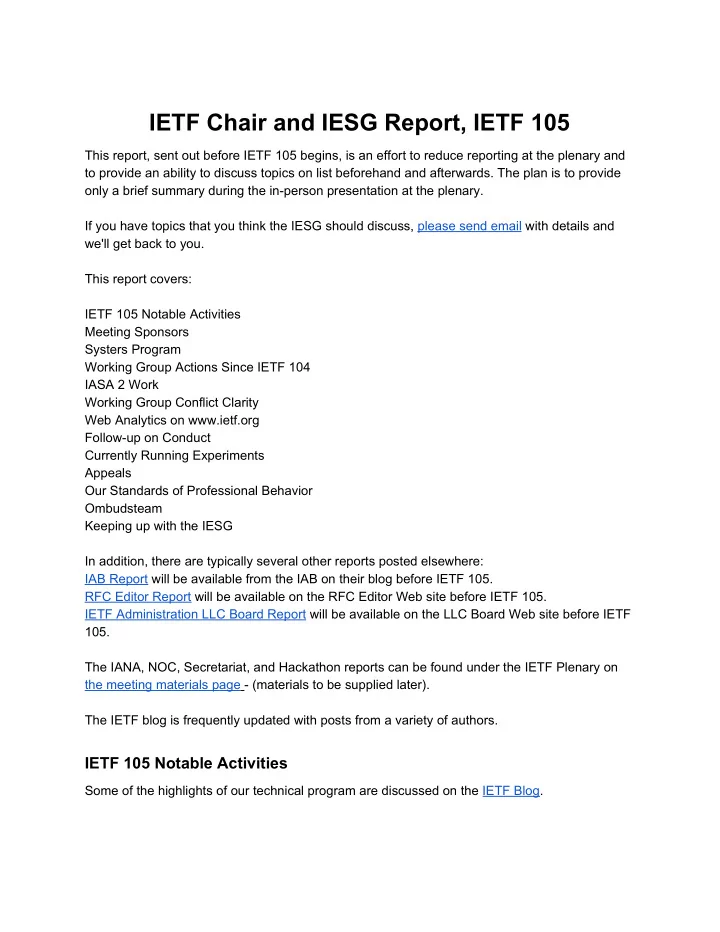
IETF Chair and IESG Report, IETF 105

This report, sent out before IETF 105 begins, is an effort to reduce reporting at the plenary and to provide an ability to discuss topics on list beforehand and afterwards. The plan is to provide

  • nly a brief summary during the in-person presentation at the plenary.

If you have topics that you think the IESG should discuss, ​please send email​ with details and we'll get back to you. This report covers: IETF 105 Notable Activities Meeting Sponsors Systers Program Working Group Actions Since IETF 104 IASA 2 Work Working Group Conflict Clarity Web Analytics on www.ietf.org Follow-up on Conduct Currently Running Experiments Appeals Our Standards of Professional Behavior Ombudsteam Keeping up with the IESG In addition, there are typically several other reports posted elsewhere: IAB Report​ ​will be available from the IAB on their blog before IETF 105. RFC Editor Report​ ​will be available on the RFC Editor Web site before IETF 105. IETF Administration LLC Board Report​ will be available on the LLC Board Web site before IETF 105. The IANA, NOC, Secretariat, and Hackathon reports can be found under the IETF Plenary on the meeting materials page​ ​- (materials to be supplied later). The IETF blog is frequently updated with posts from a variety of authors.

IETF 105 Notable Activities

Some of the highlights of our technical program are discussed on the ​IETF Blog​.

slide-2
SLIDE 2

The meeting and pre-meeting events are running from Saturday, July 20 to Friday, July 26. All information is available from the​ ​meeting website​. We are running an experiment at this meeting where working group sessions will begin at 10:00am local time to allow for more informal discussions in the mornings. In order to facilitate the scheduling of conversational side meetings, the IESG is continuing to provide a number of attendee sign-up rooms. These rooms are available on a first-come first-served basis. Projectors will be provided in all of the meeting rooms. Meetecho will not be recording or providing remote participation support for unofficial side meetings.​ ​Sign up on the IETF Meeting Wiki​. Here are some of the agenda highlights: Saturday and Sunday IETF Hackathon​ runs the whole weekend. Please join and work on implementing IETF protocols and related technologies. IETF Code Sprint​ runs on Saturday. Please join and program the IETF tools that the community needs. Request for Conversation (HotRFC)​ is a lightning talk session on Sunday evening. Presenters will get 4 minutes and a few slides to make their case for collaboration. Interested participants can continue the discussion afterwards and over the week. Goals include encouraging brainstorming conversations, helping new work ideas to find co-collaborators, raising awareness

  • f relevant work going on elsewhere, and promoting Bar BoFs.

Monday The​ ​Hackdemo Happy Hour​ will take place on Monday evening, providing an opportunity for Hackathon teams to show off their projects. A cash bar will be available. Tuesday There will be a ​Technology Deep Dive​ session about “How NICs Work Today" from 8:30 to 9:45am in the Place du Canada room. Wednesday The Technical Plenary​ will take place on Wednesday evening 17:10-18:10, followed by the Administrative/Operations Plenary​ ​at 18:20-19:50​. ​The technical plenary topic is “Current Thinking on Internet Privacy,” featuring Arvind Narayanan from Princeton University and Steve Bellovin from Columbia University.

slide-3
SLIDE 3

Related events

July 18 and 19 - Just prior to IETF 105, the IAB is hosting the Exploring Synergy between Content Aggregation and the Publisher Ecosystem ​(​ESCAPE) Workshop​ in Herndon, Virginia,

  • USA. The workshop aims to improve understanding of the requirements and implications of

Web Packaging and other initiatives to enable aggregators of news and other articles to re-publish web resources. July 22 - This year’s ​Applied Networking Research Workshop​ (ANRW 2019) is taking place right alongside Monday IETF sessions in the Centreville room, with sections focused on QUIC; DNS and Security; Time, Fairness, and Neighbors; Measurement and Optimisation; and Network Functions and Middleboxes. Attendance is open to all IETF attendees, but​ ​registration is required​.​ The goal is for cross-pollination between leading academics and other IETF

  • attendees. Check it out!

Meeting Sponsors

Comcast and NBCUniversal are our hosts for the meeting. Thank you! Comcast and NBCUniversal are two of our Global Host companies that have committed to multi-year long-term support of the IETF. Also thanks to Bronze Sponsor Verisign; Connectivity Sponsors Metro Optic, Openface, and Telus; and Equipment Sponsors Cisco Systems and Juniper Networks. The Welcome Reception is supported by Hotel Fairmont The Queen Elizabeth. Thanks​ ​for helping make the Internet work better! The Hackathon is sponsored by ICANN and supported by Cisco DevNet.

slide-4
SLIDE 4

Thanks, all! If you are interested in discussing future IETF sponsorship opportunities, please contact the ​IETF Sponsorship Team​.

Systers Program

Female-identifying at the IETF? Join the IETF Systers Program.​ ​See the blog​ and contact Allison Mankin if you want to join! Many thanks to Fastly and Comcast for their support of the

  • program. The IETF Systers will meet throughout the week, including a networking event

Monday morning and the Systers Lunch event on Thursday. See the ​IETF 105 Agenda​ for specific times.

Working Group Actions since IETF 104

The following changes have occurred since IETF 104: Approved: Relay User Machine (rum) Rechartered: JSON Mail Access Protocol (jmap) Limited Additional Mechanisms for PKIX and SMIME (lamps) BoFs: Applications Using DNS (add) Lightweight Authenticated Key Exchange (lake) Local Optimizations on Path Segments (loops) IETF Meeting Network Requirements (netrqmts) Media OPerationS (mops) Concluded: TCP Increased Security (TCPINC) New Non-WG Mailing Lists: IETF Eligibility Discussion (eligibility-discuss) Multiplexed Application Substrate over QUIC Encryption (masque) New Working Group Documents (new-wg-docs)

slide-5
SLIDE 5

IASA 2 Work

The IASA2 working group is chartered to document the normative changes to IETF administrative structures and processes necessary to effectuate the changes to the IETF’s administration that are currently underway. The IETF Administration LLC was created last

  • August. All of the working group’s ​documents​ have had their publication requested and several

are in the RFC Editor’s queue.

Working Group Conflict Clarity

The tool that we provide to working group chairs to request meeting slots at IETF meetings allows them to indicate which other working groups are first-, second-, and third-priority conflicts for them. The inconsistent use of priorities to indicate conflicts is an issue that comes up every time the agenda is developed. The intent of the conflicts listed is not always clear to the Secretariat, the AD, and sometimes even the chairs themselves. To address this issue and provide conflict clarity, we are planning to replace the priority options with an explicit indication of the type of conflict:

  • Chair Conflict: to indicate other WGs the chairs also lead, or will be active participants in

at the upcoming meeting

  • Technology Overlap: to indicate WGs with a related technology or a closely related

charter

  • Key Participant Conflict (e.g., presenter, secretary, etc.): to indicate WGs with which key

participation may overlap in the upcoming meeting The Special Request field will continue to be available for more specific needs. Responsible AD Conflicts are already taken into consideration. The result will be a clear representation of the needs of each WG, and hopefully a more informed conflict resolution process when the Secretariat drafts the meeting agenda. We intend for these changes to be effective in time for IETF 106.

Web Analytics on ​www.ietf.org

There is currently no accurate data reported about visits to the IETF web site, www.ietf.org. For example, it is not possible to understand: which pages are most commonly visited; which paths visitors travel to find IETF meeting registration pages; or whether introductory information, such as tutorials, leads to further exploration of website content. Web analytics would provide insight into overall utilization and inform future improvements to the website.

slide-6
SLIDE 6

In consultation with the tools team, Greg Wood developed an ​implementation plan​ to integrate a self-hosted analytics package into the existing infrastructure. On May 21, the IESG sought community input on this plan. We are still discussing the input and hope to have a summary of plan updates and next steps to share with the community soon.

Follow-Up on Conduct

During the IESG open microphone session at the IETF 103 plenary, there was some discussion

  • f people's experiences in working group meetings. The IESG discussed this and kicked off an

email conversation with the working group chairs about it in mid-December. Two items for follow-up emerged from that discussion: (1) a desire for further training and guidance for WG chairs and IETF leaders about managing difficult discussions and group conduct, and (2) better means of archiving expired work to signal to newcomers ideas that have been discussed

  • previously. We heard at the IETF 104 plenary that raised awareness and initial conversations

seem to be having a positive impact. Our focus since IETF 104 has been on refining guidance for WG chairs and IETF leaders, and we hope to start socializing that soon.

Currently Running Experiments

We are experimenting with flexible meeting time, as described above. We have consolidated all of the unofficial side meeting sign-ups onto a​ ​single wiki​ and we have published a​ ​calendar​ containing all of them to make it easier to keep track of when they occur. In general, the IESG would like to encourage experimenting and trying new things. If you have ideas about potentially useful things to try, try them and tell the rest of us!

Appeals

The IESG has received no appeals since IETF 104.

Our Standards of Professional Behavior

IETF meetings, virtual meetings, and mailing lists are intended for professional collaboration and networking, as defined in the​ ​IETF Guidelines for Conduct​, the​ ​IETF Anti-Harassment Policy​, and the​ ​IETF Anti-Harassment Procedures​. If you have any concerns about behavior, please talk to the​ ​Ombudsteam​ who are on site during the meeting. We also expect professional behavior on our mailing lists, including the ietf@ietf discussion list. There are multiple mechanisms to help list discussion stay focused and appropriate. Please see

slide-7
SLIDE 7

the note about​ ​Ensuring Appropriate Discussion​ for guidance about conduct on the ietf@ietf discussion list. Lastly, we have an​ ​IETF Meeting Photography Policy​. Red lanyards are available at IETF meetings for participants who desire not to be photographed.

Ombudsteam

As always, the ombudsteam -- Allison Mankin, Pete Resnick, and Melinda Shore -- can be reached at ​ombudsteam@ietf.org​ or at their individual addresses listed on the ​ombudsteam page​.

Keeping Up With the IESG

The IESG formal telechat calls are open for observation. The​ ​upcoming agenda​ is posted online and an invitation is mailed out to the IETF main announcement list in advance of each telechat. The calendar and connection details​ are also available. We post both short and narrative minutes​. And of course, the best place to follow what is going on with a particular document is the​ ​datatracker​. The relevant actions such as significant comments from the IESG continue to be automatically emailed to the relevant WG mailing list. The IAB and IESG hold a BOF coordination call before each IETF meeting. In this call, we go through the set of proposed BOFs and other possible new meetings, in an effort to help the responsible AD decide how to proceed with the specific proposals. Since IETF 96, the IESG and IAB have been publishing the minutes from these calls. These minutes can be found from the IESG page​. We also publish a ​blog post​ discussing the BOF coordination call outcomes. The IESG continues to work on increasing transparency. We'd welcome feedback on what aspects need improvement.