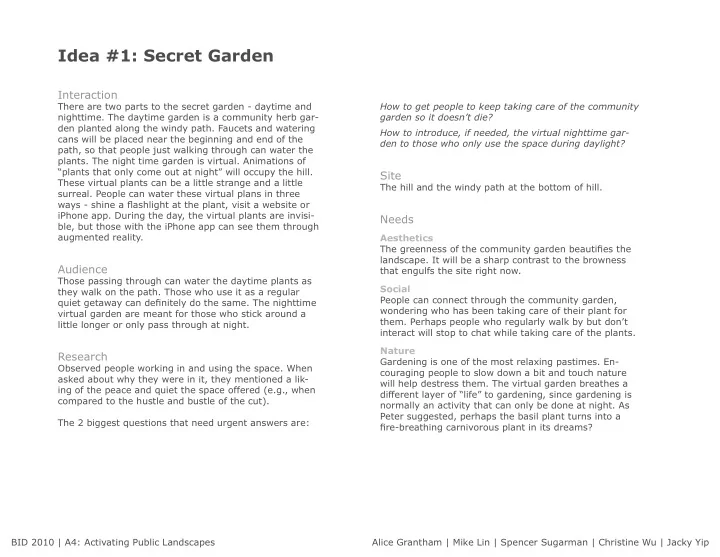
SLIDE 1 How to get people to keep taking care of the community garden so it doesn’t die? How to introduce, if needed, the virtual nighttime gar- den to those who only use the space during daylight?
Site
The hill and the windy path at the bottom of hill.
Needs
Aesthetics The greenness of the community garden beautifjes the
- landscape. It will be a sharp contrast to the browness
that engulfs the site right now. Social People can connect through the community garden, wondering who has been taking care of their plant for
- them. Perhaps people who regularly walk by but don’t
interact will stop to chat while taking care of the plants. Nature Gardening is one of the most relaxing pastimes. En- couraging people to slow down a bit and touch nature will help destress them. The virtual garden breathes a different layer of “life” to gardening, since gardening is normally an activity that can only be done at night. As Peter suggested, perhaps the basil plant turns into a fjre-breathing carnivorous plant in its dreams?
Interaction
There are two parts to the secret garden - daytime and
- nighttime. The daytime garden is a community herb gar-
den planted along the windy path. Faucets and watering cans will be placed near the beginning and end of the path, so that people just walking through can water the
- plants. The night time garden is virtual. Animations of
“plants that only come out at night” will occupy the hill. These virtual plants can be a little strange and a little
- surreal. People can water these virtual plans in three
ways - shine a fmashlight at the plant, visit a website or iPhone app. During the day, the virtual plants are invisi- ble, but those with the iPhone app can see them through augmented reality.
Audience
Those passing through can water the daytime plants as they walk on the path. Those who use it as a regular quiet getaway can defjnitely do the same. The nighttime virtual garden are meant for those who stick around a little longer or only pass through at night.
Research
Observed people working in and using the space. When asked about why they were in it, they mentioned a lik- ing of the peace and quiet the space offered (e.g., when compared to the hustle and bustle of the cut). The 2 biggest questions that need urgent answers are:
Idea #1: Secret Garden
Alice Grantham | Mike Lin | Spencer Sugarman | Christine Wu | Jacky Yip BID 2010 | A4: Activating Public Landscapes
SLIDE 2 Concept Validation
Buy a few small potted plants and herbs and place them along the path. Place thirst indicators in the pots of each
- plant. Place watering cans nearby and see which plants
get watered and repeated visits. Draw sketches of the nighttime garden and ask users about them. How would they try to interact with it? Are the methods we thought of (fmashlight, internet, iPhone app) enough?
Feasibility
A community garden is easy to implement but since plants are seasonal, we need to be mindful of the types
- f plants used. An herb garden is more useful but a
fmower garden is pleasing to the eye. The virtual night garden can be implemented with individual projections
- n individual plants. Light sensors can be used for fmash-
light sensing. Hooking up the network of virtual plants to the internet is not diffjcult either.
Secret Garden (cont’d)
Alice Grantham | Mike Lin | Spencer Sugarman | Christine Wu | Jacky Yip BID 2010 | A4: Activating Public Landscapes
SLIDE 3
Italian Basil
Spearmint Alice Grantham | Mike Lin | Spencer Sugarman | Christine Wu | Jacky Yip BID 2010 | A4: Activating Public Landscapes
SLIDE 4
Italian Basil
Spearmint Alice Grantham | Mike Lin | Spencer Sugarman | Christine Wu | Jacky Yip BID 2010 | A4: Activating Public Landscapes
SLIDE 5 Idea #2: Interactive Zen Waterfall
Needs
Aesthetics The waterfall enhances the sanctuarial feeling of the Gates lawn. This is an important aspect to focus on, as research shows users come to the space for its quiet and serene nature. Social Potentially, sensors could be placed in such a way that
- nly certain confjgurations of groups would
activate them, encouraging people to experiment in the space with their peers.
Concept Validation
A detailed description and a few supporting images would easily explain the idea. From there, users could be asked if they would fjnd the waterfall obtrusive, or if they could imagine themselves exploring the space to discover how each stone block was activated.
Feasibility
Water is in abundance, and the water-return systems necessary for an installation like this are commonplace. Similarly, installing pressure sensors around the space would be relatively trivial. The extruding stone blocks, though, might be more diffjcult to install, as they would need to be incorporated into the support structure with-
- ut compromising that structure. An issue that needs
to be explored is the viewing angles. Further research in the space would illuminate the optimal views of the waterfall.
Interaction
Water falls slowly down the concrete columns supporting
- Gates. While mainly providing a soothing backdrop to
the lawn area, the pattern of the falling water changes depending on the positioning of people throughout the
- area. Sitting in different areas activates pressure sen-
sors which in turn cause stone blocks to protrude from the support columns, changing the pattern of the falling
- water. By exploring more of the lawn, people can dis-
cover which areas activate which stones.
Audience
Anyone who passes by or stays in the lawn area. Those passing by would likely not activate any of the sen- sors, but would benefjt from the aesthetic beauty of the dynamic patterns of the waterfall. People sitting on the lawn would also benefjt from the aesthetics, and further- more gain enjoyment from being “rewarded” for explor- ing and using the space.
Site
The concrete support columns for the parts of Gates that jut out over the lawn.
Research
Observed people working in and using the space. When asked about why they were in the space, they men- tioned a liking of the peace and quiet the space offered (e.g., when compared to the hustle and bustle of the cut). Alice Grantham | Mike Lin | Spencer Sugarman | Christine Wu | Jacky Yip BID 2010 | A4: Activating Public Landscapes
SLIDE 6
Alice Grantham | Mike Lin | Spencer Sugarman | Christine Wu | Jacky Yip BID 2010 | A4: Activating Public Landscapes
SLIDE 7
Alice Grantham | Mike Lin | Spencer Sugarman | Christine Wu | Jacky Yip BID 2010 | A4: Activating Public Landscapes
SLIDE 8 Site
The site is the grassy areas just outside the 3rd fmoor café at the Gates-Hillman center and under the Randy Pausch bridge.
Needs
Users want to work outside but need to have access to power and see their screens. They also need a relatively quiet and secluded area. Functional The powerUp mushrooms provide access to power for laptop users and shade to prevent glare so that users can work effectively while enjoying the sun. By enhancing certain amenities that users already seek and keeping its more unique features unadvertised ex- cept to users under specifjc conditions, regular users can enjoy the notion of being in a “secret garden” Social The size of the mushroom shades is ideally suited for individuals or pairs of people to prevent large crowds from taking over. Emotional Fun yet functional Aesthetics The colorful mushroom forms are evocative of the video game SuperMarioBrothers and are a nod to computer
- scientists. It is also intentionally organic to keep the
area from feeling cold and sterile
Interaction
The powerUp mushrooms are movable along widely spaced tracks embedded in the lawn. In addition to pro- viding a moveable power source for the CMU community, the mushroom cap can also be used to provide shade. The mushrooms can detect when it’s users are squint- ing and offer the option to provide shade by fmashing a discrete message. If user responds affjrmatively, the mushroom cap will be raised from its stem, and extend to cover a wider perimeter. After the user sets the angle
- f shade desired using gesture, the mushroom cap will
rotate with the movement of the sun to continue provid- ing shade.
Audience
The audience is people who want to enjoy being outside
- n a sunny day while they still have to do some work
- r other (mostly) independent activity. They may get
together with a small group of people but they are inter- ested in being away from noise and crowds.
Research
We spoke to a couple of students sitting on a blanket out
- n the lawn with their books, laptops and coffee. They
mentioned that they wanted to be outside since it was a nice day that day, they needed to study and that loca- tion had power outlets and was close to coffee, both of which they needed to study. They also mentioned that the spot was relatively undiscovered, unlike a similar grassy area outside their residence where they might be hit by frisbees. They also enjoyed the relative thickness
- f the grass compared to other areas on campus.
Idea #3: Power and Shade
Alice Grantham | Mike Lin | Spencer Sugarman | Christine Wu | Jacky Yip BID 2010 | A4: Activating Public Landscapes
SLIDE 9
Concept Validation
The concept can be validated by showing current users a series of sketches about how the mushroom works and capturing heir reaction and feedback.
Feasibility
Most of the technology that is required exists in some form: face recognition, physical movement of shade based on gesture or light.
Power and Shade (cont’d)
Alice Grantham | Mike Lin | Spencer Sugarman | Christine Wu | Jacky Yip BID 2010 | A4: Activating Public Landscapes
SLIDE 10
Alice Grantham | Mike Lin | Spencer Sugarman | Christine Wu | Jacky Yip BID 2010 | A4: Activating Public Landscapes
SLIDE 11
Alice Grantham | Mike Lin | Spencer Sugarman | Christine Wu | Jacky Yip BID 2010 | A4: Activating Public Landscapes
SLIDE 12 Needs
The LED-based idea satisfjes mostly aesthetics and functional aspects. Any social playful aspects of creating visual patterns with the LED blankets are due to creating something visually pleasing. Functional The LED guide lights help illuminate the pathway around the hill area and introduce people to explore the area if they have never been or noticed this secluded location. The LED blankets allow people to stay clean by not lay- ing on the grass or dirt. Social The LED Guide lights help people explore areas as a group or individually. Emotional None. Aesthetics The LED-based ideas highlight the theme of the Pausch
- Bridge. The LED guide lights sets an attractive pathway,
which highlights the spaces around the hill. People can arrange the LED blankets by using it in as patterns that highlight the hill. Needs
Interaction
LED lights guide the user as to where to explore at
- night. We foresee the lights as a direction for a particu-
lar experience leading the people around the hill. The lights can be designed to be motion activated so they
- nly see a short amount of the path and would be curi-
- us to explore more.
LED outlined blankets get charged during the day when people use it under the sunlight. During the night, the LED is charged and is turned on to illuminate the sitting area and visually pleasing the audience.
Audience
The audience is people who come to the hill area next to gates and would like to feel secluded and be able to not feel overwhelmed by crowds.
Site
The site is the hill and grassy lawn area behind gates cafe, which most people don’t notice.
Research
We explored the location behind gates café and found very few groups of people working on the grassy lawn. The people were working next to the Pausch Bridge sup- porting concrete slabs where there were electric outlets to plug their laptops in and work. When we asked about why they liked to hang around here, they mentioned they like the seclusion and the quietness, sort of like a secret garden.
Idea #4: LED Guide lights and LED blankets
Alice Grantham | Mike Lin | Spencer Sugarman | Christine Wu | Jacky Yip BID 2010 | A4: Activating Public Landscapes
SLIDE 13 Concept Validation
The LED-based concepts can be validated by giving the users a detailed description also showing supporting
- sketches. We can also ask their opinions of whether
the idea will have a positive effect or negative (such as distracting, gaudy, etc.).
Feasibility
The LED guide lights and blanket are very feasible to implement since LED technology is easy to implement with motion sensors. The LED blankets with solar panels are also easy to implement since both of these technolo- gies are well explored in other applications and widely used.
LED Guide lights and LED blankets (cont’d)
Alice Grantham | Mike Lin | Spencer Sugarman | Christine Wu | Jacky Yip BID 2010 | A4: Activating Public Landscapes
SLIDE 14
Alice Grantham | Mike Lin | Spencer Sugarman | Christine Wu | Jacky Yip BID 2010 | A4: Activating Public Landscapes
SLIDE 15
Alice Grantham | Mike Lin | Spencer Sugarman | Christine Wu | Jacky Yip BID 2010 | A4: Activating Public Landscapes
SLIDE 16 Idea #5: Sound Cancellation
Needs
Functional The speakers actively cancel out any noise in the envi- ronment, making group collaborations more feasible and enjoyable. Social In addition to personal soundproof spaces, the speakers can also be used to create group spaces. Emotional None Aesthetics The noise removal enhances the sanctuarial feeling of the Gates lawn. This is an important aspect to focus on, as research shows users come to the space for its quiet and serene nature.
Concept Validation
A detailed description and a few supporting images would easily explain the idea. From there, users could be asked if they would fjnd the noise cancellation useful, and at what granularity (public vs. group vs. individual).
Feasibility
The technology to selectively remove patterns from waveforms is well-established in audio processing, and it is possible to manipulate sound waves in the environ-
- ment. However, according to Wikipedia’s article on active
noise control (http://en.wikipedia.org/wiki/Active_noise_ control), noise cancellation of 3-dimensional zone re- quires many microphones and speakers, making it less cost-effective. In addition, there are many interferences from both the space and the people residing in it which make noise cancellation much more diffjcult.
Interaction
Active noise cancelling speakers are located throughout the space. Any unwanted noise would be detected by a network of microphones surrounding the space and be cancelled out by the noise cancellation speakers. Furthermore, people can selectively pick out sounds to be removed from their personal environment by using interactive control panels embedded on the grass fjelds.
Audience
Anyone who passes by or stays in the lawn area. Those passing by would likely not activate any of the sensors, but would benefjt from the noise-free envrionment. People sitting on the lawn would also benefjt from the sereness, and furthermore gain enjoyment from muting personal annoyances.
Site
The site is the grassy areas just outside the 3rd fmoor café at the Gates-Hillman center and under the Randy Pausch bridge.
Research
Observed people working in and using the space. When asked about why they were in the space, they men- tioned a liking of the peace and quiet the space offered (e.g., when compared to the hustle and bustle of the cut). Alice Grantham | Mike Lin | Spencer Sugarman | Christine Wu | Jacky Yip BID 2010 | A4: Activating Public Landscapes
SLIDE 17
Alice Grantham | Mike Lin | Spencer Sugarman | Christine Wu | Jacky Yip BID 2010 | A4: Activating Public Landscapes