ICU Patient Presentation - Hypoxemic respiratory failure - - - PDF document

icu patient presentation hypoxemic respiratory failure
SMART_READER_LITE
LIVE PREVIEW

ICU Patient Presentation - Hypoxemic respiratory failure - - - PDF document

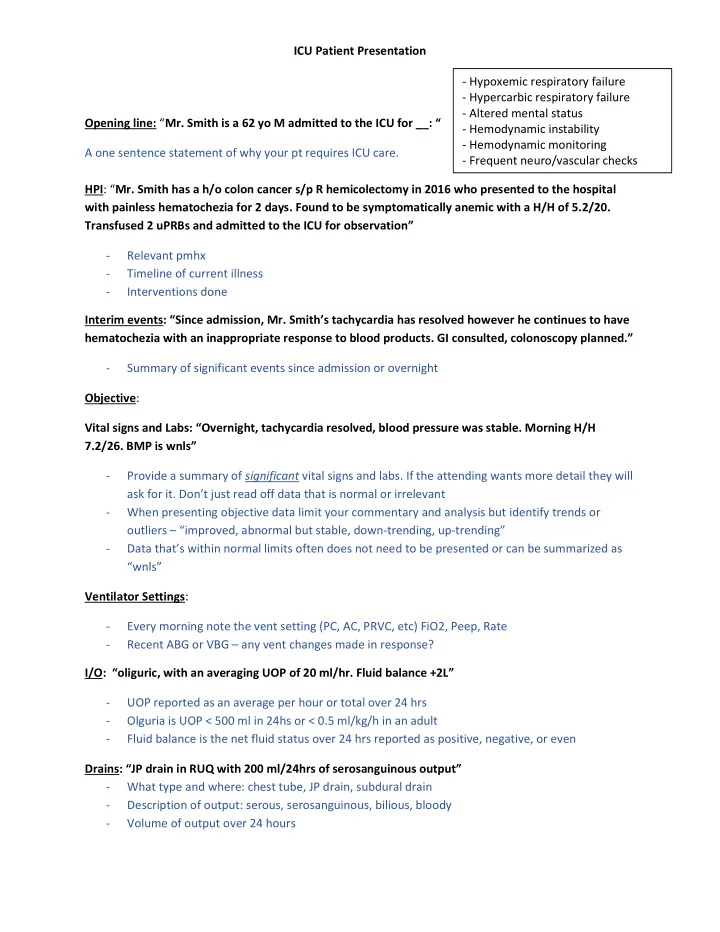
ICU Patient Presentation - Hypoxemic respiratory failure - Hypercarbic respiratory failure - Altered mental status Opening line: Mr. Smith is a 62 yo M admitted to the ICU for __: - Hemodynamic instability - Hemodynamic monitoring A


slide-1
SLIDE 1

ICU Patient Presentation Opening line: “Mr. Smith is a 62 yo M admitted to the ICU for __: “ A one sentence statement of why your pt requires ICU care. HPI: “Mr. Smith has a h/o colon cancer s/p R hemicolectomy in 2016 who presented to the hospital with painless hematochezia for 2 days. Found to be symptomatically anemic with a H/H of 5.2/20. Transfused 2 uPRBs and admitted to the ICU for observation”

  • Relevant pmhx
  • Timeline of current illness
  • Interventions done

Interim events: “Since admission, Mr. Smith’s tachycardia has resolved however he continues to have hematochezia with an inappropriate response to blood products. GI consulted, colonoscopy planned.”

  • Summary of significant events since admission or overnight

Objective: Vital signs and Labs: “Overnight, tachycardia resolved, blood pressure was stable. Morning H/H 7.2/26. BMP is wnls”

  • Provide a summary of significant vital signs and labs. If the attending wants more detail they will

ask for it. Don’t just read off data that is normal or irrelevant

  • When presenting objective data limit your commentary and analysis but identify trends or
  • utliers – “improved, abnormal but stable, down-trending, up-trending”
  • Data that’s within normal limits often does not need to be presented or can be summarized as

“wnls” Ventilator Settings:

  • Every morning note the vent setting (PC, AC, PRVC, etc) FiO2, Peep, Rate
  • Recent ABG or VBG – any vent changes made in response?

I/O: “oliguric, with an averaging UOP of 20 ml/hr. Fluid balance +2L”

  • UOP reported as an average per hour or total over 24 hrs
  • Olguria is UOP < 500 ml in 24hs or < 0.5 ml/kg/h in an adult
  • Fluid balance is the net fluid status over 24 hrs reported as positive, negative, or even

Drains: “JP drain in RUQ with 200 ml/24hrs of serosanguinous output”

  • What type and where: chest tube, JP drain, subdural drain
  • Description of output: serous, serosanguinous, bilious, bloody
  • Volume of output over 24 hours
  • Hypoxemic respiratory failure
  • Hypercarbic respiratory failure
  • Altered mental status
  • Hemodynamic instability
  • Hemodynamic monitoring
  • Frequent neuro/vascular checks
slide-2
SLIDE 2

ICU Patient Presentation Imaging: “AM chest XR with RLL consolidation, improved from yesterday”

  • summarize new findings
  • compare to previous imaging

Micro: “blood cultures from 6/26 shows moderate growth of gram positive rods, speciation and susceptibilities pending. NGTD on sputum cultures”

  • check the micro reports daily
  • report specimen type and date: blood/sputum/fluid culture from (date)

Physical Exam:

  • Preform the whole exam but only present the pertinent findings

General: level of consciousness – alert, somnolent, sedated, agitated, comatose, delirious Neuro: GCS, on or off sedation?

  • GCS – be descriptive, localizes, withdraws, opens eyes to voice/pain, follow commands?
  • Ask RN what the exam is off sedation

HEENT: pupil exam, suctioning requirements, strong/weak cough, NGT or OGT CV: ectopy? Peripheral pulses? Edema? Pulm: intubated? Breathing over the vent? Abd: distention? Genitals: foley in place? Skin breakdown? Swelling? Ext/skin: ask RN about pressure ulcers, skin breakdown, bruising, redness Assessment: “62 yo M admitted for hemodynamic monitoring with concern for acute lower GI bleed. Hemodynamically stable following blood transfusion. Colonoscopy with GI pending.”

  • Two lines or less summary of why the pt is in the ICU, significant new findings or interventions

and what treatments or interventions have been performed or are pending. Plan: a breakdown of active problems by system and your plan for intervention. What actions are you going to take today. Neuro:

  • What is the pain control regimen? Is it working? Can it be weaned, convert from IV to PO or

short acting to long acting?

  • Sedation – What drips are they on? At what rate? Is it still needed, can it be weaned?
slide-3
SLIDE 3

ICU Patient Presentation CV:

  • Blood pressure control:
  • hypotensive on pressors? Which pressors and what rates?
  • hypertensive on meds? Which meds/drips?
  • How are we going to wean the drips?
  • MAP goals
  • Lactate trend

Pulm:

  • Why are they intubated and vented?
  • Spontaneous breath trial?
  • Extubate? Tracheostomy?

GI:

  • NPO/type of diet/TFs
  • If NPO, when can they eat
  • Are they meeting nutritional goals?
  • Last bowel movement? Type of stools?
  • Bowel regimen
  • GI ppx

Heme

  • H/H trend (if normal, do not present)
  • Platelets trend (if normal, do not present)
  • Transfusions over past 24hrs
  • DVT ppx? If held why? When can it be started?

ID:

  • Comment on fevers, leukocytosis, bands
  • Narrow abx?
  • Date abx were started
  • End date for abx

Renal:

  • Cr trend (if normal, do not present)
  • AKI? Urine lytes? Renal ultrasound? Pre-renal, intrinsic, post renal?
  • UOP appropriate?
  • Foley? If so, can if be removed?
  • Are they on the electrolyte protocol? If not, are there any electrolyte abnormalities?

Endo:

  • How often are glucose checks?
  • Is the glucose controlled?
  • Can you start scheduled long or short acting insulin?

PT/OT/SLP:

  • have they been consulted: yes or no
  • If no, why not: bed rest, awaiting TLSO brace, etc
  • are there weight baring restrictions in the extremities or other limitations to movement
  • what are their recommendations?

Lines/Drains/Access:

  • Keep a running list and when they were placed
  • ETT, JP drains, chest tubes, foleys, PICC lines, CVC
  • Can any of them be removed?
slide-4
SLIDE 4

ICU Patient Presentation Dispo:

  • What is keeping the pt in the ICU: continue ICU care for – ventilatory support, hemodynamic

instability, frequent neuro checks, etc.

  • Expected discharge plan: acute rehab, sub-acute rehab, skilled nursing facility, home with home

health, home with family, etc. CODE STATUS:

  • Should be listed at the end of every note
  • All caps and bolded: FULL CODE, DNR/DNI, LIMITED CODE, DNR – SUPPORT OK

Daily Rounding Checklist:

  • Presented as rapid bullet points at the end of you pt presentation, no more than 10 seconds

□ Ventilator order

  • Update with the correct settings

□ Ventilator weaning order

  • Order daily for 0500

□ Sedation weaning order

  • Order daily for 0500

□ VAP bundle

  • Chlorhexidine mouth wash
  • Q4h oral care
  • PPI
  • VTE prophylaxis

□ Restraint order

  • Order daily for 0500

□ Evaluation for Extubation

  • Consider tracheostomy

□ Lines/Tubes/Drains

  • Each need an active order
  • Can any be removed?

□ Antibiotics

  • Stop date?
  • Narrow?
  • Review micro results

□ Labs

  • AM labs?
  • Remove unnecessary scheduled labs

□ Imaging

  • Review resent results
  • AM CXR?

□ Diet

  • If NPO -> consult dietitian and TF order
  • Bowel regimen

□ Family

  • Have they been updated?
  • Family meeting to discuss GOC?