SLIDE 1
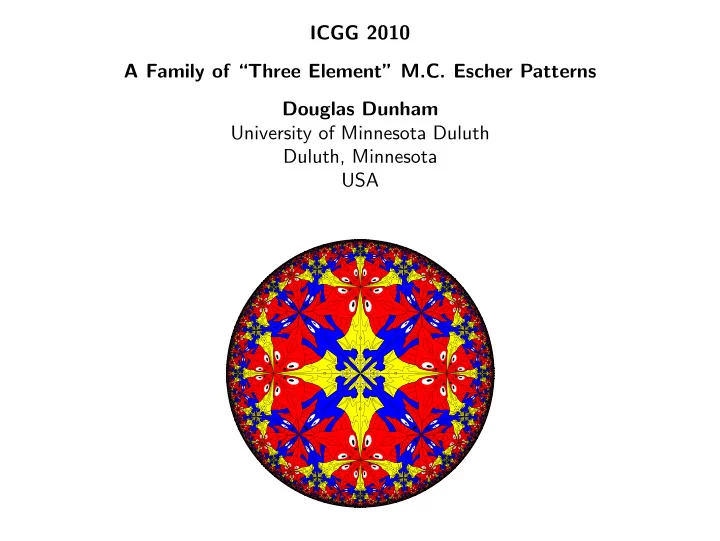
ICGG 2010 A Family of “Three Element” M.C. Escher Patterns Douglas Dunham University of Minnesota Duluth Duluth, Minnesota USA
SLIDE 2
Outline
◮ A brief history of “Three Element” patterns ◮ A review of hyperbolic geometry ◮ Repeating patterns ◮ Regular tessellations ◮ Families of patterns ◮ The family of Escher’s Circle Limit I patterns ◮ The family of “Three Element” patterns ◮ Future work
SLIDE 3
History
◮ In 1952 Escher created his Regular Division Drawing Number 85,
consisting of fish, lizards, and bats.
◮ Shortly after that he drew that pattern on a rhombic dodecahedron. ◮ In 1963 Escher and C.V.S. Roosevelt commissioned the netsuke
artist Masatoshi to carve the “three element” pattern on an ivory sphere.
◮ In 1977 Doris Schattschneider and Wallace Walker had the pattern
printed on the net for a regular octahedron in their book M.C. Escher Kaleidocycles.
◮ In the early 1980’s my students and I implemented our first
hyperbolic pattern drawing program.
◮ Shortly after year 2000, I used a program to draw a “three element”
pattern in the hyperbolic plane, the only one of the three classical geometries Escher did not use for “three element” patterns.
SLIDE 4
M.C. Escher’s Regular Division Drawing 85 (1952)
SLIDE 5 Hyperbolic Geometry
◮ In 1901, David Hilbert proved that, unlike the sphere, there was no
isometric (distance-preserving) embedding of the hyperbolic plane into ordinary Euclidean 3-space.
◮ Thus we must use models of hyperbolic geometry in which Euclidean
- bjects have hyperbolic meaning, and which must distort distance.
◮ One such model, used by Escher, is the Poincar´
e disk model.
◮ The hyperbolic points in this model are represented by interior point
- f a Euclidean circle — the bounding circle.
◮ The hyperbolic lines are represented by (internal) circular arcs that
are perpendicular to the bounding circle (including diameters as special cases).
SLIDE 6
Escher’s Circle Limit I Showing Hyperbolic Lines.
SLIDE 7
Repeating Patterns
◮ A repeating pattern in any of the 3 “classical geometries” is
composed of congruent copies of a basic subpattern or motif.
◮ For example half a black fish plus half an adjacent white fish forms
a motif for Circle Limit I
◮ Similarly, a triangle containing half a fish, half a lizard, and half a
bat, forms a motif for a “three element” pattern.
SLIDE 8
A Motif for the Title Slide Three Element Pattern
SLIDE 9
A Motif for Circle Limit I
SLIDE 10
Regular Tessellations
◮ The regular tessellation, {p, q}, is an important kind of repeating
pattern composed of regular p-sided polygons meeting q at a vertex.
◮ If (p − 2)(q − 2) < 4, {p, q} is a spherical tessellation (assuming
p > 2 and q > 2 to avoid special cases).
◮ If (p − 2)(q − 2) = 4, {p, q} is a Euclidean tessellation. ◮ If (p − 2)(q − 2) > 4, {p, q} is a hyperbolic tessellation. The next
slide shows the {6, 4} tessellation.
◮ Escher based his 4 “Circle Limit” patterns, and many of his
spherical and Euclidean patterns on regular tessellations.
SLIDE 11
The {6, 4} Tessellation.
SLIDE 12
The {6, 4} Tessellation Underlying Circle Limit I
SLIDE 13 A Table of the Regular Tessellations
. . . . . . . . . . . . . . . . . . . . . 8 * * * * * * · · · 7 * * * * * * · · · q 6 * * * * * · · · 5
* * * * · · · 4
* * * · · · 3
* · · · 3 4 5 6 7 8 · · · p
tessellations
tessellations *
tessellations
SLIDE 14
Families of Patterns
◮ If a pattern is based on an underlying {p, q} tessellation, we can
conceive of other patterns with the same motif (actually slightly distorted) based on a different tessellation {p′, q′}.
◮ This observation leads us to consider an whole family of such
patterns indexed by p and q.
SLIDE 15
The Circle Limit I Family of Patterns
◮ For a Circle Limit I pattern based on a {p, q} tessellation, both p
and q must be even, since the backbone lines are axes of reflection symmetry.
◮ For these patterns, p/2 is the number of black fish meeting at their
noses and q/2 is the number of white fish that meeting at noses.
◮ For this family, we let (p/2, q/2) denote the pattern based on the
{p, q} tessellation.
◮ So Circle Limit I would be (3, 2) in this notation.
SLIDE 16
A (3, 3) Circle Limit I Pattern.
SLIDE 17
A (2, 3) Circle Limit I Pattern.
SLIDE 18
The Family of “Three Element” Patterns
◮ In 1952 Escher created his Regular Division Drawing Number 85,
consisting of fish, lizards, and bats, which represent the three “elements” water, earth, and air.
◮ The patterns of this family depend on three numbers, p, q, and r,
which represent respectively the number of fish, lizards, and bats meeting at their heads. We let (p, q, r) denote such a pattern.
◮ Thus Regular Division Drawing would be denoted (3, 3, 3), and the
title slide would be (4, 4, 4).
◮ If 1/p + 1/q + 1/r > 1, the pattern will be spherical. ◮ If 1/p + 1/q + 1/r = 1, the pattern will be Euclidean. ◮ If 1/p + 1/q + 1/r < 1, the pattern will be hyperbolic.
SLIDE 19
Escher’s Euclidean (3, 3, 3) Regular Division Drawing 85
SLIDE 20
A Rhombic Dodecahedron (2, 2, 2) Pattern (1952) A Spherical (2, 2, 2) Pattern (1963)
SLIDE 21
A Study for the (2, 2, 2) Ivory Netsuke Carving
SLIDE 22
Masatoshi’s Netsuke Carving (1963)
SLIDE 23
A (4, 5, 3) “Three Element” Pattern
SLIDE 24
A (5, 3, 4) “Three Element” Pattern
SLIDE 25
A (4, 4, 3) “Three Element” Pattern
SLIDE 26
A (4, 4, 10) “Three Element” Pattern
SLIDE 27
Future Work
◮ Extend the repeating pattern program so that it can also draw
Euclidean and spherical patterns.
◮ Investigate other families of patterns by Escher and other artists. ◮ Create more patterns!
SLIDE 28
Thank you! To all who worked on ICGG 2010