
SLIDE 1
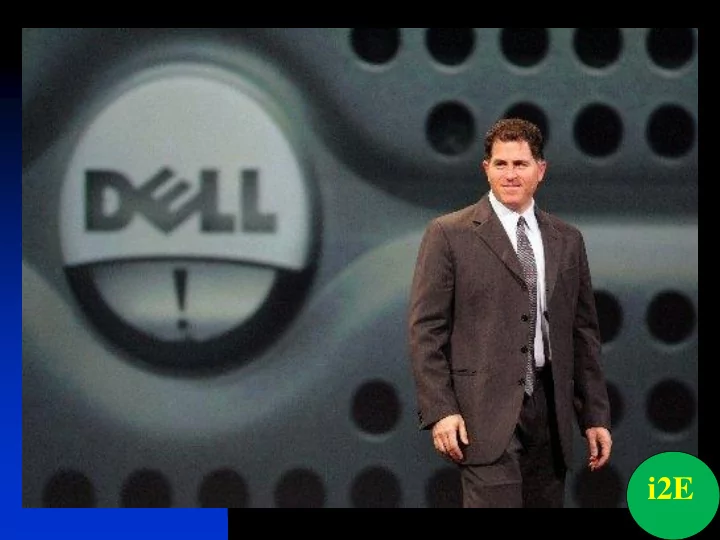
i2E Is Michael Dell an Entrepreneur? Why? High school equivalence - - PowerPoint PPT Presentation
i2E Is Michael Dell an Entrepreneur? Why? High school equivalence degree in third grade Urge to go ahead Compress things Setting up stamp auction Creating value for both Took the Apple II apart Getting at the bottom of
High school equivalence degree in third grade
Urge to go ahead Compress things
Setting up stamp auction
Creating value for both
Took the Apple II apart
Getting at the bottom of things
Set up a bulletin board
Reaching out to targetted customers
Upgrading and reselling at profit
Set up and started running the business in high school
Came up with an insight in who were the prospective customers
People who had just moved in People who had just got married
Found an efficient method in locating the prospects
Marriage license submission
Summer Job at Houston Post
PCs were sold through conventional distribution
By the time PCs reached the customers: technology had moved on For a PC costing US $ 2000: the components were only $ 600 The microprocessor manufacturers were bringing
it took long time for them to get into PCs Pinpointed the enormous inefficiency in the entire
short-charging of customers
Dropped out of college Set-up a 1,000 sq ft. office in Austin Identified the lacuna:
PCs without hard drives
Set up a business of:
selling upgrade kits
The “Venture”
A few order takers A few more people to fulfl them Manufacturing staff: 3 men with screwdrivers Capitalization cost: $1,000
Within a month, new office of 2,500 sq. ft Within 3 months, 7,000 sq ft office Achieved growth without any significant capital ($
1,000)
Customers were paying by Credit card Credit from suppliers (because they didn’t have
many customers)
Botched up many things
Made mistakes but didn’t repeat them Grew and grew and grew because of enormous
inherent value in the business
Can be at any point in the entire value chain
New products New processes New methods of reaching customers
The value is in the mind of the customer Offered what the customer wanted:
in the most cost-effective way
Developed enormous leverage with the
Offered unmatched value to the customers
Year Sales ($ million)
1985 1990 1995 2000 2005 6 400 3,500 25,000 50,000
Do family background and education matter? Are there certain traits and attributes of an
Do entrepreneurs look at things differently? Why?
What it takes to move from idea to entreprise? Do entrepreneurs change the “Rules of the
What is the most important resource? Money?
Is entrepreneurship rewarding?
Addressing a critical problem Exploiting a perceived opportunity Developing a new “ends-means” framework Validation Venturing in uncharted areas
Risk Time
Godrej Chotu Cool Refrigerator without compressor for Rs 3,250 Micromax Mobile Talk time 4 hrs Rural ATM McAloo Tikki, the Veggie Burger for Rs 20 Highest grossing item on the menu Sales up by 30 % Big or Small? Big for Small? Small for Big?
Concept Practice Contribution Attributes and Mindset Founding and growing a new
Opportunity Creativity Value Proposition Value Creation and Delivery Making the World a Better Place
Personal Computers Voice mail information
technology services
Biotechnology Cellular phone services Cable TV Internet publishing and
shopping
PC Software Desktop computing Wireless Communications/
handheld devices
Virtual imaging Electronic paging Digital media &
entertainment
Kiran Mazumdar Subhash Goel Kishor Biyani C K Ranganathan Deep Kalra Tulsi Thanti
Gururaj Deshpande Suhas Patil Kanwal Rekhi Romesh Wadhwani Vivek Ranadive Bharat Desai
What factors should be reduced well below the industry standard ? What factors should be raised well beyond the industry standards ? What factors should be eliminated that the industry has taken for granted ? What factors should be created that the industry has never offered ?
New Venture
Entrepreneur Innovation Raise Resources Deliver Value
Class sessions Exercises Readings Assignments Sharing of Experiences with
Business Plan
Understand the logic and mechanics of a business
Mindset and preparation for an Entrepreneur Develop an understanding of the entrepreneurial
Know about stages of technology evolution, product
Develop an understanding of business functions
Feasibility Study/Business Plan
Technology Ventures: From Idea to Entreprise Byers/ Dorf The Start-up Owner’s Manual Steve Blank Entrepreneurship Barringer/ Ireland
The Art of the Start Kawasaki Stay Hungry, Stay Foolosh Rashmi Bansal The New Business Road Test Mullins Readings : Required Business Journals/Magazines
Give three points which set Michael Dell apart
What is the most important action that Michael
Why were PC sellers selling computers with older
What was the most innovative element in Dell’s
Why did Dell Computers grow very fast? Mention 3 innovations which impressed you most
Established in June 2014 as an Inter-Disciplinary Program Centre
New Program: B. Tech. (Minor) in Entrepreneurship
Autumn Semester
Entrepreneurship
Fundamentals for Technopreneurs
Technological Innovation
Proof of Concept-Basic Spring Semester
Venture Creation
Entrepreneurs
Property Management for Entrepreneurs
Proof of Concept-Advanced 500+ students have joined these courses Extensive networking with alumni entrepreneurs and Venture Capitalists for courses and mentoring
JanYu Technologies
Spearheading the robotic revolution towards a mine- free world Tactical Remotely Operated Vehicle(ROV)
Enabling Digital Technology solutions
Felicitated by State Bank of India for timely delivery of a project
SOUNDREX – Immersive Music experience Top 20 in the K Star Global Challenge Technologies for better healthcare delivery Proximal SoilSenS Technologies Pvt. Ltd.
Optimizing Water Usage Through Soil Moisture Detection
Approved Projects of Ex- Students of the Course
(Ushvatech)
(SoilSense)
(Faclon) New Project Ideas Also Welcome
What you are expected to do?
1. Participate in a detailed Customer Discovery/Customer Validation process inside the campus in which you are expected to meet the different stakeholders in a given problem area and understand their pain points 2. Collate disparate baseline data existing at different locations and in different formats to come up with insight 3. Design a proof-of-concept PoC with clear success criteria 4. Help execute the PoC in a quick and structured manner 5. Finally assist the startups in delivering an impressive presentation in the third week of September.
$10 Billion – Size of Smart City Opportunity in India in the next 5 years, McKinsey. $ 267 Billion – Size of global IoT Tech., App. and Solutions market by 2020, Forbes.
Current Projects
Do I want to create things which will be of
Am I serious about learning
Entrepreneur: quits a 9 to 5 job so that s/he can work for 16
Am I willing to put in efforts of 12 credits for
A B C
Do entrepreneurs look at things differently? Why? How?
A B C
Are there certain traits and attributes of an entrepreneur?
A B C
A B C