SLIDE 1
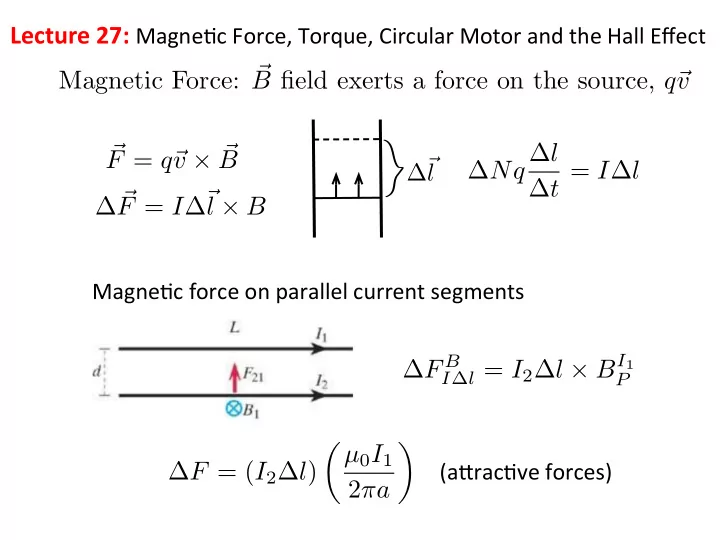
Lecture ¡27: ¡Magne&c ¡Force, ¡Torque, ¡Circular ¡Motor ¡and ¡the ¡Hall ¡Effect ¡ Magnetic Force: ~ B field exerts a force on the source, q~ v ~ F = q~ v × ~ B ∆~ F = I∆~ l × B
∆~ l
∆Nq ∆l ∆t = I∆l
Magne&c ¡force ¡on ¡parallel ¡current ¡segments ¡
∆F B
I∆l = I2∆l × BI1 P
∆F = (I2∆l) ✓µ0I1 2πa ◆
(a>rac&ve ¡forces) ¡
SLIDE 2
Current ¡loop ¡in ¡a ¡constant ¡B ¡field ¡
F1 = IaB ⊗ F2 = F4 = 0 F3 = IaB F⇤ = F1 + F3 = IaB − IaB = 0
b
IaB IaB
B
I
Torque ¡about ¡midline ¡00: ¡
(view ¡from ¡the ¡baseline ¡loop) ¡
τ = Fb = (IaB) b = IabB = IAB µ = IA = Iab ~ ⌧ = ~ µ × ~ B (present case: ⌧ = µB)
SLIDE 3 General ¡Case: ¡
~ B is in the xy plane, ↵ < 90 So ~ B = B ⇣ − sin ↵ˆ I + cos ↵ˆ j ⌘ ~ ⌧ = ~ µ × ~ B = µB
j k 1 − sin ↵ cos ↵
k ~ ⌧ = ~ µ × ~ B circular loop. ~ µ = µˆ j
SLIDE 4 Lec26-4 Motion of a charged particle in the plane perpendicular to the magnetic field r v1
P1
v2
P2
A proton is moving in a clockwise direction in a plane perpendicular to a uniform magnetic field B pointing out of the page. Determine the direction of the magnetic force at P1 and at P2. Choice Direction of Force at P1 Direction of Force at P2 1 Up Left 2 Down Left 3 Up Right 4 Down Right
Circular ¡Mo&on ¡– ¡Force ¡due ¡to ¡B ¡on ¡qv ¡
SLIDE 5 r v1
P1
v2
P2
Circular ¡Mo+on ¡– ¡Force ¡due ¡to ¡B ¡on ¡qv ¡
Given: B = const., out of the paper Find: The direction of the force at P1 & at P2
At ¡P1: ¡ At ¡P2: ¡
Period T = 2πr v = 2πm qB ✓ ω = 2π T = qB m ◆ Fcp = mv2 r = qvB r = mv qB Period is independent
Down
qv
B
qv
B
SLIDE 6 Lec26-5 Circular motion in the plane perpendicular to a constant magnetic field A proton of charge e and mass m is moving in a plane perpendicular to a uniform magnetic field. Investigate the radius and period of its circular motion. Hint:
I Fcp = mv 2 r
= evB
I T = 2πr v
Choice R (radius of the circular motion) T (period of circular motion) 1 mv/eB As v increases, T increases 2 mv/eB T is independent of v 3 eB/mv As v increases, T increases 4 eB/mv T is independent of v
SLIDE 7
Alternative ∆V ⇒ E > 0, E < 0
t
∆V
f(t) = ∆V2 sin ωt
= successive acceleration of charged particle
SLIDE 8
Hall ¡Effect: ¡Determine ¡the ¡sign ¡of ¡charge ¡carriers ¡
I B B
B
F
I
If ¡carriers ¡have ¡+ ¡charges: ¡
G
Ihall
A B
For case 1: Static polarized charge creates E ↑ ∴ Potential at B is higher. Take a test charge to be pushed by F = qvB to raise it’s potential from A to B.
VB − VA = WA→B q = qvBl q = vBl ∆~ F = ~ I∆l × ~ B
SLIDE 9 Lec27-3 Hall Experiment x y z
G B B vd I
- Fig. 27.3a shows a portion of a metal strip in a region of uniform
magnetic field. A galvanometer is connected to the upper and lower surfaces of the strip. A current I flows to the right (so the electron drift velocity vd is to the left) and B = Bˆ
- z. Determine the direction of the
magnetic force experienced by the drifitng electrons and the direction of the (conventional) Hall current through the galvanometer. Choice FB Direction of Hall current through the galvanometer 1 Up Up 2 Up Down 3 Down Up 4 Down Down
SLIDE 10
If ¡carriers ¡have ¡– ¡charges: ¡
G
Ihall
A B
For case 2: E ↓ VA − VB = vBl
Determina&on ¡of ¡v: ¡
I = |q|i = |q|nAv, v = I |q|nA n = # of electrons volume − − − − − − →
2 valence
2NA (# of moles) volume