I NTRODUCTI ON to children 2. An alternative to child welfare - - PowerPoint PPT Presentation

i ntroducti on to
SMART_READER_LITE
LIVE PREVIEW

I NTRODUCTI ON to children 2. An alternative to child welfare - - PowerPoint PPT Presentation

TodaysPresentation : What the Child mental Health Treatment Act (CMHTA) really is The Child Mental Health The Child Mental Health How CMHTA helps non Medicaid and Treatment Act Treatment Act Medicaid Children How to Access


slide-1
SLIDE 1

1

The Child Mental Health Treatment Act The Child Mental Health Treatment Act

1

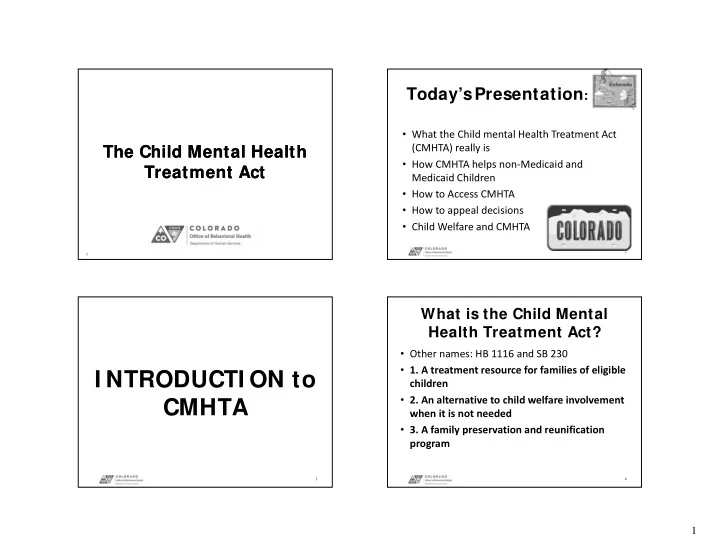
Today’sPresentation:

  • What the Child mental Health Treatment Act

(CMHTA) really is

  • How CMHTA helps non‐Medicaid and

Medicaid Children

  • How to Access CMHTA
  • How to appeal decisions
  • Child Welfare and CMHTA

2 3

I NTRODUCTI ON to CMHTA

What is the Child Mental Health Treatment Act?

  • Other names: HB 1116 and SB 230
  • 1. A treatment resource for families of eligible

children

  • 2. An alternative to child welfare involvement

when it is not needed

  • 3. A family preservation and reunification

program

4

slide-2
SLIDE 2

2

At Minimum What Does the Child Mental Health Treatment Act Provide?

5

Services: Appeals: Funding:

Non‐ Medicaid

Timely Assessment and Decision for Community or Residential CDHS Appeal Process CDHS Funding for Mental Health Services

Medicaid

Timely Assessment and Decision for Residential Treatment CDHS Appeal Process in Addition to the Medicaid Process HCPF Funding for Mental Health Services

What CMHTA Can Provide:

  • Non‐Medicaid: Access to an assessment for, and

possible approval of, community, residential, and transitional treatment services

  • Funded in part by Medicaid, General Fund, and

Tobacco dollars

  • Medicaid: Access to an assessment for residential

services only

  • Funded by Capitated Medicaid
  • Non‐Medicaid funding is not available to Medicaid

children

6 7

  • 1. Private

insurance

  • r non‐

insured

  • 2. Birth to

17.99

  • 3. Not

Medicaid eligible

  • 4. No

funder for treatment

  • 5. Has a

Mental Illness

  • 6. Family

has Custody

  • 7. Without

services the child is at risk

  • f out of home

placement

Non-Medicaid

8

slide-3
SLIDE 3

3

9 10 11

Passing of SB 230

Some of What’s Covered for Non-Medicaid…

CMHTA Case Management Day Treatment Residential Family Therapy Medication Monitoring Outpatient

12

Non‐ Medicaid

slide-4
SLIDE 4

4

ASSESSMENT

13

Points of Access

  • Each Community Mental Health Center

has a designated CMHTA liaison.

  • Only responsible person (parent) can

request an assessment.

  • http://www.colorado.gov/cs/Satellite?c= Document_C&childpagename= CDHS-

BehavioralHealth%2FDocument_C%2FCBONAddLinkView&cid= 1251655117018&pagename = CBONWrapper

14

Non‐ Medicaid Medicaid

Assessment and Notification Time Frames

15

Situation Time*

Emergent Within 6 hours Urgent Within 24 hours Routine Within 3 days

* Notification may be extended to 14 days if the parent is in agreement Non‐ Medicaid Medicaid

Assessment Process

Face to Face Mental Health Evaluation Records Review Phone Consultation Decision

16

Non‐ Medicaid Medicaid

slide-5
SLIDE 5

5

APPROVAL

Now What?

17

Approved for Community Based Care (non- Medicaid)

  • 1. Liaison helps find a provider
  • 2. Services begin promptly
  • 3. Family pays Parental Fee
  • 1. Based on monthly income and number of children

in the home

  • 4. CMHTA pays remainder of costs

18

Non‐ Medicaid

Fee Structure

  • Household income: $55,000 per year
  • Fee for Residential

–1 child living in the home: $726 per month –2 children living in the home: $501 per month –3 Children living in the home: $425 per month

  • Fee for Community based care

–1 child: 12% of total care, max of $363 –2 children: 8% of total care, max of $250 –3 Children: 7% of total care, max of $212

19

Approved: Residential (non- Medicaid)

  • 1. Liaison helps find a provider
  • 2. Child enters treatment center
  • 3. Family applies for SSI
  • Once approved the child gets Fee‐For‐Service

Medicaid

  • 4. Parents pay fee agreement (starting the first month)
  • 5. CMHTA pays remainder of costs
  • 6. Link to residential providers:

http://www.colorado.gov/cs/Satellite/CDHS‐ BehavioralHealth/CBON/1251641605227

20

Non‐ Medicaid

slide-6
SLIDE 6

6

CMHC Roles and Responsibilities for non-Medicaid Children

  • Assessments
  • Determines families ability to pay and financial

responsibilities

  • Submit plan of care to OBH
  • Provide necessary services
  • Care management

21

Non‐ Medicaid

Family Roles and Responsibilities

  • Participate in all

program aspects

  • Pay providers according

to Fee Agreement

  • Residential:
  • Apply for SSI on

child’s behalf

22

Non‐ Medicaid

Approved: Residential (Medicaid)

  • 1. Liaison informs the BHO who then approves
  • r denies
  • 2. Child enters treatment center
  • 3. BHO pays for costs

23

Medicaid

DENI AL

24

slide-7
SLIDE 7

7

Denial

25

Denied

  • Family is denied services with CMHTA

Initial Appeal

  • Family can appeal to the agency

(CMHC/BHO)

Then family can appeal to the state

  • Medicaid: CDHS and or/ALJ
  • Non‐Medicaid: CHDS

Non‐ Medicaid Medicaid

Supplemental Security I ncome (SSI ) Denial (non-Medicaid Residential)

  • Family can appeal with the Social Security

Administration but CMHTA will no longer be able to fund residential treatment

  • CMHTA will pay the first 30 days of

treatment

26

Non‐ Medicaid

HUMAN/ SOCI AL SERVI CES

27

MH Agency County Referrals

Referring Agency Reason Action Community Mental Health Center (CMHC)

  • 1. Suspected abuse or neglect
  • 1. DHS determines if an

assessment is warrented

  • 2. Meets with family and

CMHC within 10 days County Department of Human Services (DHS) [19‐3‐308 (1.5) (b), C.R.S.]

  • 1. Family issues may be

attributed to child’s MH status rather than abuse and neglect,

  • 2. CMHTA services may be

more appropriate

  • 1. Parents still requests an

evaluation

  • 2. DHS meets with family and

CMHC within 10 days

28

Non‐ Medicaid Medicaid

slide-8
SLIDE 8

8

I nteragency Dispute Resolution

An agency requests state level mediation May be in writing within 5 calendar days Within 10 days, CDHS convenes a committee Each side will present its position written or verbally Committee has 5 working days to issue its Decision Decision is final

29

Non‐ Medicaid Medicaid

Additional I nformation Please Contact:

Andrew Gabor, MA, LPC Manager, Child Mental Health Treatment Act Office of Behavioral Health 3824 W. Princeton Avenue Denver, CO 80236 Email: Andrew.Gabor@state.co.us Phone: 303-866-7422 Fax: 303-866-7481 www.cdhs.state.co.us

30