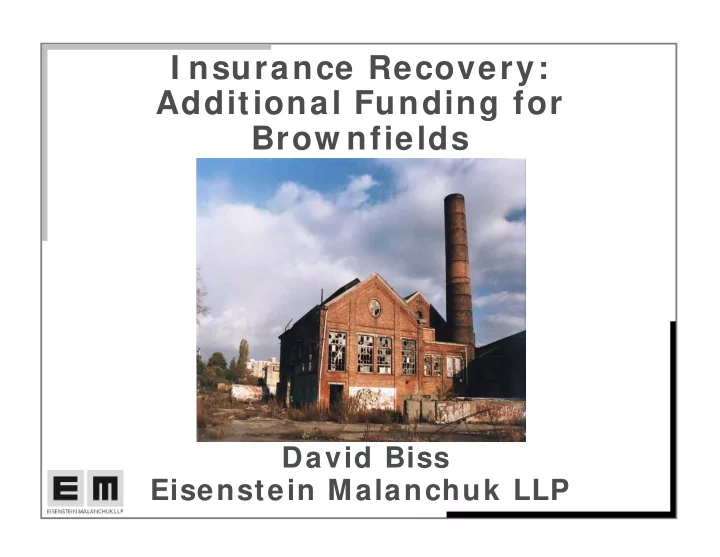
I nsurance Recovery: Additional Funding for Brow nfields David - - PowerPoint PPT Presentation
I nsurance Recovery: Additional Funding for Brow nfields David Biss Eisenstein Malanchuk LLP I ntroduction Environmental remediation is expensive Funding sources can be elusive A solution historic liability insurance policies
I ntroduction
- Environmental remediation is expensive
- Funding sources can be elusive
- A solution – historic liability insurance policies
- Negotiation of environmental coverage claims can benefit
stakeholders by providing money, and benefit insurers by providing closure on uncertain exposures
- Insurance is an often overlooked source of funding for
brownfields
2
3
I nsurance recovery introduction
- Historical liability insurance policies (pre-1985) represent
a deteriorating asset
- These policies can be monetized and married to
environmental liabilities resulting from the pre-1985
- perations, taking into account past and future projected
costs, and resulting in substantial financial gain
- You have every reason to evaluate whether insurance
recovery is feasible, and an additional source of funding for brownfields
4
I nsurance Recovery for Environm ental Liabilities
- General liability insurance prior to the mid-1980’s was
written broadly, and usually covers environmental liabilities
- Even if an entity has insufficient assets to pay for
cleanup, companies who contributed to the pollution still have valuable insurance rights
–
essentially all companies bought liability insurance
–
so did many municipalities
–
but frequently no one has pursued insurance recovery, due to lack of knowledge or expertise
- Even if the old company does not exist, insurance
recovery can often be pursued due to
–
- wners or officers with policy rights
–
insurance policy provisions dealing with company liquidation
W hat Coverage? W ho’s Coverage?
- Hypothetical ABC Chemical Company, with site operating
since 1960
–
Courts would generally allow claims on any policies issued during 1960 to 1985
- For a contaminated site coming into a developer or
municipality's possession in 2017, operated by ABC Chemical Company beginning in 1960, a claim could be made on ABC’s liability insurance spanning 1960 to 1985
–
Issues
- Do you have rights to make a claim under ABC’s
policies?
- If not, can you get cooperation of someone with
authority for ABC?
- Can you find ABC’s policies?
- Does ABC still exist?
5
Other Coverage I ssues
- Insurance does not extend to “intentional” pollution, e.g.,
criminal conduct
- Coverage exists for remediation costs but not for
redevelopment – costs need to be segregated in brownfields context
–
Similarly, restoration costs (e.g., mining restoration agreed as part
- f the mining lease) are not covered
- Owned property exclusion – need to have impacts offsite
- r to groundwater
6
7
The Goal
Assets Liabilities
- Balance assets with corresponding liabilities and cash out
the deteriorating assets. Manage the process to improve the bottom line. Use the proceeds to refund or manage site remediation, purchase more modern insurance without the flaws of the historic coverage or use funds for
- ther purposes
8
The steps in the process
I s there a case? Corporate history
- Stock or asset
purchases
- Flow of liabilities
- Policy rights
Liabilities
- Past costs
- Future costs
- Regulatory com pulsion
Policies
- Existence/ evidence
- Term s
- Exclusions
- Solvent carriers
Determ ine w hether sufficient coverage exists to support a claim Negotiate the claim Develop settlem ent strategy Prepare targets and dem ands for each carrier Hold principal-to-principal m eetings w ith each carrier to settle the claim s
Build the claim Provide details of transactions to dem onstrate coverage is proper Prepare an analysis of each site in the claim describing the site, the nature
- f the problem , the proposed
solution for risk transfer purposes, the costs to date and the future costs for the Proposed solution Perform allocations according to various theories to determ ine how m uch each policy/ carrier should pay of the total dam ages Com plete the detailed insurance coverage chart and policy language analysis I m plem ent standstill and confidentiality agreem ents
Recovery Process - Step 1 – Research & Docum ent
- Site and corporate history
–
Who operated the site
–
Who is the successor to those entities
- Liabilities
–
Past, current & expected costs
- Assets – general liability policies
–
Many sources
–
Many ways to prove cover – policies not needed
–
Insurance archeologists
9
1 0
Site History
Landfill
1 1
I nsurance I nform ation – W here do you find it?
1 2
Or here….
1 3
Or here…
1 4
Som etim es w e hire consultants to help us
1 5
Evidence
Recovery Process - Step 2 – Build the Claim
- Ownership of liability & assets
- Detailed coverage analysis
- Detailed site analysis
- Perform allocations – various theories
1 6
I nsurance I nform ation
1 7
Recovery Process - Step 3 – Negotiate Settlem ents
- Standstill & confidentiality agreements
- Agree on settlement strategy
- Prepare demands to each carrier
- Direct meetings to settle – expect a 2 year process
– At executive levels with settlement authority
- Alternative fee arrangements frequently utilized
1 8
1 9
W hy the Process W orks
- Confidential
- Insurance was purchased and premiums were
paid
- Insurance carriers have set aside reserves to
cover historic liability policies
- Settling these claims allows carriers to release
these reserves
- Carriers have reinsurance that helps offset their
payments to you
- Creating a win-win circumstance benefits all
parties
2 0
Are there any disadvantages to pursuing insurance recovery
- There is very little down side
- No new data are collected
- No new environmental investigation is required
for this process
- The time investment is minimal
- The cost is low
2 1
Preserving I nsurance Rights -- Assignm ent of I nsurance Proceeds
- Developers and municipalities often fail to
adequately consider the preservation of insurance rights when doing brownfields deals
- Acquisition of contaminated property also
should include consideration of insurance rights. Acquisition of a site, by itself, would not convey insurance rights unless there is some explicit agreement with the seller
– By contrast, insurance rights generally are
conveyed with acquisition of a company
2 2
Preserving I nsurance Rights -- Assignm ent of I nsurance Proceeds
- Generally a conveyance of insurance rights can be done
through a simple insertion of a few sentences. State laws vary, and must be consulted, however typical language would be:
–
Seller agrees to irrevocably assign to Buyer all rights to insurance claims proceeds under the Insurance Policies that relate to the Site, including but not limited to all proceeds under the Insurance Policies with respect to actual or potential environmental claims and with regard to all expenditures to-date relating to actual or potential environmental claims. Seller further agrees to reasonably cooperate with and assist Buyer’s efforts to assert and pursue such claims for insurance coverage, including to execute all necessary documentation to effectuate this assignment and to allow the pursuit and collection by Buyer or its designee of any insurance claims proceeds.
- It is critical that conveyance of insurance rights be