I mproving Relationships & Results: Building Family Building - - PDF document

i mproving relationships results building family building
SMART_READER_LITE
LIVE PREVIEW

I mproving Relationships & Results: Building Family Building - - PDF document

Improving Relationships & Results: Building Family School Partnerships Communication Strategies Module I mproving Relationships & Results: Building Family Building Family School Partnerships National Center for Special Education p


slide-1
SLIDE 1

Improving Relationships & Results: Building Family School Partnerships Communication Strategies Module National Center for Special Education Accountability Monitoring (NCSEAM) in collaboration with the Future of School Psychology Task Force on Family School Partnerships www.accountabilitydata.org

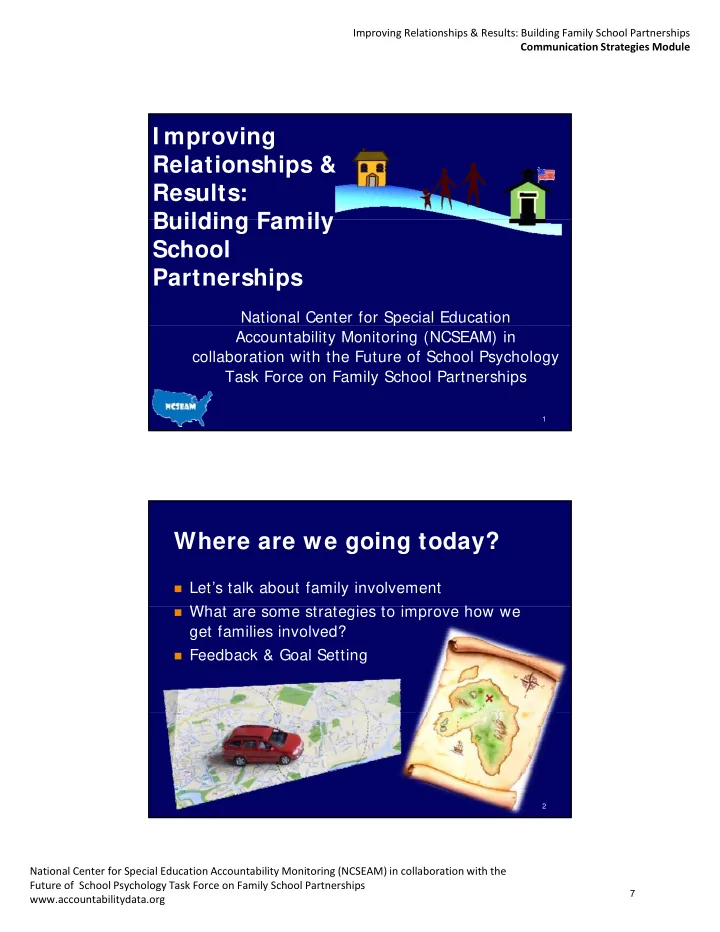
I mproving Relationships & Results: Building Family Building Family School Partnerships

National Center for Special Education p Accountability Monitoring (NCSEAM) in collaboration with the Future of School Psychology Task Force on Family School Partnerships

1

Where are we going today?

Let’s talk about family involvement

Wh t t t i t i h

What are some strategies to improve how we

get families involved?

Feedback & Goal Setting

2

7

slide-2
SLIDE 2

Improving Relationships & Results: Building Family School Partnerships Communication Strategies Module National Center for Special Education Accountability Monitoring (NCSEAM) in collaboration with the Future of School Psychology Task Force on Family School Partnerships www.accountabilitydata.org

I ndicator B-8

Percent of parents with a child receiving

i l d ti i h t th t special education services who report that

schools facilitated parent involvement as a means of improving services and l results for children with disabilities

3

Ask yourself:

How do you

approach & view f il i l family involvement with schools?

What are your

attitudes and beliefs att tudes a d be e s about building connections between families & schools?

4

8

slide-3
SLIDE 3

Improving Relationships & Results: Building Family School Partnerships Communication Strategies Module National Center for Special Education Accountability Monitoring (NCSEAM) in collaboration with the Future of School Psychology Task Force on Family School Partnerships www.accountabilitydata.org

Ask yourself:

Is the atmosphere of

your school/classroom inviting & family friendly?

What do you do to

promote promote communication & partnerships with families?

5

The 4 A’s

Approach

Attit d

Attitude Atmosphere Actions

6

9

slide-4
SLIDE 4

Improving Relationships & Results: Building Family School Partnerships Communication Strategies Module National Center for Special Education Accountability Monitoring (NCSEAM) in collaboration with the Future of School Psychology Task Force on Family School Partnerships www.accountabilitydata.org

Developing Pathways to Partnerships

Prerequisite Conditions: “3 A’s” must be in place for Actions to be accepted and effective to be accepted and effective

Approach Atmosphere Actions

Communicating a tone of partnership through bidirectional home school communication and

Successful learning

  • pportunities and

Attitude

home-school communication and fostering family involvement in learning at home

pp

  • utcomes for

children

(Christenson & Sheridan, 2001; Sheridan & Kratochwill, 2008) (Christenson & Sheridan, 2001; Sheridan & Kratochwill, 2008)

7

Approach

Families & educators Shared responsibility Relationships vs roles Relationships vs. roles

8

10

slide-5
SLIDE 5

Improving Relationships & Results: Building Family School Partnerships Communication Strategies Module National Center for Special Education Accountability Monitoring (NCSEAM) in collaboration with the Future of School Psychology Task Force on Family School Partnerships www.accountabilitydata.org

Approach

Empowerment Importance Cooperate & communicate

9

Approach

Involvement Co-teachers Information &

resources

10

11

slide-6
SLIDE 6

Improving Relationships & Results: Building Family School Partnerships Communication Strategies Module National Center for Special Education Accountability Monitoring (NCSEAM) in collaboration with the Future of School Psychology Task Force on Family School Partnerships www.accountabilitydata.org

Attitude

Feelings about partnerships Healthy & constructive

11

Attitude

Strengths Information Information

& support

Perspectives Unique

expertise

12

12

slide-7
SLIDE 7

Improving Relationships & Results: Building Family School Partnerships Communication Strategies Module National Center for Special Education Accountability Monitoring (NCSEAM) in collaboration with the Future of School Psychology Task Force on Family School Partnerships www.accountabilitydata.org

Attitude

Parent’s perspective

P l ?

Parents place? Parents as equals? Value comments? Listen & attend?

13

Atmosphere

Appreciate differences

ff f

Difficulties & conflicts Support all families

14

13

slide-8
SLIDE 8

Improving Relationships & Results: Building Family School Partnerships Communication Strategies Module National Center for Special Education Accountability Monitoring (NCSEAM) in collaboration with the Future of School Psychology Task Force on Family School Partnerships www.accountabilitydata.org

Creating the Atmosphere:

Open Welcoming

classroom

Time spent Time spent No assumptions

  • r generalizations

15

Actions

No “one” approach Current practice Communication

16

14

slide-9
SLIDE 9

Improving Relationships & Results: Building Family School Partnerships Communication Strategies Module National Center for Special Education Accountability Monitoring (NCSEAM) in collaboration with the Future of School Psychology Task Force on Family School Partnerships www.accountabilitydata.org

How can we accomplish this?

17

Effective Communication

Meeting times 2 positive: 1

negative R l

Regular progress

reports

18

15

slide-10
SLIDE 10

Improving Relationships & Results: Building Family School Partnerships Communication Strategies Module National Center for Special Education Accountability Monitoring (NCSEAM) in collaboration with the Future of School Psychology Task Force on Family School Partnerships www.accountabilitydata.org

Effective Communication

Tone of pa tne ship

Tone of partnership Helping at home Clear statements & Clear statements &

problem solving

19

Effective Communication

Concerned expressions Goal achievement Solicit information Check understanding

20

16

slide-11
SLIDE 11

Improving Relationships & Results: Building Family School Partnerships Communication Strategies Module National Center for Special Education Accountability Monitoring (NCSEAM) in collaboration with the Future of School Psychology Task Force on Family School Partnerships www.accountabilitydata.org

Administrative Support

Policies for partnership Low literacy Non-English speakers

21

Administrative Support

Professional staff development Parent opportunities

22

17

slide-12
SLIDE 12

Improving Relationships & Results: Building Family School Partnerships Communication Strategies Module National Center for Special Education Accountability Monitoring (NCSEAM) in collaboration with the Future of School Psychology Task Force on Family School Partnerships www.accountabilitydata.org

Key points

Time Time Not equal Commitment

23

  • Feedback. . .

24

18

slide-13
SLIDE 13

Improving Relationships & Results: Building Family School Partnerships Communication Strategies Module National Center for Special Education Accountability Monitoring (NCSEAM) in collaboration with the Future of School Psychology Task Force on Family School Partnerships www.accountabilitydata.org

Questions for you. . .

Taking local context into consideration, how

might this information need to be modified?

What are the potential barriers for using this

model of communication techniques?

How can we overcome these barriers? What support is necessary from administration? What support is necessary from other school What support is necessary from other school

staff?

How will we ensure this support is offered and

barriers are overcome?

25

For More I nformation

www.ed.gov

www accountabilitydata org

www.accountabilitydata.org

www.rrfcnetwork.org www nectac org www.nectac.org www.fsp.unl.edu

It’s about Better Results

26

19

slide-14
SLIDE 14

Improving Relationships & Results: Building Family School Partnerships Communication Strategies Module National Center for Special Education Accountability Monitoring (NCSEAM) in collaboration with the Future of School Psychology Task Force on Family School Partnerships www.accountabilitydata.org

We’re Done for Today! www.accountabilitydata.org

27

References

  • Christenson, S. L., & Hirsch, J. A. (1998). Facilitating partnerships and

conflict resolution between families and schools. In K. C. Stoiber & T.

  • R. Kratochwill (Eds.), Handbook of group intervention for children and
  • families. Needham Heights, MA: Allyn & Bacon.
  • Christenson, S. L., Lehr, C., & Havsy, L. (1999). Resource Manual for

Monitors to Promote Parents' Engagement of Children's L i Ch k d C t P j t U i it f Mi t

  • Learning. Check and Connect Project, University of Minnesota,

Minneapolis, MN.

  • Christenson, S. L., & Sheridan, S. M. (2001). Schools and families: Creating

essential connections for learning. New York: Guilford Press.

  • Sheridan, S. M. (2004, September). “Family-school partnerships:

Creating essential connections for student success.” Keynote presented at the annual conference of the Resource Teacher: Learning and Behavior Conference, Christchurch, New Zealand.

  • Sheridan, S. M., & Kratochwill, T. R. (2008). Conjoint behavioral

consultation: Promoting family-school connections and interventions. g y New York: Springer.

  • Vosler-Hunter, R. W. (1989). Changing roles, changing relationships:

Parent-professional collaboration on behalf of children with emotional disabilities. Portland, OR: Portland State University, Research and Training Center on Family Support and Children’s Mental Health.

28

20
slide-15
SLIDE 15

Improving Relationships & Results: Building Family School Partnerships Communication Strategies Module National Center for Special Education Accountability Monitoring (NCSEAM) in collaboration with the Future of School Psychology Task Force on Family School Partnerships www.accountabilitydata.org

Acknowledgments

The National Center for Special Education

Accountability Monitoring (NCSEAM) would like Accountability Monitoring (NCSEAM) would like to take a moment and offer a very special thank you to the Future of School Psychology Task Force on Family School Partnerships. A great deal of information presented in these modules was contributed by this team and our sincere y appreciation goes out to you for all your efforts.

NCSEAM would also like to thank those who

provided essential feedback to us throughout the development process.

29

21