Im Sober, Now What? The Role of Emotional Sobriety in Optimal - - PowerPoint PPT Presentation

i m sober now what the role of emotional sobriety in
SMART_READER_LITE
LIVE PREVIEW

Im Sober, Now What? The Role of Emotional Sobriety in Optimal - - PowerPoint PPT Presentation

Im Sober, Now What? The Role of Emotional Sobriety in Optimal Recovery Allen Berger, Ph.D. Clinical Psychologist Hazelden Author - 12 Stupid Things that Mess Up Recovery, 12 Smart Things to do When the Booze and Drugs are Gone , 12 Hidden


slide-1
SLIDE 1

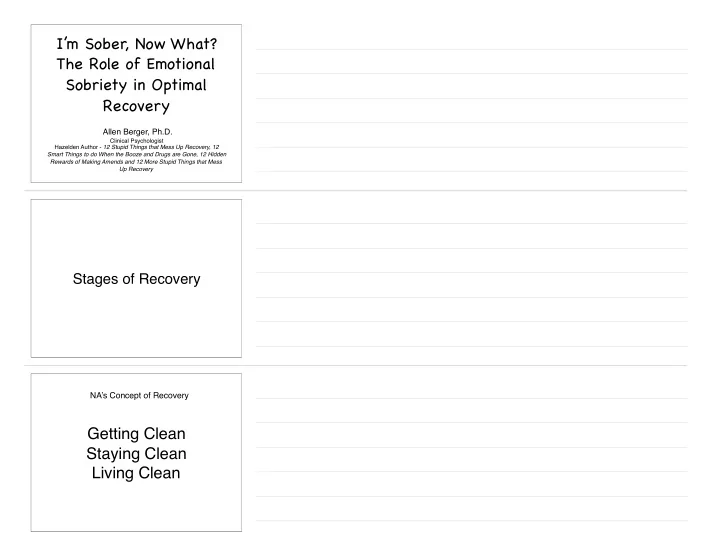
I’m Sober, Now What? The Role of Emotional Sobriety in Optimal Recovery

Allen Berger, Ph.D.

Clinical Psychologist Hazelden Author - 12 Stupid Things that Mess Up Recovery, 12 Smart Things to do When the Booze and Drugs are Gone, 12 Hidden Rewards of Making Amends and 12 More Stupid Things that Mess Up Recovery

Stages of Recovery

Getting Clean Staying Clean Living Clean

NA’s Concept of Recovery

slide-2
SLIDE 2

Getting Clean Staying Clean Living Clean

NA’s Concept of Recovery

}}

Stage 1 Stage 2

Stage I

Earnie described Stage I Recovery as breaking the bond of the primary addiction.

Earnie Larsen

“Abstinence may get you out of a bad place, but getting out of a bad place just gets you out; it is not the same as getting to a good place (p.10).”

slide-3
SLIDE 3

Earnie Larsen

“Victims of dry drunks have made a First Step relative to their addiction, but have not made a First Step relative to the living problems that underlies all addictions and ultimately limits their ability to function in loving relationships.”

Emotional sobriety is the cure for sober suffering.

Fred Holmquist - Hazelden Author

Stage II

slide-4
SLIDE 4

Stage II Recovery was first discussed in 1985 by Earnie Larsen.

Earnie described Stage Two Recovery as “...rebuilding of the life that was saved in Stage One.”

Earnie Larsen

“…Stage II Recovery gets at the underlying patterns and habits that caused us trouble in the first place. And if nothing changes, then nothing changes…the same results will pop up through our whole life (p. 83).”

Earnie Larsen

“I believe that learning to make relationships work is at the core of full recovery (p. 15).”

slide-5
SLIDE 5

Stage II Recovery is contingent on emotional sobriety.

DEFINING RECOVERY CAPITAL

“...the volume of internal and external assets that can be brought to bear to initiate and sustain recovery from alcohol and other drug problems.” Robert Granfield and William Cloud (1999) defined the concept of “recovery capital” as:

slide-6
SLIDE 6

External and Internal Recovery Capital

Family Involvement Impending Divorce Legal Trouble Professional Licensing Board Medical Complications Intervention Pressure from Work

  • r Family

Meeting Attendance Relationship with Sponsor Fellowship

Fel

Service Therapy

Willingness Open Minded

Openness

Honesty Commitment Self-Support Awareness Attitude - Self and Problem

Surrender Emotional Sobriety Nourishing Attitudes

ONE WAY TO INCREASE RECOVERY CAPITAL IS TO ESTABLISH EMOTIONAL SOBRIETY

Introduction to the Basic Concept of Emotional Sobriety

slide-7
SLIDE 7

“Emotional Sobriety is when the best in you runs the show. This state of mind is achieved when what you do is the determining force in your emotional well being rather than allowing your emotional well being to be overly influenced by external events or by what

  • thers are or are not doing.”

Allen Berger, Ph.D. - 2018

Definition of Emotional Sobriety

“There’s a space between the Stimulus and our Response. In that space is our power to choose our response. In our response lies our growth and

  • ur freedom - try to live

there.”

Viktor Frankl, M.D.

S R

The Essence of Emotional Sobriety

Fritz Perls’ defined emotional maturation (emotional sobriety) as, the transcendence from “environmental support to self-support.”

slide-8
SLIDE 8

Emotional Center of Gravity The Location of the Emotional Center of Gravity in Emotional Sobriety I’m OK if _______? I’m OK if even if_______?

Bill’s Letter 1956

Emotional Sobriety: The Next Frontier by Bill Wilson (January - 1958)

I think many oldsters who have put our ‘booze cure’ to severe but successful tests still find they often lack emotional

  • sobriety. Perhaps they will be the spear

head for the next major development in AA, the development of much more real maturity and balance (which is to say, humility) in our relations with ourselves, with our fellows, and with God.

slide-9
SLIDE 9

Emotional Sobriety: The Next Frontier by Bill Wilson (1958)

Those adolescent urges that so many of us have for top approval, perfect security, and perfect romance, urges quite appropriate to age seventeen, prove to be an impossible way of life when we are at age forty- seven and fifty seven.

Emotional Sobriety: The Next Frontier by Bill Wilson (1958)

Since AA began, I’ve taken immense wallops in all these areas because of my failure to grow up emotionally and spiritually. My God, how painful it is to keep demanding the impossible, and how very painful to discover, finally, that all along we had the cart before the horse. Then comes the final agony

  • f seeing how awfully wrong we have been, but still

finding ourselves unable to get off the emotional merry-go-round.

Emotional Sobriety: The Next Frontier by Bill Wilson (1958)

How to translate a right mental conviction into a right emotional result, and so into easy, happy and good

  • living. Well, that’s not only the neurotics problem, it’s

the problem of life itself for all of us who have got to the point of real willingness to hew to right principles in all of our affairs.

slide-10
SLIDE 10

Emotional Sobriety: The Next Frontier by Bill Wilson (1958)

Even then, as we hew away, peace and joy may still elude us. That’s the place so many AA oldsters have come to. And it’s a hell of a spot, literally. How shall

  • ur unconscious, from which so many of our fears,

compulsions and phony aspirations still stream, be brought into line with what we actually believe, know and want! How to convince our dumb, raging and hidden Mr. Hyde becomes our main task.

Emotional Sobriety: The Next Frontier by Bill Wilson (1958)

I’ve recently come to believe that this can be achieved. I believe so because I begin to see many benighted ones, folks like you and me, commencing to get results. Last autumn, depression, having no really rational cause at all, almost took me to the cleaners. I began to be scared that I was in for another long chronic spell. Considering the grief I’ve had with depressions, it wasn’t a bright prospect.

Emotional Sobriety: The Next Frontier by Bill Wilson (1958)

I kept asking myself, ‘Why can’t the T welve Steps work to release depression?’ By the hour, I stared at the St. Francis Prayer …’it’s better to comfort than to be comforted.’ Here was the formula all right, but why didn’t it work?

slide-11
SLIDE 11

Emotional Sobriety: The Next Frontier by Bill Wilson (1958)

Suddenly, I realized what the matter was. My basic flaw had always been dependence, almost absolute dependence, on people or circumstances to supply me with prestige, security, and the like. Failing to get these things according to my perfectionist dreams and specifications, I had fought for them. And when defeat came, so did my depression.

Emotional Sobriety: The Next Frontier by Bill Wilson (1958)

There wasn’t a chance of making the outgoing love of St. Francis a workable and joyous way

  • f life until these fatal and almost absolute

dependencies were cut away. Because I had over the years undergone a little spiritual development, the absolute quality of these frightful dependencies had never before been so starkly revealed.

Emotional Sobriety: The Next Frontier by Bill Wilson (1958)

Reinforced by what grace I could secure in prayer, I found I had to exert every ounce of will and action to cut off these faulty emotional dependencies upon people, upon AA, indeed upon any act or circumstance whatsoever. Then could I be free to love as Francis did. Emotional and instinctual satisfactions, I saw, were really the extra dividends of having love, offering love, and expressing love appropriate to each relation of life.
slide-12
SLIDE 12

Emotional Sobriety: The Next Frontier by Bill Wilson (1958)

Plainly, I could not avail myself to God’s love until I was able to

  • ffer it back to Him by loving others as He would have me. And I

couldn’t possibly do that so long as I was victimized by false dependencies. For my dependencies meant demand, a demand for the possession and control of the people and the conditions surrounding me. While those words ‘absolute dependence’ may look like a gimmick, they were the ones that helped to trigger my release into my present degree of stability and quietness of mind, qualities which I am now trying to consolidate by offering love to others regardless of the return to me.

Emotional Sobriety: The Next Frontier by Bill Wilson (1958)

This seems to be the primary healing circuit: an outgoing love of God’s creation and His people, by means of which we avail ourselves of His love for us. It is most clear that the real current can’t flow until our paralyzing dependencies are broken, and broken at depth. Only then can we possibly have a glimmer of what adult love really is.

Emotional Sobriety: The Next Frontier by Bill Wilson (1958)

………. If we examine every disturbance we have, great or small, we will find at the root of it some unhealthy dependence and its consequent

  • demand. Let us, with God’s help, continually

surrender these hobbling demands. Then we can be set free to live and love: we may then be able to gain emotional sobriety.

slide-13
SLIDE 13

Emotional Sobriety: The Next Frontier by Bill Wilson (1958)

Of course I haven’t offered you a really new idea only a gimmick that has started to unhook several of my

  • wn “hexes” at depth. Nowadays, my brain no

longer races compulsively in either elation, grandiosity, or depression. I have been given a quiet place in bright sunshine.”

What can we learn about emotional sobriety from Bill’s letter?

Lesson #1 Emotional sobriety is constructed

  • n a new relationship with
  • urselves and others, and with a

new understanding of what trouble means.

slide-14
SLIDE 14

The Shift in the Location of the Emotional Center of Gravity in Emotional Sobriety

I’m OK if _______? I’m OK even if _______?

“…maturing is the transcendence from environmental support to self-

  • support. (p.28). ”

Fritz Perls (1969). Gestalt Therapy Verbatim.

Lesson #2 We need to develop an

awareness of emotional dependency and insight into how it affects our life.

slide-15
SLIDE 15

“Our dependency makes slaves out of us, especially if this dependency is a dependency of our self-

  • esteem. If you need

encouragement, praise, pats

  • n the back from everybody,

then you make everybody your judge.”

Low Self-Esteem means that to an extreme extent we base our experience of ourself

  • n what we think
  • thers think about us.

Lesson #3 We need to “unhook”

  • urselves and others from our

demands or unenforceable rules.

slide-16
SLIDE 16

"We are always trying to get out of our emotional jail…. Mostly we try by begging, threatening, or pleasing other people, trying to get them to do it for us.” Virginia Satir, Ph.D.

“One of the truly basic problems is that

  • ur society bases the marital relationship

almost completely on love and then imposes demands on it that love can never solely fulfill.

  • If you love me you won’t do anything

without me.

  • If you love me you’ll do what I say.
  • If you love me you’ll give me what I

want.

  • If you love me you’ll know what I

want before I ask. These kinds of practices soon make love into a kind of blackmail, I call the clutch.”

Virginia Satir (1972) - Peoplemaking.

Virginia Satir, Ph.D.

slide-17
SLIDE 17

Lesson #4 We need to focus on self-

realization and let go of

getting others to realize what we want them to see.

“We must not allow

  • ther people’s

limited perceptions to define us.”

Virginia Satir, Ph.D.

Emotional Sobriety: Survey

  • f Psychological Literature

“It is not possible for me to relate to

  • thers intimately and allow (and enjoy)

their full expression of themselves if I have not discovered how to do this for myself.”

  • Dr. Jerry Greenwald (1975). Creative Intimacy: How to

break the patterns that poison your relationships. Simon & Shuster: NY .

slide-18
SLIDE 18

Lesson #5 Optimal recovery is based on freedom.

“The therapeutic value in the disillusioning process lies in the possibility that, with the weakening of the obstructive forces, the constructive forces of the real self have a chance to grow.”

Neurosis and Human Growth: The Struggle Toward Self-Realization - 1950.

Karen Horney, M.D.

"Life is not what it's supposed to be. It is what it is. The way you cope with it, is what makes the difference.”

Virginia Satir, Ph.D.

slide-19
SLIDE 19

Lesson #6 We bring the best of us to our relationships and learn to cooperate without losing our individuality or integrity.

When you face trouble add more “self” don’ t subtract “your self” from the conflict or difficulty.

“In order to be more

personal in a relationship, you need to stop taking your partner’s behavior personally.”

Walter Kempler, M.D. Personal Communication (1985)

slide-20
SLIDE 20

“One of the hallmarks of creative intimacy is the absence of ‘shoulds’

  • r ‘musts’ or other demands on
  • urselves or others.”
  • Dr. Jerry Greenwald (1975). Creative Intimacy:

How to break the patterns that poison your

  • relationships. Simon & Shuster: NY

.

In relationships, my lot in life changes not when I first demand change in others, but when I

seriously take stock in myself.

  • E. Larsen (1987). Stage II Relationships: Love Beyond

Addiction.

“In order to be more personal in

a relationship, you need to stop taking your partner’s behavior personally.”

Walter Kempler, M.D. Personal Communication (1985)

slide-21
SLIDE 21

“When something goes wrong I try to make a picture in my mind of a circle with myself in the middle and then I ask myself what part in my problem are my thoughts playing, my fears, ...my expectations, my interpretations.....and my lack of faith to be able to grow .”

A Vision for you from Bill Wilson

“....sobriety is only the bare beginning. It is only the first gift of the first

  • awakening. If more gifts are to be

received, our awakening has to go on. And if it does go on, we find that bit by bit by bit we can discard the old life – the one that didn’t work – for a new life that can and does work under any conditions whatever. Regardless of worldly success or failure, regardless

  • f pain or joy, regardless of sickness or

health or even of death itself, a new life

  • f endless possibilities can be lived if

we are willing to continue our awakening.”

Bill Wilson (1957).

slide-22
SLIDE 22
  • Contact Information

Allen Berger, Ph.D. 2200 Pacific Coast Highway, Suite 219 Hermosa Beach, CA 90254 818-584-4795

E-mail: abphd@msn.com Website: www.abphd.com