I dont need you. 1 11/5/2016 Normal Lung Overview The lung is - - PowerPoint PPT Presentation

i don t need you
SMART_READER_LITE
LIVE PREVIEW

I dont need you. 1 11/5/2016 Normal Lung Overview The lung is - - PowerPoint PPT Presentation

11/5/2016 Pathology Approach to ILD Disclosure Statement Relevant financial relationships with a commercial interest: Boeringer Ingleheim, speaker Kirk D. Jones, MD UCSF Dept of Pathology kirk.jones@ucsf.edu I dont need you. 1

slide-1
SLIDE 1

11/5/2016 1

Kirk D. Jones, MD UCSF Dept of Pathology kirk.jones@ucsf.edu

Pathology Approach to ILD

Disclosure Statement

Relevant financial relationships with a commercial interest: Boeringer Ingleheim, speaker

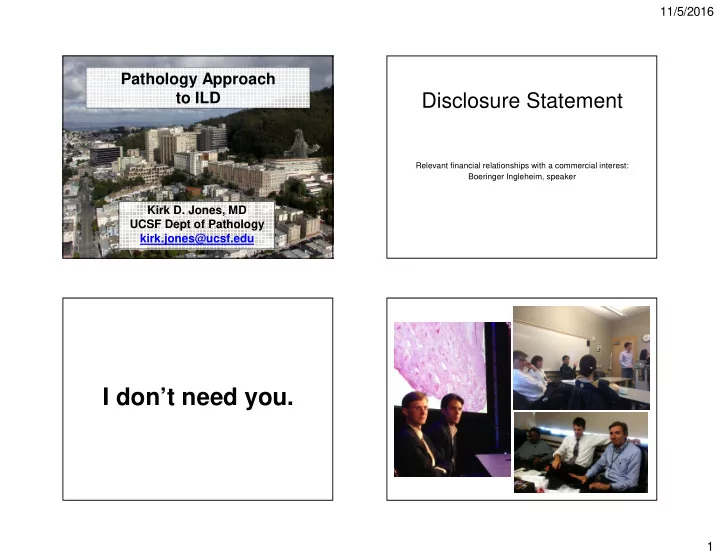
I don’t need you.

slide-2
SLIDE 2

11/5/2016 2

Overview

  • Normal lung
  • Patterns of fibrosis
  • A little on granulomas

Normal Lung

  • The lung is divided into numerous lobular units

that have a characteristic appearance.

  • Arteries run with airways.
  • Veins present in interlobular septa.
  • Lymphatics in bronchovascular bundles,

interlobular septa, and pleura.

slide-3
SLIDE 3

11/5/2016 3

slide-4
SLIDE 4

11/5/2016 4

Thinking about Fibrosis

  • Usually in patients with chronic or insidious

disease.

  • Often observed on CT scan as reticulation

(possibly with traction bronchiectasis or honeycombing) or nodules (when bronchiolocentric)

Pattern of Fibrosis

  • The distribution of the fibrosis will often correlate with the

nature of the injury.

  • Bronchiolocentric fibrosis – tends to occur in diseases

with inhalation injury (HP, RB, fume) or bronchiolar inflammation (CTD)

  • NSIP – tends to occur in diseases with diffuse alveolar

inflammation (autoimmune CTD, drug reaction, HP)

  • UIP – odd peripheral distribution pattern. Possibly related

to aberrent sensecence with most distal cells either more predisposed to stretch injury, or least likely to be replenished.

slide-5
SLIDE 5

11/5/2016 5

slide-6
SLIDE 6

11/5/2016 6

Bronchiolocentric Fibrosis

  • Look for lace-like central regions (fireworks) of

peribronchiolar metaplasia

  • Think about inhaled diseases (HP, RB, fume

inhalation injury) and diseases with small airway inflammation (aCTD)

Nonspecific Interstitial Pneumonia (NSIP)

  • Diffuse alveolar septal thickening by either

inflammation (cellular NSIP) or fibrosis (NSIP- fibrosis)

  • Can be variable, but should show fibrous

thickening of the alveolar septa in peribronchiolar, subpleural, and midzones of the lobule.

slide-7
SLIDE 7

11/5/2016 7

Dusty Cobweb Fibrosis

Term by Kevin Leslie

NSIP Pattern

  • Look for variable but diffuse alveolar septal

thickening (dusty cobweb) by fibrosis or inflammation

  • Look for additional clues to help decide the

differential (lymphoid aggregates, granulomas, pleuritis, vessel thickening).

If my pathologist tells me the biopsy shows NSIP, then my job has only just begun.

slide-8
SLIDE 8

11/5/2016 8

slide-9
SLIDE 9

11/5/2016 9

Clues for DAD

  • A compatible clinical history
  • Diffuse alveolar septal thickening or effacement

by collapse, edema, and alveolar filling

  • Hyaline membranes
  • Distal airway squamous metaplasia

UIP Pattern

  • Fibrosis beginning at the periphery of the lobule
  • Temporal and spatial heterogeneity
  • Temporal (“HORN”)
  • Honeycombing, old (dense collagen) fibrosis, recent (fibroblast foci)

fibrosis, and normal

  • Spatial – worse subpleural, paraseptal, and

basilar

slide-10
SLIDE 10

11/5/2016 10

slide-11
SLIDE 11

11/5/2016 11

slide-12
SLIDE 12

11/5/2016 12

slide-13
SLIDE 13

11/5/2016 13

The “Tip Test”

  • Since UIP shows peripheral lobular

accentuation of fibrosis, the very tip of the surgical biopsy is often obliterated by fibrosis (often with overlying fatty metaplasia of the pleura)

  • NSIP tends to show normal alveolar architecture

(with thickened septa) at the tip of the biopsy.

slide-14
SLIDE 14

11/5/2016 14

UIP Pattern

  • When there is pure temporal heterogeneity, the

diagnosis is almost certain

  • Use the “Tip Test”
  • Rare cases of HP, CTD may show UIP pattern
  • Look for central scarring and granulomas in HP
  • Look for increased lymphoid aggregates and lack of normal (NSIP instead) in CTD

OP or FF?

  • Organizing Pneumonia

– Rounded (usually) – Air on most sides – Location - airspace – Polypoid – Branching

  • Fibroblastic Foci

– Crescentic (frequently) – Collagen on one side – Location - interstitium – Sessile – Not branched

Organizing Pneumonia

  • Clinically acute or subacute presentation.
  • Patchy opacifications on CT.
  • Pathology findings will mirror CT findings with

filling of alveolar spaces.

Organizing Pneumonia

  • The appearance of this disorder looks like

something got messed up (a pneumonia of some sort) and is now being cleaned up (organizing)

  • The body’s method of cleaning up is via

granulation tissue (fibroblasts and small vessels with some inflammatory cells).

slide-15
SLIDE 15

11/5/2016 15

Organizing Pneumonia

Bronchiole Alveolar duct Alveoli

BOOP

Granulation tissue polyp

Bronchiolitis obliterans

slide-16
SLIDE 16

11/5/2016 16

Organizing Pneumonia

slide-17
SLIDE 17

11/5/2016 17

Acute Fibrinous Organizing Pneumonia

  • Polypoid plugs of fibrin (pink slightly granular

to fibrillar material) often with flattened cells at the periphery

  • Can look very similar to eosinophilic

pneumonia, so make sure you look for eosinophils when you see AFOP

Clues for OP

  • Correlates with CT and clinical
  • Rounded branching plugs (Nordy)
  • Blue with spindly cells (OP)
  • Pink with few cells (AFOP)
slide-18
SLIDE 18

11/5/2016 18

Granulomas

  • Finding granulomas on a biopsy can help make

several diagnoses, so it is important to recognize what they look like

  • Rounded aggregates of histiocytes (tissue

macrophages) often with multinucleate giant cells

Granuloma – Soft Findings

  • Tightly packed cells, rounded, coalescing, present

along lymphatic routes, lymphocytes exclude the interior = sarcoidosis

  • Tightly packed, rounded, singletons, random or

bronchiolocentric, lymphocytes in interior = MAC, hot-tub lung

  • Loose, formed of only a few macrophages and giant

cells, may show intracytoplasmic cholesterol clefts, bronchiolocentric often = HP

  • Associated with neutrophils, big floppy giant cells =

aspiration

slide-19
SLIDE 19

11/5/2016 19

Sarcoidosis?

slide-20
SLIDE 20

11/5/2016 20

Hot-tub lung (M. avium) Hypersensitivity Pneumonia

slide-21
SLIDE 21

11/5/2016 21

Courtesy of Rick Webb, MD

Hypersensitivity Pneumonia

  • Cases we have observed:
  • Feathers: Pets, Farm animal, Duvet, Pillow, Jacket.
  • Molds: Work freezer, Man-Cave, Sleep number

mattress, Hay, Orchid bark

  • Mycobacteria: Indoor spa, shower
  • Machine oil
  • ? Central valley: Almond dust?
slide-22
SLIDE 22

11/5/2016 22

Aspiration Venous injection of crushed tablets

Illustrative Case

  • 62-year-old man with severe pulmonary fibrosis
  • Prior biopsy with UIP pattern
  • Now undergoing bilateral lung transplant
slide-23
SLIDE 23

11/5/2016 23

Pathologic Pattern

  • Usual interstitial fibrosis
  • Marked fibrosis with honeycombing
  • Patchy involvement of lung
  • Fibroblast foci present
  • ?Features suggesting alternate diagnosis?
slide-24
SLIDE 24

11/5/2016 24

Pathologic Diagnosis

  • Interstitial fibrosis, UIP pattern, with

bronchiolocentric fibrosis and chronic inflammation, and poorly formed granulomas.

  • Most consistent with chronic hypersensitivity

pneumonia.

Final Diagnosis

  • Familial Interstitial Fibrosis
  • Telomerase mutation (TERT gene)
  • With superimposed hypersensitivity pneumonia
slide-25
SLIDE 25

11/5/2016 25

Take Away Message

  • I still think that it is good that we are each in our

respective career – and that the best way to make a diagnosis is through multidisciplinary discussion.

  • However, the longer I do this, the more value I find in

knowing at least some of what the other team members do.

  • It is my hope that I have effectively communicated a

bit about how pathologists look at slides for these few patterns of injury: DAD, OP, fibrosis (UIP, NSIP, bronchiolocentric), and granulomatous disease.