I. Defining Prejudice Prejudice is the spoiled fruit that grows - - PDF document

i defining prejudice
SMART_READER_LITE
LIVE PREVIEW

I. Defining Prejudice Prejudice is the spoiled fruit that grows - - PDF document

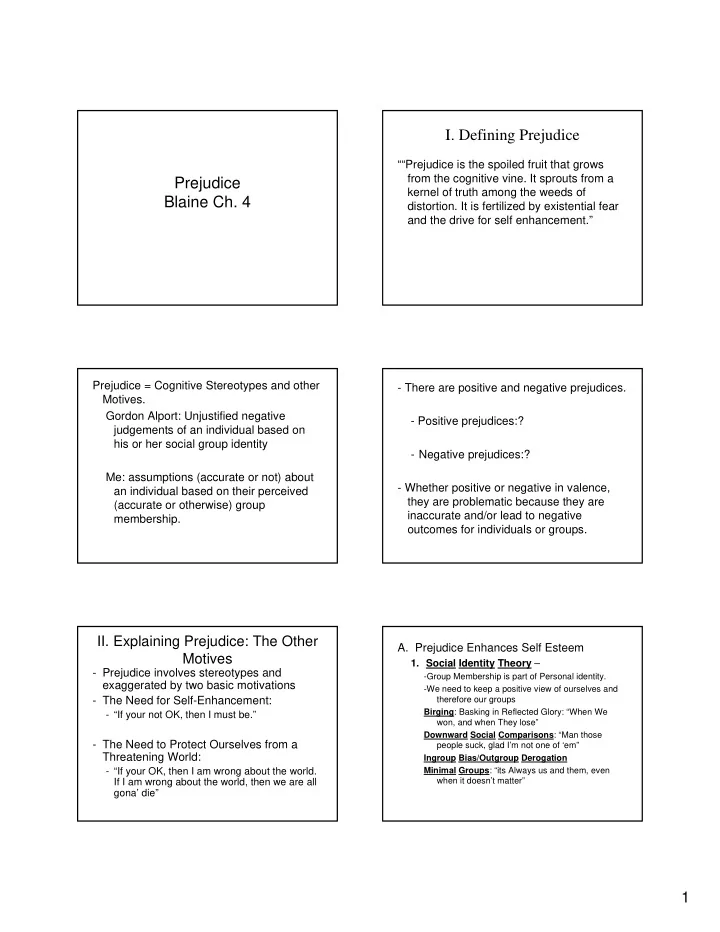
I. Defining Prejudice Prejudice is the spoiled fruit that grows from the cognitive vine. It sprouts from a Prejudice kernel of truth among the weeds of Blaine Ch. 4 distortion. It is fertilized by existential fear and the drive for self


slide-1
SLIDE 1

1

Prejudice Blaine Ch. 4

  • I. Defining Prejudice

““Prejudice is the spoiled fruit that grows from the cognitive vine. It sprouts from a kernel of truth among the weeds of

  • distortion. It is fertilized by existential fear

and the drive for self enhancement.” Prejudice = Cognitive Stereotypes and other Motives. Gordon Alport: Unjustified negative judgements of an individual based on his or her social group identity Me: assumptions (accurate or not) about an individual based on their perceived (accurate or otherwise) group membership.

  • There are positive and negative prejudices.
  • Positive prejudices:?
  • Negative prejudices:?
  • Whether positive or negative in valence,

they are problematic because they are inaccurate and/or lead to negative

  • utcomes for individuals or groups.
  • II. Explaining Prejudice: The Other

Motives

  • Prejudice involves stereotypes and

exaggerated by two basic motivations

  • The Need for Self-Enhancement:
  • “If your not OK, then I must be.”
  • The Need to Protect Ourselves from a

Threatening World:

  • “If your OK, then I am wrong about the world.

If I am wrong about the world, then we are all gona’ die”

  • A. Prejudice Enhances Self Esteem
  • 1. Social Identity Theory –
  • Group Membership is part of Personal identity.
  • We need to keep a positive view of ourselves and

therefore our groups Birging: Basking in Reflected Glory: “When We won, and when They lose” Downward Social Comparisons: “Man those people suck, glad I’m not one of ‘em” Ingroup Bias/Outgroup Derogation Minimal Groups: “its Always us and them, even when it doesn’t matter”

slide-2
SLIDE 2

2

  • 2. Positive Self Esteem facilitates prejudice:

“The more you have, the more you have to loose.” High Self Esteem, Status, & success = ingroup bias. Low Self Esteem, Status, & success = low ingroup bias. Relative Deprivation = negative outgroup attitudes

  • not getting what you should, what you had, or what

their getting.

  • “any gain they make, means I lose”

Base Line Should Have Did H ave They Get 20 40 60 80 10 0 Dominant G roup Subordinant Group

Conditions of Relative Deprivation

2) Prejudice Buffers Anxiety about an Unpredictable World Terror Management Theory: “Dying scares me, good thing it wont happen to me”

  • Our Worldview’s protect us against the fear
  • f death (the existential crisis)
  • Worldview = values, beliefs, rituals, and

concepts validated by groups.

  • Maintaining a Worldview = provides

meaning, order, and permanence to life

Mortality Salience and Attitude Polarization

  • Mortality Salience =

when we have been reminded that we will die.

  • When mortality is

salient we rely on our worldview to protect us.

In g ro u p T arg et O utgro up T a rge t 2 4 6 8 1 00 T V G rou p D ea th G ro u p

T itle

  • f C

h a rt

  • III. Modern Prejudice

Question - Has Prejudice Really Changed?

  • since 1900
  • since 1950s
  • since 1980s

Since the late 50’s self reports of prejudice have greatly decreased Question – Does this mean that people are not as prejudiced? Expressed in covert and indirect ways Question – How do you measure this?

  • A. Concealing your True Feelings
  • Overt vs. Covert Prejudice.
  • Old Fashioned Racism (Overt Prejudice)
  • Modern Racism/Prejudice (Covert)
  • Measuring it:
  • The Bogus Pipeline
  • The Bonafide Pipeline (Measuring Mental

Representations)

  • Outgroup Homogeneity Test
  • Priming and the Lexical Decision Task
  • The Implicit Association Test
  • (Extra Cred.) 1 page write up of your reaction to the Demo (don’t do

the research, you know too much) https://implicit.harvard.edu/implicit/

slide-3
SLIDE 3

3

  • B. Self reports of Modern Prejudice

Open Derogation of Values instead of race/ethnicity:

  • a. Denial of continuing discrimination:

“Discrimination against Blacks is no longer a problem in the United States.”

  • b. Antagonism towards the demands of the

Minority Group.

“It is easy (hard) to understand the anger of Black people in America” “Blacks are getting too demanding in their push for equal rights”

  • c. Resentment about “Special Favors”

“Over the past few years blacks have gotten more economically than they deserve”

  • C. Automatic Prejudice: The results of

Schemas and Stereotypes

  • Prejudice does not have to be intentional
  • Stereotypes : Automatic = fast, non-

conscious, effortless, the first response

  • Personal Beliefs: Controlled = Slower,

conscious, effortful.

  • Over time controlled responses can

become automatic, but it requires effort

  • D. Reducing Prejudice
  • 1. The Contact Hypothesis = “They become Us”

a. Sherif – The Robber’s Cave Study

http://www.ppu.org.uk/learn/peaceed/pe_robbers_cave. html

  • b. Alport (1945) contact between groups:
  • a. reduces negative attitudes toward individual
  • utgroup members.
  • b. improves our attitudes and feelings toward

the outgroup.

It only works if certain conditions exist.

  • Conditions:

1) Individuals must be of equal status. 2) Interaction must be cooperative (Common goal/external threat) 3) Contact must be sanctioned and supported by authority figures. 4) Individuals must be seen as representative of their respective groups (otherwise subtyping occurs).

How does it work

  • Results:

1) Blurs the Us n Them distinction

Redefines the Groups – They become We

2) Provides Individual Information - Reduces

  • utgroup homogeneity
  • 2. Self-regulation = Know thy self
  • Conscious efforts to reduce one’s prejudice
  • overriding the automatic responses
  • The Motivation to be accurate
  • reducing should and would discrepancies

(inherent in modern prejudice).

  • Some evidence that cognitive training

can be reduce stereotyping

  • Stereotype negation training.