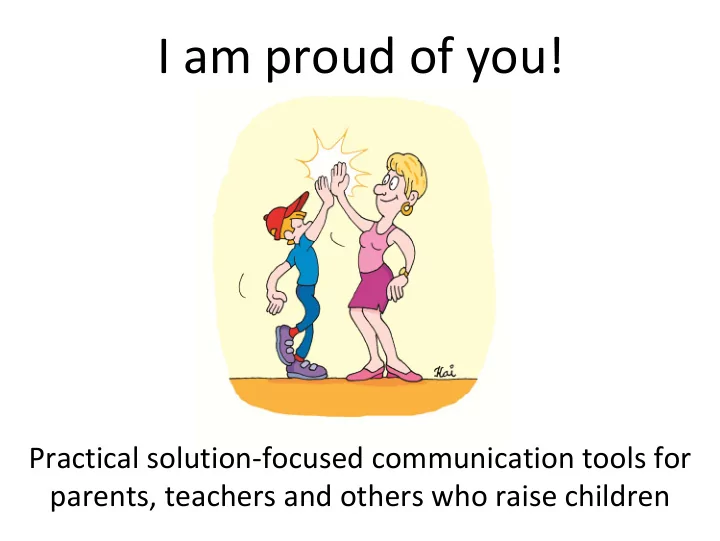
SLIDE 1
I am proud of you!
Practical solution‐focused communication tools for parents, teachers and others who raise children
SLIDE 2 The Five Sessions:
- 1. Praising children
- 2. Influencing children
- 3. Pulling in the same direction
with the other adults involved in raising the same child
- 4. Helping children overcome problems
and difficulties
- 5. Responding to wrongdoings and
transgressions
SLIDE 3
First Session Praising children
SLIDE 4 Introduction
- What is your name?
- How many children do you have?
- What are their names and ages?
- What are you good at as a parent?
– What would your children say? – What would your partner say?
- What would you want to become better at
as a parent?
SLIDE 5
The Triple ‐ triple praise
SLIDE 6 The Triple ‐ triple praise
SLIDE 7 The Triple ‐ triple praise
- Ask around
- Report a success
Report a success
SLIDE 8 The Triple ‐ triple praise
- Ask around
- Report a success
Report a success
- Others respond with a Triple
SLIDE 9 The Triple ‐ triple praise
- Ask around
- Report a success
Report a success
- Others respond with a Triple
1. Exclamation of wonder
SLIDE 10 The Triple ‐ triple praise
- Ask around
- Report a success
Report a success
- Others respond with a Triple
1. Exclamation of wonder 2. Declaration of difficulty
SLIDE 11 The Triple ‐ triple praise
- Ask around
- Report a success
Report a success
- Others respond with a Triple
1. Exclamation of wonder 2. Declaration of difficulty 3. Request for an explanation
SLIDE 12 The Triple ‐ triple praise
- Ask around
- Report a success
Report a success
- Others respond with a Triple
1. Exclamation of wonder 2. Declaration of difficulty 3. Request for an explanation
Acknowledge someone else
SLIDE 13 The Triple ‐ triple praise
- Ask around
- Report a success
Report a success
- Others respond with a Triple
1. Exclamation of wonder 2. Declaration of difficulty 3. Request for an explanation
Acknowledge someone else
SLIDE 14 The Triple ‐ triple praise
- Ask around
- Report a success
Report a success
- Others respond with a Triple
1. Exclamation of wonder 2. Declaration of difficulty 3. Request for an explanation
Acknowledge someone else
- Return the credit
- Smile and look happy
Smile and look happy
SLIDE 15 Assignment 1: The Triple
- Pay attention to something your child does
right or well
1. Exclamation of wonder – Well done! 2. Declaration of difficulty – Not easy at all! 3. Request for an explanation – How did you do it?
- Conclude with: ”Who helped you?”
SLIDE 16 Assignment 2: Praise signal
- Invent a secret sign for your family that will
allow you to praise each others without words
- It can be a gesture, facial expression or even a
code word
”I noticed that you did right” ”Well done” ”You remembered!” ”Good idea!”
SLIDE 17 Assignment 3: Gossip praise
- Praise your child (or your partner) to someone
else while they overhear you
- Praise your child to someone else and tell
about it to them afterwards
- Tell your child or your partner, that someone
else has praised them to you
- Tell your child that you will (or would want to)
praise them for someone else
SLIDE 18
Second Session Influencing children
SLIDE 19
Whinge hand
SLIDE 20
Always Thumb
SLIDE 21
Never Always All the time Not again!
SLIDE 22
Fault Finger
SLIDE 23
Description Example Demonstration Documentation
SLIDE 24
Consequenses
SLIDE 25
Suffering Illness Danger Pain Consequences
SLIDE 26
Cause Finger
SLIDE 27
Don’t you understand? Do you have to? What is it with you? Are you out of your mind? You are just like your father! What have I done wrong?
SLIDE 28
Deaf Finger
SLIDE 29
You never listen! I have told you at least a hundred times... How many times do I have to tell you? Do you have wax in your ears?
SLIDE 30
Consequences Finger Always Finger Deaf Finger Fault Finger Cause Finger
SLIDE 31
Wish Hand
SLIDE 32
Contact Finger
SLIDE 34
Request finger
SLIDE 35 From don’t to do
Don’t...
- ...run
- ...pick your nose
- ...interrupt
- ...hit others
- ...take things from others
- ...beg
- ...play with your food
- ...be late
- ...talk rudely
...do this instead
- Walk
- Use handkerchief
- Wait for your turn
- Tell an adult if you get angry
- Ask for permission
- Ask kindly
- Eat nicely
- Be there in time
- Speak nicely
SLIDE 36
Benefits Finger
SLIDE 37
Parents Others in the family Friends Reputation Health Hobbies School
SLIDE 38
Confidence Finger
SLIDE 39
SLIDE 40
Agreement Finger
SLIDE 41
How do you want to be reminded if you sometimes forget?
a
SLIDE 42
SLIDE 43
Benefits Contact Agreement Request Confidence
SLIDE 44 Assignment 1: Wish Hand
- Try the Wish Hand at home with your child or
your partner
- Team up with another person in your group
and make an agreement to help each other use the Wish hand to deal with a real situation at home or somewhere else in your life where you have a need to tell someone about their behaviour.
SLIDE 45 Assignment 2: Consulting
- Think about something that you feel that you
need to tell your child or your partner repeatedly or constantly
- Explain that you need to tell them about this
particular thing but that you don’t want to do it in an annoying manner.
- Ask them to tell you how they want you to tell
them about the thing in a good way.
SLIDE 46
Third Session Pulling in the same direction
SLIDE 47
Two adults talking about a child
A B C D
SLIDE 48 Two adults talking about a child
- Decide who is A, who B, who C and who D on the
first round
- A is the partner to whom B, C and D jointly complain
about some problem with the child
- B brings up a concern with the child
- C tries to make A understand how serious the
problem is
- D explains that the problem is A’s fault
- Repeat 4 times so that each one gets to be A
SLIDE 49 Two adults talking about a child
- Decide who is A, who B, who C and who D on the
first round
- A is the partner to whom B, C and D jointly want to
talk about some problem with the child
- B brings up a concern with the child (as before)
- C raises hope
- D asks A what he or she thinks could be done about
the concern
- Repeat 4 times so everyone gets to be A
SLIDE 50 Taking criticism
- B C D do the same as in the first version of the
previous exercise
– Show that you are interested to listen to B – Ask C if he thinks the problem is serious – Try to get D to tell you what he would want you to do about the matter and what he has thought should be done about the matter
SLIDE 51 Assignment 1
- Talk with your partner about a child
related issues like this:
1. Tell them what you are worried about 2. Tell them how you’d like the thing to be instead 3. Ask them what they suggest to do about it 4. Tell them what you have thought you could do about it 5. Negotiate an agreement with them about what to do about it
SLIDE 52 Assignment 2 Praise your partner
- In your way of being a parent I particularly
appreciate…
- Our child has this wonderful trait which I think
he/she has picked up from you
- You are a good mother/father/carer, because…
- I don’t know where I would be without you
because you are so good with…
- This thing has been better lately thanks to your….
SLIDE 53
Fourth Session Helping children overcome problems and difficulties
SLIDE 54
What skill to learn to overcome the problem?
SLIDE 55
Name
SLIDE 56
Benefits
SLIDE 57
Supporters
SLIDE 58
Power creature or hero
SLIDE 59
Celebration
SLIDE 60
Practicing
SLIDE 61
Reminding
SLIDE 62 Homework 1 Try Kids’ Skills with a child
- Find a child to try Kids’
Skills with
- Coach the child in deciding a skill to learn and
then help the child to make a plan to learn the skill based on the steps fo Kids’ Skills
SLIDE 63 Homework 2 Reminding
- Think about a person in your family you often
need to remind of something he should remember
- Tell him that you understand thay you need to
remind him and explain you don’t want to do it in a way that is irritating for him or is ineffective
- Ask him to tell you what would be a better
and more effective way of reminding him.
SLIDE 64
Fifth Session Responding to unacceptable and inappropriate behavior
SLIDE 65 The steps of responsibility
Admitting Understanding Apologizing Making up Promising Response ability
SLIDE 66
Admitting
SLIDE 67
Understanding
SLIDE 68
Apologzing
SLIDE 69
Making up
SLIDE 70
Promising
SLIDE 71
Caring for others too
SLIDE 72 Assingment
Find it at www.kidsskills.org
- Or try the Apologyletter program at
www.apolyletter.org
SLIDE 73 Suggestions
Skills website www.kidsskills.org
Skills Online program www.kidsskillsonline.com
- Steps of Responsibility www.kidsskills.org
- The book Kids’
Skills in Action, StLukes, 2010.
Skills Workbook for Children
- Solution stories –
- nline picture books for children
and parents: “Dan did wrong”
“Nigel’s nightmare” and “Linda tames her Tiger”