
SLIDE 1
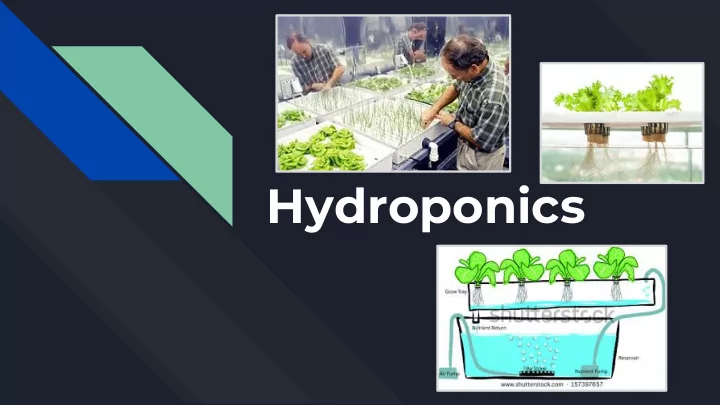
Hydroponics What is Hydroponics? Hydroponics is a subset of - - PowerPoint PPT Presentation
Hydroponics What is Hydroponics? Hydroponics is a subset of hydroculture, the method of growing plants without soil, using mineral nutrient solutions in a water solvent. History of Hydroponics - Was used in the ancient world (Hershey) -
hydroponically grown plants than in conventional ones
WICK SYSTEM
WATER CULTURE
EBB & FLOW - (FLOOD AND DRAIN)
DRIP SYSTEMS RECOVERY / NON-RECOVERY
N.F.T. (Nutrient Film Technique)
AEROPONIC
Anda, Jose de and Shear Harvey. “Potential of Vertical Hydroponic Agriculture in Mexico.” Sustainability, 13 January 2017, 9(1), 140; doi:10.3390/su9010140, http://www.mdpi.com/2071-1050/9/1/140/htm
Bardsley, Daniel. “Hydroponics could make farming flourish in UAE desert.” The National, The National, 18 July 2014, www.thenational.ae/uae/hydroponics-could-make-farming-flourish-in-uae-desert-1.34870
Haq, Rezuul. "Cultivating Wetlands in Bangladesh." Leisa Magazine, December 2004, pp. 18-20 http://edepot.wur.nl/90992 Hershey, David. "Solution Culture Hydroponics: History & Inexpensive Equipment." The American Biology Teacher, vol. 56, No. 2, Feb., 1994, pp. 111-118. Jstor, DOI: 10.2307/4449764, http://www.jstor.org/stable/4449764.
Stauffer, John E. "Hydroponics." Cereal Foods World, vol. 51, no. 2, April 2006, pp. 83-83,86, ABI/INFORM Collection; ProQuest Central Essentials, https://libdb.fairfield.edu/login?url=https://search.proquest.com/docview/230389588?accountid =10796. Treftz, Chenin, and Stanley T. Omaye. "Hydroponics: Potential for Augmenting Sustainable Food Production in Non-Arable Regions." Nutrition and Food Science, vol. 46, no. 5, 2016, pp. 672-684, Nursing & Allied Health Database; ProQuest Central Essentials, https://libdb.fairfield.edu/login?url=https://search.proquest.com/docview/1826446723?accounti d=10796.