
SLIDE 1
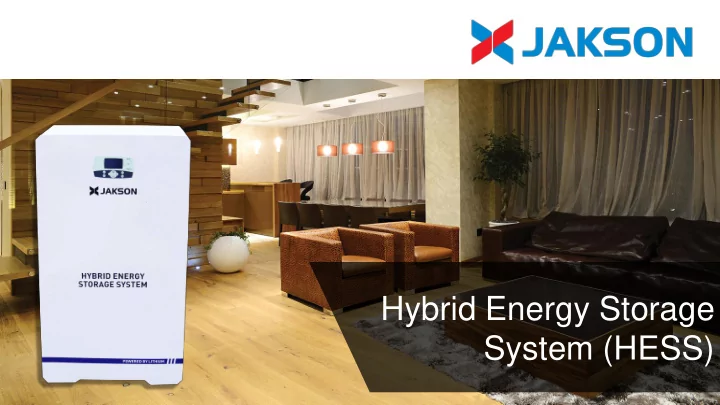
Hybrid Energy Storage System (HESS) Product Overview Smart Energy - - PowerPoint PPT Presentation
Hybrid Energy Storage System (HESS) Product Overview Smart Energy Storage System Complete Hybrid Solution Powered by Lithium Ion (Li-ion) batteries Compact dimensions Capable to run sustained loads Voice enabled (Google
Solar present, Grid available Battery Charged through MPPT charger + mains (Solar synced with grid) and Load supplied through Grid.
Condition # 1
AC LOADS (Priority) AC LOADS (Others)
CHARGING
GRID
Solar PV available, Grid available Battery almost charged Surplus PV power used for AC loads connected, only balance electricity drawn from Grid
Condition # 2
AC LOADS (Priority) AC LOADS (Others) GRID
Saving of electricity bills.
CHARGED
Pays You Back!
AC LOADS (Priority) AC LOADS (Others) SPV available, Grid available, Battery almost charged, Solar PV produced is more than required: EXCESS POWER EXPORT TO GRID
Condition # 3
GRID
CHARGED
Cloud based Remote Monitoring System High Energy Density & Easy Installation Battery charging scheduling Smarter than average battery Solar Integrated System Lithium-ion based Storage Technology
Lead-based batteries are typically more than two times the weight of their lithium counterparts
Lead acid batteries are highly inefficient in both charge and
stable in charging and discharging
Lead batteries achieve just 700
lithium batteries can achieve 2800 to 3500
There is nearly constant voltage levels through the whole discharge cycle of a lithium ion battery, while lead batteries experience a constant drop of voltage
A lead-based battery never discharges more than 80%; in fact, most manufacturers recommend a discharge depth
the lithium ion solar battery achieve almost a 100% discharge
10 KVA - 3Phase HESS 15 KVA - 3 Phase HESS
Model Solar PV rating Solar PCU rating Solar PCU Type Battery Rating Battery Type BMS Export to Grid JS-HESS-3.6 2.6KWp 3KVA/1 phase Hybrid 3.6KWH/75AH LiFeP04 LFP Type Active BMS Inbuilt Enable / Disable (Optional) JS-HESS-7.2 5.2KWp 5KVA/1 phase Hybrid 7.2KWH/150AH LiFeP04 LFP Type Active BMS Inbuilt Enable / Disable (Optional) JS-HESS-10.8 5.2KWp 5KVA/1 phase Hybrid 10.8KWH/225AH LiFeP04 LFP Type Active BMS Inbuilt Enable / Disable (Optional)
Faster charging with Lithium Batteries Cloud based remote monitoring feature Can be charged through Solar, Grid or Diesel Gensets (Optional) 3 & 5 kVA options & above Runs electrical equipment like Split AC, refrigerator, lights, fans, etc.
Farm House Commercial Establishments Educational Institutions Banks / Showrooms / Offices Residential Houses / Villas
JAKSON ENGINEERS LTD.
A-43, Phase-II Extn., Hosiery Complex, Noida-201305, U.P., India Tel.: +91-120-4302600, 4526100, 4740200 Toll Free No. : 1800 103 2600 | www.jakson.com