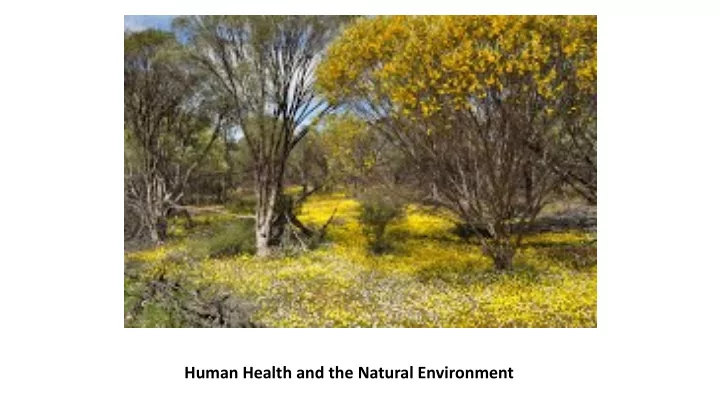
Human Health and the Natural Environment Cover photo: Kimberley - - PowerPoint PPT Presentation

human health and the natural environment cover photo
SMART_READER_LITE
LIVE PREVIEW

Human Health and the Natural Environment Cover photo: Kimberley - - PowerPoint PPT Presentation

Human Health and the Natural Environment Cover photo: Kimberley coastline, Western Australia, by Sheldon Pettit 2 Increasing salinity in Western Australia as a result of extensive clearing for agriculture Our r relationship t to t the na


slide-1
SLIDE 1

Human Health and the Natural Environment
slide-2
SLIDE 2

Cover photo: Kimberley coastline, Western Australia, by Sheldon Pettit

2

slide-3
SLIDE 3
slide-4
SLIDE 4
slide-5
SLIDE 5

Increasing salinity in Western Australia as a result of extensive clearing for agriculture

slide-6
SLIDE 6

Our r relationship t to t the na natural env nvironment nt

6

slide-7
SLIDE 7

Place A Attachment

People do not simply look out over a landscape and say ‘this belongs to me’. They say, ‘I belong to this’. Concern for familiar topography, for the places

  • ne knows, is not about the loss of a commodity, but about the loss of
  • identity. People belong in the world: it gives them a home (p. 109, original

emphasis).Jacobs, 1995.

  • Attached community members - more satisfied with their lives, had

stronger bonding and neighbourhood ties, trusted people more, and were generally less egocentric and more altruistic; more likely to resist change.

  • Evidence that “sense of place”, “place identity” – distinct dimension in

neuronal processing.

7

slide-8
SLIDE 8

Biophili lia

  • Biophilia - “the innately emotional affiliation of human beings to
  • ther living organisms.” (Wilson, 1984).
  • Implies that humans have a biological need for connection with

nature and that this connection affects our personal well-being, productivity, and social relationships.

  • Gap between humans’ evolutionary environments & current living

conditions.

8

slide-9
SLIDE 9

Intervention: spending time in the natural environment

slide-10
SLIDE 10

Figure 1: Mean Post walk Scores on Digit Span Backwards for Park, Neighborhood, and Downtown Conditions; Taylor & Kuo (2008)

A walk in the park is superior to drugs for children with ADHD

10

A

slide-11
SLIDE 11

Where to put your best foot forward: Psycho-physiological responses to walking in natural and urban environments

http://dx.doi.org/10.1016/j.jenvp.2015.11.003

slide-12
SLIDE 12

Mean change in cognitive function (backwards digit span task) from baseline to 60-min post exposure follow-up by environment.

http://dx.doi.org/10.1016/j.jenvp.2015.11.003

slide-13
SLIDE 13

Photo credit Tony Kirkby

13

Cox et al (2017) found that in five different types of neighbourhood the amount of vegetation cover and afternoon bird abundance were positively associated with a lower prevalence of depression, anxiety, and stress.

DOI: http://dx.doi.org/10.1093/biosci/biw173

slide-14
SLIDE 14

Physio iologic ical l effects o

  • f

contact w with n nature

Lower stress indicators: salivary cortisol, blood pressure, heart rate, skin conductance, muscle tension (forest vs urban walk). Japanese studies of “forest bathing” – decreased blood glucose levels in diabetic patients; more than exercise alone.

slide-15
SLIDE 15

WHO R Repo port rts o

  • n Urba

ban G n Green n Spaces and nd Health h

“The results indicate that urban green space is a necessary component for delivering healthy, sustainable and liveable cities. Interventions to increase or improve urban green space can deliver positive health, social and environmental outcomes for all population groups, particularly among lower socioeconomic status groups. There are very few, if any, other public health interventions that can achieve all of this, and especially the impact on active lifestyles, mental well-being and social interaction is frequently highlighted as a key benefit” (P 5).

slide-16
SLIDE 16

Health Effects

Exposure to and use of green spaces (after controlling for other variables):

  • Reductions in reported health problems (e.g. heart disease, cancer,

musculoskeletal problems);

  • Reduced levels obesity, higher rates physical activity (note – greater

benefits from ‘green’ exercise);

  • Higher self-rated mental health; lower rates depression;
  • Moderating the effects of climate, pollution; benefits for health.
  • Reductions in rates pre-term birth, low birth weight;
  • Enhanced cognitive development.
slide-17
SLIDE 17

Gardening: improves mood, self-esteem, physiological indices; for patients with dementia reduces agitation, aggression and other symptoms.

slide-18
SLIDE 18

Common space with a low level of vegetation Common space with a high level

  • f vegetation

Measuring quantity of common space vegetation

slide-19
SLIDE 19

1 2 3 4 5 6 7 8 Low Medium High Quantity of vegetation

Buildings with more vegetation had fewer crimes overall

# of crimes overall

slide-20
SLIDE 20

Lumeng JC, Appugliese D, Cabral HJ, Bradley RH, Zuckerman B. Neighborhood safety and overweight status in children. Archives of Pediatric and Adolescent Medicine 2006; 160(1):25-31. 17% of children were obese 4% of children were obese

A study of 768 children in urban and rural communities found first-grade children are less likely to be obese if their parents perceive their neighborhoods to be safe.

slide-21
SLIDE 21

21

Improved social relationships

slide-22
SLIDE 22

Cont ntact with t the he na natural e l environment:

  • faster recovery from surgery;
  • lower crime rates;
  • improved social relationships;
  • improved relaxation;
  • reduced behaviour problems in children;
  • better cognitive performance (attention restoration);
  • reductions in reported health problems (e.g. heart disease, cancer, musculoskeletal problems);
  • reduced levels obesity; higher rates physical activity;
  • improved immune functioning;
  • higher self-rated mental health;
  • reduction of the ill effects of pollution, including noise pollution;
  • reduction urban heat island effect:
  • higher productivity;
  • ptimized exposure to sunlight and improved sleep.

22

slide-23
SLIDE 23

23

Conversely, environmental degradation produces ill effects