Field study Field study 4 commercial organic herds Jan 2012 to - - PDF document

field study field study
SMART_READER_LITE
LIVE PREVIEW

Field study Field study 4 commercial organic herds Jan 2012 to - - PDF document

Different production environments - the same genetic material Effect of sire on pig leg health in commercial organic herds Photo: Jenny Svenns-Gillner, SLU Photo: Anna Wallenbeck Photo: Haoyu Liu Photo: Eva Persson Photo: Maria Alarik Anna


slide-1
SLIDE 1

Effect of sire on pig leg health in commercial organic herds

Anna Wallenbeck1, Christina Eliasson1 and Maria Alarik 2

1Swedish University of Agricultural Sciences, Department of Animal Breeding and Genetics 2Swedish Rural Economy and Agricultural Societies

Anna.Wallenbeck@slu.se Funded by SLU EkoForsk

Different production environments

  • the same genetic material

How does ’conventional’ breeds suit organic production environments? Breeding strategy – how to use the available breeds in the best way. Conventional Organic

Photo: Jenny Svennás-Gillner, SLU Photo: Anna Wallenbeck

Photo: Eva Persson Photo: Haoyu Liu Photo: Maria Alarik

The proportion of organic pigs with leg joint remarks (arthritis) at slaughter is high

Heldmer, 2012

Aims

Assess differences between available sire breeds (Hampshire and Duroc) and between individual sires within breed:

  • Clinical locomotion, lameness and swollen joints among
  • rganically raised offspring
  • Leg joint remarks at slaughter among organically raised
  • ffspring

Photo: Christina Eliasson Photo: Christina Eliasson

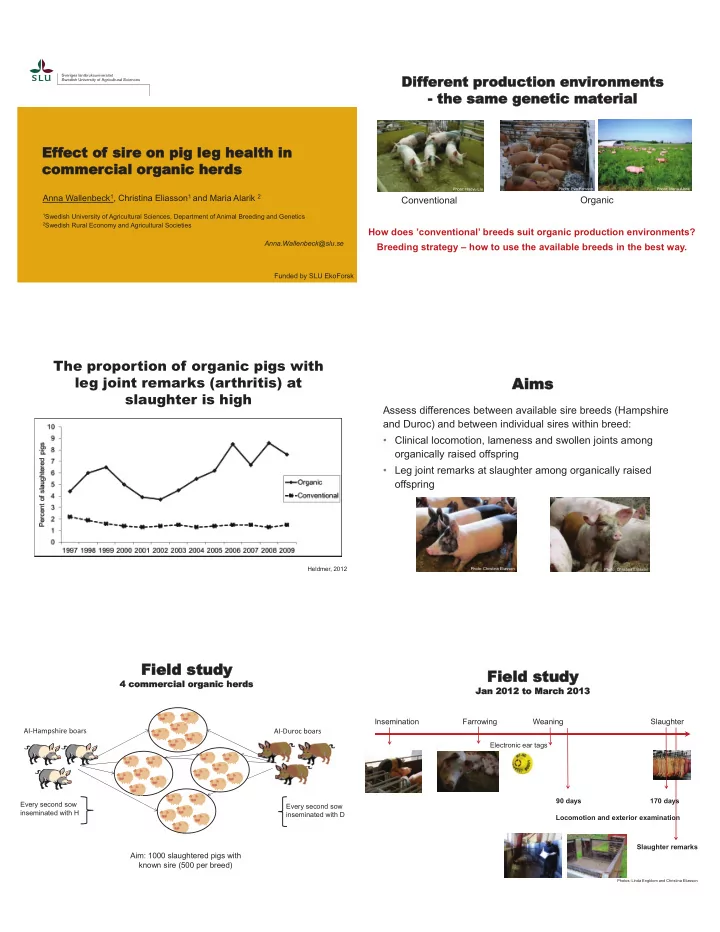
Field study

4 commercial organic herds

AI-Hampshire boars AI-Duroc boars

Every second sow inseminated with D Every second sow inseminated with H

Aim: 1000 slaughtered pigs with known sire (500 per breed)

Field study

Jan 2012 to March 2013

Insemination Farrowing Weaning Slaughter

Electronic ear tags 90 days 170 days Locomotion and exterior examination Slaughter remarks

Photos: Linda Engblom and Christina Eliasson

slide-2
SLIDE 2

Locomotion and exterior examination

  • Back
  • Leg conformation
  • Movement
  • Lameness
  • Swollen leg joints
  • 909 pigs at examination 1

(90 (±19.5) days of age)

  • 1012 pigs at examination 2

(170 (±17.4) days of age)

Protocol modified from Quality Genetics protocol

99 litters (and Yorkshire x Landrace sows), 1115 pigs at slaughter Breed differences : SAS GLM (cont. scale) y = breed + gender + herd + e Variation among sires within breed: SAS GLIMMIXED (binomial scale) y = sirerandom + gender + herd + e

Statistical analyses

ws), le) S

Results - Movement

The proportion of pigs with mild movement disorders increases with age. The proportion of pigs with severe disorders was low.

10 20 30 40 50 60 70 80 90 100 1 = Serpentine movements 2 3 = Normal 4 5 = Stiff movements Percent of pigs 90 days 170 days

  • No significant differences between sire breeds
  • Sign effect of individual sire at first (p=0.036) and

second (p=0.087) examination

  • Hampshire: Individual sire accounted for 12 to 15 % of the

variation, corresponding to a moderate to high heritability

  • Duroc: Individual sire accounted for 0 to 0.2 % of the

variation

  • Insufficient data for genetic analyses

Results - Movement

Photo: Anna Wallenbeck

10 20 30 40 50 60 70 80 90 100 0 = Not lame 1 = Visual lameness, using all 4 legs 2 = Nod with the head, unburden the affected leg 3 = Not using the affected leg Percent of pigs 90 days 170 days

Results - Lameness

The proportion of pigs with lameness increases with age. No difference between sire breeds.

20 40 60 80 100 120 No Yes Percent of pigs 90 days 170 days

Results - Swollen leg joints

The proportion of pigs with swollen leg joints increases with age. No difference between sire breeds.

slide-3
SLIDE 3
  • Low prevalence!
  • Just below 2 % of the pigs in the study had leg joint

remarks at slaughter, in line with conventionally raised pigs.

Leg joint remarks at slaughter

Could indicate no/weak relationships between clinical leg health and leg joint remarks at slaughter

Conclusions

  • No evidence that leg health can be improved in

Swedish commercial organic herds by choice of sire breed (Hampshire/Duroc)

  • Leg health may be improved by choosing the best

individual sires, irrespective of breed

Thank you for your attention!

Anna.Wallenbeck@slu.se

Photo: Anna Wallenbeck